Here’s one for a Mexican-style meatball soup, which came from my old journalist friend Larry Cheek, a restaurant critic and wonderful cook.
1 pound very lean ground beef
1 raw egg
1/2 pound chorizo (optional)
one small hot chili pepper, minced (use rubber or latex gloves while handling chili peppers, especially if you wear contact lenses—don’t rub your face or touch contacts after handling chilis)
About 1 1/2 tablespoons chili powder
2 or 3 cloves garlic, minced
Small handful of cilantro, chopped (about 1/4 to 1/2 bunch)
At least a quart of chicken broth (more, if desired)
About 1/2 glass pale beer
Olive oil
A few corn tortillas, preferably somewhat stale
Time: About 35 minutes.
Cut the tortillas into wedges. Set aside.
Combine the beef, egg, chorizo, chili pepper, chili powder, garlic, and about 1/2 the cilantro in a bowl. Mix well. Roll chunks of this mixture into meat balls, about the size of a golf ball.
Heat the olive oil in a Dutch oven or small stock pot. Toss the meatballs into the hot oil and brown, using a large spoon to roll them gently until browned on all sides. When the meat balls are well browned, gently pour the chicken broth into the pot. Add some beer. Simmer the soup over low heat for about 20 minutes.
At the last minute, add the rest of the cilantro and the tortilla wedges to the hot soup and serve it up.
Contemplatingthe Wreck of the Titanic across the street, I decided to see if there are any broadly accepted ways to protect your own property value and preserve something like peace of mind in the face of a nearby foreclosure. Here are a few strategies you can use to cope with a disastrous property devaluation that will degrade your investment in your home.
Remember that you haven’t lost money yet. Loss of value in real estate is not realized until a property is sold.
Stay informed by estimating the value of your home. You can find a valuation calculator at the Office of Federal Housing Enterprise Oversight, along with some other interesting information. Zillow will give you a rough estimate of your home’s worth, if you have an idea of which properties in your neighborhood are comparable to yours in size and quality. OFHEO and Zillow provide only crude guesses; another way to get an idea is to ask a Realtor to run the comparables, view your home, and tell you what he or she thinks the home will sell for, realistically.
Keep an eye on the foreclosed property. Pull weeds, mow the lawn, or have your own lawn service maintain the yard so that it doesn’t turn into a jungle. If you live next door to the house, use your own hose to water the plants enough keep them alive. While it’s true keeping up the house is not your responsibility, this step will help the value of your house by contributing to the value of the vacant house.
Report code violations to your city’s code enforcement or slum abatement office. Most cities have regulations meant to fight illegal signage and unsightly deterioration. A call to your mayor’s office will give you the phone number. Enlist the city and the law to force the lender that now owns the house to keep the property up.
Band together with the neighbors to form a specialized block watch for the purpose of protecting the house from prowlers, vandals, and squatters. Report prowlers to the police immediately. Banks commonly board up foreclosed houses that have been burgled or vandalized, creating eyesores that cause even more damage to neighboring homes. So, it’s in your interest to keep this kind of thing from happening.
Keep up your own home. Tend to your landscaping, keep the paint looking fresh, and refrain from parking your rolling stock on the yard or in the street. If the neighborhood looks well maintained and appealing, the foreclosed property is more likely to attract buyers who will take care of the house and not let it deteriorate further. Such buyers often can afford to pay a little more for the house, which will help your neighborhood’s property values.
On the other hand, put a hold on any elaborate home improvement projects you may have in mind. Limit improvements to maintenance, paint, and unavoidable necessities. This is not the time to add on a room, gut out and replace the bathrooms, or change out the HVAC system just to get a slightly more efficient unit.
Don’t sell unless you have to. Just as selling stocks and mutual funds on the downtick locks in your losses, so selling your house when prices are at a low ebb guarantees that you will lose on your home investment. Stay put. Sooner or later the housing market will recover.
It gets better and better. Any doubts about my neighbor’s report that Dave’s Used Car Lot, Marina, and Weed Arboretum sold instantly at auction were resolved by a Saturday morning chat with the new owner, who surfaced with a gang of junk dealers come to cart off the trash Dave left behind. So, we might add, did a horde of neighbors, who showed up asking to take this piece of junk and that piece of junk, requests the proud new owner was happy to accommodate. The more junk the neighbors carted off, the less he’d have to pay his clean-up crew.
It is indeed true that the house has been sold. But the auction price was not $192,500, an amount $32,500 less than I paid for the house across the street before the bubble started to inflate. Oh, no. That $192,500 figure is the new owner’s asking price!
That’s what he wants to get for the house. The For Sale by Owner sign in the front yard is not Dave’s FSBO effort: it’s the new owner’s.
This guy is a bottom feeder who grabs the most desperately distressed properties he can get his grimy hands on, shovels out the debris, does virtually no fix-up, and then flips them at “drastically reduced” prices. (Reduced from what? Please: don’t ask.)
So I said to him, “Are you crazy? A house just as run-down as this, right around the corner, just sold for $265,000. Put the house on the market for an amount that will pay you for buying it!”
Oh, no, said he. “If I did that, I’d have to do a lot of fix-up and improvement…and if I were going to do that, I’d have to sell it for $340,000, the amount that one house over there sold for.”
That one house was dolled up as a freaking palace and has NO, count it NO blight near it.
What this means is, first, the guy paid even less than $192,500 for it, an unheard-of devaluation around here. Second, the jerk is going to sell it to another bottom-feeder who will slap on enough paint to cover up Dave’s purple-and-green ceilings and rent it or resell it to the unsuspecting. It will be sold as a dump and chances are it will remain a dump.
Lhudly sing goddam!
One thing you have to say about properties in this neighborhood: once they’re blighted, they tend to stay blighted. I know of only two badly run-down houses that were turned around to make them into reasonably clean, well-maintained properties. All the rest have stayed in the dumps through several owners. I guess that’s what we’re going to see across the street.
Rumor has it that Dave’s Used Car Lot, Marina, and Weed Arboretum has already been auctioned off. A neighbor called one of the numbers on his FSBO sign and was told the house just sold for $192,500.
If that’s true, it’s a disaster for me:just before the bubble started to inflate,I bought my home for $232,000. If Dave’s pigsty sold for any such price, it means my house is now worth less than I paid for it.
On the other hand, why do I doubt this story? Let me count the ways:
No real For Sale sign ever went up.
No “Foreclosed” stickers ever appeared on the doors or windows.
No “Auction” sign was posted.
Dave has been out of the place for less than a week.
Houses in the neighborhood, even deeply discounted for-sale-by-lender houses, have sat on the market for weeks and months without moving; it’s unlikely Dave’s would have sold in less than a week.
As anxious as banks are to unload distressed properties, it’s unlikely that they’d let it go for $65,000 less than a similarly trashed house went for just a couple of weeks ago.
No. This story smacks of disinformation.
Well, we’ll find out soon enough. The place is not habitable as it is, so if someone bought it, we’ll soon see workmen swarming around. With any luck, maybe a speculator will clean it up and resell it at the market price (which still exists, after all).
My estimate for clean-up and updating: about $60,000. Thirty thou’ on the lowest end; sixty thou if you wanted to do a decent job of it.
Clean garbage and weeds off lot: $800
Disassemble and haul junk storage structures, the large, dangerously decrepit wooden children’s climbing set, and other large pieces of junk: $800
New air conditioner: $5,600
Reroof: $5,000
Replaster large pool and replace decrepit, probably broken pool equipment: $10,000
Scrape and paint exterior: $1,500
Paint interior: $2,000
Recarpet: $3,000
Stovetop: $800
Refrigerator: $1200
Dishwasher: $500
Cleaning service: $200 (no one in her right mind would clean out the sty for less than that!)
There’s the bare minimum: about $30,900. That would make the place rentable, but not for much. Now let’s make the place saleable for a decent price:
Wall oven: $1,200 (viewed through the haze of a filthy window, the oven looks relatively new and might stay if it’s functional and can be cleaned)
I’m very flattered to have a post featured on MSN’s money blog, Smart Spending. Welcome to all you readers who have come here from that site. Please make yourself at home. The pages listed on the left describe how and why Funny about Money came to be.
The blog originated on iWeb last December, but as it got larger I decided to migrate to WordPress. That move is still a work in progress: every archived post has to be individually copied & pasted, a time-consuming project. So check back occasionally to see if any “new old” material has come up.
I hope you enjoy Funny and will subscribe on your RSS feeder. —vh
In an odd way, the foreclosure ofDave’s Used Car Lot, Marina, and Weed Arboretum amounts to a kind of foreclosure for the neighbors, too. There’s the obvious effect that when the lender unloads Dave’s house at a bargain-basement price, our property values will drop into the basement, too. Actually, they were already headed for the basement: now they’ll just ride on down to the sub-basement without getting off the elevator.
But there’s a much larger effect: Dave has been financially distressed since he divorced a year or so ago, and his emotional depression has shown in a sharp increase in his native slovenliness. He never was into anything that might be called “pride of ownership,” but over the past year, his normally trashy lot has become a real eyesore. Also, as it develops, Dave has been cultivating a public health hazard.
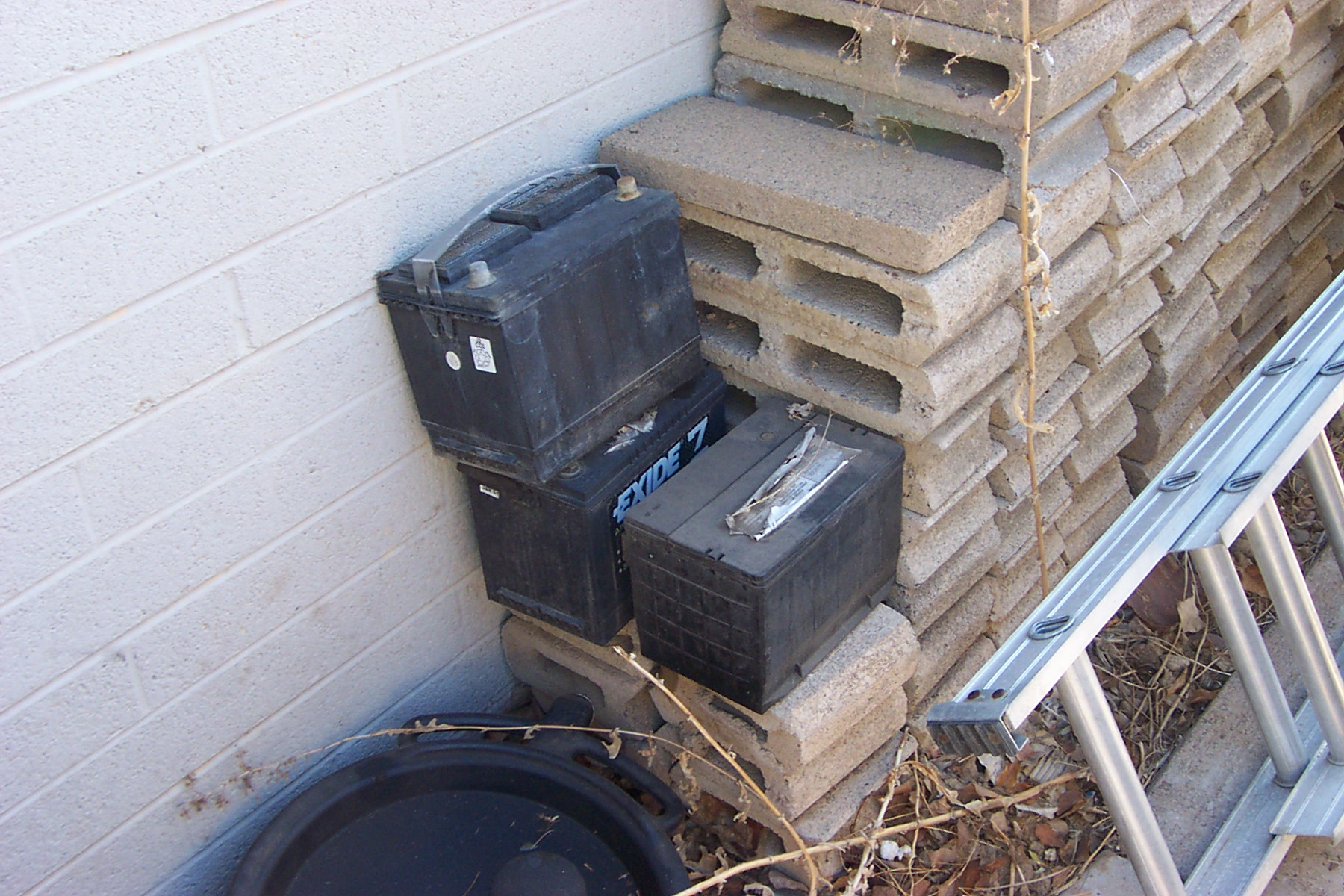
SDXB came by this morning, and out of curiosity we visited the abandoned house. Both gates into the backyard, from the front and from the alley, are unlocked and easy to open. The backyard is chuckablock full of debris, old chemicals, bottles of pool acid, old batteries, and stuff highly hazardous to kids. We have, for example, these fine gasoline cans, located behind an open tool shed replete with bottles of old insecticides.
Mighty nice, eh? How would you like your kids to get into this stuff?
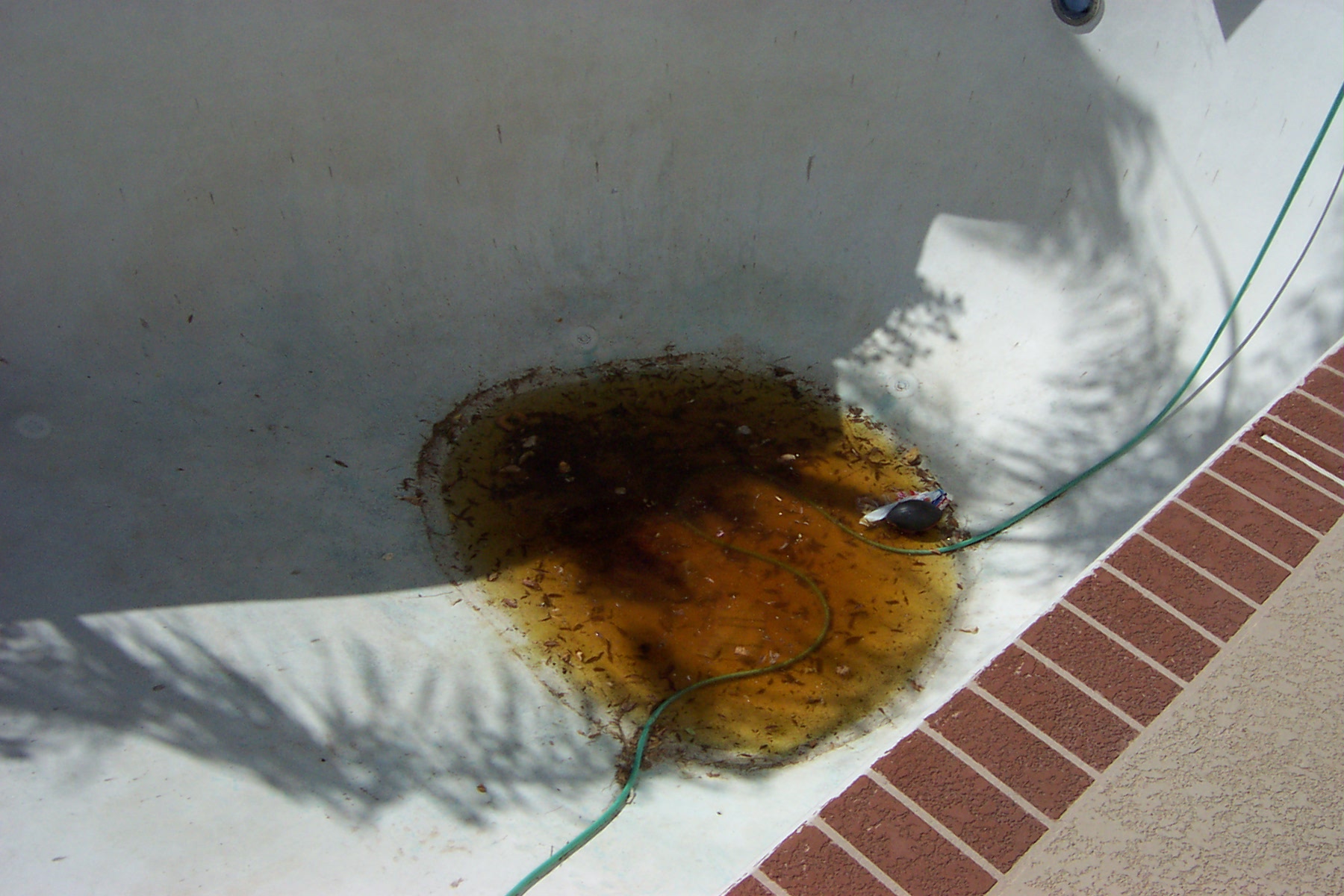
Ah, yes. Then we have the issue of the swimming pool. The pool has been drained; evidently has stood empty for quite some time. Though it’s enclosed within a wrought-iron fence, it’s easy to enter: the fencing ends at a screened porch whose two exterior doors have been ripped off, creating a nice corridor through which the curious may pass without obstruction.
Once you’ve passed through the aluminum structure, where, by the way, you’ll find a heavy-duty battery charger with enough juice to flash off big sparks and give you (or the kiddies) one heck of a zap, you come to this:
And at the bottom of this concrete-lined hole in the ground you find a collection of lost toys marinating in a fine little mosquito-breeding Okeechobee Swamp:
It explains where all the nasty little biters have been coming from for the past several seasons: straight from casa David to su casa.
Maricopa County, where we have been dwelling cheek-by-jowl with Dave, has a growing problem with West Nile virus, a disease carried by mosquitoes. And as we know, mosquitoes breed joyfully in standing water. Every year more and more people come down with this ailment, and every year we read of several deaths related to it. The most vulnerable to serious complications are the elderly.
Dave’s next-door neighbors are in their nineties.
I am in my sixties; many of the locals who have died of this disease were between 60 and 65. The most recent death I’ve read about was of a man in his 80s. My house and yard have been overrun with mosquitoes for months. This, evidently, is where they’ve been coming from. My house is clear across the street—imagine what the mosquito swarms have been like for the old folks next door to Dave!
After you’ve enjoyed the scenic view, don’t miss Dave’s old battery collection on your way out:
Maybe an enterprising kid can get a little extra mileage out of one or more of them, using the handy-dandy battery charger left on the back porch.
And as we say good-bye to Dave’s Used Car Lot, Marina, and Weed Arboretum, we pass by the famous Weed Haystack, still gracing the front driveway as it has from time almost immemorial:
Dave's Weed Haystack
Always visible from the street and from front yards in all directions, this fine landmark remains as a symbol of everything Dave has done for his friends and neighbors in Royal Oaks.
Hm. Maybe I could sell guided tours.
Long before Dave’s lender foreclosed on him, Dave foreclosed on the neighbors. He foreclosed on our property values, on our safety, and on our health. I guess we have to say thank you to the irresponsible and unethical lenders who forked out $320,000 in loans against a property worth about half that and handed it over to a recently divorced man who hasn’t held a regular job in years. If they hadn’t sunk him over his head in debt, Dave and his pet mosquitoes would have stayed in that house forever.