Coffee heat rising

Back in the Red Again

{gasp} Maybe I should type this entire post in virtual red “ink.” Today is the seventh—fourteen more days to go until the current budget cycle resets—and I’m already $93.77 in the hole.

Augh, augh, and augh!

Well, two causes for this predicament:

1. I bought that Shark vacuum cleaner from Costco that I mentioned, after having mulled it over for several days. By the time the obnoxious 9.3% sales tax was added, the $158 selling price ballooned to $174.

It’s too late to return the clunky Eureka I bought from the Fry’s electronics last March. What a piece of junk! So that’s about $300 ultimately paid in search of a decent vacuum.

2. My car was way, way, way overdue for an oil change, tire rotation, safety check, and windshield wiper change. That trip racked up an $86 bill.

Lordie! The last time I had the car serviced was in August of 2009!!!!! Inexcusable. Plus the car has needed new windshield wipers for a year. They had reached the point where their only use was to mix dirt with water and smear it around like paint. Artistic, but hard to see through.

So, those two things pushed me into the red. The vacuum cleaner alone would’ve done it. Add the car service, and now I’m in the hole with two weeks to go and not enough food to last that long.

Last month was the first time this year I’ve run in the red on the discretionary budget. But it was huge: $1,600!

That notwithstanding, I still have some money in savings, and so there’s something left to pay for the car and the vacuum cleaner. But I can’t keep on drawing down savings to meet living expenses.

Ordinarily, a fair amount is left in each month’s nondiscretionary budget—money set aside to pay utilities, Medicare premiums, and long-term care insurance. But summer is now here. Yesterday was a 110-degree day, and it’ll be the same today, cooling to 106 Wednesday and Thursday. That won’t max out the air conditioning bill (the electric company walloped us with a hefty rate increase this spring, BTW), but I expect this month’s bill will be close to $200. Same with water: if you want anything in the yard to stay alive, you have to run the water. The watering system is now on its summer schedule—and I can tell you one thing for sure: drip watering is about as overrated in the economy department as the digital thermostat. The water bills go through the roof when that thing is running. Plus of course I have to refill the pool every day; it loses an inch a day to evaporation.

If the electric and water hit their maximum levels this month, I’ll have $2.59 left in the nondiscretionary fund come June 30.

All of this is happening, natch, when no income other than Social Security and a pittance from Fidelity is flowing in to the coffers. No word from the college about when they’re going to pony up the first payment on the stipend they say I’ll get for preparing the online course.

The problem with that is they’re making me schlep up to the college every week, and that runs up the gas bill. Eighty bucks down the drain there, and two more weeks to go. Just bought gas yesterday; the last fill-up was 12 days ago. So there’s an outside chance I might make it to the end of the budget cycle without pumping gas again…but not likely.

It’s impossible not to drive around this city. Today, for example, I have to deposit some checks for the S-corporation. The credit union is way to hell & gone up at 43rd and Thunderbird, a fourteen-mile round trip. The last time I tried mailing a deposit to the CU, using their self-addressed envelope, they lost the checks. It was over two weeks before the deposits cleared, just as I was about to call clients and tell them to cancel payment.

And a couple of days ago I went over to the downscale Albertson’s, which theoretically is within walking distance, to buy some salad to feed our bloggers’ group. They didn’t have the basic things I needed to make a very ordinary meal. Wanted some cherry tomatoes: the only ones they had were in plastic boxes, and in each box about half were shriveling up like raisins. So ended up having to drive seven miles, round trip, to the Safeway to buy salad stuff!

M’hijito gave me $22 to reimburse for dinner out a week ago. I can apply that toward groceries. Plus I have a few paper dollars stashed away from other reimbursements. Over the past year, I’ve been squirreling that money for these summer months, when I figured to run short on funds. But I’d expected that would happen in August.

Not June.

Summer Budget: Very tight…like a noose around the neck

In my usual OCD way, I continue to worry about how I’m going to make it through the summer. With no idea when the surprise reimbursement for the online course prep will happen, I’m not relying on that to underwrite the astronomical summer utility bills.

Saguaro

In a low-desert summer, power and water bills take off for Saturn’s orbit. If they weren’t already burdensome enough, both local power companies and the city water department hiked rates, so I’m figuring an extra 10 percent for both electric and water. Southwest gas also raised its rates; add another five or ten bucks there, too.

Meanwhile, in May the breathtaking costs for Medicare kick in. Part B—$110 a month—is deducted by the Feds from your Social Security check, commensurately reducing net income. The $20/month Medicare Part D plan I signed up for magically morphed into a $40 bill. The woman there had some excuse for this, but it was such double-talk I couldn’t follow her pitch, so just gave up. Though I paid upfront for a year’s worth of $90/month Medigap coverage, as a practical matter another $1080 to pay for next year’s bill will have to come from somewhere—make that $1080 and then some, because you know they’ll jack up the premium in 2011. So I’m having to self-escrow that out of cash flow. These two costs plus the $200 monthly savings and the $325/month self-escrow to cover property tax, homeowner’s insurance, and car insurance raise the monthly nonnegotiable expenses from $800 to $1240. That’s if the lawn man doesn’t show up.

Even that is a little short. Budgeted power and water bills are based on past high watermarks. But the fact is, those are way past watermarks. I’ve been figuring $225 for power and $125 for water. Last summer’s highest bills, though, came in August: $257 for electric and $133 for water. Add about 10 percent for the rate increases, and you get estimated August bills of $282 and $146, respectively. The grayed-out items below represent estimated figures for statements that have yet to come in.

Two things are saving me this year: a rainy winter drove cool-season water bills as low as $57, and learning to live in a cold house produced four months of $60 to $70 electric bills, both well under budget. So there’s some cushion in the checking account to cover the summer’s astronomical costs.

However, everybody has their hand in my pocket. Three years ago, when I had a decent income, I pledged $100 a year, for three years, to Andrea’s Closet. They neglected to bill me last year, but now that I’m unemployed and about to be broke, they want their money. I guess I’m going to have to pony it up, since I said I would, but it’s going to make things awfully tight. Charity’s dandy, but not when you need some yourself…

Well OK, I don’t. But it still frosts my cookies. I wish I’d just given them the three hundred bucks then, rather than going along with their pledging strategy.

Anyway, as you can see, I should make this month’s budget with about $5 to spare. That’s if the lawn dude doesn’t show up. And assuming I don’t pay Andrea’s Closet…

But of course, Gerardo the Lawn Dude is going to have to show up, because the damnable palm trees are already sprouting spikes from which to launch their pool-clogging blossoms. Even if I don’t let him do any clean-up, he or one of his compatriots will have to climb into the trees and cut that stuff out, to the tune of about $200. So at least one month this summer—undoubtedly June—is going to end in the red.

According to my ditzy calculations, there should be enough to carry me through the summer, if no major expenses arise and if I can manage to do most of my own lawn and pool work. Big, big if.

If the college actually pays the $2,400 that was bandied about, I figure the net should be around $1,920. That plus the alleged $400 end-of-summer remainder would come to $2,320, a pretty comfortable amount of play.

But it remains to be seen whether that comes to pass.

Saguaro Image: Artist unknown. Public Domain.

Ten Ways to Cope with a Budget Shortfall

Susan-B.-Anthony-Dollar

Argh! I’m busted, disgusted, and can’t be trusted! By yesterday morning, my discretionary budget was $2.26 in the black, with two days to go to the end of the budget cycle. But, having stayed out of grocery stores for a good two weeks, I was running out of food. I had to make a grocery run, leaving me with about a $25 shortfall for the month.

Thank goodness today is the end of this month’s budget cycle. Tomorrow is another day. A major grocery-run day, we might add.

Even after applying $700 from savings to cover the clothes shopping frenzy, I started this month’s budget very thin. Right off the bat, a dentist’s bill sucked $232 from my $800 allowance. That would have been tolerable. But then the air-conditioning guy blindsided me with a $467 bill, blithely doing some work at the downtown house without telling me first what it would cost.

$800 – $232 – $467 = not enough $ to live on for a month!

When you come right down to it, surviving only $25 in the red after the budget was reduced to $101 for a month’s worth of food, gasoline, dog care, and house maintenance is pretty amazing. With a few simple strategies (and some mildly onerous belt-tightening), I managed to get through the month without having to visit the pawn shop.

So, how can you cope when you see a budget shortfall coming your way?

1. Plan way ahead. While you’re in the black, realize that sooner or later a time will come when you’ll miss your budget goal.

In flush times, stock up on staples and frozen food.

Example: Because my freezer was full of chicken, pork, beef, and fish bought in prior months, at no time this month did I have to buy meat. Pantry shelves also held enough pasta, rice, beans, and canned goods to supplement the frozen meat and veggies.

Grow a garden. At the very least, have a few herbs and veggies growing in pots.

Example: Even though it’s the tail end of the season, the chard in the backyard has been edible all month. Thanks to the oranges on the trees, I haven’t had to buy juice all winter, and the lemons added to cooking and made salad dressings.

Build an emergency fund. This should go without saying.

2. Leave the car in the garage. Don’t drive anywhere unless absolutely necessary, and when you do, plan trips to hit several destinations along the way, limiting the number of times you have to go out in the car. This has several benefits:

Obviously, the less you drive, the less you’ll spend on gas.

Not driving means staying out of stores. Staying out of stores preserves capital. You discover you can go a lot longer between grocery-store runs than you thought, and that those little repair jobs that might send you to Home Depot can wait for a while.

If you walk to a grocery store, you can only carry so much home. This will limit your purchases to what you really need.

3. Eat at home. I’ll say that again: Eat at home!

Never eat in restaurants when you’re short on cash.

Brown-bag your lunch to work or school.

Make your own bread to help save on grocery bills. It’s cheaper and tastes a lot better than most grocery-store loaves.

4. Eat well, but eat less. This is a good time to go on a diet.

Cut portion sizes.

Prepare dishes that lend themselves to leftovers, such as stews, roasts, and pasta dishes, and then be careful not to pig out the first time they appear on the dinner table.

5. Get off the sauce.

A bottle of wine or beer is a hole into which to pour empty calories and money.

6. If you smoke, cut back as far as you can without suffering intolerable discomfort.

A cigarette is a torch with which to set fire to cash.

7. Do without. If you don’t need something right this minute, chances are it can wait until after the budget crisis passes.

A burned-out lightbulb, an empty bottle of vitamins, a dead triple-A battery can be replaced later.

8. Substitute creatively. If you run out of something you regard as crucial, look around for something that can take its place for awhile.

Woolite or unscented dish detergent works well as shampoo.

Ordinary hand cream is the same stuff that’s in expensive face creams.

Hand soap worked into a thick lather works as well as shaving foam.

Baking soda works in place of toothpaste.

Vinegar substitutes nicely for Windex.

Rice or pasta can take the place of potatoes, to good effect.

9. Return stuff. If you’ve recently bought something that you don’t need to use right away, take it back.

10. Drink water, coffee, or tea, not pop.

Another good excuse to start a diet! Water is free; home-brewed ice tea  or iced coffee is very cheap. All are better for you than soda pop.

February Budget: On target

Well, so far, so good: We’re two months into Bumhood, all this month’s bills are paid, and the budget is still running in the black!

That’s in spite of a plumber’s bill!

This month’s regular recurring bills were quite low. One was zero: having prepaid the February COBRA premium in January, I owed nothing this month. The power bill (SRP) also was very low, because the weather has been warm enough that I haven’t had to run the central heating.

What we can see here, though, is that even if I had paid COBRA in February, I still could have afforded to pay a modest repair bill: $252 less the COBRA premium of $185 would have left $67 in this part of the monthly budget. That happened only because the plumber’s bill came in the middle of the winter. In the summertime, power and water bills run about $200 higher than the winter bills, and so those costs would have eaten up most of the budget, leaving too little to cover a household repair.

However, last month $112 remained from the budgeted amount, despite my having paid $313 to COBRA. When the January balance is added to this month’s $252 remainder, some $364 is sitting there, waiting to take up the slack in the summer.

To cover the May, June, July, and August utility bills, I’ll need at least $800 more than I’m having to pay now. The amounts budgeted, as a matter of fact, are based on the summer 2009 utility bills, and so even with the coming rate hikes, there probably will be enough to pay the highest 2010 power and water bills.

Moving on, this month’s “discretionary” spending—the cost of everything other than monthly recurring bills—also stayed under control:

With $73.91 left over at the end of the credit-card billing cycle, I’m doing better than last month, when only $43 remained of the budgeted $800. This is in spite of making a run on the very dangerous Baker’s Nursery and in spite of buying $61.97 worth of cosmetics. Too, gasoline ran significantly higher than the $60 allotment: in February I ended up spending $95 on gas!

But here again: with $74 left from this month and $43 from last month, a small, de facto cushion is slowly piling up in the “discretionary” category, too.

Now that cash is finally flowing in from Social Security and from the community colleges, there seems to be plenty of money to cover budgeted costs. Projecting all income and outflow through the end of March:

February was a little precarious, I will say… But it looks like after this things will be better, at least until the end of August, when (assuming no major emergency expenses come up) the month-end balance will drop dizzyingly: to $22. In September it starts to climb again, and by the end of November it’s back up to around $1,800.

So, in a strange way, “money happens.”

w00t! Under budget!!!

A miracle! In spite of the $200 charge to drain and refill the pool, in spite of paying the hair stylist the tip I forgot to give him the last time, and in spite of running amok at Ikea the other day, as the monthly billing cycle ends I’m under budget by $83!

That improves on last month’s under-run of $42.

Yah, I know: microscopic! Click on the image to zoom it to full size.

One explanation for this little success is that I haven’t been driving my car. Without the 44-mile round trips to lovely downtown Tempe and with no trips to the community college, I’ve only had to buy one tankful of gas this month. Also, I’ve stayed out of Costco, thereby spending only a little more than half the food & household budget.

Classes begin this week, though, and since I have a Monday-Wednesday-Friday schedule I’ll be burning a lot of gas—probably more than I used to drive to Tempe, since I had pretty much stopped going out there more than once or twice a week. And I’m almost completely out of food and staples: on Thursday, when next month’s budget cycle resumes, I’ll have to make a major Costco run. That certainly will consume the full $300 for Costco in the January-February cycle.

So, I expect that next month I’ll run over budget. And there’ll be no frolics in the aisles of Ikea!

Budget: Positive news

Well! Only six more days till the end of the current budget cycle, and an amazing $352 is left in the kitty. Not, we might add, through any extreme deprivation: I’ve gone out to eat with friends four times in the past three weeks; bought $38 worth of scrumptious wine at Costco (some of which I enjoyed last night with steak, asparagus, and a mighty tasty avocado salad); spent over $80 on gasoline; and had my hair done. Two women have even asked who does my hair! Since I cut the budget to $1,000 preparatory to canning day, having some $350 left with a less than a week to go is a very positive development, indeed.

How is this happening? Since January, on a $1,200 kitty I’ve run over budget five months out of nine. Of the four months in the black, only one of them came in with expenditures of less than $1,000; a second was close, but no cigar.

One explanation, I think, is stockpiling: at the start of this cycle, the freezer held plenty of food. Yet I’ve spent about $317 at Costco, much (but not all) of it on food. There have been no extraordinary bills (yet): no vet bills, no car repairs, no plum…oh, wait: there was a plumbing bill. Hmmm…

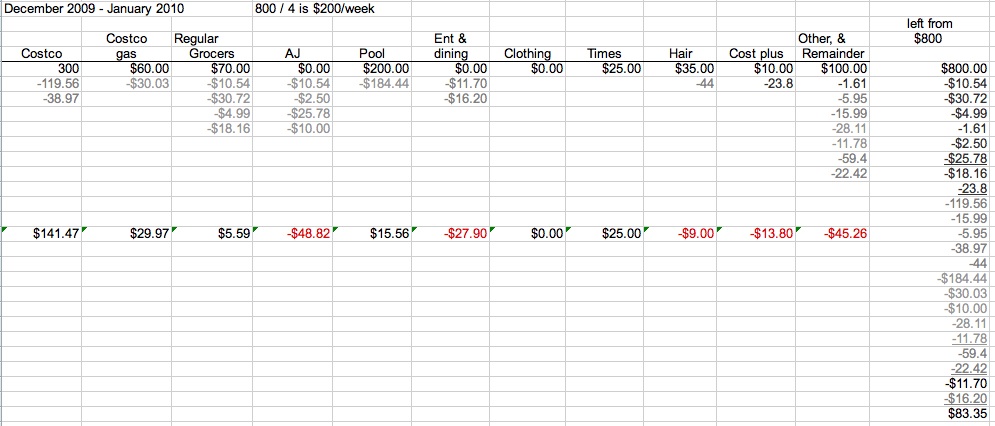
The big change is that I decided to abandon microbudgeting and see what would happen if I set up virtual “envelopes” for the month instead. In microbudgeting, the budgeted amount for the month is divided in four and allocated to four periods of roughly a week each. With the envelope system, you establish an amount to spend on each of several categories, and then quit spending on a given category when you reach its limit.

Presently, the result looks like this:

In this first experiment, it appears I’ve overbudgeted for Costco and underbudgeted for gasoline and hair. Since I don’t get my hair cut every month, I figured I could think of $20 as a kind of “average,” but maybe it would be better simply not to have a “hair” budget in the months when I don’t need a trim. No law says you have to have the same budget categories, month in and month out.

I hardly ever go out to eat—really, it’s a rare month when I spend as much as $50 in restaurants. For some reason, this month all my friends have been asking me to join them, and since I have precious few friends, I incline not to turn them down. At any rate, it’s covered by the savings from the pool and Cost Plus categories.

So the question is: Does a virtual “envelope” system, even when the proprietor cheats here and there, work better than microbudgeting?

Psychologically, it may: with the weekly microbudget, one feels it’s OK to spend all the way to the hilt. In fact, when the overall monthly budget gets tight, it’s difficult not to spend the entire week’s microbudget: $250 is not much to cover all one’s bills, from food and gasoline to pet care and property maintenance. One $200 run on Costco plus a tank of gas and you’re over budget…and how often can you get out of Costco for under $200?

With the envelope system, you don’t feel so constrained: you have all month in which to spend the money allocated for groceries, clothing, gasoline, and the like. One $150 trip to Costco came nowhere near running me into the red, but if I’d spent that much out of a one-week microbudget and then had to spend $35 on gas and $30 on the hairstylist, I’d have had $35 left to last the rest of the week. One trip to Safeway would have blown it. With the virtual envelopes, it’s easy to see what remains in the budget for specific purposes, making it easy to back off some expenditures as needed.

Clearly I’m going to have to reallocate allowances for some of the categories: less on Costco and more on gas, for example. But if I’m right that this approach works better than microbudgeting, the implication is huge.

Huge.

It means that next year I should easily be able to live within my much constrained means, without having to hold a fulltime job and without even having to crank any freelance work. Combined income from Social Security and part-time teaching should more than cover my needs!

$14,400 SS + $14,160 teaching – 20% tax = $22,848 net income
$565 monthly recurring costs + $1,000 discretionary budget x 12 = $18,780 routine expenses

That leaves me almost $4,070 to the good. From what I can tell, that extra amount will just cover the cost of Medicare, which should run around $300 a month, by the time I’ve cobbled together all the aspects that go to creating full coverage. It doesn’t leave anything for emergency savings, but I have $10,000 in that fund to cover 2010; in the following year I’ll be allowed to earn more money.

So, if I don’t get the Glendale Community College job, it won’t much matter: as long as I can keep discretionary spending to around $1,000 a month, I should be fine.

And in the unlikely event that I do get the job, it would make sense to stay on this budget and save all the unspent net income, thereby making it possible not only to buy a car in cash but also to replenish savings with new earnings.

Either way, the new budget is a winner!