Coffee heat rising

A Few Twinkles of Hope in the Money Department

…or is it “all that glisters is not gold?” Not sure, but lately we’ve seen some hopeful signs that The Copyeditor’s Desk, the little editorial business my associate editor and I started together when we were canned from the Great Desert University, just might manage to make enough to support one or (preferably) both of us. Whence this shining image? And is it a mirage?

Well, first off, we decided that we needed to seek a different kind of clientele. We’d been networking with local publishers and authors. Nothing wrong with that, except that Arizona, renowned as a cultural backwater, is about as far from a hub of the publishing industry as you can get, this side of the Sahara desert. With a few notable exceptions (such as Pearson, Poisoned Pen Press, and the University of Arizona Press), publishing companies here tend to be DIY operations staffed by a Would-Be Author with a desktop computer, whose raison d’être is to print and, with any luck, sell a few copies of the W.B.A.’s magnum opus. To the extent that these entrepreneurs recognize their need for an editor, they’re willing to pay just a shade more than minimum wage. They’re running on a shoestring themselves, and they expect to get shoestring contractors. A number of vanity presses serve those who aren’t quite techie enough or just don’t want to invest the time to create camera-ready or Kindle-ready copy; these outfits, too, expect the hired help to earn less than a good cleaning lady commands.

Much of the material we saw from this set would be unpublishable in the mainstream market because it tends to the woo-woo: full of theories about space aliens, strange diets, and life on the other side of the veil. A great deal of it is painful to read.

Late last year we realized that other kinds of businesses—the client in hand was a plumbing and HVAC company—would actually pay a living wage. In fact, they expect to pay a living wage. And by that, they mean about six times what we’ve been charging.

If you offer to contract to these folks for the wages we’ve been asking, they think you’re an amateur. However, if you ask for $60 an hour—a number that looks stratospheric in our limited view—they don’t even blink.

As a matter of fact, if you take time to do some fairly extensive research on what people like us earn, you discover that sixty bucks an hour is on the low side. That is to say…what we think is an extravagant figure is actually competitive.

So, lately we’ve been seeking business clients, and we’ve been practicing the art of uttering “sixty dollars an hour” with a straight face.

And y’know what? It’s working!

In the past two months, we’ve landed four clients who hardly even gagged when we said the magic words. For one academic, we agreed to drop the fee to $45,  knowing what it means to be a tenure-seeking academic. For the others, we’ve acted like we believed what we were saying. In two months, we will gross more than half what we normally make in an entire year. And the content of what we’re reading is great: working documents for two excellent nonprofits, a new book for a handsomely published up-and-coming author, and an interesting academic study that’s already been accepted for publication.

Not a word of woo-woo among these folks.

Next, we’re taking some steps to encourage a steady flow of this kind of work. We hope. We’ve applied for a two-year business development program called AAAME, backed by the Small Business Association and Arizona Public Service, a large regional utility. You get mentoring, workshops, and project-based training with an emphasis on marketing (exactly what we need the most!), with regular meetings and opportunities to meet hordes of business owners and community leaders who could use our services. And amazingly, it’s free.

No guarantee that we’ll get accepted, of course—only about a dozen small businesses make the cut every couple of years. However, just writing a new, more formal business plan has already generated a few insights. We’ve begun to build a database of contacts and created a newsletter, the first issue of which we distributed to 57 past clients and current friends. I have a vague idea about how to market…what’s needed is some understanding of how to apply it to finding our client base and selling our service to it.

At any rate, just in the past month and a half, The Copyeditor’s Desk has found enough paying work to free me from teaching not one but two classes.

I came up with a spreadsheet to express our revenue goals for the next two years. If I earned $15,000, it would replace my teaching income with something to spare. Twenty grand would not only spring me free of the classroom but pay all the bills, and a similar drawdown would free Tina from waiting tables, allowing us both to earn our living at what we do best. Twice that much, and we’d both be living like queens. Why? Because I have about $12,000 worth of Social Security coming in, and Tina earns significantly more than that as managing editor of a large scholarly journal.

Interestingly, even two salaries of $40,000 plus enough to cover overhead would not require us to generate an unreasonable number of billable hours. At least, I think not: truth to tell, I don’t yet know what to expect as “reasonable.”

For each set of projected goals over the next two years, I calculated a bare minimum we would need to earn, what I think is probably within reason, and a figure that would make us do a wild dance of joy. Check out the Year 2 figures:
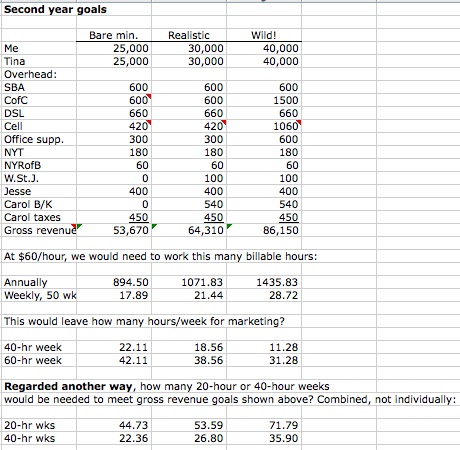
The amazing thing about this is the number of hours we would (or rather, wouldn’t) have to work to meet the goals. To earn enough to pay ourselves $40,000, between us we would only have to bill about 29 hours a week. You see…that’s 15 hours of work apiece. Assuming, of course, that we can get our $60/hour rate—which apparently we can.

Presumably work will not come in steadily. Right now it never rains but it pours, and we have no reason to think that will change. So I asked how many weeks we would have to work in year 2 to meet our revenue goals.

Welp, even if we’re still dorking around in classrooms and restaurants, we could make our goal by working half-time, because that 71.79 hours represents our combined workload. With two of us sharing the work equally, we’d each work about 36 weeks to earn enough for the corporation to cover its overhead and to pay us each 40 grand. If we bestirred ourselves to work at it 40 hours a week, it would take 35.9 full-time work weeks—18 work-weeks apiece—to make our goal.

LOL! Well, of course, we know all this glamorous work isn’t going to find its way in the door by itself. So I calculated the number of hours that would be left after finishing the paid work to spend on marketing. If I did all the work (which I won’t, because Tina will be handling some of it), I’d still have 11+ hours left in a 40-hour week or, in my more usual 60-hour week, 31 hours to devote to marketing activities.

This could work.

As long as we’re baking pie in the sky, I say to Tina, “how much would you like to earn from the editorial business?” Says she, “Well, my real goal is to someday earn $100,000.”

Holy moley. This could require us to quit carrying plates of chicken mole out to restaurant patrons. But…what would that actually look like? Could it be done?

In this scenario, I figure I don’t need any more than 40 grand, so there’s no point in my drawing any more than that out of the business:
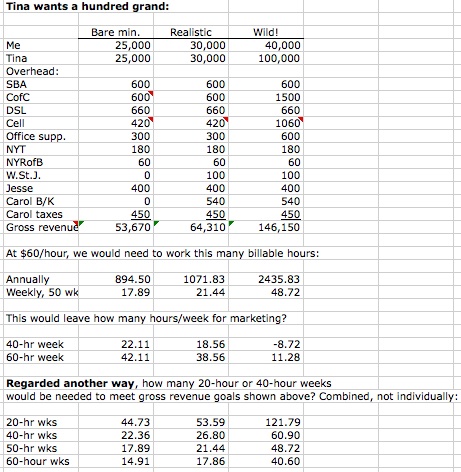
Hmmm… We’d both be reduced to working at least 40 hours a week. However, remember that we’re sharing those hours, so instead of 60.9 forty-hour weeks, the actually load of billable hours would be more like 30.45 full-time weeks. And we also would be farming work out to print and Web designers, proofreaders, and the like, from whom we would engross a 25% cut. Still…the negative balance in the hours available for marketing doesn’t look good…possibly what would need to be farmed out is the marketing work!

Well, we’re not going to earn any of that unless I get back to reading some copy. And so…to work!

Image: Stars in the Sky (LH 95 star-forming region of the Large Magellanic Cloud). European Space Agency. Creative Commons Attribution-Share Alike 3.0 Unported license.

Networking

Trying to kick The Copyeditor’s Desk into high gear: improve networking efforts online and face-to-face; tell the world who we are and what we can do for them.

Around editing 40 pages for a client and teaching a class that goes till after 9:00 p.m., I wrote Newsletter #1, compiled a Contacts list in Google, and this morning shipped the copy off to 57 people. Minutes later it was out the door to a meeting of a freshly a-borning chapter of a large women’s business networking group.

It was pretty interesting. Had a good time meeting the various proprietors of various small businesses. Had an OK lunch at an expensive restaurant perched on the side of a fake lake. Handed out a bunch of cards; collected a bunch of cards. Heard the pitch for why we should join up. Three hundred dollah a year and $20 a lunch. Two meetings a month. If you’re not a member, you don’t get to give your 60-second commercial.

So…how to tell whether a group like this is worth it?

Well, it looks to me like the value of a networking group depends on whether a certain number of the members meet the criteria of the kind of client you realistically can help, and the kind of client who can afford you. Most of the folks I met there were one-person shops: very, very tiny businesses that depend entirely on the talent and industry of their sole proprietors.

The networking group I do belong to mostly consists of small businesses, but only one is a true one-man operation. Some, maybe most of them, could in theory afford what we want (and need) to earn for our services.

The friend who invited me to today’s shindig is a chiropractor. Most of the women there were middle-aged and older: full of aches and pains. They represented a rich vein of potential patients for his practice. But for a couple of editors? Maybe not so much.

If you’re an entrepreneur, you need to pick your networking groups to fit your business. The members need to have some need for your service or product and they must be able to afford you. They need to be in your business’s demographic—that is, the kind of people who are interested in whatever you offer—and they should be open to your specific kind of marketing.

The ladies were perfect for the chiropractor but way off the screen for a publications consultant. One woman was waving around a couple of books she’d self-published. If she’d sprung for one of our designers, she could have promoted her business with books that looked like they’d come from a real, mainstream publisher. But had I suggested that to her, back when she was in the production stage, chances are she would have ignored it. She either would have felt she couldn’t afford a designer’s $50/hour fare, or she would figure that writing and self-publishing a book was something she could do herself, with Amazon’s help. One way or another—whether she hired me or not—I’d be wasting my time courting her.

Work smart. Network smart.

Workin’ on the Business Plan

I’m going to try to enroll our business, The Copyeditor’s Desk, in a really interesting-sounding program that comes out of a partnership between the Small Business Administration and Arizona Public Service, a large utility. Called AAME, it’s a two-year program of workshops, training, and mentoring designed for small minority- and women-owned businesses.

Yeah, I know: it’s a 90-degree turn from the real estate scheme. However, there’s some reason to think building the editorial business, which is something I know well and in which I have a talented business partner, might be smarter than leaping into an entirely new enterprise in which I have no experience and for which I have no idea whether I have any aptitude.

The main reason is that we’ve started getting work from people who don’t blanch at our hourly rate.

The community college district hired our company to help compile what amounted to a very large application. Pay was good and there was no caviling about it.

A scholar in Tucson wants us to help edit her latest book; an arcane study of Japanese sociolinguistics.

A large nonprofit asked if we would edit an employee manual.

And an old client reappeared at the door with a new book in hand—and news that the work we helped her with has found an excellent publisher.

 And IMHO the other reason is that we’re not getting the kind of work we want for the kind of pay we expect is because we’re not working hard enough at it. And for that the main reason is that Tina and I are each trying to do too many things at once. Her life is as gestalt as mine, maybe more so: in addition to working three jobs, she’s also trying to bring up a little girl, cope with a crazy ex-, and build a life with her fiancé. Because we’re both trying to do too much, neither of us is fully focused on any one of our several endeavors. The result is…we’re not giving our all to any of these enterprises.

What if instead of running off after some new money-making scheme, I worked a little harder at getting the one we have to fly? We need to focus more on one thing and less on three or four things.

This AAAME program looks like just the thing to jump-start that:

Mentoring
Workshops
Training in business management and marketing
And opportunities to network with just the kind of business owners who can use our services!

To say nothing of schmoozing with some of the biggest movers & shakers in the state…

Part of the application process entails writing a business plan. Naturally, we have a business plan, of sorts. But it’s vague.

That right there may be part of our problem! 😉

To create the plan for the AAAME application, I’m following the SBA’s business plan template. It’s pretty simple to do, and very clear. Rather than fill it in online, I simply hit “continue” all the way through, copying the instructions into a Word file. Now I’m following the SBA’s steps to create a business plan tailored for the AAAME application’s needs. I’m about half-way through it.

It’s pretty useful because it forces you to re-articulate your ideas in terms of a specific structure and asks you to identify exactly who you think is going to buy your services and why on earth they would want to. It also asks you not only to describe what you think you want to sell, but more to the point, why your product or service is competitive.

These are things that we just sort of know, but that we’ve never really put into words. And they should be put into words, outlined in very specific detail. No question: this is the platform for a new business’s marketing plan.

Marketing is our weakest point. But just putting the requested business plan together is spurring some ideas that should make a difference. I’ve started to build a database of past and present clients and intend to emit a quarterly newsletter. The first one will talk about our effort to reposition ourselves toward businesses and professional practices, and that will give us a nice opportunity to articulate some of these very topics to our customer base: what can we do for you and why?

The business plan is a valuable exercise as well as a potential tool if you need to apply for grants or loans. It’s something you can apply to just about any enterprise you want to pursue, including blogging.

If you’re thinking of monetizing your blog, or if you’ve already monetized it but are more or less flying by the seat of your pants, you might want to consider writing out a business plan. If you don’t want to follow the SBA template, there are several others on the Web, or some versions of Word have a template. It really clarifies your ideas… Try it. You’ll like it.

Big Job…

MIA for a few days because we picked up a nice contract job from the community college district, editing an application for a large and prestigious award. As with any document written by committee (don’t know why that always happens), we started with the deadline practically on top of us. It was about 25 or 30 pages long, and our job was to edit it, turn the bureaucratese into English, and make it sound like it was written by one person.

IMHO, it turned out pretty well. If it goes over exceptionally well, the college where I teach will win a grant of about a million dollars.

That would require some serious exceptional. The school was invited to apply for this award, along with about 115 other colleges. I think they have a shot of at least being recognized for the excellence of several of their programs. Given the difficulties community colleges face under the best of circumstances—serving an absurdly diverse constituency whose motives are so various and many of whom are unprepared for college-level work, while funding is precarious and a perverse legislature labors to undermine education across the state—this particular school does an amazing job of keeping young people in school, delivering vocational programs that at least have a shot of getting them into decently paying work, and funneling a fair number of them into four-year colleges.

Anyway, we got paid decently—not quite what we regard as our natural due, but we’re willing to come down on our hourly rate for nonprofit organizations. And we are so thrilled to work with someone who does not try to persuade us that the red rocks of Sedona were put there, coded with a secret message for humanity, by the same space aliens who built the pyramids.

We have another large, interesting job coming up the pike, a third materializing on the horizon (we hope), and an application for a fourth winging toward a business publication’s editorial board.

This is the sort of work we want to get. We are both royally tired of working for outfits that think we should provide professional-quality work for graduate-student pay, with trying to humor wannabe writers who think their self-published memoirs and amateur novels will inevitably be best-sellers, and with folks who commune with the dead and theorize about conspiracies.

We’re now officially registered contractors for the Maricopa County Community College District, one of the largest college districts in the country. This summer I hope we can engage a few strategies to keep us moving in the right direction:

Join the Small Business Administration and start networking through that agency
Learn, through the SBA, how to apply for federal contracts
Look in to applying for state contracts
Engage with the college district’s Small Business Center, which offers one-on-one consulting plus networking opportunities
Join one of the chambers of commerce or start attending groups listed in Networking Phoenix

That ought to keep us busy this summer, especially given that I have a class to teach and Tina is transitioning from a paid employee of the Great Desert University to a contract employee for the Chinese government.

And speaking of busy, it’s after 6:00 a.m. Gotta run!

Speaking of Time Sucks…

Signed up for the free access subscription to Literary Market Place. Useless. Will need to spend half a day in a library using the hard copy, since I’m not paying them $25 a week for the privilege of accessing the premium version online. None of the city libraries here open before 11:00 a.m., which is about the time I’m leaving for class. This, thanks to the Tea Partiers at City Hall who used the recession as an excuse to shut down city services every which way from Sunday.

The community college library does not carry LMP, a key reference work for anyone in any branch of the publishing industry. The Great Desert University does. That entails a long drive and a complex set of tergiversations to find a free place to park.

Fortunately, I have a Google Adsense check to deposit. Fortunately, a branch of the credit union resides on the Great Desert University’s west campus, only a 20-minute drive from here (that would add up to 40 minutes on the road, hm?). Fortunately, if you walk in to the credit union to deposit a check instead of going through the drive-through, you can get a sticker that will let you leave your car in the guest lot for an hour or two. Fortunately, the GDU libraries open at 8 a.m.

So. Tomorrow, well before my late-morning meeting in the East Valley (for which I happen to need information from LMP), it’s off to West (adding an extra 30 minutes to the drive to Tempe…), a junket that will require me to spend three hours to engross about an hour’s worth of data from GDU’s hard copy edition of LMP (interestingly, they do not carry the database version, which would have much simplified life…). Then it’s fly low to get to Tempe by 11:30.

Total time suck.

Any question why it takes forever to get the simplest tasks done around here?

A Peek through the Escape Hatch…and other minor details

So tonight after half a day of teaching blessed souls who want so badly to do well in freshman comp (in spite of not knowing how to frame a thesis statement or write an idiomatic sentence), it was off to the new real estate course. It looks good. I enjoyed it, enjoyed the instructor, and came away feeling pretty upbeat. Very upbeat.

The textbook is around $65, but I can get a 10% discount with my faculty card. Natchurly, I didn’t have it with me this evening. Tomorrow I have to take the car to the repair shop, there, we hope, to fix whatever is making the ominous noise—that’ll be a pricey fix, you can be sure. So I won’t be able to buy the book until Thursday, when I’m back on campus to teach again.

Meanwhile, I made a little discovery: for those of us who are given to startling back pain, the amount of quinine in a can of tonic water may be enough to quiet the muscle spasms that give rise to that pain.

For the past week or ten days, I’ve been enjoying an ongoing storm of back spasms. They started in the neck and shoulder and by yesterday had worked their way down to the lower back, which I hate even more than upper back pain. So insistent were these spasms that I could actually feel a muscle in my back twitching. Ugh.

So of course I had recourse to the Hypochondriac’s Treasure Chest: to wit, the Internet. Googled “back muscle twitching.” And lo! It develops that a whole flock of neurotics suffer the same phenomenon. Many of them highly praise quinine.

Alas, though, some 1 percent of 1 percent of humanity has a dangerous sensitivity to quinine. Make that a life-threatening sensitivity. In response, Big Brother has taken quinine pills, which deliver a respectable dose, right off the market.

Well. In response to something. One message board contained a squib from a practicing pharmacist, who said quinine was not going to hurt you. The real story is that the patent ran out on said pills, widely loved by sufferers of those nasty leg and foot cramps that strike in the wee hours. Big Pharma, unhappy with this development, lobbied to have the drug banned. It’s now back on the market in a new, wildly expensive patented form, presently approved only as a malaria cure. So if you want it, you have to find out what it’s called and then find a doctor who can be persuaded to prescribe it for an off-label use, which is exactly the same as the previously on-label use for which it was prescribed for years. Yes.

Numerous comment posters touted drinking 8 ounces of tonic water about three to five hours before retiring. Various sufferers responded, always with one of two answers: it either worked like Jesus touching Lazarus or it didn’t do a damn thing.

Now I know I’m not allergic to quinine, having ingested more than my share of tonic water over the years. So it was off to the Safeway, there to grab a six-pack of little cans full of the stuff. And a bottle of Bombay Sapphire, not wanting to waste the trip.

The result?

One 12-ounce can of the stuff (abetted by a slug or two of gin) is definitely, unmistakably Jesus touching Lazarus. By the time I crawled into the sack, the twitching had stopped, once and for all. Not a single tic. And though the pain was still there, the gawdawful knife stab had abated enough that I could actually find a comfortable position to sleep. Crapped out around 10 p.m. and slept all the way through until 6 in the morning. That’s some kind of a record.

This morning my back still ached a little, but it wasn’t excruciating. Getting out of bed did not elicit a moan or a cry of pain. I was able to lift Cassie off the bed without fear of dropping her. And the pain has stayed at bay. In fact, it’s actually improved slightly. Right now we’re coming on to 9:30 and it hardly hurts at all.

Tonic water. Don’t forget the Bombay Sapphire.

🙂

Image: A bottle of Bombay Sapphire gin that is half full. Ben Efros. Creative Commons Attribution ShareAlike 3.0 License.