Coffee heat rising

Credit Report Check

If you don’t already know it, take note: Going online to get annual credit reports is amazingly easy and fast.

The site to visit is Annual Credit Report.com, because it does not try to sign you up for any gimmicks or paid recurring reports. You get what you order here, with no hassles and no sales pitches.

You can order reports from any or all of the three major credit bureaus: Experian, Equifax, and TransUnion. They don’t give you your credit rating (though you can purchase it for a nominal fee), but they do signal any problems.

Because each credit bureau is required to provide one free credit report per year to consumers, it’s a good idea to set up a calendar reminder to hit one bureau every three months, giving you an ongoing record instead of one annual picture.

However, each bureau is a little different; they don’t all have identical data. I was concerned enough about the late, great Macy’s fiasco that I wanted to be sure no black blot was lurking on my records, especially since one’s car and homeowner’s insurance rates can be affected by negative credit reports. If I decide to buy a car, even though I pay in cash I don’t need whatever extra hassles or charges might ensue from any negative items, so I decided to order all three reports this time.

TransUnion was the only bureau that disgorged a detailed report for me. Equifax and Experian produced one-page summaries, and I couldn’t see any way to get in and see a full report. The summaries, though, sufficed, because they both reported no negative items.

At any rate, it’s extremely easy. Where in the past you had to fill out three separate online forms and enter a lot of data, now you fill out one form at Annual Credit Report.com plus answers to a few identifying questions at each site, and voilà!

It’s worth your time to do it.

A “Gift” from Sears

Lenten thanks, Day 29

A gray morning; a soft soaking rain falls from the sky. Blossoming plants shiver with joy at the last good drink of fresh rainwater before the blast of summer comes up. Not bad, God! Definitely an A+.

So some time back M’hijito needed a new dryer. Since he pays cash for everything, we put it on my AMEX card so I could rack up a little more in the annual rebate kickback, and he forked over the dollars to me. Sears’s come-on to buy appliances just then was an $80 mail-in rebate offer.

I always figure those are a rip. “Mail-in rebate” too often means “no rebate”: even when you remember to gather all the ditzy pieces of paper required, fill out a form asking for information that’s none of their business, and stuff it all into an envelope, half the time you never get any money back. But nothing ventured, nothing gained: shortly after we acquired the dryer, I shipped off the paperwork. That was several months ago.

Now comes in the mail from Sears the rebate…in the form of a debit card! It’s a preloaded Mastercard debit card.

No cash. Noooo….  You’re expected not to drop the money in your savings, but to diddle it away at restaurants and the like. You can transfer the money to your bank account, but this requires you to go online and share all the details of your bank account with Citibank’s Visa employees. You can get cash off the card, but only if you use an approved ATM. If you don’t use ATMs (as those of us for whom cash washes through the fingers like water tend not to do), you’ll just have to spend it.

Okay. So it’s M’hijito’s birthday. I figure $40 apiece would buy us a very nice dinner at a much tonier greasy spoon than we are accustomed to frequenting, and I propose to invite him out to celebrate.

Then I start to look at the swath of fine print that comes with this thing.

It has a $3.00 “account management fee,” which kicks in if you don’t start using the thing. If you use the it outside the U.S.—say in Nogales, a 90-minute drive from here—you get dinged 3% per transaction. If you have not used up the money by the expiration date, they apply a $3.00/month gouge. You are limited to a maximum of 12 transactions a day (“or your daily limit,” whatever that is). To find out what “your daily limit” of transactions is, you have to log onto their website, whose URL is not given. Under the federal anti-terrorism laws, you are required to give them your correct name, correct address, and correct telephone number. They will share this information and any other personal information they gather with whomever they please unless you fill out a separate form, put it in a separate envelope (which you supply) with a separate stamp (which you supply), and mail it off.

It is an “account.” You can reload this card with cash by depositing money with Citibank, and from now until the end of time can pay for junk with plastic. For a fee.

So, I wonder…if they nick you three bucks every time you turn around and this thing is an open “account,” presumably they’re going to start charging you a bank fee of $3 a month whenever it runs out of cash? And it’ll be quite a trick to figure out how much cash is on the thing, right? Because you’ll never know exactly what day of the month they decide to engross three bucks out of this “rebate” gift. And am I right in thinking that effectively Sears has set up a bank account for me, which I have not asked for, at an institution with which I do not choose to do business?

😯

Looking this gift horse in the mouth, I call the number on the card and after just one runaround reach one Duane, a human. When I ask how the $3 nick works and how I go about canceling this thing as soon as I can spend the $80 so generously “given” to me, he admits that on request they’ll send me a check. Great, say I: please do send a check.

Supposedly this vast lucre will show up in the mail sometime in the next couple of weeks. I’ll believe it when I see it.

😀

Really, I do dislike mail-in rebates. They’re such a nuisance. And this new twist is plain annoying. What’s difficult about just sending the money in the first place? Or better yet: How’s about giving customers a fair price in the store, rather than making us jump through hoops to shave off a few bucks?


“Healthy” Junk Food: We spend MONEY on this?

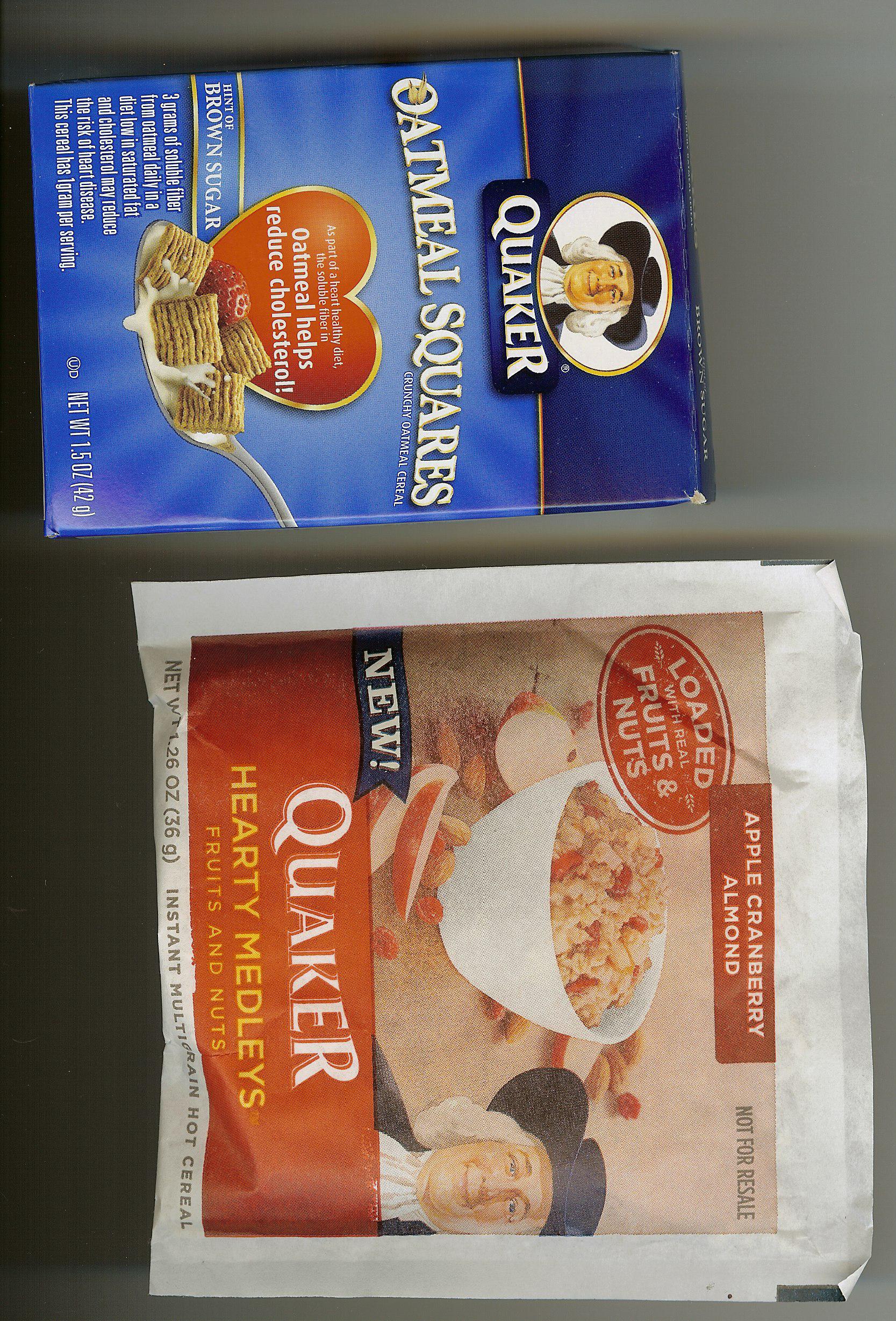
Ewwww! One of the door-to-door litterers hung a bag with two minipackages of Quaker cereals on my front gate. I don’t eat processed junk cereals, and so was about to throw them out when I thought…wait! Maybe this is something I could eat between classes on Tuesdays and Thursdays.

There’s no decent food on campus (decent by my lights, anyway—I don’t eat junk food, and that’s about all that’s sold in the student union, except for a few pathetic attempts at salads). The stretch from 7:00 a.m., when I have breakfast, to 3:30 or 4:00, when I get home, is a long one, and I get awfully hungry. So hungry that the instant I get into the house I fix a big dinner and then overeat. The overeating at mealtime is what keeps the weight on, I suspect.

So, I go to look at the ingredients in the minipackage of Quaker Oatmeal Squares:

whole oat flour, whole wheat flour, brown sugar, sugar, maltodextrin, malted barley extract, molasses, salt, and then a list of the same ingredients that appear in a bottle of multivitamins.

Maltodextrin is a form of sugar. Malted barley extract is a type of sweetener which also contains a form of sugar.

Sooo…what we have in this little box is some ground oats and wheat (very cheap), five doses of sugar(!), and some spray-on vitamins. Oatmeal Squares, sold as “heart-healthy” and so by implication good for you, is largely, if not mostly, sugar.

Yuck! Why do people put stuff like this in their mouth?

Well, the answer is probably that they think it’s good for them (“2 grams of soluble fiber from oatmeal daily in a diet low in saturated fat and cholesteral may reduce the risk of heart disease,” it says here). And they probably think it’s inexpensive food.

What does this stuff cost? At the Safeway, with the Red Card membership discount: about $2.50 for 12 ounces. That’s twenty-one cents an ounce, which at first glance seems pretty cheap. But really. It’s an awful lot for a vitamin pill sprinkled over some heavily sugared grain.

You’d do a whole lot better to buy a box of real, actual oats. Takes about five minutes to cook them, and when you pour the stuff in your bowl, you get the whole three ounces (or more)…not the one ounce that resides in a single serving of Oatmeal Squares. If you like your cereal sugared up, at least you know how much sugar (or honey, or maple syrup) you’re putting over the stuff.

Is there any question why Americans are overweight?

A Bible of Customer Service

Frugal Scholar has been holding forth (again) about the sometimes execrable customer service at Chico’s. Really. One wonders where retailers get the people the hire, or if they deliberately train them to turn off the customers. Is it possible that there are some among us they just don’t want to do business with?

Some retailers and retail staff trainers could do with some pointers. If you’ve ever stayed at a Ritz-Carlton hotel, you know what customer service is supposed to be like. Back in the day, when I was married to the corporate lawyer, he and I in fact did linger at Ritz-Carlton  hotels on occasion…the one at Laguna Niguel, as I recall, was particularly amazing.

Well, there’s an official history of Ritz-Carlton that describes the company’s strategy for building world-class customer service. It’s called The New Gold Standard: 5 Leadership Principles for Creating a Legendary Customer Experience Courtesy of the Ritz-Carlton Hotel Company. You also can get it in a Kindle version.

Here’s my plan: We all buy a copy of this thing and send it to the president or CEO of Chico’s. If Chico’s Facebook CSR responded to their neglected customer because she noticed Frugal Scholar’s criticism (entirely possible: companies do set their Web browsers to gather online mentions, turning the Internet into a gigantic online clipping service), then maybe if all of Frugal’s and FaM’s readers sent a little hint upper management, we’d see some changes made.

😉

Motivating People around Us: Six Ways to Better Customer Service

A week or so ago, Financial Samurai posted a thoughtful article on the importance of recognition in motivating workers, especially as they move upward through the organizational hierarchy to take on greater and greater responsibility.

He touches on an issue that was presented to me some years ago. While I was an editor at Arizona Highways, I was sent off to take a seminar in motivating creative workers. To boil a daylong talkfest down to a sentence or three, the gist was that creative people are motivated less by money than by recognition of their skill and talents. It was claimed that graphic artists, writers, and editors feel a great deal less validation from promotions, nice offices, and raises than from awards (whether from inside the organization or from trade and creative groups) and verbal commendations from management.

Well. I recall thinking that sounded like a good excuse to pay creative workers less than accountants, circulation managers, and ad salespeople—as though those folks never engaged any kind of creativity in their jobs. What I took away from the seminar was that all workers thrive on generous recognition of excellence: that positive feedback on good work is more effective than negative feedback on efforts that leave something to be desired.

Weirdly, that idea was recently reinforced by, of all people, a dog trainer.

Motivated creative worker

Cassie the Corgi and I were attending an agility training class. The trainer was trying persuade everyone that the key to convincing a dog to do what you ask is effusive praise. In the middle of his harangue, he stopped and said, “How do you feel when the boss says to you, ‘Great job, Joe! You really did exactly what was needed!'” He mimed a handshake and a pat on the back.

“That makes you feel like doing the same thing again, right? Maybe even better the next time.

“But what if he just grunts ‘Nice work there’?” He made like a guy walking past the cube, waving a coffee cup in the air. “How does that make you feel? Not so enthusiastic about the job.”

You don’t have to be a boss (or a dog trainer) to profit from this advice. One obvious application is to customer service reps and sales clerks. Ever think about how you behave affects the way they feel about their jobs? Imagine having to put up with some chucklehead who can’t even make eye contact while she yammers on the cell phone as you’re toting up her grocery bill. What must it feel like to be on the receiving end of a call from a customer who has just spent ten, fifteen, or more minutes listening to infuriating Muzak, advertising, and “we value your patronage” pseudomessages while trying to get a simple answer to a simple question?

We can “motivate” all sorts of employees around us. Even though they’re not strictly “our” employees, they’re our employees in that they’re trying (in theory) to please us with various products and services. It’s in our interest to motivate them, because happy employees provide better services and may even go above and beyond the call for us, in one way or another.

Here are some ways to build better morale and promote better service among the employees we run into every day:

Refrain from yakking on your cell phone while the checkout clerk is charging up your purchases (that is so rude!).

To keep the edge out of your voice after navigating an endless phone tree, turn on your speaker phone so that annoying ads and muzak aren’t pumped straight into your ear. Try not to take out your frustration at having to fight to reach a human on the human being who finally does answer the phone.

Thank people for their efforts, even if they’re just doing their job.

When people do something you like, compliment them on their professionalism, helpfulness, or special effort.

Even if the person is doing just an adequate job, compliment him or her on something or make some empathetic remark. Recently a tired-looking bank teller perked right up when I observed that her manicure looked lovely.

When a talking machine asks you to comment on a telephone representative, say “yes” and leave a positive comment—most people only comment when they’re complaining, so these devices serve mainly to add stress to an already stressful job.

What strategies do you use for getting the best out of the people around you?

Image: Pembroke Welsh Corgi on an agility teeter-totter. Elf. GNU Free Documentation License.

Return Policies: It pays to shop where they’re generous

Yesterday, at Frugal Scholar‘s repeated urging, I returned to Costco’s optical department, bearing the goggle-like glasses I’ve disliked so vigorously. As you may recall, the progressives work adequately for watching TV (which I rarely do) and for eating dinner, but I can’t read sheet music for choir through them, or much of anything else; the “intermediate” pair the optometrist proposed to take the place of a pair of glasses that worked fine for reading and computing is more or less adequate for the computer but I can’t read a book or a newspaper through them.

The optician proposed to make a new pair of lenses for the progressives. Tentatively, I asked if there was any chance I could get my money back instead, since I’d had to buy another pair somewhere else.

“That’s your choice,” said she.

“Well,” said I, “I’d rather have my money back, if that’s possible, since these new glasses I had to buy were pretty expensive.”

Amazingly, she agreed to refund the entire cost. But it gets better!

“Is there any chance I could get my money back for the other pair, too, since I can’t read through them, either?”

To my astonishment, she agreed to that, too!

I walked away with $283.96 credited to my American Express card.

What’s staggering about this is not just that they returned my money for something they can’t resell. It’s that I bought these glasses LAST NOVEMBER!

Can you imagine? I still can’t, and I watched it happen.

This refund erased the $94 worth of red ink in this month’s budget and put me $151.46 in the black. I then bought $82 worth of groceries and household products. leaving me about $70 to the good.

Today is the 9th. I bought gas over the weekend, which, since I’m not driving around much, should run the car for another ten days. The grocery run provided enough food to last, probably, until the end of the budget cycle on the 20th. I may need a head of lettuce, but that’s sure not going to cost seventy bucks.

So. Despite overspending the budget this month, I come out unscathed.

It really does pay to shop at stores with generous return policies. With this sort of customer service, Costco has made such a fan of me that one little troll, gorged on troll kibble (I buy it at Costco, of course), decided that Funny must be a paid shill for Costco.

I wish. But they certainly have me coming back.

In contrast, I try to avoid shopping at stores that won’t let me bring back unsatisfactory items. I rarely go into Fry’s Electronics, for example. They have a one-month return period, and although they’ll eventually give you back your money,  in the past I’ve found it’s quite a hassle to engineer a refund. The useless vacuum cleaner, whose replacement is the main cause of this month’s budget overrun, was purchased there over a month ago and so can’t be returned. The new vacuum came from Costco. You can be sure I won’t be buying much from Fry’s again.

B’Gauze, one of the few stores that carries clothes that fit and don’t look just hideous on me, accepts no returns at all. Consequently, the $700 spent on the late great shopping spree went to J. Jill, not B’Gauze. Women’s clothing is weird stuff: it can look OK in the store, but when you get it home and look it over by the light of reality, you’ll find it doesn’t actually fit very well, or it’s shoddily made, or the red dye rubs off on your white pants. So when a clothing store refuses to take returns, it discourages one from shopping there. I never buy more than one or two items at a time from B’Gauze, and my trips to the store are few and far between.

Paradoxically, then, a generous return policy works as much to the store’s benefit as it does to the consumer’s.