OMG, to coin a phrase: The power bill that arrived yesterday was only $128.89. That’s down from last month’s of $209.58 and August’s of $218.91. Both of those are below the budgeted high of $225, which the Salt River Project has attained in the past.
This, we might add, is with my turning the thermostat down to 77 degrees at 9:00 p.m. in hopes of sleeping all night long. Forlorn as that hope is, there’s absolutely zero chance that I’ll get to sleep when it’s 80 or 82 in here.
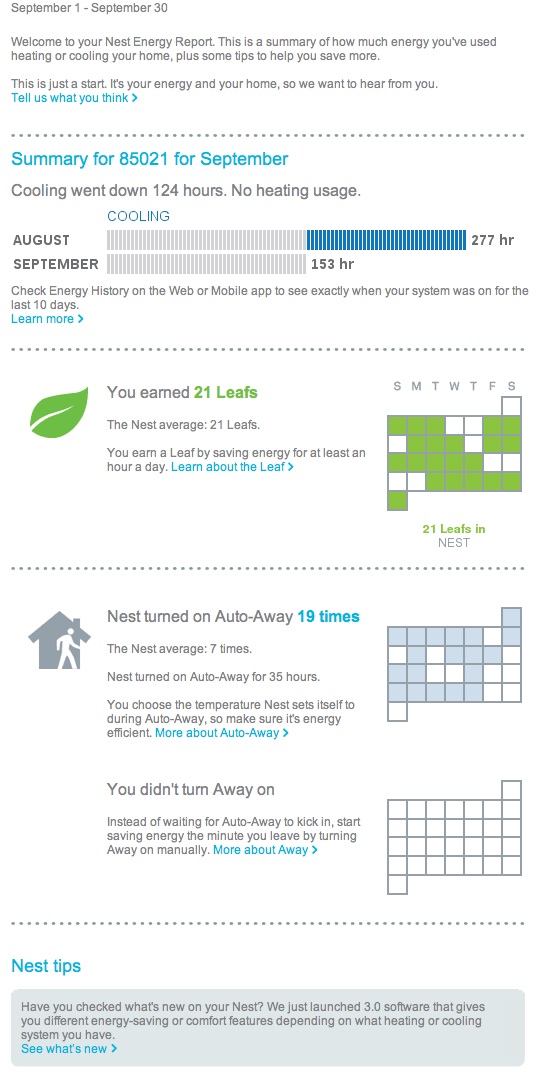
I guess the Nest gadget my son gave me for Christmas last year is working! ♥ It’s attached electronically to the iPad. So in theory, if you have nothing better to do with your time, you can control it remotely.
Check out this report the company generated and sent by email:
How kewl is that?
The “Away” business has to do with an interesting feature on this thing. The thermostat has a sensor that records whether anyone walks past it. If it can’t detect any activity for a while, it turns the system way down. Or “up,” I suppose, in the summer: it gets into the middle 80s in here if I’m gone for a long time. Or not moving: Take a nap and you wake up to an 86-degree sauna.
However, so far I haven’t found that especially inconvenient or annoying. When you walk past the thing or wave your hand at it, the AC immediately comes back on. I’ve never been really uncomfortable, as I have been in the past. When I first learned about this feature, I was worried about the dog, but she insists on laying on the tile floors (even though she has plenty of soft things to lounge on), and the tile stays quite cool even when temps indoors are in the upper 80s or low 90s. She doesn’t seem bothered by warmer temperatures in the house.
Salt River Project provides some monthly usage figures, which show, among other things, the average daily cost of power in your house. In October 2012 it cost me $4.30 per day, on average, to cool the shack. In October 2011, the average daily cost was $5.29: a dollar a day difference. The daily bill in September (which covers the hot and humid month of August) was $6.76. In September 2011, it was $7.62 a day: again, about a $30/month saving. Over the course of a summer, that’s a saving of about $90 to $100.
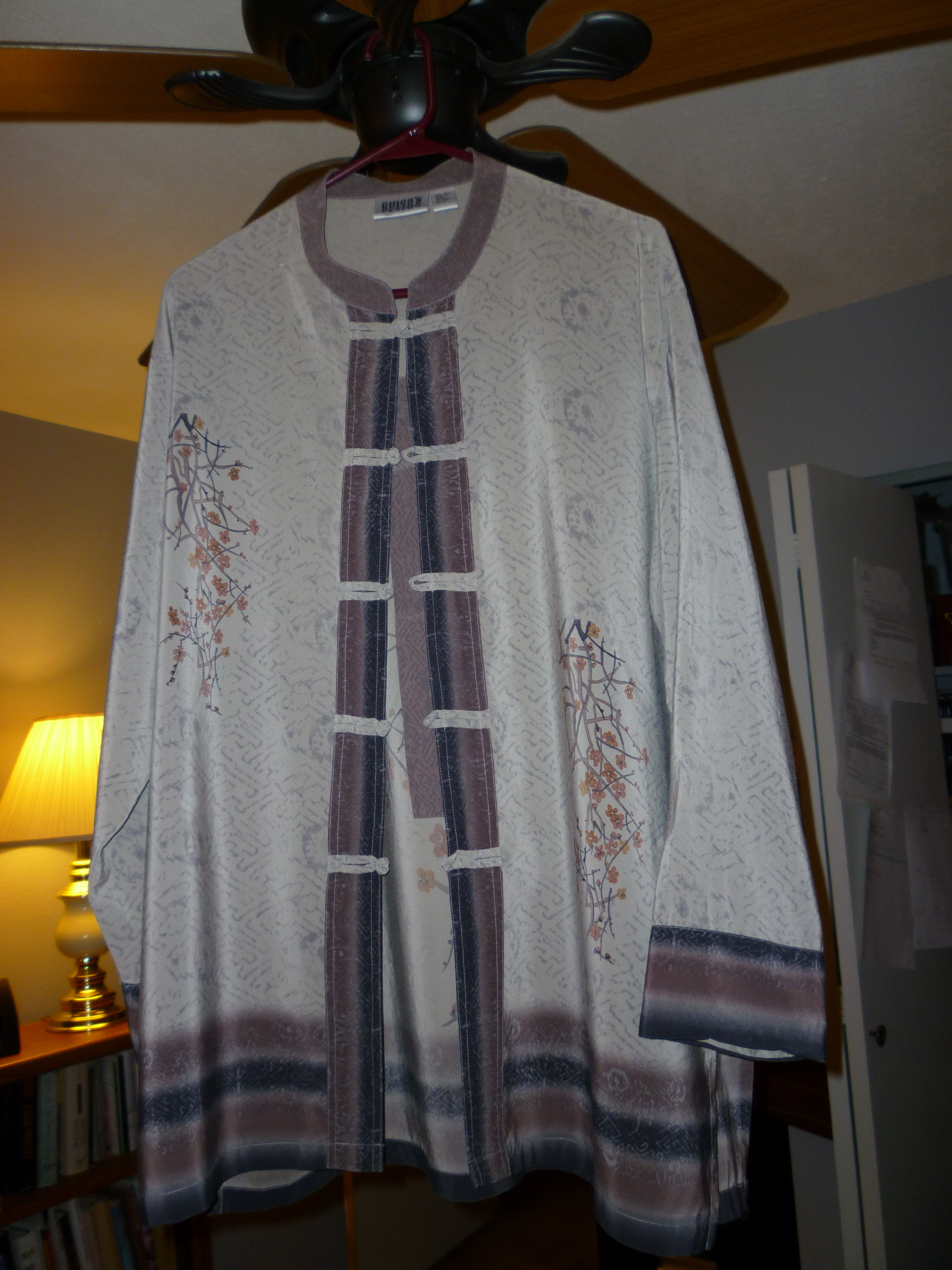
One hundred percent silk. Two shades of taupe, trimmed with brown and slate-black. Chico’s. $12.
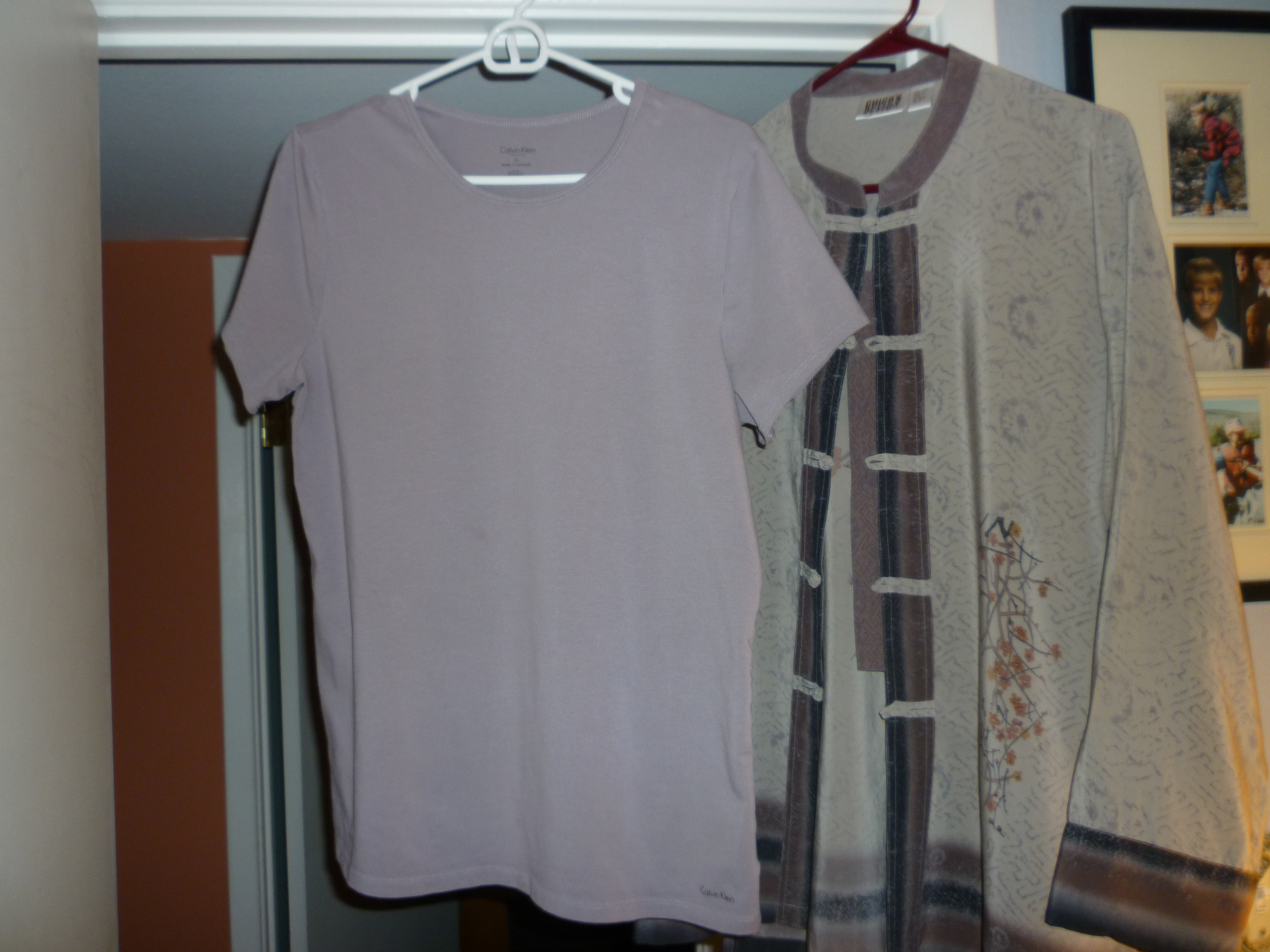
And remember this?
Purchased to use as a swimming top in the absence of the devil-pod tree, whose messy fronds blocked passers-by’s view of the pool. Already used for loafing around the house and doing yardwork. Taupe. Looks like it was made to go with the silk top. One of two shirts out of a package from Costco. $10.
Not pictured: A pair of brown slacks, absolutely made to go with the silk top. Chico’s. $12.
Well, actually, the Chico’s items didn’t come from Chico’s. They came from a second-hand store, the redoutable My Sister’s Closet.
OooooMG! Can you BELIEVE i found this? For $24? (Plus about five bucks for the T-shirt…) (Plus tax.)
Taken together, it’s the perfect look forthe upcoming job interview. It fits the corporate culture over there to a…heh…to a T.
Saturday morning La Maya and I set out at dawn for a new-to-us produce market, a moveable feast hosted by a nonprofit group called the 3000 Club. What these people do is “rescue” produce that grocers and distributors would toss out because it’s not the perfect size or shape to sell instantly or because it hasn’t moved off grocery shelves in a day or two. Each year, millions of pounds of veggies and fruits are thrown in the landfill. The 3000 club acquires this otherwise doomed food. The produce is donated and sold through the group’s Market on the Move, where $10 will buy you up to 60 pounds (!) of produce.
Proceeds go to support food banks and other worthy causes.
So it was off to the nearest market. Semi trucks haul loads of produce to a number of churches and community centers around the Valley each weekend. We chose to visit one in a small food desert on the north end of the conduit of blight that is 19th Avenue, putting us down on the backside of Moon Valley in an area where the only supermarket, a decrepit Safeway, closed years ago.
The produce was incredible! Though selection was limited, it was huge. We found spectacular heirloom tomatoes, peppers, gorgeous eggplants, zucchini, crookneck squash, organic sweet grape tomatoes, piles of sweet corn. For ten bucks, I got as much food as I could carry (which was far from 60 pounds!). And this weekend I set out to roast it all.
Check out the bounty:
And take a look at these amazing heirloom tomatoes:
I couldn’t have bought those alone (or the three boxes of fancy organic “grape” tomatoes, either) for ten bucks. Amazing, huh?
They were on the high side of ripe and needed to be consumed or prepared right away, more about which later. Meanwhile, I needed some onions and carrots, which the Market on the Move didn’t offer. Six dollars later I returned from the corner ethnic market with more loot:
Mwa ha ha! All I needed to turn the MoM loot into gold, and then some. Plus a can of sardines in tomato sauce. w00t!
I kept half of one of those purple tomatoes and a large, firm red one for Saturday’s dinner, which was mozzarella slices sandwiched between juicy, sweet/tangy tomato slices drenched in a vinaigrette made of Meyer lemon juice (from the backyard tree), garlic, and olive oil, accompanied by some roasted asparagus and lettuce from the back yard.
Then I minced a half-dozen cloves of garlic and about a half-cup of back-yard parsley, which I stirred into about 3/4 cup of olive oil. Cut the remaining tomatoes in half, arrayed them in baking pans, and packed them with the garlic, parsley, and olive oil mix.
Set these in a preheated 400-degree oven and let them roast for about an hour.
When you do this, tomatoes melt down into an incredible sauce. All that remained to do was to lift them out of the pan into a bowl and whack them into a sauce with a fork. The result is staggeringly delicious. Perfect for pasta or for some of that eggplant that came from the MoM.
Then I roasted all the corn on the cob, as well as a bunch of asparagus I’d picked up at a Safeway. Tossed both in olive oil; flavored the asparagus with a little tarragon and the corn with some fines herbes.
Today I’m still cooking. I’ll convert the squash, onion, and eggplant into ratatouille, some of which I may flavor with a bit of that cilantro from the Mexican market. What’s left, I intend to use in a “vegetable stew” from the Provençal cookbook I picked up at an estate sale—it looks fresher and brighter than traditional ratatouille. The carrots will be roasted with sweet herbs, and the cabbage with onions, garlic, apple, and white wine.
By golly, there’s enough veggies there to last me for a month! 🙂 What doesn’t get eaten quickly will go into the freezer, ready to spring into action when needed.
Watch for organizations like this in your town. It’s an improvement over a CSA because you get to select what you want, rather than having to take what someone else puts in a food basket for you. And you don’t have to drive so far to find a Market on the Move venue. On the other hand, later in the day La Maya made a run on one at another site and found the choices and quality disappointing—apparently the quality of the market depends on the quality of the volunteers who are working it and the luck of the draw.
…Or can you use what you have, wear it out, make it do, or do without? Have you noticed that we’re surrounded by things that we think we need, but that we could easily live without? Some of those are expensive don’t-needs.
The example that comes to mind is my clothes dryer. The thing has been on the fritz for at least a couple of years now. Its thermostat apparently died: on any of the heated cycles, the machine gets so hot it will burn your hand, clearly creating a fire risk. I’ve never replaced it, mostly because I can’t justify a $300 to $600 hit for a new dryer.
Instead, I strung a few clotheslines from the rafters under the patios, and on laundry day I simply hang my clothes outdoors. Not long after I started doing this, I realized I much prefer drying clothes on the line.
• It frees you from the nagging b-l-a-a-t of a dryer buzzer going off every twenty minutes. • You get to put your clothes away at your convenience, not at the dryer’s. • It saves on electricity. • It’s better for the environment. • And line-dried sheets smell wonderful!
And it saves the expense of having to buy a big-ticket appliance.
The dryer still works on air-dry, so I occasionally use it to tumble dog hair out of Cassie’s blanket or to whack out the wrinkles in my jeans. But otherwise…it turns out I don’t really need a dryer! All the laundry has to be taken out, hung up, folded up, and put away anyway. So why not take it off a clothesline at my convenience, rather than hurry to haul it out of a machine every time a buzzer goes off?
Not too long ago, Sierra Black ruminated on the same topic at Get Rich Slowly, when she reported that instead of fixing a showerhead whose temperature control device quit working, she simply turned down the thermostat on the water heater. She reflects that frugality is about making choices—in this case, between taking weekend time to fix the plumbing instead of spending the time with the kids, or between paying a plumber to fix it instead of using the money on yoga classes or a family camping trip.
I wonder how many amenities that we’ve come to take for granted are really things we could do without? And to what extent do some of those “conveniences” actually represent more hassle than we realize?
The other day Costco was selling fresh turkeys for 89 cents a pound. Turkeys with no weird chemicals injected into them! Personally, I deeply dislike “Butterball” turkeys, which have been infused with fluids deemed to taste “buttery” and to keep the bloated bird nice and juicy while it spends untold hours in your oven as you try to cook 20 pounds of meat. Flavorless is bad enough; fake flavor surpasses bad enough.
Anyway, no weird gunk in them and under a buck a pound! Hallelujuah: just what Cassie the Corgi needs to feed her for the next three months!
So I grabbed a 20-pounder, and Thursday it went into the oven to roast slowly, unstuffed, at 325 degrees, for five hours. After La Maya and I returned from an outing, I hauled it out. Beat back the pup, who was driven mad by the aroma and a larger pile of food than he ever thought could possibly exist in one place. Because onions are poisonous to dogs, I’d cut up a big onion (also purchased at Costco for considerably less than the buck apiece Safeway is now charging) and put it under the bird, which I set on a rack over a roasting pan. Planned to make an onion-flavored gravy to pour over whatever part of the meat I chose to eat myself, hoping to make it taste like something.
Unlike last year’s fiasco, this turkey did not exude something over a quart of water. The pan contained mostly actual pan drippings, which cooked into a nice gravy when some wine and flour were added.
The meat…meh! It came out of the oven moist and nicely cooked. It didn’t taste as bad as last year’s turkey dog-meat experiment, but it still had some of that unpleasant chemically flavor that seems to permeate all modern turkeys. Guess that’s just what you get from factory-farmed birds.
Anyway, it’ll do to feed the dog, and since I can no longer afford beef, I’ll have to eat some of it, too, like it or not.
And what an enormous amount of meat! Two plates laden with it, plus a gigantic carcass with which to make enough turkey stock to last a year.
We ended up with enough turkey to fill six large Ziplock bags and two plastic refrigerator containers. This will last Cassie for a long time. It definitely will carry her through the holidays, when I invariably run out of dog meat the evening before Christmas or New Year’s. Supplemented with an occasional purchase of chicken or pork, which can still sometimes be found at an affordable price, it should keep the little dog in business for quite a while.
What do you want, financially? What should you want? Me, I know what I don’t want: I don’t especially want to be rich. I’m content to live in modest comfort, with no debt obligations to anyone.
Owning more money and possessions than I need doesn’t interest me, though I wouldn’t mind seeing a little more cash in savings now than I estimate it will take to carry me through to the end of life.
Obviously, this is a subjective thing: each of us needs to weigh what really matters in our lives and decide what will make us content. Our friend Evan, for example, premises his excellent blog on his goal of reaching multimillionaire status. Yet we see that as he celebrates his thirtieth birthday, he reflects on treasures that have nothing to do with money.
There’s a difference between contentment and happiness. Would I be happy if someone gave me a million bucks? Well, sure: I’d be tickled. Would I like to have a Jaguar and a cute little BMW roadster sitting in the garage? I suppose. (Ever had to take care of a Jag or a BMW? You need an apartment over the garage for the live-in mechanic).
But would those things make my life better? I doubt it. How would a fancy car that requires constant upkeep improve on an eleven-year-old Toyota that after 106,000 miles still runs like a top and gets me where I need to go with minimal maintenance? Would a million dollars buy peace, or just give me something else to worry about?
Contentment is being at peace with one’s surroundings. It’s a long-term thing, whereas happiness is a short-term thrill.
What I want is to reach a state of serendipity. By that I mean I wish to reconcile what makes me content with the demands of the culture around me. To the largest extent possible, I would like to be free of those demands, or at least to be able to pick and choose the demands worth complying with. I can do without being badgered to pay bills, to pay taxes, to drive through homicidal traffic every day to show up at a miserable job, to care for a lot of unnecessary junk, to respond to this and that and the other requirement imposed by someone else.
While having some money helps to achieve that goal, having a lot of it is irrelevant. At some point, it’s not money that matters; it’s attitude.
To my mind, one crucial way to spring free of societal demands is to get free of debt. All debt.
Another is to reduce your psychological and social dependence on the possession of things. If debt is slavery, stuff is the slave-master.
“We got more places than we got stuff. We’re gonna have to buy MORE STUFF!” The other day a friend who’s a mortgage broker spoke of some incredible bargain a client landed when he bought a 12,000-square-foot house in the present depressed real estate market. Think of the amount of STUFF that lucky purchaser will have to acquire!
The time wasted chasing down the stuff.
The energy wasted cleaning and maintaining the stuff.
The landfill space wasted when the stuff wears out.
Of course, if you can afford a 12,000-square-foot hovel, you can spare some of that square footage for the Jaguar mechanic who lives over the garage. And you can afford a staff of house cleaners to dust and polish your stuff.
Now you have to hire, pay, remit taxes for, and supervise those people. And you get to deal with the mountains of paperwork, workplace rules, and taxation the come the way of every employer in this country. If stress is your pleasure, now you’re in paradise: there’s nothing like management and HR tasks to add stress to your life.
How much more peaceful to own only what you really need: to have just enough around you to fit a human-sized life.
To my mind, money is another form of stuff. It’s something that has to be acquired, stored somewhere (not under the bed but in arcane spaces like the stock market, bonds, real estate, and bank accounts), and managed. It has to be dusted off, cleaned, and put back away—often by paid agents with whom, like household staff, you have to deal in ways that consume time, attention, and energy.
It’s not that we don’t need money, nor that we don’t need a little stuff. Obviously, we need a roof over our heads, a table to eat dinner at, and some pots and pans to cook in. My point is that none of us needs more than enough provide a comfortable home just large enough to house us, a healthy diet, adequate transportation, and the tools to educate ourselves and stay in touch with the people around us.
That amounts to a great deal less than a pile of junk sufficient to fill 12,000 square feet. Or even, for most families, 3,000 square feet. Or 2,000 square feet. Stuff may make us happy, but that’s temporary. Contentment is permanent, because it’s based on the things that matter.
The things that matter are, by and large, free: a growing child, a bouncing puppy, a good friend, a beautiful day, a lovely sunset. And freedom from stress.