Coffee heat rising

Stuff! Where to find storage space for it

Frugal Scholar, still one of my favorite bloggers after all these many months, reflects on decluttering and the challenge of living in a historic house with little storage space. LOL! I do recall that the beautiful cottages in Phoenix’s Encanto district could be heavy on charm and light on closet and cabinet space.

FS describes some of the things we can’t bring ourselves to get rid of for sentimental reasons. That led me to google Steiff animals—I have a whole trunkful of them, my mother’s Christmas presents bestowed each year throughout my childhood—which led to this amazing site. Is this or is it not a hoot? And OMG, I have one of these! Who would think anyone would pay that for an old stuffed animal?

So, given the fact that we are not about to give up our 50-year-old stuffed toys or the faded midcentury tablecloth we acquired as a young bride, what to do about storage space?

In this house, I’ve managed to contend by

adding or widening shelving;
rededicating clothing closets to other kinds of storage;
building new closet and cabinet space; and
using furniture creatively for storage.

One of Satan and Proserpine‘s DIY renovation projects was to pull out all the early 1970s kitchen cabinets and replace them with handsome new Kitchenmaid cabinets. This made the kitchen look very attractive. However, it had a few drawbacks.

Those old Mediterranean-brown cabinets were very spacious, even without adustable shelving. Moving in, I discovered that my dishes, which are Heathware and sized the way dinner plates were sized in the 1970s, wouldn’t fit in the wall cabinets! They ended up in one of the deep under-counter drawers Satan had installed for the pots and pans, leaving that much less storage for cookware.

And the house originally had a generous set of cabinets hung from the ceiling over the counter that held the sink. This was where I had kept two sets of dishes and all my glassware in the old house, built by the same contractor. Satan and Proserpine had removed these by way of opening up the space between the family room and the kitchen. This did indeed look very nice…but it meant the kitchen had just enough storage space for dishes and cookware used every day, assuming you were the type who thinks “cooking” means “warming in a microwave.”

Well, I do cook. And I have a number of items that I don’t use every day but when I need them, I need them. Easily, without having to climb into the attic to get at them.

When I first moved in, I set up some bricks and boards in the garage to hold things that wouldn’t fit in the kitchen, along with various yard care and cleaning items. This worked OK, but the problem with open shelving, especially outdoors, is dirt. The garage door doesn’t fit tightly, and so dust would seep in through the cracks all the time. Whenever Gerardo and his Home Depot Parking Lot Caballeros would show up with their blowers, they’d blow dirt and leaves in through the cracks; same would happen all summer long while the monsoons held forth. Any kitchen items had to be washed thoroughly before use.

Eventually I installed inexpensive garage cabinets. For about a thousand bucks (as I recall—may have been more like $800), I lined both sides of the two-car garage with melamine-coated particleboard cabinetry. Because only one car is parked in there, one of the cabinets could be extra-deep. It leaves plenty of room for two smallish cars. On occasion, SDXB has parked his Toyota truck in there next to my van—that’s a tight fit, but it can be done.

These cabinets hold a ton of stuff. They allow me to stash lifetime supplies of Costco’s finest paper goods and cleaning supplies and still cling to my precious collection of old someday-(surely!)-it-could-come-in-handy glass bottles.

I moved the bricks and boards indoors and set them up inside the closet in the bedroom that is my office. This provided ample space for work supplies, useless old scraps of computer hardware, books that won’t fit in the small bookcase in here, and a great deal of worthless junk. Removing the closet rod created extra room between shelves. There actually is room in there to install another board shelf above the one that came with the house, but I’ve never gotten around to that project.

Notice that bricks & boards lend themselves to constructing extra-wide shelving. The two bottom shelves are two boards wide, effectively doubling their available storage space.

The guest room had no closet. For reasons unknown, some previous owner had removed the closet from this bedroom. Low on linen closet space, I hired a handyman to build a new closet and install closet doors like those in the other secondary bedrooms. He did this for surprisingly little cost—I don’t recall how much, but it was nothing like what I expected. If you know how to frame out a wall and can tape and plaster wallboard, you could do the job yourself. Just because a room has one closet doesn’t mean it can’t have two closets. You could easily add a second closet to a spare room that’s rarely used.

The new closet, too, was furnished with bricks and boards. The handyman offered to install a set of built-in shelves, but since future buyers would be looking for clothes closets in the bedrooms, I decided to keep the shelving mobile.

All but the top shelf in this construction are two boards wide.

Widening shelves that don’t span the depth of a closet can add a surprising amount of storage space. In this hall closet, for example, the original shelf was only half as deep as the closet itself. Simply setting another board atop supports nailed to the drywall more than doubled the size of the shelf.

That flange toward the back is a metal coathanger thing nailed along the front edge of the old shelf, installed when the house was built. So, all the space in front of it is new shelf space. The extra board not only gave me room to store lightbulbs, vacuum cleaner supplies, and miscellaneous junk, it even provided a space for one of those battery-powered closet lights.

In the master bedroom closet, Satan had already added an extra shelf by spanning the width of the back end of the walk-in closet between existing shelves that ran along the left and right walls. It’s not much extra space, but every little bit helps.

The left side of that closet was designed with two shelves accommodating those strange coathanger things (which substituted for traditional clothes rods—SDXB replaced one of them with a regular rod), providing twice as much closet space for short items. Very nice, but the lower shelf was quite narrow. Here, too, I simply added another board. Years ago I got in the habit of storing shoes out of dog’s reach, since the German shepherd was given to eating shoes and the greyhound liked to furnish his nest with them.

Beneath the shelf, there’s a small bookcase, which also holds shoes and boots.

You realize, of course, that armoires were originally intended to store linens and clothing, not televisions. I was reminded of this when visiting my sister-in-sin’s beautiful old Seattle house, where she had placed an armoire on the second-floor landing and filled it with bedding and towels. So, when I bought a new lightweight feather “blanket” for summer and couldn’t figure out where to stash the winter comforter, I thought…why not?

This would annoy me if I watched TV very much. But I don’t. Eventually, I’ll probably hang the television set on a wall and fill the armoire with linens and things. It came with an extra shelf, which is stored inside the piece. With three deep shelves and a large drawer, it offers a lot of extra storage space.

So it goes: cobbled together—some of it jerry-rigged—but it works.

Another backyard project under way

“Under weigh” is actually the correct phrase, a nautical term. But let’s go with the flow. The tidal flow, of course.

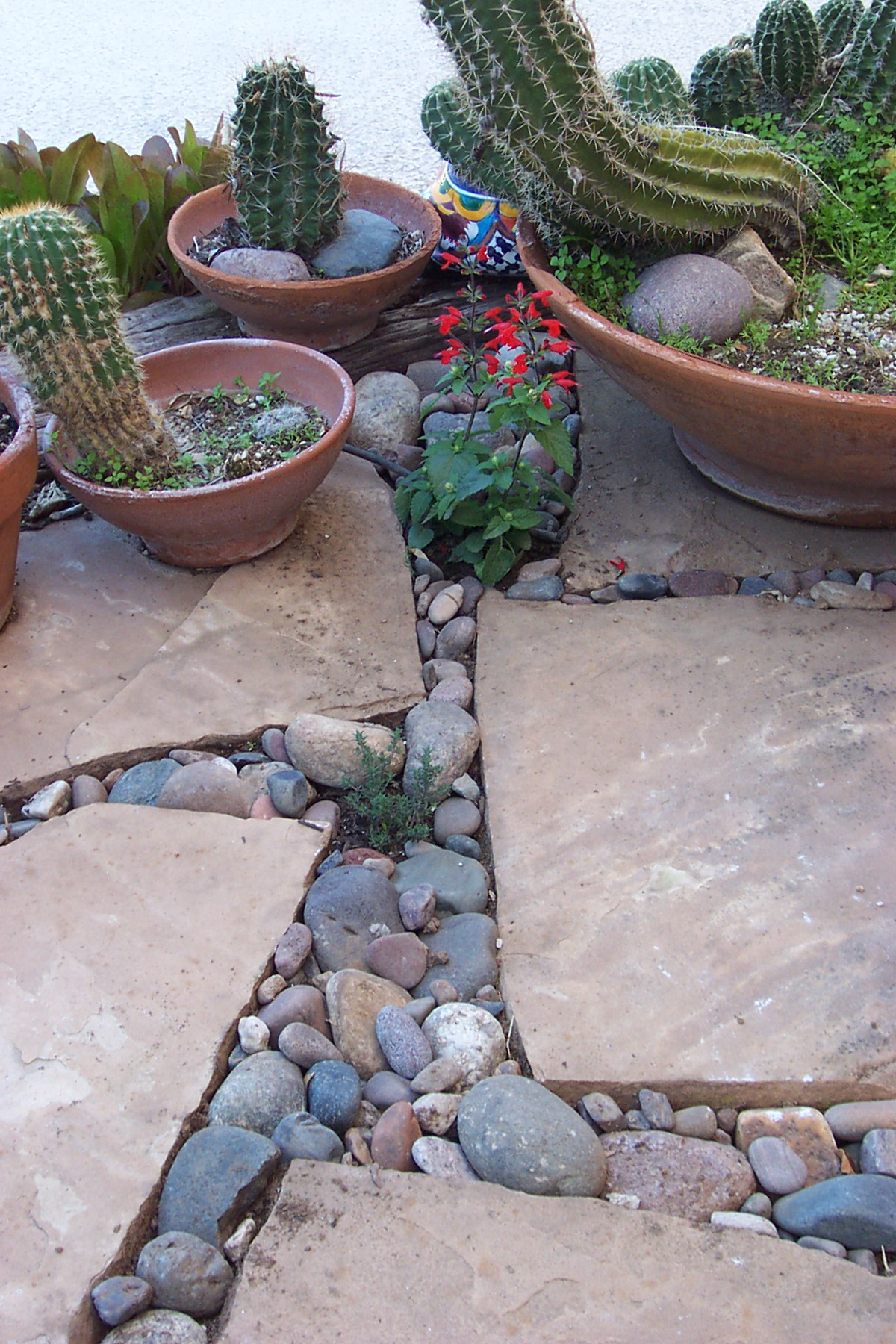
Old-timers here will recall that a year ago I had the bright idea of digging the sand and weeds out from between the flagstones in my front courtyard and filling in the spaces with river rock. It’s worked pretty well: minimal weed intrusion, and the overall effect is reasonably pleasant.

Outside the back door is another flagstone patio, installed by the late lamented Satan and Proserpine. For yea, many a year, I’ve tried to get dichondra, thyme, and other “steppable” plantlets to grow there. For yea, many a year, what’s grown there has been weeds.

 Until last spring, the favored weed has been burr clover. This particular weed has not been unwelcome between the flags, because it makes a pretty little yellow flower and it does not, despite its name, make burrs.

Sweet little plant, isn’t it? In the past I’ve let it grow. It makes a nice mat similar to dichondra, and it costs nothing: it seems to materialize out of the air.

Last spring, though, a hideous invader took root between the back patio’s flagstones. Whereas it is true that I know almost everything, one of the very few things I don’t know is what the hell this little monster is. I don’t recognize it as a native desert plant (and I know most native desert plants). I don’t remember it among the many weeds that have grown in the several lawns I have been stupid enough to dump water on (but anything’s possible). I can’t find it among my favorite lists of invasive and annoying newcomers to the Sonoran Desert. The only thing I can think is that this thing blew in on the winds of globalization.

When it first appeared last spring, I thought, “Well, OK… It looks like something that will make flowers, so let’s leave it there.”

Wrong. It does not make flowers. And while it’s inoffensive enough when it’s young, as it ages it grows rangy, wiry, and uglier than pussley.

And it ain’t easy to pull out.

It crowds out the expensively installed dichondra I planted late last spring. Amazingly, it crowds out burr clover, an aggressive and resilient weed. When the heat comes up, what you have is an ugly tangle of wiry, tough gunk.

I pulled it out last summer and this spring found twice as much of it growing than I saw last year.

So I decided (once again!!) to dig out the weeds and dirt between the flags, only this time instead of trying to get something I want to grow there, to replace the stuff with stones, much like the front courtyard’s stoneware.

Consequently I’ve been scrounging free stones from the alleys again. Here’s the result, so far:

Daffodils
Red Salvia & Easter Lily Cacti
Shamrocks & other things

It’s working out. Only a few more crevices left to fill—maybe two or three runs up alleys with the pooch covering for me (oh, dear Manny, Nosiest of All Possible Neighbors: just wringing out the dog behind your house :-D). Unexpected benefit: no more ankle-turning trips on the flags. The dirt has settled so much since Satan installed the patio that if I’m not careful to set my feet firmly on a flagstone, half my foot will slip into a crack and I’ll wrench my already strained ankle once again. With the stones carefully set so they’re level with the surfaces of the flags, I can walk across the surface without risk of additional pain.

Very nice.

I hope this landscaping scheme is not altogether hideous. Frankly, I think it’s better than the weeds. But for sure, one man’s weeds are another’s Eden.

Burr clover image: Shamelessly ripped off from UC Berkeley, but probably in the public domain, UC being a state institution

Low-key and DIY burglar repellents

Last weekend my now-former research assistant, who bought a house in the neighborhood shortly before Her Deanship announced the university would close our office and can us all, reported that the house was burgled while she and the kids were at church. The burglars missed her laptop, which was recharging in an out-of-the-way spot in the family room, but they did grab her husband’s laptop and cleaned out all her jewelry, most of which consisted of keepsakes from her mother.

Understandably, she’s feeling pretty disturbed and vulnerable, especially since the burglars entered with ease through the carport door. Apparently popping the lock was so easy, the cops said they couldn’t even find any evidence of forced entry. She’s taken to putting a piece of Scotch tape at the door’s threshhold so she can see whether anyone has entered before she goes into the house.

Even though our area is relatively safe compared to some parts of the city, no neighborhood is immune to burglaries and home invasions. I personally resent and resist living behind iron bars, glaring lights, and shrieking alarms. It’s the criminals who belong in jail, not us!

Over time, I’ve developed a number of strategies to minimize the risk of burglaries and the damage done if a perp gets into the house. Some of these are psycho-philosophical, some are mechanical.

On the philosophical level, I’ve adjusted my attitude about break-ins. Except for the dog, the stuff I have in my house is junk. Most of it is low in value—the only things that really matter are the computers, and even those are not the point: what matters is not the computer; it’s the data in the computer. The data can easily be backed up onto a flashdrive and carried around on one’s keyring, thereby protecting the only truly important inanimate object in the house.

So. My attitude is that I don’t much care if the burglar comes visiting, as long as he stays out of the house while I’m here. I don’t want a home invasion, several of which we have had in this neighborhood, because anyone who knowingly breaks into your house while you’re there doesn’t mean you any good. But otherwise…meh!

For my home office, I installed a solid-core door and a heavy-duty pick-resistant lock whose bolt slides through the framing into the stud next to the door frame. While it’s not 100 percent burglar-proof, it sure will slow the perp down. Outside the window, which faces the street, I planted the thorniest, fiercest roses I could find, and this spring a man-eating bougainvillea may join them. Most burglars would rather enter where they can’t be seen, and obviously they’d prefer an entrance that is not going to leave them bleeding.

From the guys who put the elegant lock on my office door, I learned that most locks are very easy to open. The lock they installed will break the perp’s drill bit if he tries to drill the lock. Trouble is, it ain’t cheap. On the other hand…what’s peace of mind worth?

Other than discouraging entry to my office in my absence, for me the trick is not to make unauthorized entry impossible but to force the perp to make enough noise to alert me if I’m here when he tries to get in. All I want is enough lead time to get out a different door and run down the street—or to barricade myself and the dog inside the office behind the pick-resistant lock so that I can call the cops or, if the phone’s disconnected, climb out the front window.

On the front entrance, I installed a low-end security door, purchased at Lowe’s. The problem is, the locks you buy at big box stores are just ordinary door locks; even the best are simple to defeat. Though the metal door itself is pretty strong, it’s only as burglar-resistant as the lock. To get a security door that will really deter burglars, you have to buy a specialty lock and have a locksmith install it. So, I think of the security door as something that will slow the burglar down a bit and cause him to make enough noise to alert the yapping dog while he’s trying to get in. Here, the point is to let me get out the back door while he’s trying to get in the front.

My house, like my RA’s, has several Arcadia doors, and all the the windows are also sliders. These, as we know, are extremely vulnerable. Some people install bars over the windows and double-wide security doors over the sliding doors. This strategy is counterproductive for two reasons:

Barring intruders from getting in through a window means you also bar yourself from getting out during a fire. The idea that a set of bars will have locked release catches and in an emergency you’ll find the key, unlock them, and then climb out is highly problematic. In a fire, smoke can cause true black-out conditions. If the power is out, as it’s likely to be once a fire gets going good, you can find yourself trapped in a bedroom with no light, even if there’s little smoke to blind you. Children in particular are likely to panic in these conditions and not be able to find the key or remember how to work it. Personally, I’d rather go mano-à-mano with the burglar than die in a fire.

Security doors are not at all difficult to break through. All it takes is a crowbar.

La Bethulia had those one of those double-wide security doors put over an Arcadia door in the back of her house. She went out to dinner for about an hour one evening and when she got back some guy had pried it open and had a nice visit. The locksmith told me he felt they’re a waste of money because they’re way too easy to break into, and that for the cost you’re better off installing an alarm system.

A sliding door or window can be secured pretty well in one of several ways:

Put a piece of doweling in the track along the bottom. This makes it impossible to lift the door and slide it open. An alternative is to drive a small metal screw into the metal frame at the top of the door, tightening it just enough that the head of the screw clears the top of the slider. This also will block a person from lifting the slider far enough off its track to slip the lock and push it open.

Install two sliding bolts, one that slides downward into a hole drilled in the concrete slab or window frame, and one that slides upward into the frame above the door or window. Be sure the bolt on top side of the door is long enough to slide well into the wood frame. If you place them intelligently, they’re hard or even impossible to see from outside, and so this will usually discourage the perp.

Get screw-on locks made for sliding doors. They come in two varieties: one with a little lever that you just turn to tighten the device down, and one with a key lock. However, remember that everyone in the house, including children and the very elderly, needs to be able to get out in a fire. These things mustn’t be tightened down so much that a kid can’t get it open quickly and easily, or out of a child’s reach. Better to lose the jewelry and the computer than the kids.

On all my sliders, I use both screw-on locks and dowels in the tracks. To get through a door or window that’s been secured in this way, you have to make some noise. Chances are, you’ll have to break the glass. Many burglars prefer not to break windows, because the noise can draw a neighbor’s attention. In any event, if you’re home, the sound of a man struggling to defeat these devices or breaking glass to get at them will alert you so you can get out before he gets in.

To add to the noise level, you can get inexpensive battery-run alarms that you can attach unobtrusively to sliding doors and windows. I found a lifetime supply of the things at Costco; no doubt Lowe’s and the Depot have them, too. They glue on. When the little switch is in the “on” position, the alarm emits an ear-vibrating shriek when the door or window is opened. Not a true burglar alarm, of course, but it’s enough to wake you up if someone tries to get into the house.

Just knowing that you’ll be alerted is usually enough to give you some peace of mind. I have them on all my sliding doors and windows, and on the dog door cover. Because, when the weather’s nice, I like to sleep with the front door open and the security door locked, I even put one on the security door, so it will go off like a banshee if someone drills that lock.

Should the burglar come a-calling while I’m out of the house, I’ve left a few treats around for him. For example, I have some check pads for old bank accounts that were closed years ago. I put a few of these in easily accessible drawers. If he finds them, he’ll think he’s scored a whole pad of negotiable instruments. An ancient Toshiba laptop, so superannuated it’s useless today, sits out where it’s easy to find. And I’ve also left a few fistfuls of cheap costume jewelry in a couple of drawers.

The things my mother gave me, which aren’t worth much but which I’d like not to lose, are hidden in strange places—yes, you could find them, but it would take some time and effort, both of which are in short supply for burglars.

Truth to tell, many burglars are fairly benign. They don’t relish violence—that’s why they burgle rather than mug, rob banks, or deal dope. My feeling is that if some guy wants to make off with the priceless necklace I made with $20.00 worth of stuff from the craft store, bully for him as long as he stays out of the house when I’m home. A few alarms and extra locks will keep you safe from intruders while you’re in the house, and as for the rest of it…BFD!

More Kitchenry

Frugal Scholar continues her discussion of kitchen renovation with tales of cabinetry discovery.

And check out Hostess of the Humble Bungalow‘s amazing remake, with pictures of the beautiful cabinetry her husband custom-built.

It’s all very  interesting. One commenter at FS remarks on her pleasure at having substituted drawers for all the lower cabinets. I have to say that sure sounds like a great idea. My kitchen has two big lower-cabinet drawers. Because Satan and Proserpine took out about half of the wall cabinets to open up the space between the kitchen and the family room, the remaining upper cabinets are not large enough to to hold my Heath dinnerware. Even though the cabinetry was fairly expensive semicustom Kraftmaid stuff, they just aren’t deep enough to hold a 1970s dinner plate.

But a single big drawer not only holds the plates, it holds two stacks of bowls, the salad plates, and the bread plates: the entire set fits inside one drawer! I’d love to have drawers for the pots and pans, too.

Kitchens

Frugal Scholar is doing an interesting series about her experiences remodeling a kitchen on a budget. I love it! I seem to have spent my entire life remodeling houses, and so I’ve developed some strong opinions on the subject. Frugal proves how brilliant she is by happening to agree, more or less, with those ideas.

Kitchens and bathrooms are just about the most expensive remodeling jobs you can do, short of ripping off and replacing a shake roof. Much of it is stuff you can’t easily do yourself: plumbing (especially having to move plumbing!), wiring, gas connections in ancient houses.

Over the course of years, I’ve learned a number of things that help a little to keep costs under control:

If cabinetry is functional, consider painting instead of replacing.

It’s a lot cheaper to have a skilled finish carpenter build a few cabinet doors with glass in them than it is to replace the cabinetry in your kitchen because you think you’d like glazed doors in some wall cabinets.

Sometimes less is more. If you have storage space in the garage or another room, or if you can bring yourself to get rid of stuff you don’t use much, you can open up a kitchen by removing certain cabinets altogether.

Don’t run with the herd. Just because something is radically popular and every designer in sight is using it (think avocado green appliances…think black granite countertops) doesn’t mean it’s especially desirable.

Try to build and design with materials and colors that will be timeless. Avoid products and colors that are currently “hot.” Something that’s stylish now is likely to cause future visitors to sniff, “Oh, she did that in 2010!” A dated kitchen can make it hard to sell a house, or to get the full price you think it’s worth.

Hire licensed and bonded contractors. Let me say that again: hire licensed and bonded contractors! Even if Joe Handyman does a decent job, a kitchen or bathroom that is not to code may have to be rebuilt before the house can be sold.

That said, one surprising job can be done by a good handyman or a strong, handy homeowner: installation of ready-made or custom-sized cabinets. If you’re buying cabinets from Lowe’s or Home Depot, check around. Many handymen will underprice the big-box stores’ installation fees, and the job is not at all complicated.

Get bids. Get lots of bids. It never ceases to amaze me how widely fees vary for plumbers, carpenters, tile-layers, painters, and electricians.

It may be worth paying to join Angie’s List for a year, if it’s available in your area. I found several excellent craftsmen through this site, including the Adirondack Chimney Sweep. Be aware, however, that many of the recommendations are redundant, and there’s nothing to stop a craftsman from putting all his friends and relatives up to sending in ecstatic (and phony) reports. Get real-world references, too.

Pay to get mid- to top-of-the-line appliances, but pay for function, not style. Prefer mechanical controls to electronic, because the latter break sooner and are more expensive to repair. A repairman told me that the cost of appliances no longer relates to their quality or longevity: he said that all kitchen and laundry appliances are now engineered to last no longer than about seven years. Thus it doesn’t make sense to pay extra for fancy gear, which likely will say good-bye long before you sell the house. This is especially annoying if you’ve bought a stove or refrigerator because it’s the height of fashion; in seven years, that style will no longer be in production and the replacement won’t go with your carefully crafted design.

Check Craig’s List and estate sales for building materials and late-model used appliances. The washer and dryer we bought off Craig’s list for M’hijito’s house are higher quality than the ones I bought for myself new, and they’re still running fine. At an estate sale, I scored over 1,000 red bricks for about 10 cents apiece, far less than I would have paid at the brickyard or Home Depot.

If you actually cook (rather than microwave or reheat) and your house has gas heat but an electric stove, consider springing for the cost of having a gas line run into the kitchen. Gas is so far superior to electric—especially to those obnoxious glass-topped things—that there’s no comparison.

Once you have gas in the kitchen, there’s little reason other than ego gratification to buy an expensive eight-burner heavy-duty Viking chef’s stove. Any stove will do the job just fine. Take a look at the ordinary stoves and stovetops at Sears, Lowes, and Home Depot. They cost enough to prove to the world that you’re not headed for the poorhouse, but they won’t take so much of your money that you’ll end up feeling foolish.

If the house has a built-in oven plus a stovetop, leave the electric oven and convert only the stovetop to gas. Electric ovens work as well as gas for their purpose; it’s the stovetop burners that really matter.

Keep every warranty that comes with every item you buy.

The last remodel job I did was at M’hijito’s, a 1951 brick cottage that ultimately required us to gut it out and rebuild everything. It was very expensive. Even though we cut every corner we could think of, we spent over $35,000, all told, on the interior (kitchen, two bathrooms, installation of antique doors and French doors, saltillo flooring throughout, window treatments, paint). That doesn’t count the roof or the new air conditioner. Or the landscaping.

Our biggest mistake was hiring a handyman who was not licensed and bonded. We came across him when he was working on the house next door, and the owner recommended  him highly. He was doing essentially the same work we wanted done, so we imagined he could or would do the same for us. It was a huge mistake. We were very lucky he didn’t do serious structural damage when he cut large holes in a bearing wall to install the French doors. So far, that seems to have gone all right, but other jobs he did really need to be taken out and redone. Ultimately, because he was very slow and took on other work in the middle of the job he was doing for us, leaving us high and dry for days and even weeks at a time, we had to fire him and find someone else to finish the work. That was quite the little headache!

If I had it to do over, I would buy the cabinetry at Ikea or Lowe’s rather than Home Depot. Ikea cabinetry is problematic because the doors do not join the way American cabinet doors do, so you can see the shelves through the crack where the doors come together, and because the system used to attach them to the wall is idiosyncratic. You need to get a workman who knows how to install them, or else you have to be very clever and very patient at handyman work yourself. I’d never buy cabinets at Home Depot again: sales staff were slow, difficult to deal with, and on two occasions downright rude not only to us but to fellow staffers, and the cheaply built products came missing parts—two cabinets still don’t have all their shelves.

All in all, the remodel job on the downtown house produced a very nice place to live—pleasant enough that if M’hijito has to move while the recession is still on, I would cheerfully sell my place and move into that house. But it’s worth noting that after the remodel job I did on my last house, the reason I bought my present home is that the previous owners did all the remodeling…

The joy of installing new plumbing in old houses