So here we are in the garage, recalling a youth misspent scouring dishes in the kitchen sink and reflecting that there must be a lot of Americans who’ve never had the privilege, thanks to the almost universal distribution of the dishwasher. Come the Apocalypse (which as we know is bearing down on us at all times), they might like to know. So it goes like this:
Scrape food off the dishes into a garbage can. Pour any grease from pans into an old can or disposable container; failing that, soak it up with paper towels and put in the trash. Do not ever pour grease down the drain. Otherwise you’ll end up in the same predicament I’m in: calling the plumber in the middle of a holiday weekend. It’s inevitable.
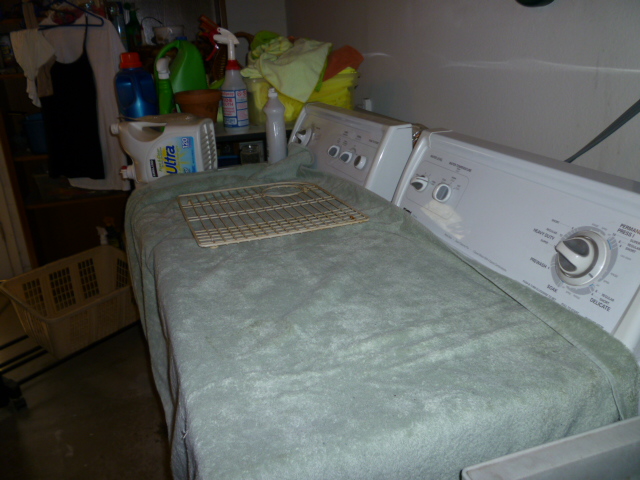
Place a dish rack on a dish drainer (a plastic or rubber mat designed to let water drain off into a sink) on the countertop, or lay out some towels on which to arrange the dishes to dry.
Used a sink rack to span the washer & dryer...
Assuming you have a functional kitchen with a double sink, fill one sink with hot soapy water and one with cold, clear water.
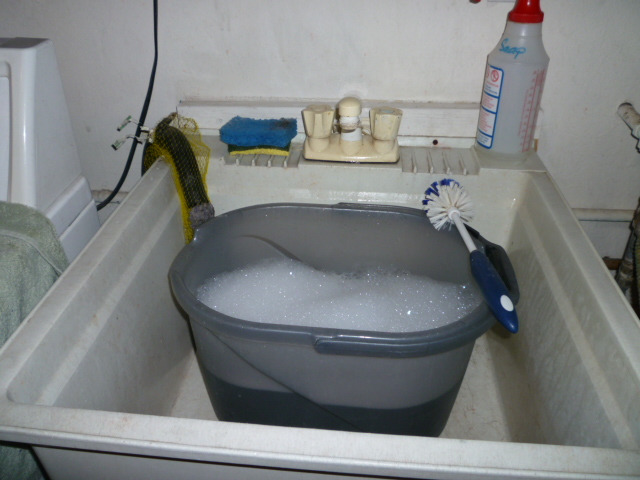
If you have only one sink, as in, say, a dingy garage, get a pail or plastic dishpan. Fill it with hot soapy water.
If you have an actual kitchen sink, wash in the soapy water and then set the clean dishes into the cold water to rinse. Lift them out, one by one, and set them in dishrack to drain. If you have a sidekick, that person can make him- or herself useful by lifting the dishes out of the cold water, setting them in the dishrack, and drying them with a towel. But the truth is, that step isn’t necessary. It’s probably better—more sanitary—to air-dry the dishes.
Always start with the glassware. You’ll want to wash clear glass items first, while the water’s still clean.
If you have only one sink or washtub, rinse each item one-by-one in running water. Turn the water off between items; this is a wasteful technique that should be avoided if possible. Oh well. We’re in the garage, after all.
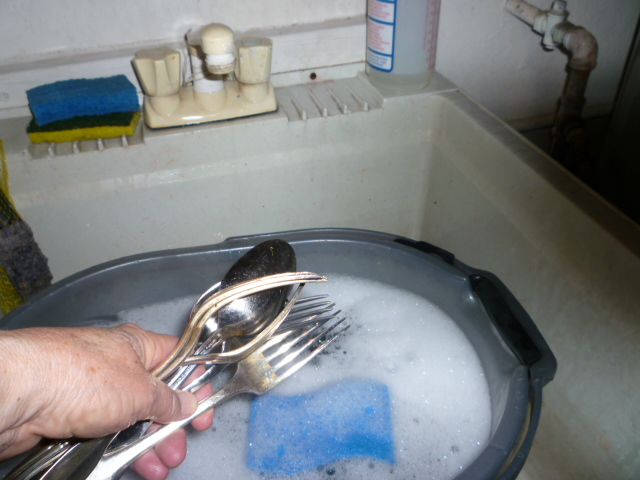
Next, wash the silverware. The water’s still clean, so they’ll come out shiny if you get to them next.
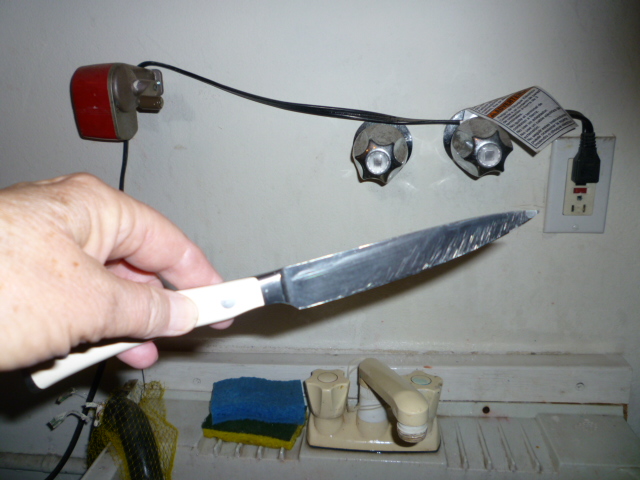
See this little guy?
Do not drop a thing like this into a sinkful of soapy water! You won’t enjoy the nasty cut it’ll give you while you’re groping around trying to find it. Silverware can be dropped in the water to soak. Cutlery…not so much.
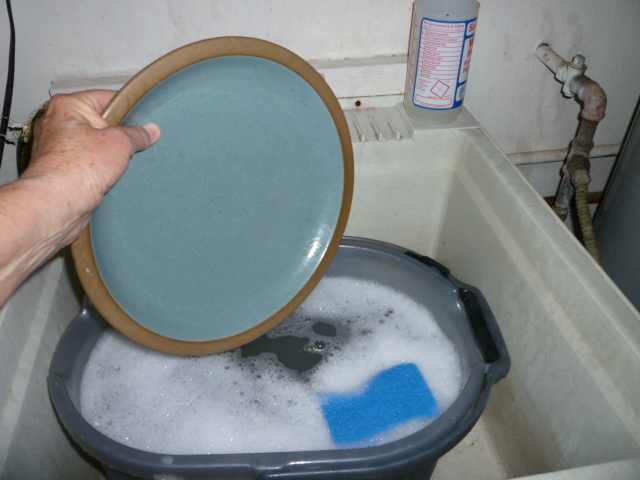
Next move on to the stoneware or china. This stuff will be greasier and will start to get the dishwasher dirty. You’ll notice that the suds get progressively less sudsy as you proceed. There’s a reason for that.
Wash all the cups, saucers, salad dishes, bowls and plates. Arrange them in the dish drainer or across a towel.
Finally, it’s time to tackle the pots and pans.
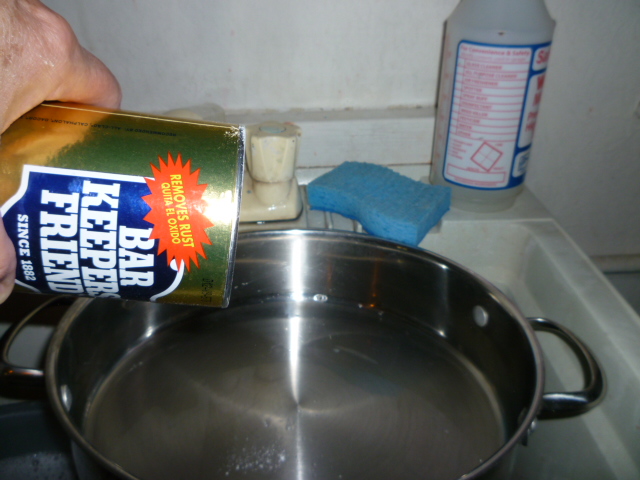
Save the dirtiest cookware for last. Chances are you’ll need to scour a pan or two. Barkeeper’s Friend is great for stainless pans. Comet and other chlorine-bleach powder knockoffs are almost as good.
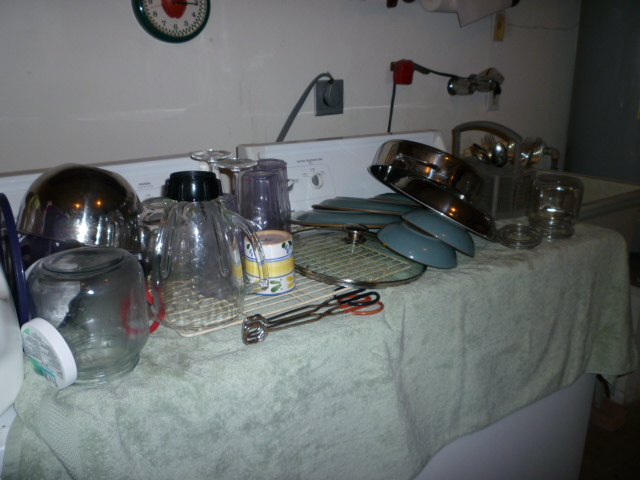
Et voilà! The whole mound of dishes is clean!
Now you can get on with, God help you, the rest of your day. ↓↓↓↓↓↓
Don’t know where I stumbled across this idea—Atlantic online, maybe? NY Times cookery sections? Somebody’s blog??—but it stuck with me: when you find yourself with a bunch of veggies, whether because you got a lifetime supply from some warehouse store or because your garden produced a bumper crop or because some friend showed up at the door with armloads of produce from his own garden, COOK IT NOW.
And the easy way to cook it?
Roast it.
During the holidays when I fell heir to branch after branch of wonderful fresh Brussels sprouts from the All Saints Silent Auction, whereinat we submitted a fine donation of The Copyeditor’s Desk’s time, I overhead other partiers remark that they would roast their veggie loot and it would be wonderful. So indeed I did cook the sprouts in the oven. The result was pleasing enough.
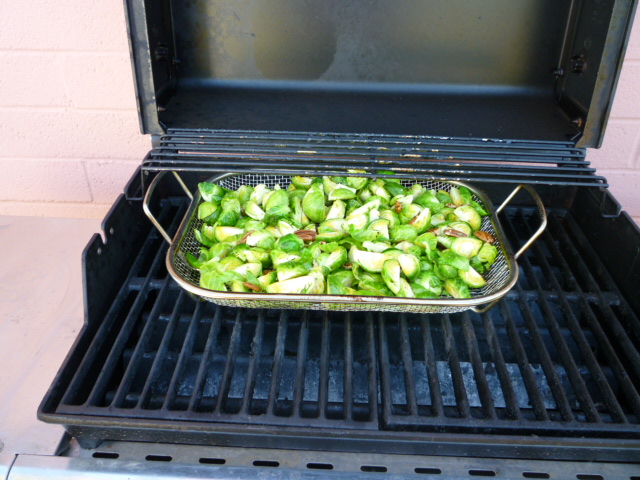
Weather being somewhat nicer just now, I decided to try cooking a Costco Lifetime Supply of bagged Brussels sprouts in the propane grill.
Dumped them out of the bag into a mixing bowl; added some pecans. Then sprinkled a little olive oil over the mound, tossed well to coat, and spread everything in a wire grilling basket.
Preheated the grill to about 400 degrees; then turned the heat down to “medium.” Set the veggie/pecan mix in; let it cook a few minutes; tossed them around and then let it roast until done. The result is a kind of barbecue al dente. Very tasty on its own. Even better when you add other items, such as chopped roasted peppers or fresh herbs or minced green onions.
The logical thing to do here is to divide the cooked veggies into meal-sized portions, pack them in Ziplock bags, and freeze. Then when you need a serving of (fill in the blank: sprouts, asparagus, carrots, broccoli, cauliflower, squash…etc.), pull it out, add whatever blandishments you please, and enjoy!
Here’s a guest post from one of this spring’s magazine writing students, Audrey Gallinger. Audrey says she has a blog of her own, but it’s not ready yet for the whole world to see. Here’s hoping for a bright new blog in the New Year! 🙂
Staying beautiful on a budget can be difficult. Luckily with just a few pantry staples (and no excess packaging or chemical additives) you can create these four all-natural beauty treatments at home.
For an exfoliating mask mix 2 tablespoons of honey with a teaspoon each of ground nutmeg and cinnamon, microwave for 5 seconds to soften the honey and apply all over your face and neck. Leave on for 30 minutes and gently scrub away with a warm damp cloth using a circular motion. Immediately follow with your favorite moisturizer for silky soft skin.
Love Bioré pore strips but not the sticker price? Mix 1 tablespoon unflavored Knox gelatin with 2 tablespoons of milk, microwave 10-15 seconds, stir and quickly apply across the bridge of your nose. Let harden 15 minutes then gently peel away the mixture to reveal clean, dirt free pores.
To restore shine to dull, damaged hair combine 3 teaspoons of olive oil with 1 teaspoon of honey in a small saucepan, heat until mixture begins to boil. Remove from heat and allow hot oil treatment to cool. Apply mixture at the roots, comb through hair and wrap in a towel or cover hair in a shower cap. Leave treatment on for 30 minutes then shampoo as normal.
For incredibly smooth skin create a brown sugar body scrub by combining ½ cup of coarse brown sugar with a tablespoon each of honey and olive oil and ¼ tablespoon of fresh lemon juice, apply all over your body using a gentle scrubbing motion and rinse.
These simple, inexpensive beauty solutions are as good for your wallet as they are for your body. Now you can create a DIY spa right in your own home, so raid your pantry and pamper yourself with these all-natural beauty treatments tonight.
It’s notduct tape. But it may be something you have around the house…or more likely, out in the garage. Just the other day I had use for it.
Saturday morning when I went to pour the water off the olives I’m curing, I carelessly refilled one jar with hot instead of cold tap water. That seemed undesirable…the olives should soak in cold water. Too lazy to snap the handy plastic lid back on, I poured the water out through my fingers…and of course, the wet glass slipped right through my hands, crashed into the sink, and exploded into a mass of razor-sharp glass and olives (with pits!), all of which came to rest at the opening to the garbage disposal.
Yes.
A great wad of busted-up glass and olive pits, poised to drop direct into the garbage disposal.
Well, after picking out the glass shards and rescuing as many olives as I could (and cutting the hell out of my fingers), what I had was a bunch of broken glass and olives (with pits!) down inside the garbage disposal. Put on some disposable gloves and fished out as many as I could, cutting myself only once more.
{sigh}
Dialed the plumber. This was adding up to a new garbage disposal. I could feel it in my bones.
Got the plumber on his cell phone. “Want me to turn the unit on and see what happens?”
Well, no. “Uhmm,…” said he, “do you have a shop vac?”
“Yeah.” (Doesn’t everyone?)
“Good. Turn it to wet-vac, stick the hose down the drain, and try to vacuum everything out of it. Then fill up the sink and try to rinse whatever’s left down.”
Okay.
Got off the phone. Emptied the dirt out of the shop-vac, still there from whatever the last adventure was. Put the thing back together. Plugged her in, shoved the hose end into the garbage disposal, and turned her on!
She howled and she clicked and she clattered and she jingled as the glass and olives and whatnot flew out of the plumbing. Didn’t take long before the rattle of debris passed and it sounded like nothing else was coming out.
Disengaged the vacuum cleaner. Filled a bucket half-full of water and poured it into the sink while the accursed water-saving tap was running at its excuse for full-bore. This put enough water into the sink to flow down the drain with some force.
And turned on the garbage disposal switch.
Mirabilis! It WORKED!
Nothing banged, nothing clanked, nothing rattled…and the garbage disposal did not jam! Saved!
There you go: the real handyman’s secret weapon. The shop-vac. Worth its weight in plumber’s tools.
Okay, so I was going to write a nice, solid PF piece with a fine political spin, but…it’s 110+ out there, I’ve run all over town, now have a couple of margaritas under my belt, and about all I’m up for is editing a detective novel (if that) and nattering on here. And hereabouts, about the best I can come up with is a few handy household hints.
Get gunk off wooden surfaces with mineral oil
The cheapest mineral oil in the world is to be had at Ikea. They call it Skydd; I call it Skkwsh.
Mineral oil (or baby oil, which is the same thing, but don’t put either of them on your baby) works miracles on soiled wood. Some people use it to polish furniture with oil finish; I personally don’t care much for that use, because it leaves an ever-so-slightly tacky film. However, it is the business for cleaning sticky stuff off utilitarian pieces of furniture and kitchen grease off the ledges and crannies of your kitchen cabinets.
This noon I made a run on Costco (’nother hint: never do that on Saturday!), where I finally brought myself to buy a folding table to hold the semi-permanent garage junk that has needed a home for a long time. Among other things, since time immemorial the shredder and the crockpot have each been perched on separate vintage cheap-wooden folding TV tables. Many’s the time I’ve thought that if I just had one of those large, cheapo work tables churches and schools always seem to have on hand, it could hold those two items plus a great deal of other in-the-way junk, and even more in-the-way junk could be stowed beneath it.
Rescued vintage tables
Bringing this object—the folding utility table—into the garage liberated the two ancient TV tables. I brought them into the kitchen to clean them, it being way too hot in the garage for anything resembling physical work. They each had some sort of black greasy gunk, presumably well-aged drips from the crockpot seasoned with dust-storm residue. Wiping them off with a wet paper towel did nothing to dislodge the black greasy spots.
Best to hide the things...
But: rubbing a little mineral oil into the top of the table, letting it sit for a minute, and then wiping it vigorously off removed the stuff without a whimper. Cut about 15 years off the crotchety old tables’ apparent age, too. Sure would be nice if the gunk would have the same effect on the aged human face.
Don’t even think of trying that. It’s toxic.
Moving on…
Store household cleaners in plastic tubs…and be smart about it!
Said garage is lined with storage cabinets, and one of the shelves of said storage cabinets holds my various lifetime supplies of household chemicals. Among those chemicals one could find a couple of bottles of ammonia, which I use to make a DIY version of Windex glass cleaner.
I keep these things, for convenience, in small plastic bins, the sort of things that used to be sold as dishwashing pans. They make it possible to slide out a whole slew of bottles and cans, rather than having to stick my head into the cabinet and shuffle through a bunch of containers in the dark
Welp, turns out this habit has another benefit: if one of those containers leaks, the plastic bin collects and contains the liquid, keeping it from creating a gawdawful mess all over your cabinetry!
Yesterday afternoon preparatory to washing the Arcadia doors, I pulled out a bottle of ammonia, therewith to whip up some more glass & tile cleaner…only to have it splash on my bare feet! The damn plastic bottle had developed a leak!
Pulled out the plastic bin, hauled out and rinsed its contents. Godlmighty but in there were not one but two unopened bottles of Clorox toilet cleaner, a substance liberally laced with chlorine bleach. As we know,
ammonia + chlorine bleach = death.
Mercifully, the toilet-cleaner plastic bottles were not breached. I carried them into the backyard anyway.And the particleboard shelves were unruined—they would have been trashed if ammonia had been quietly dripping onto them for God only knows how long. So:
Item: Storing bottles of household chemicals in plastic bins is a good idea. But…
Item: Do not store products that contain bleach in the same plastic bin with products that contain ammonia!
Get gunk off tile grout
Before in the foreground; cleaned toward the top
Satan and Proserpine, previous owners of the Funny Farm, laid a bunch of tiles down in the living room, hall, kitchen, and dining room, all by their little selves. My tile dude said they did a good job of it, but like moi was mystified at the reason for their having slathered the grout with off-white “sealer” that really is nothing more than a type of latex paint.
Now…what happens to white grout over time?
Yeah. It collects dirt and turns…well, dirt-colored.
Same thing happens to fake white grout created by painting real grout with latex “sealer”: over time, the joints in S & P’s tiles (hm. Hadn’t thought of that confluence. Was the latest market crash and rape of the Baby Boom’s savings caused by Satan and Proserpine themselves?) …Yes, the joints in the tiles had become grody, to put it kindly. Yesterday with Pup out of my hair and all of next semester’s courses designed and posted online, I took it upon myself to do some serious cleaning.
What should I find when I emptied out the plastic bin into which a bottle of ammonia had slowly been leaking but a box of Mr. Clean Magic Eraser wall cleaner knockoffs from Target!
Recalling that these strange chemical sponges do a great job of cleaning the grout between Mexican tiles on the countertop, I decided to try them on the fake grout paint stuff on the floor.
Amazing!
Totally after
It made a huge difference: so huge that where I accidentally missed a line of grout, it jumps right out at me. The tiles look almost as bright and clean as they did when I moved in here, shortly after those two painted the stuff on all the grout in the house.
The box contained four pieces of the stuff, which dissolves annoyingly as you scrub with it. These cleaned the kitchen, dining room, and the endless hall floors. Next weekend I’ll have to buy another box of the stuff from Tar-Zhay and do the living room. Very, very effective.
Make magnetic fridge notepad and pencil
You’ve seen those cutesie magnetized notepads with stick-to-the-fridge coordinating pencils and ballpoints? Of course, being a little funny about money yourself, you’re too cheap to spend the stupid amounts of money these pieces of kitsch cost, even though you can imagine the handiness of having a pad of paper hanging from the refrigerator, there to post stuff you’ve run out of.
Well, cheap yourself out of these things no longer!
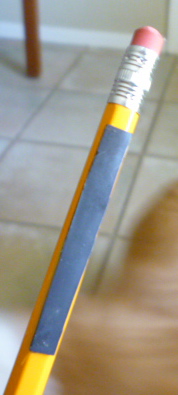
First, get yourself an old-fashioned yellow pencil, the kind that’s milled with six flat sides. Cut off a two-inch-long (or so) strip of rubbery stuff the width of one of these sides. Remove the protective backing and stick it onto the pencil, just below the eraser.
Voilà! Now you have a pencil that will stick on the fridge. And I suppose you see the rest of this coming, eh?
Now get yourself a small yellow pad, 5 x 8 inches. These are available in lifetime supplies at my favorite purveyor of middle-class goods, Costco.
At any good craft store (such as Michael’s or even…yes! Home Depot) you can find magnetized sheets of bendy rubbery stuff, which you can cut with scissors.
The rubbery stuff has a stick-on backing, which is and is not sufficient for our purposes.
Cut off several more fairly large pieces of rubberized stuff, so that you can glue at least a couple on the cardboard backside of the yellow pad. It will probably take more than one. Depending on the brand of magnetic rubbery stuff, I’ve had it take two or three pieces to hold up a mini-yellow pad.
Do not buy a lifetime supply of magnetic rubbery stuff! It’s ridiculously easy to reuse this stuff. When you run out of paper, or when you’ve sharpened your pencil down to where its magnetic holder resides, simply pull off the rubbery stuff and glue it, using some Elmer’s or carpenter’s glue, onto a new pencil or pad. It lasts forever.
And there you are: A kewl yellow pad and pencil, hanging at your disposal on the fridge at all times!
Out and About on the Web
And if you’ve done all these things and still find yourself at loose ends, pass some time at a few friends’ websites:
Guess I’m not the only one who loved (or at least got excited about) this post from Nicole and Maggie at Grumpy Rumblings of the Untenured on passing judgment about other people based on their personal pastimes. It’s a great post, and the comments come up to the same standard. Hm. You know, I think this may be one of the truly great personal blogs out there, right up there with Donna Freedman’s Surviving and Thriving.
In the earning, planning, and saving department, Evan has a few well-placed observations over at My Journey to Millions.
And along those lines, FMF offers some really startling insights at Free Money Finance. This is quite a piece of writing. If you’re still in your earning years, you need to read it. If you’re not but have children or friends who are, pass it along.
But in the same department, SVB over at Silicon Valley Blog brings up an entirely new set of questions about planning for lifetime savings and retirement.
Image (other than Funny’s): “All is Vanity” by C. Allan Gilbert. Life, death, and meaning of existence are intertwined. (Woman gazing into boudoir mirror forms shape of skull.) Public Domain.
This afternoon KJG happened to mention that she came across an incredible way to get those dratted clear glass shower doors really clean—and do it without working yourself to death. She’d heard you could use Jet-Dry, the blue rinse agent that goes in the dishwasher, to cut soap film in the bathroom.
Nothing ventured, nothing gained…last night in a moment of boredom she poured some on a sponge and slathered it generously over the shower door where her DH loves to splash suds around. Then she rinsed it off.
And to her amazement, the glass came totally clean. With no scrubbing!
This has been a well-encrusted shower door, she says, one that she hasn’t been able to fully de-soapify in years.
So. Try this.
If you have clear instead of frosted shower doors, be aware that some clear doors have a coating that’s supposed to repel soap scum. If yours is one of those, you might want to be careful about smearing Jet-Dry on it—the stuff is pretty strong. Test it in a small corner first. Wear a pair of rubber gloves to protect your skin, and be very careful not to let it splash near your eyes. The manufacturer pointedly does not list the ingredients (what are they trying to say to us?), but the fumes are unpleasant, IMHO, suggesting the stuff is not something you’d want to wallow around in.
Wiping with a Magic Eraser is said to help, too.
Once the shower door is clean, you can make it soap-scum repellant by adding a coat of Rain-X, the water repellant made to go on car windshields.

 If you have an actual kitchen sink, wash in the soapy water and then set the clean dishes into the cold water to rinse. Lift them out, one by one, and set them in dishrack to drain. If you have a sidekick, that person can make him- or herself useful by lifting the dishes out of the cold water, setting them in the dishrack, and drying them with a towel. But the truth is, that step isn’t necessary. It’s probably better—more sanitary—to air-dry the dishes.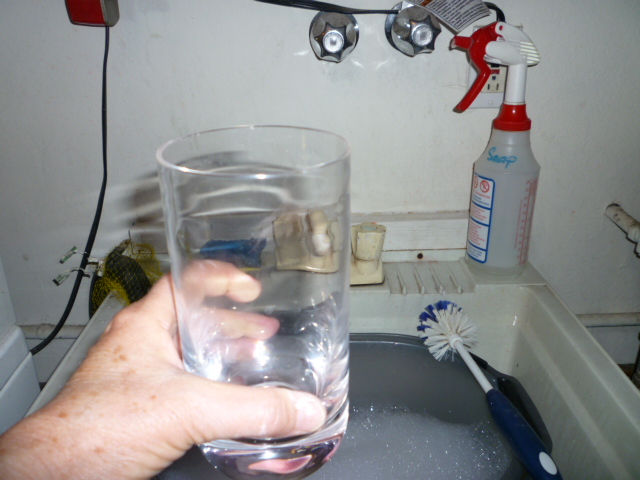
 See this little guy?
 Do not drop a thing like this into a sinkful of soapy water! You won’t enjoy the nasty cut it’ll give you while you’re groping around trying to find it. Silverware can be dropped in the water to soak. Cutlery…not so much.
 Wash all the cups, saucers, salad dishes, bowls and plates. Arrange them in the dish drainer or across a towel.
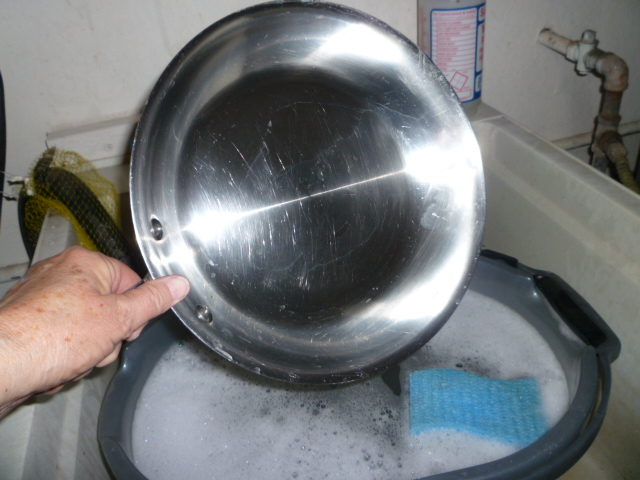 Save the dirtiest cookware for last. Chances are you’ll need to scour a pan or two. Barkeeper’s Friend is great for stainless pans. Comet and other chlorine-bleach powder knockoffs are almost as good.
 Et voilà! The whole mound of dishes is clean!
 Now you can get on with, God help you, the rest of your day. ↓↓↓↓↓↓