So around 10:00 a.m. the insurance adjuster is supposed to show up. It’ll be interesting to hear what he has to say about the heat pump, the roof, and the CoolDeck.
The air-conditioning dude who tried to sell me a capacitor for the allegedly destroyed unit (alleged by two other AC dudes) dropped by M’hijito’s house and said nothing was wrong with the brand-new unit on his roof. So I suppose that’s a hopeful sign.
That notwithstanding, it probably would be a good idea to have the roofer look at that house, too. It sez here in Wikipedia, the Font of Hive Wisdom, “Hail damage to roofs often goes unnoticed until further structural damage is seen, such as leaks or cracks. It is hardest to recognize hail damage on shingled roofs [that would be us!] and flat roofs, but all roofs have their own hail damage detection problems.”
Otherwise, I’m hoping for a quiet day, for a change. I still have to read two Eng. 101 papers that the endlessly annoying Blackboard somehow “hid,” despite the students having filed them on time. I do need to track down the invite from a couple of blogging friends to join their Google site, which I haven’t been able to find a minute to do in all the craziness of the past couple of weeks. And I should work on course prep for next semester, since I’d dearly love to have that out of the way before the end of this semester, so I can have an actual break during winter break.
On the other hand…there’s a farmer’s market at Town & Country, starting about the time the insurance guy is supposed to show up. I could dart over there the minute he goes out the door. Or I could just ride my bike around. That would be good.
A large hailstone that fell in Harper, Kansas, May 14, 2004. U.S. National Weather Service. Public Domain.
Gustave Doré’s illustration to Dante’s Inferno. Plate IX: Canto III: Arrival of Charon. “And lo! towards us coming in a boat / An old man, hoary with the hair of eld, / Crying: ‘Woe unto you, ye souls depraved!'” (Longfellow’s translation) “And, lo! toward us in a bark / Comes an old man, hoary white with eld, / Crying “Woe to you, wicked spirits!” Public Domain.
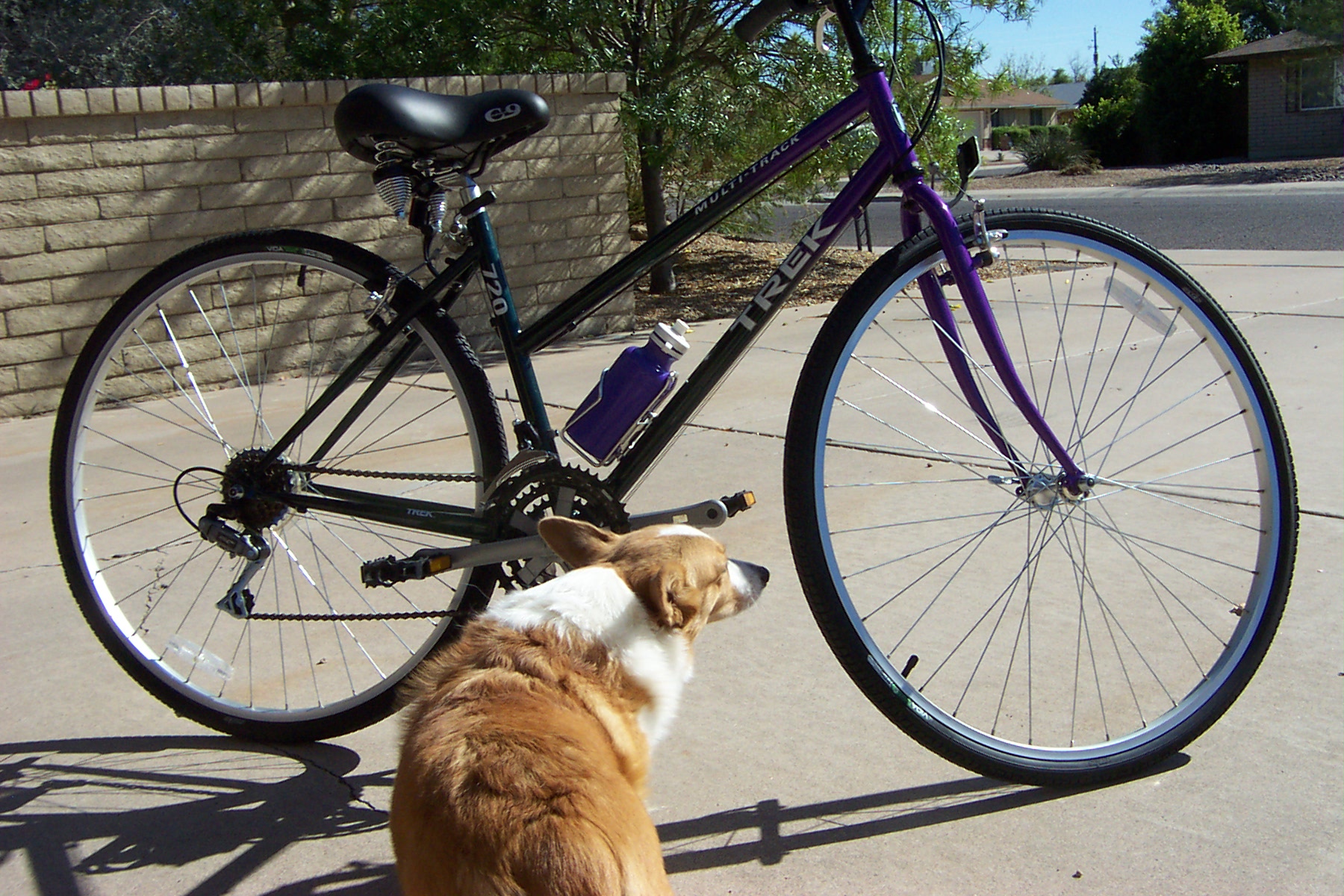
Look what my friends in the choir gave me over the weekend!
(Click for an enlarged view)
My friends Joan and Lee offered me this beautiful purple bicycle, which happens to be exactly what I’ve been looking for and exactly what I can’t afford. These things cost something over $500 these days. They bought a pair of bikes about 16 or 18 years ago, because they were living in a nice house near the canal, which has been turned into a miles-long linear park with bike paths. They said they only used the bikes a half-dozen times or so, and then the things became garage sculptures.
Well! Can you imagine?
I took it over to my favorite bike shop, where they dusted it off and fitted it out with new tires, mega-puncture-proof innertubes, and a sort of bicycle Barcalounger for a seat. The bike guys much admired it. They were amazed that it was in such good condition. One of them said he used to sell that model, and that it looks brand-new.
Check out this little doodad I found:
It’s a little bell for binging at pedestrians so as not to catch them unawares when you come up behind them. Cool, eh?
I’ve been wanting a bike with gears for a long time, to make it possible to ride along the canal. The bike path goes under the roads, so that to get out from beneath the underpass you need at least three speeds. On my old beach cruiser, I have to get off and push the thing uphill out of the underpass, which isn’t much fun.
So! This will allow me to go for miles and miles. SDXB rides in from Glendale following the canal; it goes all the way through Scottsdale into Tempe.
Now I’ll be able to get the exercise that has been so direly lacking in my life the past few years. If there’s a blood pressure problem (it’s beginning to look less likely), a few hours of long-distance riding a week in addition to the daily dog-walking should take care of it. My friends may have given me more than a bicycle…they may be giving me several more years of healthy living!
{sigh} We have seen the future, and it is…the Dark Ages. The Party of No has wrested control of the U.S. House of Representatives from the Party of the Half-Baked. No hope for relief from the metastasizing mean-mindedness and outright viciousness that have invaded our body politic is to be found, anywhere.
Here in Arizona, voters have approved a measure that exempts citizens and businesses from the national healthcare plan. The comically moronic Governor Jan Brewer (she of “uhhhhhh………..tee hee!……..uhhhhhmmmmmm”) was re-elected, of course, and the craven pol who presided as superintendent of public instruction while Arizona’s school system sank to the bottom of the national rankings is now, God help us, the state attorney general.
Now I’ll have to say, I wasn’t pleased with Obama’s healthcare plan. Without a national option, it’s just another iteration of what we already had: it threw us into the lion’s den with a pride of hungry insurance companies. We needed an option to make something like Medicare available to everyone who wished to accept it. Medicare is expensive — even after the state’s insurers raised their rates, my employee plan cost an eighth of what I’m paying to be fully covered under Medicare. However, for what I’m paying, coverage is better. If I fall ill and have to go doctors frequently, my overall costs will be much lower. Requiring everyone to sign up for full coverage with private insurers while blocking insurers from shafting people who really need care simply guaranteed that everybody’s costs would go up, coverage would be no better than what we have, and the well-heeled insurance industry would be joined by every other well-heeled industry in mounting a no-holds-barred campaign against the Obama administration.
Accepting compromise on healthcare was stupid. If the Democrats couldn’t swing a national healthcare option, then they should have dropped their plan until they could.
As for the Afghanistan mess: We were in Afghanistan long before Obama came along. Matter of fact, it seems to me we entered the war in the Middle East because a certain pack of lies emanated from a previous administration. Afghanistan was where the perp was hiding, but instead of going after him, we took it upon ourselves to depose a dictator who was formerly our ally, not because he was much of a threat but because, said our then-President, “This is the guy who tried to kill my dad.”
So…now we have in office some folks who think it’s acceptable to stomp on the head of a woman who disagrees with their doctrine.
Time to get out our brown shirts and iron them. And if you still believe you’re in the middle class, say good-bye to all that.
So this morning I’m driving around and who should come on the radio but Juan Williams, late of NPR and recent of Fox News, chatting with Diane Rehm. Personally, even though what the guy said was taken hugely out of context, my empathy with him is limited by the fact that he was asked several times to quit violating the terms of employment under which he agreed to work. But today he scored some serious points with a couple of telling remarks.
First, he pointed out that if individuals can’t say, on talk shows or in any other respected public venue, how they really feel—for fear of trespassing on some standard of political correctness—then we will not know how people think and feel. All we will know is that they mouth the party line for fear of whatever repercussions may follow an honest statement, right up to and including being fired from their jobs.
And second, while he conceded that conservatives in this country now have an extremist wing that will not tolerate any sort of dissent from its rigid thinking and whose members would happily impose that thinking on all of us, he noted that the same is true of the liberal side. Among the left, who do comprise a large and influential slab of Americans, if you make certain statements that reveal you don’t buy into the accepted dogma, you become a “bad” person, even an immoral one.
As anyone who’s been reading this blog any length of time knows, the threads on my wing-nut turn to the left. But that notwithstanding, I have to allow that Williams has got something there. Advocates of both sides can be bigoted, pig-headed, and doctrinaire. And the consequences for anyone who gets in the line of fire can be devastating.
When I was running the editorial office at the Great Desert University (now it can be said), one of my underlings was a very bright Ph.D. student in history. And one of our client journals was a prominent interdisciplinary journal of women’s studies. To say its contributors were doctrinaire is to understate.
I have little patience for pigheadedness and broad, paranoid assumptions about evil forces, whether they be the white male hegemony or the brown tide. And so, I foisted most of the work onto my graduate student, who enjoyed reading this drivel about as much as I did. She needed the job more than I did, though, so she dutifully plodded through it.
And she did a good job. Authors whose thinking is clouded by preconceived opinion and dictated by emotion produce less than optimal writing. We would get articles that were full of factual errors; muddled understanding of history, literature and science; ill-written copy; and logical howlers. How the things made it through peer review was a perennial mystery. All we could figure was the peer reviewers were every bit as flakey as the journal’s execrable contributors. Copyediting this material was a challenge, and one that took a strong stomach.
Nevertheless, our graduate student persisted through two years of steady, dreary work.
The deconstruction of our office, the only one like it in North America and probably in the world, came on the heels of a series of shattering events in the history department, whose then-eminent public history program fed its graduate students into our handsomely paid twelve-month research assistantships. First, the director of the scholarly publishing program, who had taken over a couple of years before, after its highly respected founder retired, quit with a month’s notice. This left our sister program essentially rudderless for about a year.
Then, in the wake of that disaster, the public history program’s director died. Formerly the chair of the entire history department and deservedly one of the most respected scholars in the Southwest, he was an éminence grise who kept a lid on the craziness over there—and in other precincts in the College of Liberal Arts and Sciences—by the sheer weight of his dignitas.
Shortly after this gentleman passed, I began to hear complaints from the editors of the feminist rag about my research assistant’s work. She made too many errors, they said. Indeed, they said, she was incompetent.
Well, she wasn’t making any more errors than any of us made, which was precious few. Most of the errors were being instilled by authors who rejected our edits and whose inanities then went to the typesetter. They had to be corrected, expensively, at the page proof stage because of changes that were made behind our backs. Additionally, these two women—whose names were, unlike ours, on the masthead as the journal’s editors—apparently declined to review the copy before sending it to press, despite repeated reminders on my part. Consequently, there was, shall we say, a disconnect between the return of edited copy to the authors and the shipping of approved copy to the press that published it.
What you need to know about this young woman is that she was a pretty, trim blonde, an alarmingly wholesome person who was openly devoted to her two children and made no secret of her religious faith. To make things worse, until her husband took up with a colleague at his office and abandoned her, she was a happy stay-at-home mom who intended to home-school her daughters.
Anathema upon anathema!
While our office’s future within the university grew dimmer beneath the gathering financial clouds, the chaos in the history department worsened. My dean explicitly forbade me to tell my staff that we were closing, even though she and I knew it nine months in advance. Consequently, when the time came to grab new assistantships and grants, the R.A. in question, who was A.B.D., missed her chance to get the financial support that the university promised to all the Ph.D. students in that department—because she had no idea her assistantship would cease to exist when the fall semester ended and because some hitherto unheard-from forces were coming into play.
What was happening is that the radical feminists in the department, who had come to dominate the place and who highly resented the success of pretty, wholesome, traditionally oriented young women, had turned on her. The chair of her committee, who like any smart academician bent with the breeze, announced she would not read our young editor’s dissertation because she did not see it as a history dissertation. A number of tergiversations ensued, which I shall refrain from detailing here.
Suffice it to say, they did everything they could to block her from writing the dissertation.
Fortunately, she and I were not without resources. I called a friend who held dual tenure in that department and in another, an internationally prominent scholar and author. He had drifted from the history department in response to similar behavior that he had observed in the past. His annoyance over that sort of thing persuaded him to take my R.A. under his wing. He recruited another colleague to sit on her committee, and they wrested the supervision of the young woman’s dissertation away from the assembled witches. She’s writing as we speak, and the coven, whose department is now defunct, will have little to say about it from here on out.
Interestingly, the response to any woman whose choice of lifestyle did not fit what our dogmatic colleagues considered “enlightened” can only be called reactionary.
One can be reactionary on the left as well as on the right. And that, I fear, is what is ailing our country.
Our nation’s polity has shattered into gangs of reactionaries who spend their time, energy, and wealth undermining and lobbing brickbats at each other. They can’t hear each other because they’re too busy shouting. Meanwhile, vast moneyed interests who care nothing about democracy or constitutions or freedom (and in fact would prefer to operate in the absence of those nuisances) manipulate the citizenry and its distracted representatives as they please.
There’s nothing new about vicious divisiveness in America. Many of us can remember McCarthyism—one wrong word and you were a Communist, a tag that under the influence of Joe McCarthy’s personal star chamber could destroy your career and your life. What worries me is that today extremism is so widespread and so pervasive, there seems to be no help for it.
Unless things change, and soon, the democratic republic that we know as America is going to be over. Once and for all.
Hm. When you’ve been around since the Cretaceous and spent part of geological time overseas, you could turn a fair amount of a map red. Let’s check it out.
Well. In spite of all that gallivanting, I’ve only visited 9.77% of the world and 50% of the U.S. Unfortunately the site doesn’t offer maps of Wonderland or Oz, no part of which I seem to have missed…
Each of our blogging friends asks where we would like to go after this. The strange thing is, I feel almost no desire to travel anymore. I guess people are supposed to want to spend their retirement bouncing around the world. Even if I could afford it, I’m pretty much done with my expeditions. To my mind, traveling is a lot of work—crowded, inconvenient, occasionally scary, and these days very invasive of your privacy. It’s interesting to have seen all those places (I guess), but in fact I live in a place where everybody else wants to visit. Why go galloping around when you already live in a destination?
I’d like to go back to New Mexico. I adore Santa Fe and the whole area around there. And I think I’d like to explore the south of France. But the rest of it? meh!
Finally done with all the English 101 stuff, the grades finally entered in the District’s system. Let’s hope nothing there comes back to bite. That’s a forlorn hope, of course: as anyone who teaches anything knows, someone has to make an exception of himself. Every. single. time. So let’s rephrase that: let’s hope that whatever comes back to bite isn’t a pit bull. 😉
We now have three days until class starts again, this time not one but two eight-week gigs: the magazine-writing course and another English 101 crew. People are already turning in stuff for the magazine course, it having gone online a few days early, for their convenience. Oh well.
Having been sick for the past two and a half weeks with some sort of indigestion and heartburn paired with an unending headache, I’ve been madly self-medicating. Started with my usual subtractive medicine: stop ingesting things I love that I know are probably bad for me. Getting rid of the coffee helped some—alas. One of the small things that makes life worth living, or at least tolerable, is starting the day with a delicious cup of top-quality French-press coffee. But it must be admitted that the stuff keeps me awake at night, contributes hugely to the tooth-clenching, and does annoying things to the gut.
Then it was off the sauce—damn it. The other small thing that makes life worth living is celebrating the end of the work day with a beer or a glass of wine. But we suspect that daily tippling is not good for our health, or at least not good for our moral standing. After I snuck back into the grocery store two days ago to purchase a Murphy’s stout to go with dinner, the instantaneous and unmistakable protest from the belly showed, beyond a shadow of a doubt, that there will be no more swizzling for the likes of me!
I’d been using a generic version of Pepcid AC, which was laying around the house because the vet recommended it for the dog, who occasionally would barf in the weeks after I got her. This stuff did so little that it soon became apparent it was doing nothing. So yesterday when I was at the Safeway I picked up a package of omeprazole, the stuff that’s in Prilosec. The pharmacist said it had virtually no side effects.
Right.
These days I don’t take anyone’s word for that, so looked up a non-woo-woo study to check the side effects and their incidence rates.
HOLY God! Headache? Chest pain? Severe diarrhea? Severe stomach pain? Pancreatitis (some fatal)? Esophogeal candidiasis? Liver failure (some fatal)? Liver necrosis (some fatal)? And on and on…
Like I’m not sick enough?
So we’ll be returning that stuff to the store.
Moving on, I turned to the woo-woo pages, where I learned that a tisane of sage leaves and hot water has been used for centuries to treat indigestion and heartburn. Supposedly, too, chewing up and swallowing a half-dozen blanched almonds calms your stomach. We’re also told that raw apple is imagined to be soothing.
Well, what the heck. I happen to have a sage plant growing in the back yard, almonds in the freezer, and a lifetime supply of apples in the fridge. None of these things is known to cause necrosis of the liver.
So I picked some sage leaves, made a tea of them, and then blanched some almonds. Surprisingly, munching the almonds seemed kind of calming. Probably all in my head, though.
The sage tea, however, actually did seem to work to good effect. Can’t say it cured anything, but after drinking it, I did feel quite a bit better.
This morning, having awakened queasy again, munched some more almonds, brewed some more backyard sage tea, and took the dog for a walk. When we returned, I ate some of the rice I’d fixed for the dog’s cuisine, and afterward felt OK.
So, who knows? Maybe the stuff helps. Or maybe the passage of time helps (three weeks seems like a lot of passaging…but when you get old, your body heals very, very slowly). Experience suggests that these little ailments will do one of two things: kill you or go away on their own. Not much exists in between.
Old age. 😀 It’s not for the young or the faint of heart.
Right now a gigantic pot full of chicken carcasses and the bone from a chuck roast (found yesterday for $1.69/pound!! and converted to hamburger) is simmering with onion and herbs to make a glorious stock for future soups, which we hope also will be duly therapeutic. So good…
How to Make Leftovers Stock
You can make this in a slow cooker, but for some reason I think the stuff tastes better when it’s made in a pot on the stove.
Save a bunch of bones from chicken, beef, lamb, and pork—toss them in the freezer till you’re ready to use them.
When ready to spend the better part of a day keeping an eye on a slowly simmering brew, break out a large stock pot. Skim the bottom of the pot with olive oil. You’ll want to start this process in the morning, BTW.
Then coarsely cut up a fresh onion—no need to peel it—and brown it gently in olive oil. Add some cut-up celery and carrot. Toss in a couple of garlic cloves. Add herbs to your taste—I used some dried fines herbes and (what else?) the sage leaves wilted when I made the sage tea. Anything will do nicely.
When the onions have lightly browned or fully caramelized, depending on your mood and how closely you were watching the pan, add your collection of bones. Cover the whole mess with water.
Turn the heat to medium high. This is the only time you’ll need to hang around the kitchen. Keep an eye on the pot, and when it just comes to a boil, turn it down to low. Cover and go away.
Allow the broth to simmer for hours. Many hours.
When you get around to it, much later in the day, turn off the heat and heave the pot over to the drainboard next to the sink. Set a large bowl in the sink and place a strainer over it. Ladle the broth and cooked stuff into the strainer, draining the juices into the bowl. Use the back of the ladle to press as much of the broth out of the bones & veggies as you can. Discard the used-up bones and veggies.
You now have a stock that you can use for any number of delicious things, either to cook with or simply to eat as a light soup. You can add stuff to it to make a sturdier soup—pasta, rice, veggies, barley, whatever. A little white wine or sherry gives it a very nice flavor.
This is not real stock, which has to be clarified and reduced. But it’s sure good enough for government work!