Coffee heat rising

Time Management: Where DOES the Time Go, Anyway?

Have you noticed that time seems to be going extinct? It goes away so fast that it has now become almost impossible to find, at least in the wild. I’m sure there are time zoos that still have a few hours in captivity…but where has all the free time gone?

It’s Friday already. Have I done much work this week? How? This week was never here!

Well, actually, you could argue that I have managed to get a few things done: edited and rejiggered a client’s new introduction; done the bookkeeping and wrestled the current stack of paper off the desk and into the file drawers; written a new chapter and roughed out the plot outline for the second novel in the Cottrite Chronicles (yeah: haven’t sold the first book and am already writing the second…talk about living in a fantasy world); fired a now-former client who thinks $6/page for developmental editing is “too much” (result of my bad call: I mistook her for one of the Singaporean Ph.D. students who have been pounding at our doors and gave her the cut-rate starving-student rate for the first stuff we did for her, and so now she thinks we should work for less than minimum wage); ascertained that the magazine-writing course will probably make.

It’s what I haven’t done that worries. Videlicet:

Written a report to the membership of the Scottsdale Business Association on the outcome of yesterday’s meeting (huge!)
Written and e-mailed a new calendar of speakers for SBA members
Sent out a new press release for an upcoming choir event
Written and published a round-up for FaM, not in what seems like for-freaking-EVER
Updated and posted new material to the waiting Canvas shell for the maga-writing course
Ridden herd on the 102 course
Inserted new material in client’s memoir and made that work; figured out what portions of the MS to delete to bring length down to something even remotely publishable
Billed clients in, yes, for-freaking-EVER
Done any serious work toward learning how to market e-books
Deleted outdated ads on FaM as requested weeks ago by a certain well-known advertising agent 🙄
Written a decent personal-finance or stress management post for FaM since the memory of person runneth not to the contrary
Lined up new leads for SBA members
Figured out how to generate 12(!!) of those this year
Rewritten SBA New Member packet
Taken SBA lead form to Kinko’s and figured out how to get them to reproduce the things
Printed and put together a badge for new SBA member
Begun working on jewelry to donate to this fall’s Silent Auction (these things take time to make and need to be started now)
Started buying stuff for New Pup
Sat down and figured out how exactly I’m going to afford New Pup
Informed art director that there’s something missing in the mock-up of the map I sent him two or three weeks ago. Yes. That would be a large river that extends several hundred miles. Ahem. And…uhm…oh well.
Traipsed to the optometrist’s and picked up the new Vision System — four new pairs of glasses.
Purchased new battery for MacBook before it’s too damn late!!!

It’s interesting how many items have to do with “figuring out.” This is not a task that accommodates itself neatly to my favorite time-management device, The List. It’s not very practical to schedule x number of minutes or hours for sitting down and staring at the wall while thinking through this or that scheme or challenge. In effect, thinking time has to be crammed into the interstices around tasks that require physical action. Really, it’s only physical, get-it-done-now items that can, in any practical way, go on a to-do list.

Today the only things that will get done, I expect, are

the SBA catch-up tasks;
the remaining work on the client’s book;
and picking up the glasses.

While I’m out to get the glasses, prob’ly I should traipse to the Apple store and pony up another pile of dough to replace the laptop’s batteries. Trouble is, just now four (count’em, 4) projects are in progress on this thing, and I don’t relish having to close down every file associated with them. That would be sixteen files now standing open, none of which has to do with the SBA stuff that needs to happen today.

This weekend the maga-writing course presumably will have to go online, assuming none of the new enrollees have dropped since I last looked at the roster, and I’ve GOT to get the billing done. If any time is left around those, maybe I can choke out a round-up (endless apologies to beloved bloggers such as 101 Centavos, Evan at My Journey to Millions, the spectacular Donna at Surviving and Thriving and her doughty daughter at I Pick Up Pennies, the globe-trotting NZ Muse, and the ever-entertaining Money Beagle, Planting Our Pennies, and Revanche at A Gai Shan Life…not forgotten!)

And so, to work…

What Happens When You Don’t Keep Up with the Incoming Paperwork at the Funny Farm

AUUUUUUUGGGGHGHGHGHGHG!!!!!

Just LOOK at this!!!!!!!

P1020632

Over the past two or three weeks, I’ve been not feeling on the top shelf. Not only that, but every time I sit down at the flicking computer, I get up so damn spavined I can hardly stand up. So, as you can imagine, I’ve been putting off whatever I could, because I don’t want to sit at the computer any more hours than absolutely necessary, because it hurts to sit at the damn computer. Everything that can’t be put off goes on the front burner, and that includes nothing more than what someone is paying me to do — and not even all of that. The rest of it gets put off for another day.

See that thar, above?

FIVE FLICKING STACKS OF INCOMING!!

We have stuff to file.

We have stuff I need to do something about, ASAP.

We have transactions (in some cases unending lists of transactions) to post. These annoying pieces of paper will then be moved to the TO FILE stack.

We have the mounds of incoming paper related to the latest identity fraud attempt.

And we have piles of sh!t that I don’t even know what to do with!

That doesn’t even count the MOUNTAIN of junk that goes directly from the mailbox to the recycling barrel.

And it’s just come in over the past couple of weeks, while I really, truly, haven’t felt like dealing with it.

Am I the only one who feels harassed by the need to keep up with incoming pesky paperwork (or online statements) and overwhelmed when even a week or two goes by without constant upkeep?????

Go ahead. I dare you to click on the photo to see exactly what all those five mounds of paper entail.

Decluttering Hell: File Cabinets

Lookit this…

P1020418

And this…

P1020419

And this!!!

P1020420

This weekend I spent seven hours shoveling out file cabinets!

The accountant, who’s also doing my bookkeeping, would like to get file folders that contain only a few months’ worth of statements and receipts, rather than a pile that requires me to rent a llama to get the junk to her office. These are records that need to be saved for seven years, and so to accommodate her wish, I had to break free some space in the file cabinets in the office and the garage. The current bank account and charge card records reside in my desk file drawers, which have just enough room to hold them. Having to create duplicate files and add them to yet more hanging file folders ain’t gonna work.

The four-drawer garage file cabinet was jammed, and the two-drawer model in the office was also about maxed.

Problem is, I never know what to keep and what is safe to throw out. The ex- (the corporate lawyer, who presumably should know) kept every scrap of paper having to do with finances, jobs, etc. all the way back to before the beginning of our 25-year-long marriage. He kept every check he ever wrote — and in those days that was quite a few. I expect to this day he has some set of bureau drawers packed full of that kind of stuff.

That sort of imprinted me with the importance of keeping anything for which, by the remotest chance, you might be called to account.

All right…so, it was off to the Accountant from Nirvana to get the facts on record storage. Via e-mail, the Q&A:

•  What about statements and paperwork for homeowner’s and auto insurance, dating back to the mid-1990s? Can that stuff go? I have a new insurance company. Is there any reason I might be asked to prove that I had a car or house covered in the past? If I have to keep some of it, how much to I need to keep?

Keep for 3 years.

Statements from old, long-closed investment management accounts? Statements from the 403(b) at GDU, which has now been rolled into my big IRA? Statements for mutual funds that I no longer own? These go back 15 or 20 years. At one point Reimer (investment manager) asked me to come up with evidence for the “cost basis” of some Vanguard account. I don’t even know what a cost basis is, much less how to find it in that mountain of paper. Apparently he wanted to know how much I had originally invested, back in the 1980s. I managed to unearth what I thought was the first statement from Vanguard, but he said that wasn’t it. Do I have to keep all these stacks of old statements? 

Keep the December statement only (or whatever month shows a good summary for the entire year).

Bank and credit union statements for accounts that have been closed? Some date back to the 1990s. Some are more recent. 

Save for 7 years.

How about pay stubs dating back to my first pay period on the job at GDU? At one point my first paycheck came in handy…at retirement, GDU tried to claim I’d started a year later than I really had, thereby trying to screw me out of a year’s worth of RASL credit, to the tune of several thousand dollah (yeah, i know it’s a huge faceless mindless institution, but in my paranoia i do not believe for a minute that there’s no agency behind that kind of thing). Should all those job records be kept? Some of them? Which ones, if only a portion?

Toss them all once you receive your W-2 for that year.

How about records of annual reviews, student evaluations, CYA notes on formal proceedings with a particularly nasty colleague that could have led to a lawsuit? Don’t know if anything could still come out of it — the student involved has since moved on, and there surely must be some kind of statute of limitations. What on earth to do with THAT pile of paper???? 

I don’t know about those types of professional issues.

 Evidence of malfeasance on the part of a former chair, notoriously incompetent but now retired? Is there a statute of limitations that might apply to colleagues and former ASU employees who might have a grievance against this woman?  

Again, I don’t know about how  long you would save these items as they relate to standards that are part of the education profession.

Well, this was all very informative. Also very work-making. It meant I had to go through yards of hanging files, sifting out the December statements for many more investment accounts than I can add on my fingers. The ex- and I divorced in 1992. Over twenty years of obsessive document-filing resided in those cabinets! Two of the banks that issued scores of monthly statements no longer exist. Neither do two or three of the investment firms that managed my money before Stellar came on the scene.

I threw out 18 or 19 years’ worth of home and auto insurance paper, 11/12ths of 21 years’ worth of old investment statements, 14 years’ worth of old bank and credit-card statements, five credit cards from long-defunct accounts, and any number of miscellaneous archaeological finds.

An Internet search brought up the specifics of Arizona’s statutes of limitations. For most civil cases, it’s one year. The litigious student who got into the fight with my scoundrelish former colleague is now a successful real estate agent, so she’s unlikely to file a lawsuit even if she could. Other former colleagues who still have gripes against GDU have missed their chance to include the noxious chair in their complaints. My former secretary, La Morona, whom I managed to force out by riding her to do the job right until she finally gave up and quit, also has missed the boat, which sailed four years ago.

So I threw out everything that had to do with GDU.

Then it was into the house to clear out the office file cabinet.

This thing has fast become overwhelmed by the constant flood of dead trees from Medicare’s ancillary insurance companies. Medigap carriers AND Part D drug plan carriers, it develops, send you a three-page (minimum) document called an “Explanation of Benefits.” These things list Every. Single. Doctor’s appointment; Every. Single. Test you take; Every. Single. Procedure that is done on you; Every. Single. Prescription you fill… every goddamn thing any medico or para-medico can think of to charge you for, world without end, amen.

These documents are well-nigh incomprehensible. Without training in the intricacies of the medical bureaucracy, the only way you could figure out what the things mean is to spend several hours poring over each one, studying every entry, looking up the mysteries on the Internet, and trying to relate the mess to reality. Such as it is.

Look up a question like “how long to save EOBs” and you discover nothing is said about when to dispose with this tsunami of paper. Indeed, at least one federal site implies that you should keep the litter forever by remarking that you can use past EOBs to reconstruct your health history, in the event of some question or catastrophic illness.

Another site states that insurance companies are required to store EOBs electronically and can disgorge copies on demand. Uh huh. So, in theory, you should be able to discard them as soon as you’re sure your medical provider has actually been reimbursed.

But yet another source (sorry, didn’t have time to save URLs while heaving paper) tells you that you should match each EOB with the medical provider’s corresponding bill, checking to be sure that the correct procedures were charged (it’s your job, as it develops, to ride herd on Medicare fraud) and searching for reasons to challenge any denials of coverage. Then you are to clip each EOB to each statement and save them until tax time. If you’ve been sick enough that you might be able to claim a medical deduction, then you have to haul all this stuff out, revisit it, and use it to document your deduction. If not, then you should save it for at least a year.

Why not? Who has anything else to do with their time, eh?

By the way, each EOB conveniently includes your name, address, birth date, and Social Security number. 🙂 Ain’t that grand? So all of those things have to be shredded or burned.

They’re not the only offenders. Bank One and Chase Bank print your credit-card number (!) on their statements along with your name and address; American Express does not.

Shoveling all this crap out resulted in a mountain of paper  that completely filled the 18-cubic-foot recycling barrel.

P1020422

And that was just the stuff that didn’t need to be obliterated.  The pile of paper spread all over the floor around a trash can and the dining-room chairs, pictured in the third image above, is all stuff that has to be shredded or burned. Then there’s this stack of paper from a prior, half-baked file-drawer purge, which I just haven’t had time or energy to figure out what to do with:

P1020421

I was going to burn those five (!) folders full of defunct documents over the winter, but we had no-burn regimes every night when it was cold enough to use the fireplace. And besides, burning paper in the fireplace results in a godawful mess to clean up. And it stinks.

My shredder is already on its last legs. So the options are

a) to pay someone to shred the stuff, which I’m just too ornery to do;
b) to go buy a new shredder (which I probably ought to do, since mine has to be coaxed); or
c) burn the whole pile in the backyard charcoal barbecue.

Undoubtedly, c) is the cheapest option. However, as we scribble it is 105 degrees in the shade. The barbecue is  parked in the full sun. Outdoor stuff around the neighborhood is, as you can imagine, quite dry, and that raises a concern about hot ashes floating around.

So, I suppose I’m going to have to get up off my duff and drive to OfficeMax or Costco to get a goddamn shredder.

Lord, how I hate this kind of thing! No wonder my blood pressure is through the freaking roof. Whose isn’t?

Decomplicate Me!

Ohhhhhh gawd one more piece of paper to have to figure out, act on, and file is gonna break my achin’ back! Yesterday afternoon I was trying to figure out how to organize the usual complicated mess before handing it over to The Accountant from Nirvana, who offers to take on the migrainish bookkeeping. Obviously, the less mess for her to have to plow through, the fewer hours it will take her to beat it back. Hence: decomplication.

So much paper comes pouring into my house that often I just can’t keep up with it. It piles up like dust on the Plains until finally I’m forced to deal with it, and that dealing can take the better part of an entire day. Yesterday, I thought if only i could find a way to cut the number of transactions and the number of pieces of paper i have to screw with, maybe it wouldn’t take half my lifetime to keep this shit under control…

One spring that feeds the flood of papers is the charge cards. Specifically, the AMEX card. Costco’s American Express card is one of America’s premier kick-back cards: almost every charge racks up a few pennies or a few dollars toward the annual “rebate,” which in my case goes directly into savings. Because I charge everything on the AMEX card and then pay it off at the end of each month, some years that kickback has amounted to three or four hundred dollars. To make that happen, though, entails snowflurries of charge slips, each of which has to be entered in Quickbooks.

Most of these small charges, some as small as a couple of bucks, occur at a limited number of retailers: Costco, Safeway, Costco gas, AJ’s (a local purveyor of fancy groceries and the best coffee beans in town).

What if…? What if I were to buy cash cards at the places where most of my charges take place? You can buy cash cards at Costco with which to purchase gasoline and groceries. Ditto Safeway: give yourself a gift card. Same at the local upscale AJ’s. A person could pay for these things with the richly endowed AMEX card, thereby preserving the coveted kickback.

Wouldn’t it make sense to buy gift cards or cash cards to cover purchases at the most-frequented retailers, thereby consolidating 87 gerjillion receipts into three or four?

If said person then paid for purchases under about $50 with cash, wouldn’t that also get rid of a lot of ditzy little receipts to keep track of?

Then how much would be left to charge on credit cards, track, and organize monthly payments for?

Hm.

Averaging charges in various categories over seven months, I discovered that typically I’ve been spending about $55 a month at AJ’s, $300 at Costco on groceries and household goods, $95 on Costco gasoline, $120 at Safeway, and around $160 on small sundries. On average, large planned or unplanned bills can come to as much as $370 in any given month.

What if the only things that went on the charge card were gift or cash cards and large bills? And all the little stuff were paid in cash?

This would hugely change the budgeting scheme. Instead of $1100 a month to be charged on the card and paid off at the end of each month, things would look like this:

CashBudget

Biggest drawback: it would require me to traipse to the credit union once a month and get actual cash, of all things…

On the first day of each budget cycle:

1. Drive to the credit union; withdraw $160
2. Drive to Costco: Buy $395 Costco cash card ($95 for gasoline; $300 for in-store purchases).
3. Drive to Safeway, get $120 Safeway cash card.
4. Drive to AJ’s, get $55 AJ’s card.

Manage funds accordingly.

This would consolidate all the charges for groceries, cleaning goods, personal care products, and household stuff into three charges — Costco, Safeway, and AJ’s. Gasoline and some clothing would also be comprised in the Costco card. There would be no reason to itemize every single stupid little charge in these categories; instead, all that would be noted is the cost of an estimated month’s worth of charges, to be paid with a cash card.   Same would be true of the ditzy little bills, 50 bucks and under, that would be paid for in cash.

The only bills requiring serious itemization would be bigger-ticket items such as major car repair bills, gifts, dental visits, and the like.

Right there, dozens of scraps of paper, direct to the trash! Or at least not stashed in a file folder or envelope to be inflicted on the (expensive!) accountant.

Today, speaking of major bills, I have to leave my car at the shop for a brake job, so I won’t be driving around buying cash cards and extracting cash from the credit union. But tomorrow…


The Time Management Waltz

So the back is feeling a little better, though we’re told by the physical therapist and Young Dr. Kildare that it will never be 100 percent again.

The most obvious immediate cause of this predicament is my habit of spending hour after uninterrupted hour in front of the computer.

Yesterday, for example, I woke up at 12:30 a.m. Couldn’t get back to sleep. Finally gave up a little after 1:00, got out of bed, and sat down in front of the computer. Graded 14 student papers. Wrote a blog post. Answered e-mails.

Fell back into bed after dawn, around 5:30 or 6 a.m. Couldn’t get back to sleep. Rousted out of bed by Gerardo, shortly followed by M’hijito, who dropped off his sick dog to preclude a gigantic floor mess at his house.

After all that dust settled, parked myself in front of the computer again. Edited a lengthy article by an ESL writer. Read a broad and random selection of news and play-nooz stories online. Commented on fellow bloggers’ sites. Fielded e-mail. Responded to student queries and plaints. And on and on and on and on… Shipped off the edited copy to the anthology editor about 8 p.m.

This

has

got

to

stop.

So later in the evening another activity that occupied time in front of the computer monitor was an analysis of just how much time I do spend and how much I should spend sitting in front of the computer monitor.

It occurred to me that, with the help of a cheap kitchen timer, I should be able to establish some limits on the amount of time per day that I spend sitting in a back-demolishing desk chair. Set the thing for 30 minutes or an hour and when it goes off, get up and do something else for a while. Or — outlandish idea — just stop working!

Thinking about this some more, it struck me that I tend to work at random, plowing through whatever pile is on the desk in an attempt to get through it all as fast as possible. So on some days, I’m doing things that don’t really need to be done that day — they could be put off. This habit tends to keep me sitting in front of the computer for unnecessarily long stretches.

Because I have several enterprises going at once — teaching, blogging, making jewelry, writing the proposed books that never get finished because there are so damn many other things to do — there’s always something that either needs to be done right now or could be done right now. And that creates the illusion that everything must be addressed right this minute.

Not, of course, so…

I took it into my head to list the things I typically do in a day, strictly limiting them to the smallest number of minutes or hours I estimated it would take to do them. This, I figured, would allow me to get a grip, simply by setting a timer for the designated period per task and then stopping and moving on to the next task each time the timer bleats.

The bare minimum number of hours needed to accomplish all I do in a typical day came to slightly over eight.

Holy sh!t. No wonder I spend my entire life in front of a computer.

Finally, it crossed the feeble mind that one could, at the start of any given day, decide what will be the dominant task of the day. Knowing that x or y will be emphasized that day, one could then schedule enough computer time for that job and, if desired, for one or two other jobs. And then, knowing what amounts of time should be scheduled for the given computerized projects of the day, one could limit that time.

The result, with any luck, would be fewer hours spent at the desk and more hours devoted to getting a life.

This thought appears to be on the right track. I created a spreadsheet showing what would happen if one spent x number of hours on one task and y and z hours on other things. The assumption here is that eight hours is the absolute maximum I wish to spend in pursuit of profit. The number of hours slated for each specific activity appear as negative figures, so they will subtract from the 8 hours allotted per day using the ∑ button.

ComputerEscape3

Here, the hours per task are subtracted from eight hours budgeted per day. The “Remaining hours” row shows the time that could be used getting up out of the bone-crushing chair or devoted to tasks that don’t get done during the time allotted to the scenarios posited in the top row (i.e., spending more hours than usual blogging, or more hours on editing).

The first column, “On Average,” represents the number of hours I typically spend on any given task — assuming nothing out of the ordinary is going on. So, if on a typical day I spent only the typical number of hours on those activities, they would occupy about eight hours.

As a practical matter, they’d occupy a lot more than that, because few of these activities limit themselves naturally to the periods shown in column 2. That’s because I tend to work on something until I’m done, rather than stopping after a reasonable time.

The bottom row shows the number of hours each scenario would have me working.

Let’s say I follow this scheme to allocate time. If I spend three hours on blogging, one or more other tasks will have to be cut back or go away altogether — as we see in column 3, to provide three hours for blogging and still keep the workload at 8 or fewer hours, I’d do no editing, no other writing, and no jewelry-making. Teaching time would be limited to one hour. And so on.

Some of these task allocations would free up a significant amount of time. Others…not so much. On a day when I did a lot of blogging and then tried to complete one four-foot-long beaded lariat, I’d end up spending 9 hours (at least!) with my nose on the grindstone. As a practical matter, this would add up to much more than that, because it’s not easy to stop when you’re on a roll. The kitchen timer went off about five minutes ago, and I haven’t stopped typing…

In theory, I should get up right now and vacuum the floors. But wouldn’t it be good if this post went live before the day ends on the East Coast? To make that happen, I have to sit here and FINISH the damn thing!

But a few helpful guidelines do present themselves from this exercise.

Get a timer and set it for one-hour periods. Once an hour, get out of the chair and spend 15 minutes moving around the house or yard.

Editing and serious writing really take it out of you, and each requires large chunks of uninterrupted time. Do not try to do these on the same day. (I don’t put blogging in the “serious” category because it doesn’t require a lot of formally cited and documented research, nor, like writing fiction, does it require you to transport yourself mentally into a detailed imaginary world and enter the minds of fully conceived imaginary characters.)

The jewelry-making is ditzy and demanding. One needs to focus on that for a lengthy period, too. Don’t try to do it on the same day as editing or real writing.

Occasionally, the work of teaching is also somewhat demanding and tiring. Do not try to combine a lengthy stretch of course prep or grading with a lengthy stretch of editing or serious writing.

Don’t assume the budgeted time must be consumed by the assigned tasks. If the work is done, stop. Spend the rest of the day socializing, exercising, cleaning, gardening, playing with the dog, or loafing.

Sounds good, doesn’t it? Well. Let’s see if mindfully following this scheme works…

Budgeting Time for a Better Life

I am getting so flicking fat! Since I got sick three months ago, I’ve put on six or seven pounds, an unheard-of thickening. Was already overweight, so an extra slug of poundage really does put me in the “fat” category.

Why? Well, besides the fact that for about a week or ten days all I could gag down was ice cream.

As a practical matter, I’ve gone on ice-cream binges before and never gained an ounce. IMHO, the why behind this predicament is bone-laziness, loafing in front of the computer all day long. I mean, really: how long does it take to write a blog post? An hour, at the outside? Two blog posts a day should take one a couple hours, maybe three at the outside. Yet I seem to spend so much time at my desk that I don’t clean house, I don’t get any exercise, I don’t take care of the yard, and I often don’t bother to fix a decent meal for myself. No wonder I’m turning into a barrel of lard.

Woke up at 4:00 this morning wondering what on earth I do with all my time and why on earth I can’t seem to get off my duff long enough to waddle around the block with the dog. After all, I’m normally up by 5:00 a.m. and go to bed around 9:00 p.m. That’s 16 hours of consciousness a day, seven days a week: 112 potentially useful hours a week.

In 112 hours, I can’t find time to get a few minutes of exercise? I can’t dust the furniture or scrub the floors? WTF???

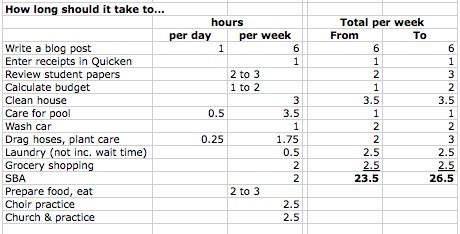
So, if I were to add up all the things I routinely need to do, how much of that 112 hours would they really absorb?

Hmm… So, about 20 to 30  hours a week are occupied in productive activities. Add in class time and driving time, about 8 hours a week, and we still aren’t occupying all of 40 hours. Out of 112 available hours.

Well, then: what AM i doing to waste the remaining 74 to 84 hours a week?

Playing Mahjong and other computer games
Reading news on the Net
Surfing and commenting on websites (I probably spend as much time writing at other people’s sites as I do on my own)
Surfing the Web
Eating
Driving around

That is a lot of time to kill diddling around with a computer. And what am I neglecting while wasting all this time?

Health: not exercising, not eating well

Could be doing:

Walking, biking, hiking
Cooking and storing healthy meals

Social life

Could be doing:

Inviting friends over
Socalizing
Volunteering

Cleanliness

Could be doing:

Cleaning house at least once a week
Cleaning car
Cleaning garage
Taking better care of self and appearance
Keeping windows, window coverings, fans, & lights clean

Writing e-books

Could be doing:

Scheduling specific periods to compile e-books

Marketing business

Could be doing:

Joining groups, making presentations
Working marketing campaigns

Huh! So, what should I, could I do that I’m not doing now? Not on a regular basis, or not in any organized way?

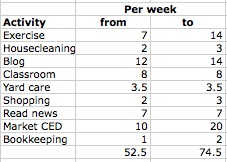
Bookkeeping: 1-2 hours/week
Exercise: 1-2 hours/day: 7-14 hours/week
Clean house: 2-3 hours/week
Blog: limit to 2 hours/day, 6 days/week: 12 hours/week
Teaching: 8 hours/week
Yard care: ca. 30 min./day: 3.5 hours/week
Shopping: about 2-3 hours/week
SBA/PPP: 3 hours/week (+ driving time)
Read news: limit to 1 hour/day: 7 hours/week
Market business: 10-20 hours/week
Learn real estate: ca. 3 hours/week over next 7 weeks
Cooking: 1.5 hours/day: 10.5 hours/week

How would this shake out, if I could actually organize my time to comprise all these activities on a regular basis?

This would occupy 53 to 75 hours a week of the 112 hours during which I’m awake and reasonably conscious. And that would leave 37 to 59 hours a week to loaf. And get in 7 to 14 hours a day of exercise!

{Sigh} I need to get organized. I need to spend as much time and thought on budgeting my time as I do on budgeting my money!