Coffee heat rising

New Washer!

Okay, the new high-efficiency high-priced washer is ensconced in the garage: a Samsung double-whammy top-loading vast-capacity VRT (must stand for “vertigo,” which is what you get when you gaze through its glass lid to watch it running). It is really a neat machine, a computer with a wash tub attached to i t.

M’hijito blew his Sunday afternoon traipsing around the city looking for wash machines and prices. We found one of these marked down at Lowe’s—$900-plus—and having seen that price tag returned to the Sears Outlet store, where we snagged a brand-new model for a mere $775. The retail price is $1100, so that wasn’t bad.

Saved even more when M’hijito volunteered to install the thing. So we had them load it into the Dog Chariot (how does anyone live without a pickup or a minivan?), hauled it home, and before long he had it hooked up and running.

We looked at the “traditional” agitator-style washers available in the stores. Junk. For $350 I indeed could have replaced my old washer, with a much lesser machine—fewer cycle options, same old clothes-ripping agitator, cheap-looking construction. The Samsung looks sturdy. No question all these electronics will crap out expensively, and that it’s better to get a machine with mechanical controls. But I’m afraid those are pretty well phased out now.

And…

Holy mackerel what a change in performance!!!!!

Got some HE detergent and tossed in a peach-colored towel that has seen better days. Over the years it had acquired a 5 o’clock shadow of ground-in grime, especially on the ends where I wipe my hands and face on it. Well, I ran that thing through with the whites and out it came, looking like brand-new! It’s bright and clean and free of any trace of gray grime.

The other clothes came out looking good, too, and much softer than they were after washing in the old Kenmore. The Samsung must not only wash more effectively, it must be rinsing out the chemicals more efficiently, too.

The crazy glass lid is a hoot. There’s something mesmerizing about watching the thing in action.

Some time back, Trent Hamm wrote a long post at The Simple Dollar more or less justifying the purchase of one of these devices, arguing that over time it would pay for itself in reliability and savings on water and power. I dunno about that. At least for small loads, it looks to me like the Samsung actually uses more, not less, water than the decrepit Kenmore did. I’ve yet to wash a large load, so don’t know if the machine uses the same amount of water for all loads, in which case it probably would save water if you have a big family. But I will say it has so many washing options, from several different water heating choices (for me it’s usually “cold”) to responses to different “soil levels” to extra spin (or no spin), extra rinse, and even a delayed start option—if you’re on your power company’s time-of-day plan, you could toss the laundry in and then set the machine to come on when the rates drop.

Love the top-loading design. Really: I have paid my dues with front-loaders and never, ever want to bend over to haul wet clothes and sheets out of something that looks like a Bendix. Without an agitator, the drum is HUGE! It will easily hold a comforter without the traditional wrestling match.

One of the complaints I saw in reviews of these top-loader things is that they supposedly tangle and wad up clothes. So far, I’ve not seen it do that. In one load, I put two pairs of jeans in, a recipe for knots in the old Kenmore. No tangles, no wads.

Consumers also complain that high-efficiency machines take half a lifetime to run a single load. However, this one has a “quick wash” cycle that takes 34 minutes, just a few minutes more than the old Kenmore’s regular cycle. And it really got the clothes clean in that time. I can’t see why you would need to run a longer cycle unless you had to wash large loads of very dirty clothes.

After the house-painting endeavor, the S-corp is going to have to repay a chunk of the money I lent it so I can pay for this thing. But I love it.

Images: Samsung top-loader, shamelessly ripped off
from Amazon (whose price is not bad…)

Old Bendix that looks just my mother’s: shamelessly ripped off the Internet.

Update on the Nest

Hm. I see I forgot to report on what happened with the Nest thermostat.

After M’hijito’s installation caused it to blow icy air when set at 70 degrees, I checked at the Nest website and found a list of technicians certified to work on the gadget. Thence to Angie’s List, to check the credentials of the three outfits closest to my house. All of them had “A” ratings, suggesting the Nest people are screening applicants for their technician training. I hired the outfit that had the most reviews, upping the probability that a fair number of the “A” ratings were written by real customers, not by the owner’s in-laws, cousins, aunts, and uncles.

In due course a fellow showed up. He determined that one wire was attached to the wrong connection. Turned it on. Blew cold air. After some more fiddling and telephone discussion about the thing’s inner workings, he concluded that the fault was not in our thermostat (dear Brutus), but in our HVAC unit. Up the ladder, down the ladder: he must have climbed up to the roof a dozen times trying to get the machine to talk to the thermostat. Failing this, he did some exploratory surgery. And lo!

The motherboard that directs the machine’s operation was fried. Brown singe all over it.

He came down and said he thought it probably had suffered in a brownout. And yea verily, we have had several brownouts over the past year. Also yea, that thing has never worked the way the old unit worked. I’ve been quietly regretting having bought the Goodman unit ever since it was installed.

Now he runs up to the Goodman wholesaler, purchases a motherboard, returns, mounts the roof again, and installs the part. Climbs back to earth, turns on the thermostat…voilà! Works like a charm! The loveliest, warmest air of the entire winter season flows in through the vents. He tested the air-conditioning function, and the thing breathed out a certifiable Blue Norther.

He spent a good three hours on these adventures.

Price?

Free. Labor and parts are covered by the Goodman warranty.

The $112 bill for installation posted at the Nest site? $80. Angie’s List coupon.

I really, really need a guy to do the twice-annual maintenance on the unit. I disliked the outfit that installed it and so haven’t called them back. Was very unhappy with the outfit that bought my old favorite AC company when the recession ran it out of business. So have had no one to do the work. Asked him about a contract. They want $200 for an annual contract, but if I would sign up on the spot, they would drop the price to $180 and throw in the thermostat installation and the three hours of work the guy just did!

Sold!

So. Now I’ve got a new AC company. The unit is working better than it ever has. It no longer has to labor interminably to bring the ambient temperature to the thermostat setting, because it’s not intermittently blowing frigid air into the house. It’s not cycling on and off all the time, either.

Last summer—the first summer with this new unit, after the insurance company replaced it following the hail damage—my power bill went through the roof. Since the unit is supposed to be ultra-efficient, supposedly far outstrips the defunct 20-year-old Goettl unit, I was a little shocked at the electric bills, but I put it down to a rate increase and a string of extreme-heat days. But now I wonder. I suspect it has never run right. If that’s correct and this is the first time it’s operating the way it’s supposed to, we may see lower bills next summer. It’ll be interesting to compare 2011’s summer electric statements with 2012’s.

Everyone has laughed and hooted at the extravagant price tag of this doodad. But if the present transaction led to repair of a part that wasn’t working right from the outset, maybe over time the thing will do more than look pretty and act kewl. Maybe it will actually save a few dollars.

You get what you pay for, maybe?


NESTing the Thermostat

Look at this extremely kewl thing my son gave me for Christmas! It’s called a “Nest.” It’s a thermostat that (allegedly) can learn your wants, desires, and real-world habits, can talk to your computer, can be spoken to through your  mobile devices, and on top of all that is decorative as all get-out.

So white-hot is the mob’s desire for this Objet that M’hijito, having ordered it in what he thought would be plenty of time for Christmas, only just received it from the manufacturer. Yes. A two-and-a-half-month backlog.

It really is very beautiful and very easy to operate. Instead of having to figure out and remember how to set a programmable thermostat using a manual that would make an engineer’s head hurt, you simply set it to the temperatures you would like at the times you ordinarily like to change the temps, spinning an outer ring much as we could do with old-fashioned, easy-to-work, now unavailable, round thermostats. A week or so of this and it will “learn” your preferences and adjust your climate control accordingly. You can set it to “away” to change inside temps to uncomfortable (but cheaper) levels when you’re at work or on vacation, and your manual settings can be “learned.”

And…it is very, very handsome.

If you have to ask, you can’t afford it. So…best not to ask. I could not believe my son spent that much on this thing. But having been gifted with it, I’m thrilled.

Now all we have to do is get it to work.

It looks easier to install than it is, especially in an old house with old wiring, the crumbling drywall hiding the ghosts of past air-conditioning units. M’hijito had no problem hooking it up to something and getting my MacBook and my iPad to talk to it. In the balminess that was Saturday afternoon, setting it at 68 degrees seemed to work just fine. It chugged along happily, and in fact I believe it was working fine.

Then I turned it off, because I prefer having it chilly for sleeping.

Sunday morning after the 4:00 a.m. hot flash wore off and the 62-degree ambience became apparent, I turned it back on and set it back to 68.

Three hours later it was still 62 in the house. The blower had been going nonstop, and what it was blowing was cold air. Apparently the Nest was actually running the house fan, not the heat pump. Or whatever heats in a heat pump.

For an extra $112, you can hire a technician in your area, certified to work on these things. So I got online and found not one, not two, but three of them who also appear in Angie’s List. All three have “A” ratings and rave reviews, which is something. Certainly not what I expected! Called the one with the largest number of customer reviews. Asked the dispatcher if she could tell, before I paid for someone to come traipsing over here, whether the thing was compatible with the new Goodman heat pump the insurance company had installed after the late great hailstorm. She said yes, sure it is. Asked if they had an Angie’s List coupon. She said yes, they sure do. Asked how much the job would be: $80.

So. Not good, but an improvement over a hundred and twelve bucks. And I think it just might be worth it. This thing is really, truly, extremely kewl. It is so kewl it’s Applesque.

Cranky Old Bat vs. Newfangled Junk

You know you’re getting old when (among other things) you begin to feel that none of the gadgets, doodads, gizmos, and minor amenities that made your life comfortable exist anymore. Or if they do, the darn things don’t work anymore!

Case in point: The potholder.

What is it with those silicone things that the young pups think is so great?

These little frauds are a total mystification. They’re clumsy. They’re ugly. They won’t wrap around a hot pan handle. And contrary to what their admirers say, they don’t protect your hands from heat any better than a real potholder, which is to say, “a potholder made from several layers of heavy terrycloth.”

One consumer effuses, “I absolutely love these potholders!!!!” Exclamation point. Then she goes on to remark, “You need to be aware of the location of the hole in one corner of the potholder. I didn’t pay attention one day and got a nasty burn pulling a very hot pan out of the oven. If you are a bit of a klutz, like me, best to keep 100% aloe in the house just in case you do what I did.”

Uhm…. Doesn’t a hole in the potholder defeat the purpose of a potholder? The whole idea of using a potholder is to keep from getting burnt so you don’t need to have a bottle of aloe vera cluttering up your kitchen counter.

Another burbles, after allowing that they are a bit stiff and difficult to use, “They have a bonus use, as a very good way to get a grip on jars or similar items that are hard to open. (I use mine to unscrew the faucet water filter when it needs to be replaced.)” So…the tradeoff for the aloe on the kitchen counter is a hot pad that doubles as a rubber gripper. Why not just get a rubber gripper for those hard-to-open jars and opt the burned fingers?

Well, we—or more likely, a coalition of manufacturers and marketers—have decided that the silicone things are so wondrous that real potholders are getting very hard to find. The last time I searched in Williams-Sonoma, Bed Bath & Beyond, Sur la Table, and Target, I couldn’t find a real, terrycloth potholder, one that’s terrycloth on both sides, not one with a decorative scene stamped on useless cotton or one with a shiny, fake asbestos backing. All I want is a terrycloth potholder, terrycloth through and through. And I’d kinda like it not to be ugly.

After some traipsing through Amazon, I came across these Gourmet Classics terry Potholders, which look like they might do the trick:

Red is the only color that’s not plug-hideous. They also come in pea-soup green, dungeon black, and apartment-house beige. What recommends them is their size: they’re 8 by 8, the size of a normal potholder.

However, here’s one that purports to be 8½ x 8½. It comes in blue, red, and yellow, and not only that, but it’s a few cents cheaper than the “gourmet” variety.

That Wedgewood blue doesn’t match the blue trim in my kitchen’s Mexican tilework, but what the heck. The things hang inside a cabinet, so no one’s going to see them when they’re put away. Truth to tell, with some exploration you discover that this model comes in many colors, from day-glo red to cobalt via moss green.

If nothing will do for your kitchen but metaphorical greenness, believe it or not they make an “organic” potholder.

We’re told these things are made of cotton “grown without the use of harmful chemicals, pesticides and fertilizers. The methods, materials and dyes used in organic cotton have a low impact on the environment and are certified by Skal International.” The only colors available are earth-tones. In addition to the brit-shindle above, there’s a kind of pinkish terracotta, a leaf green that verges on the minty, and maize yellow. That’s a better selection than any of the other offerings. This potholder, though, is an odd shape: 7¾ x 9 inches. But that might not be a bad thing.

Isn’t it ridiculous that you can no longer buy an ordinary, functional potholder at the corner grocery store or even at the mall kitchen shop? Well. If all else fails, you can make your own:

Do-it-yourself_potholder

What products from the good old days do you miss the most?

The Green Beauty Guide

If you like beauty products but are made nervous by applying products containing gunk like formaldehyde and 1,4-dioxane to your skin, you (or your lady friend, for those of the male persuasion) will be very interested in Julie Gabriel‘s comprehensive encyclopedia of DIY and commercially available nontoxic creams, perfumes, nostrums, and make-up. My friend KJG shared a copy the other day. It’s called simply The Green Beauty Guide.

This woman has compiled an incredible amount of research on synthetic, “natural,” and “organic” ingredients in make-up, body, hair, and aromatherapeutic products of all kinds. The book is largely free of the kind of gullible credulity that you find in much of this sort of thinking—Gabriel is not shy about cluing readers to the risks inherent to the many “green” products out there, just as she is frank about the industrial ingredients that render many drugstore and department-store products toxic.

I would add one caveat, though: Gabriel seems to be very fond of Bare Escentuals products. You should be aware that the line does contain bismuth oxychloride, as do most mineral powder make-ups. If you are at all sensitive to this chemical, it can cause severe redness, itching, and long-term irritation to your skin. Check the ingredients of all beauty products; just because they’re labeled “organic” or “natural” does not mean they’re free of potentially unpleasant ingredients.

The fun aspect of this book, though, is its wonderful collection of make-it-yourself beauty nostrums, from nail creams to acne nostrums. Did you know you can make your own self-tanning oil, right in your kitchen? You can whip up your own shampoo, conditioner, lip balm, face creams, depilatory wax, and even hair coloring. Lots and lots of things to experiment with here, some of them very simple to make!  Try, for example, this enhanced version of olive oil as cleanser, something Funny reported on some time back.

To two ounces of organic extra-virgin olive oil, add 1 ampoule of vitamin E and one drop of essential oil of chamomile. Shake well. You can dispense this from a pump bottle, where it will keep for a long time in a cool, dry place.

The other very positive aspect of this guide is that Gabriel names names. In discussing commercially made green products, she gives brand names and in many cases critiques products. She also tells you specifically what’s wrong with which conventional products, and she provides an appendix listing common ingredients in over-the-counter beauty products and cleansers explaining what those ingredients will do to you. Another appendix provides online resources for less-toxic beauty products.

You can have a lot of fun with the many recipes Gabriel provides for beauty nostrums of all varieties. Or, if you prefer to buy your products instead of making your own, her advice on which low-toxicity products to buy can help you feel more comfortable about what you put on your face, hair, and body.

Highly recommended!

Also check out these pages at FaM:

Olive Oil: The Ultimate Hair Conditioner
Olive Oil: The Miracle Skin Cleanser
Sunscreens: Be Scared, Be Very Scared
Frugal Cosmetics: Lemons for Your Beauty Routine
Lemon and Vinegar Highlight Your Hair

Update: Vacuum cleaner adventures

You may recall that not so long ago I was agonizing over whether to buy a little Shark upright bagless vacuum cleaner, shortly after having bought a Eureka model that I grew to loathe more with each use. Well, I finally capitulated and bought the thing at Costco, where I paid about $20 more than Amazon is now charging (at the time of the purchase, Costco was underpricing Amazon).

Mwa ha! Click for link to Amazon!

This is a terrific gadget! I love this machine!!! Best vacuum cleaner I’ve ever owned, and by golly, when you’re a survivor of the Pleistocene you can remember dragging a leaden Electrolux on sled runners around the house. You can, that is to say, remember owning a lot of vacuum cleaners.

What I like about it:

It’s wonderfully lightweight. Easy to push around and easy to maneuver.

The brush head thingie on the bottom is narrow enough to get between the bathtub and the toilet and to weasel in between furniture legs.

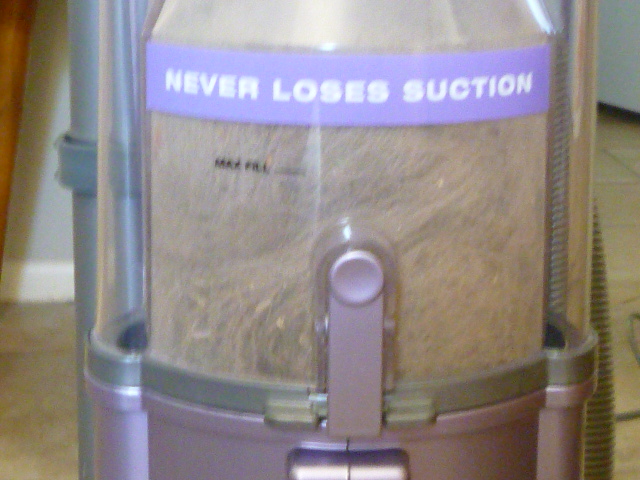
The suction defies belief! This thing is astonishing. And when you run it along the baseboard, it picks up bits of debris and dog hair all the way right up to the wall. The hose is as effective as the floor vacuum part. If it gets ahold of your leg or your hand, it gloms on like a lamprey eel. Check out how much dog hair it sucked up in just one vacuuming adventure:

Dog-hair-in-vacuum
Cleaned this out before starting to vacuum!

And Cassie isn’t even shedding much—there were no major dog dunes on the floor when this housecleaning episode started.

It does not blow dog hair up into the air as you’re moving around the tiled floor. A miracle!

It has a generously long attachment hose to begin with, and it comes with an extra length of hose.

Its attachments are sturdy and intelligently designed. The crevice tool is very long and slender, letting you get deep into narrow spots.

It has a good long cord.

It runs pretty quietly, especially in the “bare floors” mode.

Possible drawbacks:

I thought I’d prefer a model that uses bags, having emptied the dirt out of altogether too many old-fashioned vacuum cleaners. The Shark, however, is easy to open and clean out, and so far I haven’t ended up with the dirt all over me instead of inside the trash can.

The cylindrical canister that houses the dustbin and motor is bulky, obviating rolling the vacuum under the bed or other furniture.

It doesn’t have a lot of space for onboard attachments. IMHO, that’s a good thing: I’ve always hated having to haul all that junk around the house willy-nilly.

On reflection, I realized I seem to have accumulated quite a few Shark gadgets. When my ancient Rowenta warhorse iron finally wore out, I bought a cheapo Sunbeam, which worked fine but got way too hot around the grip. After burning my fingers on the thing, I picked up a Shark steam iron. The price assuredly was nothing like what a Rowenta costs, and yet it works just about as well. The stainless-steel is good and tough—so far it hasn’t scratched up at all—and you get a lot of control over the amount of steam emitted and the heat levels. I would call it very comparable to the Rowenta at a far more reasonable cost.

Then there’s the Shark floor steamer that I finally found to replace the beloved old Bissell steamer, a gadget that could not be beat—never has been, never will be. Shark’s steam mop comes pretty close, though. If you have a lot of tile flooring, this is the contraption to own. With no stinky, toxic chemicals, it steams the dirt and grease right up. You end up with your floors clean, with no eau de dirty mop perfume in the air after you’ve finished the job.

Its only drawback is that the pad that comes with is almost useless. It’s too thick, and it doesn’t stay attached. And they only give you one. I’ve solved that problem, however, with those microfiber rags you can buy in the automotive department at Costco and, presumably, at auto parts stores like Checker and Auto Zone. I just clip one on neatly, using a couple of clothes pins. These things are highly washable, and because you can buy a great stack of them, you can switch them out as you move from room to room (my entire house is tiled), giving yourself a clean mop head at all times.

I was mildly surprised when I realized my house had been invaded by a school of sharks. Since I’m kind of picky about the gadgetry I use for cleaning, it must mean the Shark products are OK. Maybe even a little better than OK.

🙂