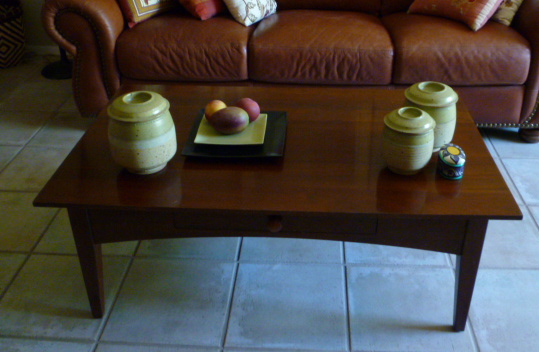
Coffee heat rising

Most coveted junk

So, what do you want for Christmas? The New York Times “Home” section, one of my favorite catalogs for the aspiring nouveaux, has any number of inspirations for valuable junk you can give to friends and relatives, or, better yet, ask them to get for you. I love looking at this stuff. It’s so hilarious! Consider, for example, the stone platters edged in gold leaf, at $375 apiece an item you surely will treasure for the rest of your life and hand down to grateful children. Speaking of leaf, we have these fine leafy spoons, designed to scrape the hide off your palate, at $195 to $275. And who wouldn’t appreciate a framed collage of dried weevils, your loved one’s for a mere $700!

Surely we must all be guilty of coveting some useless object that costs more money than anyone has good sense.

Moi, I want a set of Christofle sterling silver flatware in the Cluny pattern. The going rate for this stuff is $990 a place setting, or $7,920 for eight place settings; but one place online will let you cobble together eight place settings for a mere $4,640 (shipping free!).

What makes this wee craving especially ridiculous is that I already have a perfectly fine set of Cluny in silverplate.

Yes. But…I want it in sterling.

Having received precious few of the pieces of the Royal Danish we registered for our wedding, after my ex-husband made full partner in the tony law firm where he worked, he and I set off to San Francisco one year in search of a set of sterling that would meet our tastes, which had evolved somewhat since the day we were joined in holy matrimony. As a young thing I had selected Royal Danish because it vaguely resembled the pattern I really wanted, which was George Jensen’s Acorn. Why did I think I had to have that? Because one of the other budding partners’ wives selected it.

She and her groom, however, could afford it. We could not, and amazingly enough we had enough sense to realize that we never would: today eight place settings will  lighten your load by $11,625. IMHO, it’s not that much better than Royal Danish: they’re both kinda ugly.

By the time XH and I went in search of sterling, I had decided that I wanted something astringently, Spartanly plain. No frou frou. None. No curlicues, no roses, no leaves, no “acorns,” no acanthi that look vaguely like “acorns” that look like acanthi. What I wanted was something that would resemble the few 19th-century coin-silver pieces handed down from my great-great grandparents through my mother.

Do you know how hard it is to find sterling flatware that is free of gew-gaws?

It’s hard, that’s what it is.

We had just about given up when we stumbled into Neiman’s—it was the last place we were going to look. If we couldn’t find what we (i.e., “I”) wanted, we would resign ourselves to living with our perfectly fine, breathtakingly expensive Danish stainless. We explained what we hoped to find to the sales lady (at Neiman’s, we don’t drool over the silver in its glass cases: we ask to be shown the silver). Forthwith she led us to the sliding wooden cases where the Christofle resided, and by golly, there was a perfect rendition of what I had in mind.

However, in those days Cluny was not produced in sterling. You could only get it in plate. At that time and in that place, the silverplate cost as much as an American set of sterling. XH was prepared to buy sterling, and I expect he would have bought it in sterling were it available. I’m sure, however, that he was privately relieved when I announced I loved the pattern so much that I had to have it, plate or no plate.

Polished and ready for Thanksgiving. Note how similar the Cluny is to the antique pieces in the lower right quadrant of this photo, some of which are dated 1864.

I’ve treasured this stuff since we got it. After I exited, I left the fancy Danish stainless with XH and decided that I would use the Christofle every single day, the theory being that when you save things for special occasions, you never do use them. And I have. Not only that, but I wash it in the dishwasher. It has held up well: the plate is so thick that after 18 years of daily use, it shows no sign of wearing through.

But, it being plate, it goes clunk when a couple of pieces bump together. I want my Christofle to go ping!

I ask you: is that unreasonable?

Almost ready for Thanksgiving. We actually had more people, and wine glasses were lined up on the kitchen counter for immediate use by arriving guests. I should've put the plates on, since all the food was brought to the table.

Shopping estate sales for deals

Five-Cent Nickel features a nice guest post by Craig Ford, proprietor of Money Help for Christians. Craig holds forth on ways and places to find a good deal, among them yard sales. Just last night, I was congratulating myself for having found one of my all-time best buys—a deluxe “Rabbit” wine opener that normally sells for as much as a hundred bucks—at an estate sale. I picked it up for five bucks.

Estate sales are different from yard sales in several big ways.

A true estate sale is organized by professionals. Estate sale operators are companies and so must charge sales tax. They have a good feel for what things are worth (usually less than the homeowner thinks), and they usually do a nice job of organizing the merchandise.

Estate sales are generally held inside the house and in the back yard, so you get to see how other people live.

And some of the other people live mighty high off the hog. Estate sales often take place in multimillion-dollar homes, sometimes owned by people who can afford to maintain several places and who, when selling a house, simply dispose of all the designer furnishings and redecorate the next place from scratch.

Estate sales may take place in gated communities and HOAs where ordinary yard sales are not permitted.

Nine times out of ten, the offerings at an estate sale are much, much nicer than anything you find at a yard sale. Often you’ll find expensive items that are barely used or even brand-new.

In addition to the Rabbit, which I use a couple of times a week, I’ve bought high-quality cutlery, a beautiful set of coveted Tonalaware, a matching red leather sofa and recliner for M’hijito’s house, a fun leather ottoman for my own place, a gorgeous custom-made library table, upscale cookbooks, and any number of tschotchkies, yard items, and household gadgets.

The trick to estate sales is finding out about them and then getting there before they open. An easy way to find an estate sale in your area is to go to Estatesales.net and subscribe. At the site, you can click on your state and then your city to find a list of nearby sales. It’s even easier to subscribe; this will elicit a weekly e-mail listing of upcoming events, and the e-mail generally tells you whether and where the estate-sale company has posted photos.

A listing with photos is especially useful, because you get a feel for whether a given sale has goods that may interest you, and you waste a lot less time than you do wandering from yard sale to yard sale.

Remember, though, that you will be competing with antique and second-hand dealers. This means you need to get there early! Be there a half-hour before the door opens, and be prepared to stand in line. If a sale is really hot, the organizers will let only 15 or 20 people in at a time, for safety and for the sake of maintaining order. The dealers are always there as dawn cracks, and they go straight to the best stuff.

It’s smart to bring a basket, box, or shopping bag, so you’re not having to balance things in one hand while you inspect the merchandise. Also, some people will bring their own tags marked with their name and SOLD. Usually you claim an item by removing the tag or picking it up and carrying it over to the cashier’s table, but not everyone knows an untagged item is considered “sold.”

Estate sales are a lot of fun, not only because you sometimes score a fantastic deal but because you get to see some amazing real estate, some interesting antiques, and some expensive designer furniture. La Maya even found her house in our neighborhood at an estate sale. She visited the estate sale, having found it in a weekly e-mail notice, and once inside she realized she loved the beautiful house. When she asked the estate-sale organizer if the owners were planning to sell, the answer was yes! Instantly she called her partner, who agreed that it was a perfect place for them, and before long they were living around the corner from me. Now there’s an estate-sale triumph!

Do you do mail-in rebates?

Grrr! I think I just got jumped through the hoops for very little in return. At Costco I picked up a package of three air-conditioning filters for $39.99; mail in a rebate form (which asks for personal information such as your e-mail address and phone number) and they’ll send you a munificent three bucks, dropping the per-filter price to $12.33.

They’re high-quality filters, the nonallergenic electrostatic variety supposedly good for three months, reinforced well enough that they don’t foop up into the air-conditioning vent and form a giant concave toy whistle every time the AC unit comes on. But still.

In June of 2008, I bought two similar filters from Ace for $31.17, or $15.58 apiece; allowing for 3 percent inflation, today they might be expected to sell for $16.04. In other words, I used my time and my 44-cent stamp to save $11.13. Had I chosen not to kill time, compromise my ethics by lying about my phone number and e-mail address on their form, and use up a postage stamp, my savings over an Ace Hardware purchase still would have been $6.75—without the rebate.

Was it really worth the hassle to send in a rebate for three bucks, which I may or may not ever see?

Do you consider a mail-in rebate offer a strong enough come-on to persuade you to buy a product, or to prefer Product A (with rebate) over Product B (same price, no rebate)? Is there a limit on how small a rebate you’ll bother with?

Delayed Gratification: The frugalist’s secret weapon

Over the weekend, M’hijito and I dropped by a Cost Plus (World Market) in hopes of finding some stylish and cheap outdoor furniture to decorate the newly refurbished yard. And did we hit the jackpot!

The past few months, we’ve admired various pieces of Late Downscale Designer furnishings there but generally thought they were too expensive. I’ve lusted after some faux teak outdoor tub chairs, very comfortable and kinda nifty-looking, and he has coveted various tile-topped tables and faux teak dining sets.

The tub chairs normally cost $100 apiece. And though they’re very nice, I’m sure, I never felt the quality was worth a hundred bucks. Especially since I already had some perfectly fine second-hand outdoor chairs. Once, feeling flush, I almost succumbed to temptation, but then personfully managed to resist. As for the dining set: the table was over $300 and each chair was $100. Nine hundred bucks plus 8.8 percent tax was outside M’hijito’s price range, and so for him such a purchase didn’t even rise to the level of temptation.

Well. Today when we visited the Camelback store, they were trying to move the last of their seasonal outdoor furniture off the floor. Oddly, in other parts of the country, summer is almost over (for us, outdoor season will return in about a month). So, just when we’re wanting to buy outdoor stuff, it all goes on sale.

And what a sale! Everything was marked down 75 percent!

There wasn’t much left, alas…but fortunately, Cost Plus is a cookie-cutter chain. The manager called around the city and located the pieces we coveted—four tub chairs for moi, two tub chairs for M’hijito, a table, and four side chairs—in Chandler, a quarter-tank of gas from our part of town. By the time the loot was found and claimed, it was too late on Saturday afternoon for us to drive halfway to the Mexican border, so we made the trek the next day, on Sunday.

What an incredible buy! M’hijito got a handsome faux-teak trestle table that seats six people plus six matching chairs for $231! I got four of the chairs I’ve quietly been coveting for the original price of one.

One of the frugalist’s most important strategies is to think twice about buying stuff you think you want. Pick it up, look at it, put it back down, and then take time to think about whether you really need the object of your current dreams. It won’t go away within the next couple of days. Often if you leave the store without it, you’ll find that on reflection you really don’t have such a crying need for it. If, on reflection, you do decide you need it, want it, and can afford it, then you can be confident that you’ve made the right decision.

And, as we see in this sterling example, sometimes when you come back to something you’ve resisted buying, you’ll find it’s on sale. Delay buying seasonal items, especially clothing, holiday gear, and outdoor items, until the designated “season” is almost over, and you often can almost name your price for the stuff.

Heeee! Seventy-five bucks for a sturdy, handsome table that seats six!

Purchases!


With the advent of more and more good movies and British television shows to watch over the Internet—and the steady loss of good things to watch on my television—I moved a moderately comfortable Eames-style chair out of the TV room into my office. There, I could push my desk chair aside and pull up the Danish lounger to luxuriate in front of some of the wonderful performances to be had by computer. This left a big, gaping hole in the TV room’s decor. So, I decided I should try to purchase an inexpensive chair for that spot. No one ever sits there, so it doesn’t have to be especially comfortable, but it shouldn’t be too ugly. 

I’d spotted a dowdy but more or less acceptable chair at a store that bills itself as an antique mall but really is a collection of second-hand furniture dealers’ booths. I don’t remember what the style is called—I always used to think of it as “ranch furniture,” because you’d see it on ranches and even in the dorm rooms at the University of Arizona: the chair consisted of a wooden frame with wide, flat armrests big enough to set a can of beer on; upholstery was a seat cushion and a back cushion. Although they can be surprisingly comfortable, this one wasn’t, and while the fabric on the cushions was in excellent condition, it was truly hideous and would have to be replaced. 

But I can make cushions and could certainly have built new covers for those. Though the dealer wanted $175 for the chair, I figured I could push it down to around $150.

Still: it wasn’t a very pretty chair, and if I hired an upholsterer to recover the cushions, I could end up paying another hundred bucks or more for the final product.

A notice came in the mail from Crate and Barrel, advertising a 50 percent off sale. Hot dang! On the first day—Thursday, I think  it was—I shot out to Scottsdale like a rocket. Hope springs eternal in the consumer’s breast…

Well, if Crate and Barrel was selling anything at a 50 percent mark-down, I sure didn’t see it. They had one piece marked off 40 percent…the sort of thing that goes on sale for a reason, the reason being no one in their right mind would want to own it. Otherwise, the deepest discount was around 20 percent. The two chairs that would have done the trick in the TV room were well beyond my price range. 

While I was there, though, naturally I had to wander through the houseware department. There I found…ta DAAA! These excruciatingly nifty Polish glass items.

They reminded me of my wonderful Polish sister-in-law, who once gave me a glass sugar and creamer set that looked very much like the one here—a little more modern and stylish but very similar. To my dismay, I broke the creamer a few years ago. I always regretted not getting to know my former sister-in-law better: she and I had much in common other than the brothers we married. She lived on the East Coast and then later in Texas, and the distance made it hard for us to stay in touch. 

So, with this purchase in hand I drove back into town and revisited the junk antique store, planning to buy the wooden chair. Boy, those cushions were ugggg-leeeee! Each was an off-size, too: no chance of buying cushions somewhere else to wriggle out of having to make new ones. And the chair’s joints were loose: it needed to be taken apart and reglued. This thing was beginning to look like a large project, and one that could run up the price considerably.

Pier One has some cool furniture. Most of their chairs are sterling uncomfortable, but comfiness was not a high priority for this decorator item. Besides, it occurred to me that I might get one of their wicker or fake-wicker outdoor chairs, some of which have real panache and actually are more comfortable than their interior furniture. So, before making a final decision about the $175 second-hand masterpiece, it was back across the city to the nearest Pier One outlet.

Their latest sales ploy is to have an employee accost you the instant you walk in the door, eagerly offering to follow you around the store and direct you to the many things you surely will want to buy there. I hate that. So I had to tell the manager, who was the accoster of choice that day, to leave me alone, thank you. 

I found several patio chairs, any one of which would do the job. The one I liked was selling for around $125, but of course you had to pay extra for the seat cushion. The ones they had on the chairs in the store were sterling hideous (have you noticed lamps and upholstery fabrics all seem to be done by graduates of The School for Ugly Design?), and the only cushion I liked didn’t fit the chair.

They did, however, have a couple of wicker indoor chairs that were reasonably priced and very nifty-looking. The jazziest of these was one of the most breathtakingly uncomfortable things you would hope never to sit in. But another, given the right cushions, was pretty tolerable. If guests came over, I could sit in the Pier One chair and let my friends have the better seating. Unlike the seat cushions, Pier One’s throw pillows are to die for! It’s hard to resist coming out of that place with an armful of the things. Soooo….  This was the result:

The wicker looks almost black in this image; it’s actually a dark brown. Overall cost, with the chair and three fancy pillows plus 8.3 percent tax: $334. More than I wanted to spend, but a heckuva lot better than the $1,266 Crate and Barrel wanted for the best of its offerings. I figure I probably would have ended up spending pretty close to fifty bucks on upholstery fabric to rebuild the second-hand chair’s cushions. And regluing the joints…who knows how many hours of my time? Actually, that job might have been beyond my skills, so I would’ve had to hire a handyman to do it: two hours of Greg’s son’s $30/hour time: another sixty bucks.

$175 + $50 + $60 = $285, plus the cost of my time and hassle

So though I didn’t get a bargain, I don’t feel I did that badly, either. Not bad at all. Forty-nine dollars for to save four or five hours of my $60/hour time devoted to repairing and upgrading the junk vintage chair? I’ll take it.

😉

Get those estimates!

dollarWhenever you need to get work done by a contractor—any contractor—be sure to ask for several estimates. The range of prices you’re offered can be amazing!

Case in point: We need to have three short lengths of gutter installed along the freshly painted eaves of the downtown house. I’d like to get those seamless make-it-onsite things, which don’t cost much and which come in so many colors you can usually get one that closely matches the paint job.

Day before yesterday, I called three outfits that advertised free estimates. Two responded. The first sales rep, who called me back within minutes, showed up that very day and said he’d do the job for $600. The second outfit agreed to send an estimator over at 8:00 yesterday morning. She made the same measurements and pulled out an identical book of color chips…and then presented a bid of $430.

That’s a difference of $170! For the same, exact job with the same, exact product.

Update!

It gets better: The next estimator stalked around the house, measured, cogitated, waved his calculator, and disgorged an estimate of $325…just a little over half the amount the first guy wanted. Amazing!

Next: to find out how much it would cost to buy the materials at Home Depot and get a handyman to hang the stuff from the fasciaboards & rafters. This should be innaresting…