Today is the first day for not one but two new classes, a section of English 101 and the new online magazine writing course. Well, actually, the mag course officially started yesterday, but not much is going on other than to answer the occasional plaintive “I can’t make Blackboard work” message.
LOL! Neither can I, kiddo!
These eight-week courses are great. Because they move right along, you don’t have to pad them with a lot of time-wasting busywork (if it’s busywork for them, it’s busywork for you, too—you end up having to read the stuff!), so you get through the essential course material in a timely way. If the section that just ended is representative, the shorter format attracts more ambitious and motivated students, so you have better retention and overall better effort on the part of classmates. And if one of them turns out to be a shade on the troublesome side, you get them out of your hair quickly, instead of having to deal with a problem child through 16 long weeks.
Offer letters were supposed to have gone out yesterday, so when I get to campus one should be waiting for me. We’ll see if the Boss has granted me the much-needed three sections next semester, and if more than one of them will be in the eight-week format. We’re doing a repeat of the magazine writing course in the spring, the current one having filled right up. So I’m hoping he’ll clone my fall schedule, which has been pretty easy to deal with, work-wise.
Some time back I came up with the idea of managing time by blocks dedicated to specific activities. This weekend I engaged a new tool for the purpose—offspring of a Doh! Why didn’t I think of this before moment. Google’s calendar is perfect for dedicating chunks of time to particular types. You don’t have to be logged in to an Outlook account to get it to give you a reminder; it’ll ping you through any e-mail address. And the calendar, IMHO, is somewhat easier to use than Outlook’s.
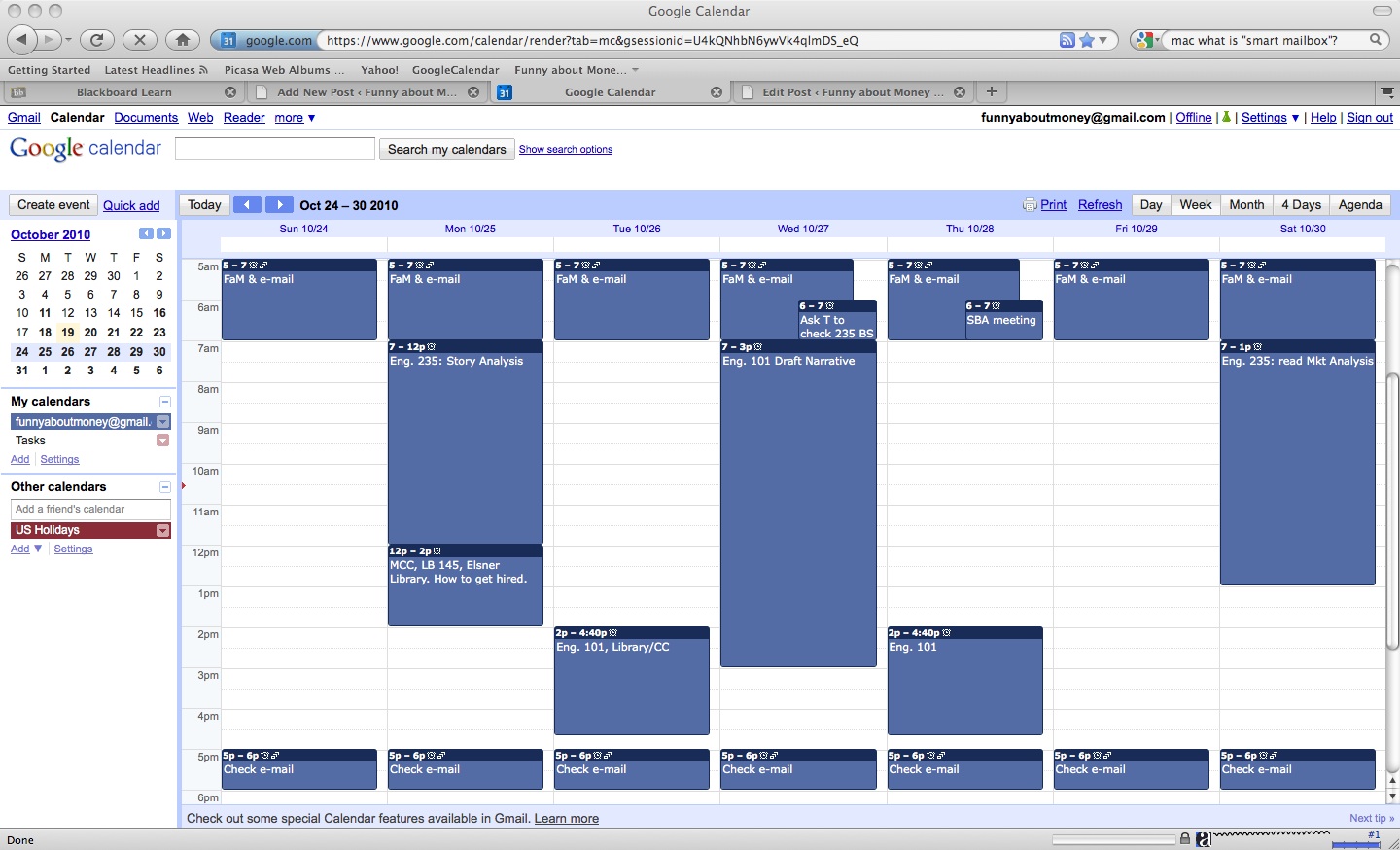
Over the weekend, I went through my semester calendar, noted each due date, estimated the amount of time required to grade each assignment, figured out when I could devote that much time to it, and then entered the assigned slabs of grading time into Google Calendar. The result:
(Click on it for an image large enough to see details)
It remains to be seen, of course, whether I’ll actually stick to this scheme. If I can, it should help to get the workload under control.
One way or another, though, it presents an interesting little revelation. Look at how much time is left free after I’ve supposedly done all the work associated with these two courses and FaM!
What, one wonders, have I been doing sitting in front of a computer 14 hours a day?
Well, one thing is answering the e-mail. Five new messages have come in during the ten minutes or fifteen minutes it’s taken me to write this much copy and upload that image. I’m constantly diddling with the e-mail. So I’ve decided that I should take a leaf from other bloggers’ books and limit e-mail reading to early morning and late afternoon. And just this moment, it’s {click!} Off with MacMail! Command-Q: Quit Mail!
The other vast time-waster for me is cruising the Internet. It’s hypnotic. I spend way too much time cruising news sites (CBS Marketwatch: Dow is down 1.2 at 11,010, but eek! it was down below 11,000 earlier today) and reading other people’s blogs. When I’m working during the school year, I need to get a grip on that. There have to be better ways to spend those nice clear spans of free time!
Is any one office chair perfect for everyone? Experts in ergonomics will tell you “no.” The perfect office chair for you depends on many factors, such as your height, weight, posture, areas of pain, and what your chair will be used for. How many hours per day will you be in it? And does your work entail computer, phone, or paper work? As you can see there are many variables.
As a doctor of chiropractic my main concern is the patient’s posture. Recent research has shown a direct relationship between many health problems and a forward neck posture. With more and more people spending more and more time on computers, cell phones, and other electronic devices, health problems are beginning to pop up. Some of these health conditions include disc herniations, loss of concentration, reduced immune function, and cardiovascular, respiratory and gastrointestinal problems.
Human bodies were not designed to sit in chairs for hours at a time, yet this is what our modern age has brought us five to seven days a week for six or eight or more hours per day. Welcome to the wonderful world of health problems and premature aging.
So, since you’re spending most of your waking hours sitting in front of a desk, it’s in your interest to find the best office chair for your body. An ergonomic chair gives you the most adjustable options for your body. But these chairs have so many options to select! If you are looking for the best office chair for yourself, what are the guidelines you should use?
What is Ergonomic?
The term “ergonomics” comes from two Greek words: ergo, meaning work and nomos, meaning natural laws. Ergonomics works with your body’s makeup so the chair fits your body’s posture.
A correct office chair for you should be adjustable in many ways to fit your body.
• The chair should rotate 360 degrees. • The depth of the seat should be adjustable. • The chair height should be adjustable. • The chair seat should tilt front and back. • An adjustment to tighten or loosen chair seat tension should be available. • The chair’s back should tilt front and back. • Arm height should be adjustable up and down. • The distance between the arms should be adjustable in and out. • The arm pivot front and back should be adjustable. • A lumbar air pump should be available.
Some specialists in ergonomics frown on chairs with arm rests, because they may make it hard for you to get close enough to the computer. This is another matter that depends on the user’s size, body characteristics, and preferences. Each workstation problem can be solved by working with a specialist in ergonomics.
Putting Your New Chair to Work
Once you have chosen your chair and it feels great, you must integrate it into your workstation. Although many believe that the chair you’ve chosen is the most important device in your workstation, there are other factors to consider.
The overall workstation, including chair, desk, computer, and desktop tools, can be the most modern and up-to-date in the industry, but if you abuse it, you will have health problems. With your ergonomic chair, some of these problems are easy to solve. For example, when you sit at your workstation your computer should be in front of you. The top of the screen should be no further than 24 inches from view, controllable by chair positioning. Don’t forget to use a glar- reducing screen, which helps with eye strain. Arms and hands on your board should be relaxed and just below the level of your heart. Knees should be either level with or slightly higher than your hips. All of these can be made correct with your new ergonomic chair.
The height of your work surface should be between 24 and 32 inches. This is a variable based upon the individual’s height. Raise or lower chair or work surface to find the most comfortable position.
Now Get Up!
You have your chair and work surface perfect, right? Now consider one other thing.
Sitting at your workstation for hours without moving causes stasis, which for individuals may mean vascular problems, muscle tightness, headaches, fatigue, and numbing of the work brain. The solution is to get a kitchen timer or something similar and set it for 30 or 45 minutes. When the alarm goes off, simply get up, walk around your workstation, and take a few deep breaths. This will do wonders for you and your job.
A proper office chair can mean the difference between a comfortable place to work that is safe, healthy, and productive or drudgery blighted with repetitive strain injuries and postural health problems.
Go find yourself an ergonomic chair and enjoy your job and a healthy life.
Images:
Aeron Chair. Public domain.
Computer Workstation Variables. Integrated Safety Management,
Berkeley Lab. Public Domain.
Okay, so one train of thought that’s been going on here at Funny about Money has to do with the dawning realization that I’m spending too many hours on work that doesn’t pay a living wage and too few hours on actual…well, living.
In a good month, FaM returns about two hundred bucks, and that’s fine, because it’s exactly the amount I need to get out of one section of freshman comp a year. Or, more to the point, to make up for an assigned section that doesn’t gel.
And I normally make $200 or $250 a month reading detective novels (!) for my favorite client, Poisoned Pen Press. This amount covers a second freshman comp section each year, and of course it’s pay for play.
So, between them these two piddling sources of income either give me the option of teaching two and two (i.e., two courses a semester) instead of three and three or provide a safety net should one of three assigned sections not gather enough students to fly.
For both these income streams, pay per hour is beneath laughable. FaM earns about $6.67 a day, on average; spending two hours on a post and another hour on blog-related web-surfing yields a pay rate of $2.19 an hour. Earnings for editing the novels are somewhat better: $12 an hour.
Usually, those novels serve as bed-time reading, so the work I do on them doesn’t occupy productive daytime hours.
After a little experimentation, I’ve found that if I get up off my rear end in the morning and do some yardwork, housework, dog walking, or socializing before settling in to paying work, I can put off writing blog posts until the evening. It’s something that can be done, as it was in the beginning, from an overstuffed chair in front of the television. That strategy defuses the blogging work by moving it out of daytime hours that should be better paid or at least should provide some fun, exercise, or relaxation time.
Now. What about the teaching?
What, really, does it pay by the hour? And is there a way to manage time used in teaching to ensure a decent hourly wage?
Well, I did a little English-major math and made some interesting discoveries. First, I posited that a “decent” rate would be about $30 an hour, approximately what I was earning at GDU before the layoff. Second, I established that I should work no more than five days a week—I should get weekends off to sing in the choir, schmooze with my son, and do whatever I feel like doing. A community college course here in Maricopa County, Arizona, pays $2,400. With those as givens, let us ask…
How many hours can you put into a community college course and still earn a decent wage?
Okay, so what we see here is that no matter how many weeks the course spans, the maximum number of hours you can work on the course to keep the pay rate at $30/hour or better is 80. Next area of inquiry: is that realistic?
To keep your rate at $30/hour, what is the maximum number of hours you could spend on a course working outside of class meeting time?
Well, if you add up the number of hours per period and multiply by the number of class meetings, you find that an eight-week course meets about 42 hours; a sixteen-week course meets 40 hours. Since the excessively long meeting time for the short-form course requires several breaks, you could (sort of) argue that class meeting time for the eight-week course is actually about 40 hours, too.
A fully online course, by definition, has no class meetings, but it requires a great deal more course preparation time.
To keep your pay rate at $30 an hour for an eight-week course, you could spend no more than five hours a week outside of class, giving you one hour a day of grading and interaction time.
With no face-to-face (F2F) time, an online course provides a full ten hours a week for grading and online interaction with students.
For a 16-week F2F course, you could spend no more than two and a half hours a week outside of class. That’s only a half an hour a day, five days a week.
On the face of it, this doesn’t look very practical; realistically, one spends many hours a week reading student papers and answering e-mails. However, it’s not as dire as the figures above suggest, because you can manipulate due dates so that some weeks pass with no incoming. So, let’s look at this from a slightly different perspective:
How many hours does it really take to grade student papers?
The community college district requires four papers for English 101 and three papers for English 102. A typical set of freshman comp papers takes four to six hours to grade.
Okay, an hour an a half is still not long enough to grade a set of papers. However, assuming one doesn’t have to grade a set of papers every single week, then what? In fact, with 40 hours of in-class time, you have another 40 hours, at $30/hour, available to read student papers. That provides plenty of leeway to perform 24 hours’ worth of grading!
This optimistic conclusion, alas, leaves out the untold numbers of hours one spends in course preparation.
How much time could you spend on course prep and still gross $30 an hour?
In reality, it takes about four or five full-time, eight-hour days to prep a composition course, especially in the semesters when a new edition of the overpriced textbook comes out.
Thus, to make this work, prep time would have to be cut to no more than sixteen to twenty-two hours. All scutwork—that is, all checking and scoring of in-class exercises, drafts, and homework—would have to be foisted on a teaching assistant, so that all the instructor had to read would be the required, final full-length papers. Assuming about 15 or 16 hours of scutwork, I could afford to pay a T.A. $10 an hour and still be left with enough to buy groceries.
If all one read were the required papers and a T.A. scored the other student activities, how many hours would you spend on a course and what would you earn per hour?
It works out. Of course, about fifteen of those hours would actually earn only $20/hour, but the $10/hour wage for one’s T.A. would be tax-deductible.
In its strange way, this perspective starts to make things look a little better. First, what we see is that teaching, even adjunct, is my best and steadiest source of income. And on inspection, we see that I’m actually grossing approximately what I earned, per hour, at GDU. It explains why I seem to have plenty of cash during the nine months of the school year, and it suggests that even one course over the summer would chase away the summertime budgetary doldrums.
What can be done to bring course preparation time under control?
There, too, I have a plan.
The base content (such as it is) of freshman composition has not changed since I started teaching the subject about 40 years ago. There are only so many ways you can explain what an essay is, what a research paper is, and how to write them. This means that every newly adopted textbook and every new edition of an existing textbook is just another rehash of the same material.
So, prep time could be cut by creating fungible modules that can be plugged in to each new semester’s sections to fit time available. We might call such modules “learning module templates.” These would key reading assignments to subject matter, and writing assignments to specific patterns of development, not to chapters in the current textbook. Thus if in a given week you want to teach students a specific mode of discourse, you simply take whatever textbook you’re handed and look for the chapters or passages that discuss that.
To avoid having to create new assignments for each new textbook edition, you would have to be sure never to key a writing assignment to a reading selection (i.e., a sample essay) printed in the text, since these tend to change as new editions are churned out. You could require students to use the book’s selections as source material for their essay citations; this wouldn’t stop plagiarism, but at least students would feel they were using the textbooks more fully.
Each module could contain the following
• The module’s learning goals • Subject matter that should be addressed in reading • Homework, related to this subject matter but independent of specific reading matter • In-class lectures, discussions, and activities • Writing assignment, if any (depending on the number of weeks/course)
If you made the modules generic enough, it would be very easy to pick and choose to fit your timeframe, and quick to plug in new reading material and resources to make the broad choices specific.
It would take some time to create these things, but once they were in place, each semester’s prep time would drop to a few hours.
So what does it all mean for Working Smarter?
In the first place, sideline enterprises that earn less than a living wage should be relegated to the status of hobbies. They should not be permitted to consume time that could be spent more profitably, nor should they be allowed to morph into work.
Blogging, for example, should be as entertaining as reading detective novels. It should never be treated as a job. In other words, I should not be trudging in to my office every morning, there dutifully to crank out another post. I should not be checking e-mail every few hours to screen out spam and accept comments from real humans—instead, do this at the end of the day. Adsense? Alexis? Google Analytics? Awstats? Is there some point in tracking data whose significance is negligible, except as gratification for a hobby? Obviously not. These should be ignored; certainly never checked more than once a week.
In the second place, the number of hours put into decently paying work should be tightly controlled so that the per-hour wage never drops below a minimum threshold.
With teaching, it appears this is eminently possible. Medicare keeps overhead down so that, given enough sections, $30 an hour amounts to a middle-class wage. The only drawback to focusing solely on teaching as the “real” source of income is that it doesn’t pay enough to add to savings. However, next year I should be able to get some summer courses, and in that case, any editing and blogging income can be rolled into savings. That would fund my Roth each year, as long as I can dodder into a classroom or sit in front of computer to teach an online course.
And there really is no third place. It’s pretty simple.
• Move the hobby income out of the center of one’s field of vision. • Focus on the endeavor that earns the most money. • Control time spent on that endeavor to maximize per-hour income.
{sigh}Decided to kick the caffeine habit for awhile and so now have a fine caffeine deprivation anemia headache. Today being only the second day of this moment of ascetic virtue, I expect another day or two of migrainish crabbiness.
Once when I went off the killer brew, the headache lasted an entire week! Dang. Hope this goes away sooner than that. I’m allergic to aspirin, acetaminophen and ibuprofen, so headaches and other minor pains are experiences to be…well, appreciated. LOL! As in “it feels so good when it stops.”
Normally, a cup or two of regular tea will dull or even kill the pain. Tea has less caffeine than coffee (heh…at least, the way I brew coffee, the result of which will melt a teaspoon left in the cup any length of time), and so it works for backing off the much stronger coffee. After a day or two, I can drop the caffeinated beverages altogether with no further effects.
Just to perfect my misery, I also decided to get off the sauce for awhile. I usually have one or two glasses of wine or beer a day. Probably two is too much, and two is the normal dose around here. Problem is, I tend to slip over that threshold with wine: an open bottle is too easy to tip over into a glass, especially if you haven’t finished your meal and you think, “Oh well, a tiny swiggle more won’t hurt.” Several tiny swiggles more and you’ve consumed half a bottle of the stuff! Because I have to get up, walk across the room, retrieve a new bottle of beer from the refrigerator, and open it, I’ll invariably stop after two or even one: the minor effort of having to move around and flip off a top is enough to signal that enough beer is enough.
The immediate cause of this frenzy of self-deprivation was yesterday’s conversation with La Maya. She’s determined to go on a diet, and she remarked that a mutual friend has lost a lot of weight but is drinking again and so seems to be gaining it back. I’d like to say our friend is more of a lush than I, but as a practical matter a half-bottle of wine is about a half-bottle too much. So we won’t be calling her kettle black.
Also lately I’ve been having a lot of heart palpitations, diagnosed as “stress attacks” by the worthies at the Mayo. These can be pretty scary, because they cause lightheadedness that at times makes me feel like I’m going to pass out. One of these occurred the other day while I was riding down a long escalator, which was a bit alarming. More often they happen when I’m driving at a high rate of speed on some road where there’s no place to pull over. So far they haven’t caused an actual faint, but I suppose there’s always a first time. Whether there’s a connection between these episodes and the coffee or the wine, I don’t know.
But I do know that sometimes the body seems to get saturated with caffeine, resulting in an overall sense of angst and jitteriness. That’s when it’s time to get off the bean. And I suspect there’s a connection between early-in-the-day caffeine and night-time insomnia. Even though my coffee consumption ends by about ten in the morning, older people metabolize drugs (which is what caffeine is) more slowly than younger ones. So it makes sense that the stuff could build up in your system over time and begin to affect you over a 24-hour period.
Interestingly, opinions are mixed about the real harm or benefits either of my favorite potables cause. We’re told by the worthy authors of Wikipedia that
Coffee consumption has been shown to have minimal or no impact, positive or negative, on cancer development; however, researchers involved in an ongoing 22-year study by the Harvard School of Public Health state that “the overall balance of risks and benefits [of coffee consumption] are on the side of benefits.” Other studies suggest coffee consumption reduces the risk of being affected by Alzheimer’s disease, Parkinson’s disease, heart disease, diabetes mellitus type 2, cirrhosis of the liver, and gout. A longitudinal study in 2009 showed that those who consumed a moderate amount of coffee or tea (3–5 cups per day) at midlife were less likely to develop dementia and Alzheimer’s disease in late-life compared with those who drank little coffee or avoided it altogether.
Very nice. On the other hand, as we learn from the same source,
Coffee prepared using paper filters removes oily components called diterpenes that are present in unfiltered coffee. Two types of diterpenes are present in coffee: kahweol and cafestol, both of which have been associated with increased risk of coronary heart disease via elevation of low-density lipoprotein (LDL) levels in blood. Metal filters, on the other hand, do not remove the oily components of coffee.
Yes. Well, I happen to favor French-press coffee, qui s’en fie de paper filters. I’m doomed!
As for wine, medical researchers apparently like the stuff, because they can’t bring themselves to condemn it wholeheartedly. Let’s get real here: it is, after all, booze. Nevertheless, we learn that
Population studies have observed a J curve association between wine consumption and the risk of heart disease. This means that heavy drinkers have an elevated risk, while moderate drinkers (at most two five-ounce servings of wine per day) have a lower risk than non-drinkers. Studies have also found that moderate consumption of other alcoholic beverages may be cardioprotective, although the association is considerably stronger for wine. Also, some studies have found increased health benefits for red wine over white wine, though other studies have found no difference. Red wine contains more polyphenols than white wine, and these are thought to be particularly protective against cardiovascular disease.
Hmh. I’ll drink to that.
Problem is, we’re never clearly told what “moderate” consumption is. The Brits would have us believe “moderate” means about a third of a small wine glass or half a pint of beer—a sip or two that, IMHO, would never last through a full meal. Five ounces, however, is a fair amount: almost half of one of my huge burgundy glasses. Here’s one of those monsters with five ounces of water measured into it:
Two swiggles of that much wine, and I’m cha-chaing around the kitchen. w00t!
The whole idea of depriving oneself of the minor pleasures of life in the name of some health or moral benefit has always struck me as dubious. Life is difficult, after all. One has few enough small joys (or large ones). Does it really make sense that taking away the small pleasures that make life worth living is going to make things better?
I doubt it.
However, experience has shown that long-term consumption of the type of Europeanized cowboy coffee I happen to favor will build up a state of tenseness and may contribute to the alleged “stress attacks.” Since I have nothing to be stressed over just now, it’s reasonable to run a test to see whether the caffeine has anything to do with that.
And the wine and beer? Well, like my friends, I certainly could stand to lose five or ten pounds. That beloved beer, in particular, is adding mostly empty calories. Now’s the time, while the weather is good, to be exercising, cutting calories, and running off some fat.
w00t! I’m never going back to work at GDU again. Over at the community college, the last of the student papers are graded, and all that remains is to meet one class this afternoon to return their papers. I’m waiting till this evening to post grades, because there’s still a shot my marvelously brilliant but distracted Asperger’s student will turn in a final draft (I gave a couple of foot-draggers until today to finish).
LOL! This kid is so amazing that even if I grade from the work-in-progress he turned in by way of proving that he is working on it, he’ll finish with a strong B.
Moving on: by this evening, I am going to be free of any sort of slave labor (except for copyediting another detective novel….heh heh heh heh!) for an ENTIRE MONTH.
Yesh.
I had forgotten how lovely winter breaks and summer vacations are. The only thing hanging over my head between now and the middle of January will be designing next semester’s courses. And I’m actually looking forward to that, because I have some highly creative new ideas.
Springing free from the Great Desert University is an enormous relief. One of the other things I’d lost sight of is how toxic that place is. I do not know one soul who works there who is happy in her or his job. At least one therapist in the city has a practice that consists almost entirely of GDU employees.
Imagine: a shrink who specializes in treating employees of a single organization. Does that tell you something, or does that tell you something?
The god of Sleep has returned to my precincts. I’m sleeping through almost every night undisturbed! It’s literally been years since I’ve had a full night’s sleep, one that wasn’t interrupted by a spate of wakefulness between 1:00 and 3:00 a.m. Matter of fact, that was the genesis of Funny about Money: nothin’ else to do in the wee hours but read blog posts and write a few of my own.
And since, for the first time since the memory of Person runneth not to the contrary, I feel rested when I wake up in the morning, I’m not irritable and on edge all day, I feel no desire for a drink every afternoon, and navigating our homicidal streets no longer reduces me to screaming rage.
Do I worry about money? A little. But I know I’ll get by at least through 2010. By this time next year, I should be well accustomed to living on a third of what I earned at GDU, and if that’s the case, I can go along forever on Social Security, part-time teaching, editing, and a very small drawdown (if any!) from savings.
Yesterday’s guest post by Revanche struck a chord, when she remarked on her surprise at realizing how much she revels in freedom from the workplace. Right on, lady!
I think a lot of wage slaves who trudge into an office, factory, or retail store stay on the gerbil wheel for one reason and one reason only: health insurance. It certainly was true for me: shortly after I divorced I realized that once the COBRA ran out (my ex- covered that, as part of the agreement), I would be uninsured and unable to afford my own insurance. That mooted the prospect of freelancing, which, in my financial naïveté at the time, I imagined would support me. Several times during my tenure at GDU, I thought I should quit the damn job and go back to freelance writing and editing, but the reality was that I could not get insurance to cover me fully and even if I could, nothing was affordable.
Insurers dream up every reason from Hell to short you on coverage. In my case, I was told that because I had a “diagnosis” that I had never heard of—something a doctor had innocently noted on my record but thought so minor he didn’t bother to tell me about it—Blue Cross would not cover any broken bones, back pain, or muscle spasms. This meant that a good car wreck would bankrupt me. And good car wrecks are commonplace around here. In any event, the cost was prohibitive. If I wanted to be able to go to a doctor, I had to keep working for GDU. Which of course was what was sending me to doctors…
Starting in January, the discounted COBRA will carry me through to Medicare. Though Medicare costs about 11 times more than GDU’s EPO does, it still is not beyond reason. The state of Arizona’s health insurance is so cheap (and you get what you pay for, BTW) that it far underprices what most Americans pay for group insurance, and so Medicare probably looks like a bargain for most folks.
Once government-provided health insurance is in place (if it ever gets past the retrograde types who are resisting it), I wonder what effect that will have on the labor force.
I suspect a lot of people figure they could get by with self-employment or in part-time jobs, but keep trudging because they can’t afford health insurance and are unwilling to go bare. How many workers who dream of jumping off the treadmill will do it, once that barrier falls?
I know I would have left GDU a long time ago if affordable public insurance had been an option. Why would anyone put herself through a lifetime of misery if there were a reasonable way to get out of it?
Maybe this is the reason the right-wingers oppose a public option: they know darned well the more self-starting wage slaves will flee if we don’t have to stay in the traces to get medical care when we’re sick.
What’s freedom worth to you? If you had access to decent, affordable health insurance and you could earn enough to cover your living costs on your own or through light part-time work, would you quit your full-time job—even if it meant cutting back on your lifestyle a bit?
Image: Pierre-Narcisse Guérin, Morpheus and Iris. Public Domain.
A miracle! The three a.m. wake-up call has stopped. The day after finishing my last real task for the Great Desert University, I fell into bed at 8:30 and slept all the way through to 7:00 a.m.: ten and a half glorious hours! Most amazingly, without interruption.
Next night, I slept from 9:30 til around 6:30, nine incredible hours, also without waking up.
Last night I didn’t get to bed until around 11:00 p.m. but slept seven hours, again without the mental alarm going off in the wee hours.
It’s been so long since I’ve slept all the way through the night, I truly can’t remember the last uninterrupted stretch of sleep. Seven hours is a long night’s sleep for me—but it’s normally cobbled together, a few hours before 1:00 or 2:00 a.m. and a couple of hours after 4:00 a.m.
Getting quit of GDU is doing it, I suspect. That and feeling fairly confident that I can get by in penury next year. Next year, at least: there’s enough to live on through 2010, and that will provide a full year to figure out what to do next.
SDXB, a man renowned for the soundness of his sleeping habits, remarked yesterday that he woke up at 3:00 a.m. just as though an alarm clock went off, and after that he was up for the duration. As it develops, last week Child Protective Services removed all four of his daughter’s children from her home, lodging one of them with her ex-husband (on condition of 24-hour supervision: the kid is in his home, but the father’s not allowed to be alone with him) and disappearing the other three. No one knows where the other three kids are, whether they are together, whether they’re in foster homes, group homes, or an institution, or what the state intends to do about them.
I observed that this would explain the insomnia. He insisted that worrying wasn’t what was keeping him awake. He says he’s washed his hands of the daughter’s problems, experience having proven there’s not a thing he can do about them.
Uh huh.
Pretty clearly, what wakes you up in the middle of the night is stress. Even if you don’t actually pop into consciousness with your brain spinning on the issue at hand, before long you certainly are turning it obsessively in your mind. I often would wake up unaware of thinking about GDU or money or the ailing dogs any of the other various little headaches that have haunted my dreams over the past few years. At a certain hour, I would just awaken, as though it were dawn and time to get up. Occasionally, though, I actually would wake up in a cold sweat, with the angst du jour right there in the front of my consciousness.
Whether you’re aware of it or not, evidently even when you think you have the stress under control, it doesn’t go away.
I’ve been yawning all morning. Expect to get another solid night’s sleep this evening. It looks like the body is going to try to catch up with all the sleep it’s lost over the past few years.