Coffee heat rising

Pay Off a Mortgage or Invest the Money Instead?

Yesterday at the weekly Scottsdale Business Association meeting, the assertion was again made that you should never pay off a mortgage in advance. If you have the money to do so, we’re told, you’ll come out ahead if you invest the money in securities and keep making those mortgage payments.

I wonder about that.
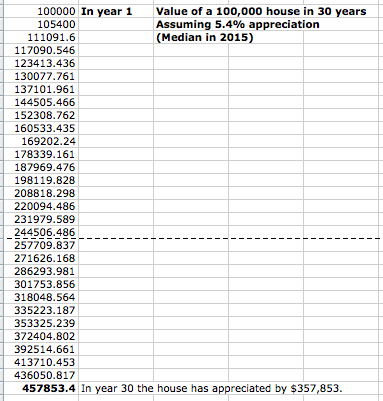
housevaluespeculation2Years ago, I paid off my $100,000 mortgage. (Can you believe I managed to wiggle into a North Central house for a hundred grand? Another recession was on: it was during the savings and loan fiasco.) The university had hired me into a full-time position, which though nontenurable, paid as much as an assistant professor in my department earned. SDXB was paying half the mortgage, which I carried on my books as rent, turning  the many upgrades the house needed into tax deductions.

With a year or two of alimony to go, it occurred to me that a) I would like SDXB to move out of my house and b) if I were covering the monthly mortgage payment myself, it would consume exactly half my net pay. Even with SDXB’s help, I was spending a little more than my entire net pay each month; if he left, I wouldn’t be able to stay in the house.

However, I had an inheritance from a distant relative, and I also had earned a chunk of dough by writing Math Magic for Scott Flansburg. With those amounts in hand, I could scrounge up the rest to pay off the mortgage from a couple of small investment accounts.

Over my investment adviser’s strenuous protests, I did it: Paid off the mortgage!

On several occasions, I’ve been glad I did it:

It allowed me to show SDXB the door.
After I was promoted to head up the university’s scholarly editing project, the increase in salary allowed me to stash a lot of money back into savings, thanks to the absence of an onerous mortgage payment.
When I was laid off the job, I was able to hang onto the house, which would not have happened if I’d had to make mortgage payments.

Because the value of the house was pretty small, in the larger scheme of things, the tax effects of getting quit of the mortgage were nil. Maybe if the house had been worth half a million bucks or so, or maybe if I were earning a living wage, it would have made a difference. But in my circumstances, it did not.

But the question keeps coming back to haunt: was it a mistake to pay off that mortgage?

So I applied a little English-Major Math to the issue. Here’s what I came up with:

Let us imagine you can buy a house for $100,000. You can finance it at 3.5% with no down payment (it’s before the Bubble, OK?). Incidentally, you happen to have $300,000 laying around in investments; of that, about $150,000 is not in tax-deferred instruments.

What would happen if you…

a) paid the $100,000 to a lender over 30 years; or
b) paid off the $100,000 in one swell foop?

In 30 years at a 5.4% appreciation rate, your $100,000 shack will be worth $436,050. Subtract the Year 1 value of $100,000, which you paid in cash, and your net value for your house will be $336,050.

If you took that $100,000 and instead invested it in an index fund returning about 5% p.a., on average, after 30 years that fund would be worth $411,613.

At a glance, it looks like you’d do better to put the 100 grand in savings than into the house.

However…that doesn’t take into consideration the real cost of a $100,000 mortgage over 30 years.

According to Bankrate, the total interest and principal you’ll pay on that 30-year mortgage at 3.5% comes to $161,657 — not including tax and insurance. Again, it looks like we’ll do better to put the cash in a nice, calm index fund.

So, let’s think about that:

At the end of 30 years, you’ve paid $161,657 to buy a house that is now worth $457,853. The net value of the house ($437,853 valuation minus $161,657 total interest and principal payments) is $296,196.

If you had not financed the house but paid for it with $100,000 out of pocket, your net value for the house after 30 years is 357,853 (i.e., $457,853 – $100,000).

Okay, keep these figures in mind:

Finance the house: net $296,196 on sale of house 30 years later
Pay off the house: net $357,853 on sale of house 30 years later

Even though paying off the house looks better, these figures still make the $411,613 that could now be sitting in your index fund look very good. Sell the house for $296,196, and you end up with an admirable enough $707,809.

HoweEVER: what if you figured that if you could afford to fork over a monthly PITI payment to a mortgage company in the amount of about $625, you could afford to stash that amount in savings — after you’ve paid off the house?

If you invested $625 a month in a low-load index fund (Vanguard has two of them), in 30 years you would have $357,853. Let’s suppose you have the foresight to do exactly that: you pay your $100,000 in cash, and you invest the equivalent of the house payments over the course of 30 years.

Now you have a total of  $769,466 ($357,853 + 411,613). That is $60,000 more than you would have had if you’d paid that $625 a month to a lender.

These prognostications depend strongly on interest rates. Mortgage rates are still very low just now — at the present 3.4%, it makes sense to buy a house with as large a home loan as you can get. But once rates rise above about 5 percent, that changes.

Over the past 30 years, the average 30-year fixed mortgage rate has been 7.19%. At times, it’s risen over an eye-popping 16%.  The present extended period of cheap money pushes that average to a deceptively low level.

At 7.19% interest, your principal and interest payments on $100,000 would add up to $244,122 over 30 years. Now the net value of the house to you is $193,731 (i.e., $437,853 – 244,122).  That doesn’t compare well at all with the $357,853 you would net on the house had you paid out that $100,000 lo these many years ago.

So, here are four strategies, in the order of effectiveness — from most profitable to least profitable.

1. Pay off the $100,000, then invest the equivalent of principal & interest payments at 5% (your net after 30 years: $594,103: value of house + value of index fund)
2. Finance the $100,000 at 3.5%; invest the amount of the monthly mortgage payments in a low-cost index fund (you end up with $532,446)
3. Pay the $100,000; spend the payment amounts to support a better lifestyle ($336,050)
4. Finance the $100,000 with a conventional 30-year fixed-rate mortgage at 3.5% and pay principal and interest until you’re ready to fall into the grave ($296,196)

Disclaimer: Don’t believe things you read on random websites! I am not a financial advisor. I am an aging English major who prefers playing with Excel to solving crossword puzzles. None of the above constitutes or is intended to constitute financial advice.


Orlando: What to think?

orlandoAnother atrocity occurs, and once again we have frenzies of screaming about everything from Islamism to gun laws. That the horrific event was not an act of foreign or even of true domestic terrorism doesn’t change the fact that crazies on the right think we must immediately ban all Muslims from immigrating and crazies on the left think we must immediately confiscate all Americans’ guns. That the perpetrator himself was crazy gets lost in the uproar.

The sanest conversation I’ve heard about the heartbreaking event in Orlando is taking place in a Facebook group called Writers of Nonfiction, where a member asked,

DO WRITERS HAVE A DUTY to give a voice to the feelings of important times? The news out of Orlando yesterday was horrifying in its scope for so many reasons. The internet responded by widely circulating Mr. Rogers’s “look for the helpers” quote. Prominent political figures scrambled to posture, and news outlets stepped over each other to try and scoop each new detail first. As a writer, do you feel you have a higher duty to bring your point of view to the much-needed catharsis of profoundly stirring events? In what ways are you moved — or not — to action or expression?

The responses, which went on throughout the day, were more than you could count: dozens and dozens. They were thoughtful, reasoned, and insightful, and as the hours passed they explored any number of issues related to the phenomenon of high-profile mass shootings.

Since it’s a private group, I hesitate to quote much of what is said there. But I have no fear of repeating what I said myself. 😉

One member remarked, in response to another comment, that he tried to “take the moderate approach, adding a middle ground that dilutes some of that whipping up behavior. As I mentioned, I feel I have an obligation to join the conversation, but I clearly have an equal obligation to do so with respect and consideration, never letting go with the off-the-cuff comments.” I came back with this:

Yes! It’s hard to stay moderate when something like this happens. And “Moderate,” alas, is not my middle name… That’s why, at least for me, it’s probably best to watch and wait before jumping into the fray.

That, to come back and address Barbara’s question, is not to say writers have no obligation to speak out. Those who think faster than I do and who are able to separate reasoning from emotion better than I do absolutely should put fingers to keyboard. Pour moi: I’m chronically mad as a hummingbird and really need to keep a grip on the opinions until the adrenaline passes.

I do not know when I’ve ever been so angry as when I learned the Orlando shooter was able to buy a street-sweeper even though the FBI was aware of his terrorist leanings. It has taken until this morning for me to remember the FBI abuses during the Civil Rights and the Vietnam War periods, and to remind myself that a citizen’s civil rights should not be curtailed because some government agency dislikes what he thinks. In this case, a “guilty until proven innocent” policy would have saved lives. But do we really want such a policy in place, all the time?

These are difficult, terrible issues. It takes time to think them through. I personally am not quick enough on my feet to start writing before some time has passed. But…writing is what we writers do, and what we should do when we have something significant to say on the big issues of life.

What a lot of stupid stuff appears in the media whenever a gut-wrenching event like this happens! Journalists must be trained to ask shallow questions and utter sappy things: that’s the only explanation. And we have the evidence.

I belong to a group whose members volunteer to let students at the Great Desert University’s School of Journalism to interview us, by way of preparing print and broadcast copy. And by golly, before the day is half-done, along comes this little quiz (complete, here, with my responses):

What most concerns you about the shootings? Are politicians and community leaders addressing those concerns?

The politicization of the event: everyone is jumping right on the bandwagon to push his or her special agenda. Politicians and community leaders by and large ARE the concern.

Does this shooting change the way you think about your safety? Is there anything that should be done about public safety in Arizona?

Question 1: No.
Question 2: Yes. Improve mental health care and make effective mental health care services available to unstable, mentally sick individuals. All of them. Without cavil, without stigma,  and without excessive cost to the person.

Do you fear terrorism is becoming more prevalent in America?

No. Of course not. Please don’t promulgate such silliness. In the first place, the perpetrator was not a terrorist. In the second place, an efflorescence of madness is not an act of terrorism.

You’re many, many times more likely to be hurt or killed by a lightning strike, a car wreck, or a fall from a ladder than you are to be harmed by a terrorist.

Do you consider this a hate crime? Why or why not?

To the extent that a mentally ill individual can commit a crime, obviously it’s a “hate” crime. This demented soul was consumed with hatred. Evidently he was not actually associated, in any real way, with any of the terrorist groups who are our self-appointed enemies. Thus his act was not terrorism in the sense of war-like acts motivated by political goals. Clearly his act was motivated by hatred.

Has the Orlando massacre affected any community you belong to? If so, how?

Of course everyone is disturbed, heartbroken, and angry. Many of my friends are gay, lesbian, or trans, and about 99.8 percent of my friends are Americans. All of them are horrified and grieved.

How should we talk to children about what happened in Orlando? What do we tell them?

I wouldn’t know. It’s been a long time since I had a child around, and when I did, children didn’t have access to social media and electronic tools that expose them not only to responsible reports but to lurid alternatives. I don’t envy parents today.

I have one more thing to say about that, and then I will sit down and shut up:

All through the day, NPR journalists repeated the phrase “the deadliest mass shooting in U.S. history.” They said that over and over, about every five minutes. The meme was picked up, seemingly on every news outlet in the land.

Folks. Fifty victims “the deadliest mass shooting in U.S. history” do not make.

Leaving aside Wounded Knee, where 150 men, women, and children were massacred by Euro-American soldiers, the ground is littered with corpses, white, black, and Indian.

In 1877, for example, a band of US soldiers and civilian volunteers attacked a Nez Perce village as the residents slept, slaughtering 89 men, women, and children before the Indians fought them off.

In 1872 — right down the road from where I write today, my friends — US troops and Indian scouts killed 76 Yavapai Indians who had taken refuge in a remote cavern in the Salt River Canyon, today known (aptly) as Skeleton Cave.

A year before that, the ex-mayor of Tucson and a group of Mexican and Yankee followers with about 100 allied Pima Indians attacked a band of Pinal and Aravaipa Apache men, women, and children who had surrendered to the US Army and taken refuge next to Camp Grant. More than 100 were killed; a sole adult survivor and a number of children were sold into slavery.

On the ranch I used to own with several business partners, up out of Yarnell on the road from Kirkland Junction to Crown King, you could see the adobe footings of an old Indian village, up atop a low knoll that overlooked the area above the Hassayampa River. One time I asked our foreman, a grizzled old-timer who had known the Hole-in-the-Wall gang as a young fellow, what he knew about that. He said the villagers had been exterminated by the locals. And, he remarked, “it was a good thing.”

Native Americans have not been the sole targets of our historic atrocities. In 1857, a band of Mormons attacked a wagon train passing through southwestern Utah. They killed 120 men, women, and children.

  Not quite in the same category, but close, were the race riots that took place in Tulsa, Oklahoma in 1921, during which some 300 people died.

The episodes barely scratch the surface.

Please. Let us contain our hysteria. The explosions of madness we see today among our neglected mentally ill and our hate-infected enemies are truly hideous. But in the interest of our own sanity, we need to cling to the truth and to keep the facts in perspective.

VOTE! Monty Python Show or Kurt Vonnegut Novel?

Lordy! Which do you think it is? Do we live in a Monty Python Show or a Kurt Vonnegut Novel?

Here’s the evidence:

Dateline Emory University: College students “scared” and “no longer feel safe” after exposure to chalk sidewalk graffiti supporting Donald Trump. People who in any other century, in many other cultures today would be grown men and women express their terror at scribbling on the sidewalk saying “Vote Trump!” None of them seems to realize that their chalk works on sidewalks, too.

Dateline Phoenix Arizona: Maricopa County Recorder (the person in charge of the bureaucracy that cut the number of  polling places by 70% in a city the size of Los Angeles County) blames four-hour-long waits to vote on the voters. “Well, the voters (are to blame) for getting in line….”

Dateline Seattle: Internet trolls take all of one day to subvert Microsoft’s chatbot, “Tay,” posting nasty Tweets in gay abandon. Digital fanboys don’t even register the question of why no one at Microsoft saw that one coming…

Dateline North Carolina: Perp arrested for failing to return videotape borrowed 15 years ago from a long-defunct video store. Apparently life is so quiet in NC the cops have nothing better to do with their time. Either that or North Carolina has no concept of “statute of limitations.”

Dateline Georgia: Man packs lawnmower with explosives and then shoots at it; blows his leg off.

Soo…which is it: Are we living in a Monty Python Show? a Kurt Vonnegut novel? Or are we trapped inside a country-western video?

Work, Interruptus

Yesterday was incredibly hectic, full of a staggering amount of work, all of which distracted 100% from paying projects. Wow!

Px mountains from iPhoto 2
Click on the image for Bigger & Better…

To start with, though, SDXB showed up here at 9 a.m. to go hiking in the nearby mountain preserve. This seemed OK, because I didn’t yet know how fantastically my little efforts to produce something salable were about to be obstructed. 😀

By the time I got home, the freshly washed and set hair was soaking wet…so there was a job that would have to be done again.

As long as I was already drenched in sweat, I figured I’d better finish the job of cleaning out and refurbishing the storage shed. Started the project several days ago. I knew it would be huge, and it was. By now I’d hauled the junk out, carted a lot to the trash, deconstructed the brick-and-board shelving and reconstituted it in the corner outside (this is all out of sight of the backyard and pool). Found that water had seeped in under the cinderblock supports and corroded the plywood floor Satan had put into the shed.

Why would you put plywood flooring into a construct that sits outside in the rain? Even though he set it on top of some block paving he’d built, of course water is going to seep up out of the ground and get into your finely built floor. What possesses people? Why not use the stuff he build the deck out of: fake wood planks made of some sort of indestructible synthetic? I’ve lived here now for twelve years, perched plants on it, watered them every day throughout the summer, and the thing is as good as it was when I moved in.

Oh well. That was a mess.

So the shed flooring has been drying out for the past couple of days, with all the junk strewn around the yard waiting to be put back.

At Lowe’s, I found some flimsy but serviceable plastic shelving that snaps together like Tinker-Toys — about the limit of my handyperson skills. The bottom-most shelf sits on the ground, but it’s ventilated, and the only part that actually touches the ground is the outside rim of the thing. Air should be able to move through there and allow the plywood to dry out after the next rainstorm. They’re very deep, so they conveniently fit around the rotted spots in the floor.

Meanwhile I used the metal shelving Satan had left behind, which according to Home Depot has a carrying capacity of 250 pounds, to hold the leftover tiles Mike the Tile Dude and Satan himself had left on the floor in there. They groan under the burden, and it remains to be seen whether the weight will eventually break through the weakened plywood floor. If it does, then The Handyman from Heaven can be begged to replace it with something better.

After tapping the big new cheesey plastic shelves together with a rubber mallet, it was time to reload.

The things I actually need — pool gear, mostly — now occupy only a couple of shelves, right in front. The valuable old paint cans, the precious old mortar, the beloved old tile grout: all that went on the metal shelving, pushed all the way to the shed’s back end.

This left plenty of room for the priceless collection of rags to cover plants in wintertime.

Yeah. I’ve now got two gigantic, deep shelves jammed with old sheets and drape panels, lest Phoenix ever get another hard freeze. This hasn’t happened for the past several years. If we’re to believe the climate prophets, it may never happen again. But…it’s a symptom of my cheapskateness, I suppose: I can’t bring myself to throw out anything I just might need again someday. And they do have another use. Many are already spattered with paint: they make fine drop cloths. Just in case I should ever choose to paint the house again… 🙄

This project and its aftermath — scrubbing out the shop-vac, which ended up with mud inside it — consumed most of my energy.

But day was not done…not by a long shot.

Eventually I sit down in front of the MacBook. Go to switch from some program over to Word, aptly nicknamed Wyrd in these parts.

Word hangs on a file that contains data I need to use all the time. It won’t open, apparently because something in that file is awry.

Force-Quit Wyrd.

Try to reload. Wyrd hangs.

Force-Quit. Hangs.

Look up how to keep OSX from auto-reopening files after a crash. The system is already set that way. Look up how to keep Wyrd from reopening files after a crash. You have to get into Word’s Preferences, which means you have to open the program. The program won’t open.

Now I’m beginning to panic. Are the files I’ve been laboring over saved to Time Machine? Check external hard drive: the goddamn thing has somehow disconnected itself! Even though the cable is tightly connected and seems to be operative.

In a word, f-u-c-k.

Get into the iMac. The suspect file, which resides on DropBox, is functional there. Apparently the problem is not a corrupt Wyrd file.

Having force-quit Wyrd yet again, I now manually closed all the rest of the open programs, shut down the computer, and let it sit for a few minutes.

When the computer rebooted, Wyrd loaded normally.

All of which is to say, I suppose, that any file that’s under construction at any given time should be on DropBox, where Time Machine on the iMac will back it up…just in case the MacBook’s external drive mysteriously disconnects itself.

Just LOVELY.

Ah. But that was but the beginning.

The Wyrd file for the book I’ve been working on for the past several days has developed a strange little quirk: on every recto (odd-numbered) page, a little symbol that looks like a dwarfed, compressed paragraph (hard return) mark appears in the upper left-hand corner. The first two lines of copy wrap around this thing, creating an indent.

Weird code 3The book can’t go to print with the first two lines of every other page indented about 1/8 of an inch.

I did not put this character there. I cannot make it go away. It will not delete. There seems to be no way to insert such a thing and no way to get rid of such a thing. A search of the Web with several keyword strings brings up two (2) references to the issue, with no explanation as to what it is and, most to the point, no clue as to how to get rid of it.

Friedman’s Word guru suggests it indicates an anchored image or object in the line above it. I think not: there are no objects or images in the text.

I have done a phenomenal amount of work on this damn thing, and it now appears that if it is to be prepared for print, I’m going to have to type all 325 pages over, from beginning to end!

Along about 10 p.m. last night, it dawned on me that if Wyrd can’t highlight the thing, Word probably can’t copy the thing. So I created a new file in the desired template, highlighted a copied a chapter, and pasted it into the new template.

Hallelujah! It worked.

After a fashion.

This strategy lost a lot of the formatting I spent hours fixing: now I have to go through the whole damn thing and fix a whole new raft of widows, orphans, and loose lines. The small cap formatting reverted to all caps or lc/roman, only Word doesn’t recognize that. Where in the other file I could search all caps and replace with small caps, in this file it thinks the all caps are small caps. So I have to plod through 302 pages again and reapply the small-caps style. The pagination all has to be readjusted to  make chapters appear on recto pages. Running headers/footers have to be redone. Word can no longer read the chapter title styles, so EVERY CHAPTER TITLE has to be restyled!

To wit: most of the three days’ worth of mind-numbing work I did on this thing now has to be done all over again. And then some. But at least I don’t have to retype it from beginning to end. I guess.

I. hate. Word.