
LOLOLOLOL! This is too good… You’ve gotta click on the link.
Uncategorized


Loafing at the Publishing House…
 So I’ve gotten three, count’em (3) publishing enterprise-related activities done today. And that’s about it. Can’t quite say I’ve been totally loafing. But it’s close.
This morning I typed up and emitted our newsletter to those hardy souls who kindly subscribe. (You know who you are! ♥ ) Sounds simple, looks simple enough. Doesn’t it?
No.
 It consumed the entire morning, from about 8:30 to almost 1:00 p.m. Let the dogs out after they rousted me at 7:00; turned on the heat, fed the dogs, and then climbed back into the sack with the laptop to wait until the chill was off the refrigerated air.
Read the news on the Internet. Played a computer game. Filled in a crossword puzzle. Then figured I’d just flow the copy I’d drafted into MailChimp, tidy it up, add a picture or two, and ship it off.
No.
 Should’ve known better. Once sucked in, I was like a fly in a vacuum cleaner: there was no escape.
Item: Do not, ever, paste copy from Wyrd directly into MailChimp. At the very least save your file as an HTML file. But don’t. Best choice: Paste it into a WordPress post, edit it there, and then copy and paste from WordPress into MailChimp. This will cause relatively little conversion wackiness.
 Failing that, paste it into a plain text editor. Do the best you can to edit in that, then paste into your MailChimp page and edit copy and add your images there.
After merging content from two draft sources, pasting the resultant Wyrd copy into MailChimp, and fiddling around ad nauseam to make the result vaguely coherent, I tried to format heads, subheads and body copy and add an image or two. Holeee crap! What a nightmare.
Hours of fighting with MailChimp later, I finally gave up and sent it out. And what did I see in the version MC kindly sent to me?
 Let me assure you, it looked nothing like what MC was showing me at its site. Crazy type fonts in the subheads — some look sort of like Copperplate Bold (huh?????), some like Tahoma. The bulleted lists? The bullet points appear in the middle of the second character in the first line of each list item! Like that character overwrote the bullet point. Wha-a-a-a-a?
I had set the whole damn thing, blanket-style, in Times New Roman 12 points! Each subhead was formatted using Mailchimp’s “Styles” function. The bulleted lists were set using “Styles,” too.
 If I tried to pull up extra space between a level 2 head and the following paragraph, sometimes the paragraph would morph into 18 point boldface. Sometimes it would not. Sometimes the graf would appear flush left, no first-line indent; sometimes it would appear indented. No rhyme nor reason for these quirks was evident. It was all catch as catch can, trial and error.
So I spent the larger part of the morning dorking with that, to not very good avail. Would’ve been a lot better off to have printed out my draft from Wyrd, dropped the print-out next to the computer, and transcribed the entire thing character by character into MailChimp. Would have saved a lot of time by doing that.
 Oh well.
Then it was off to the church to drop off a couple of small donations.
From there: a straight shot into the scariest part of South Phoenix, where the printer has his plant.
Somewhere near there, according to a couple of hand-lettered signs, are a couple of living spaces. One is described as barato; the other as barrado. Spelling variation?
 Hm. Barato means “cheap.” Or it can mean “trashy.” What is this person trying to say to us?
Barrado means “barred.” Now that would be a selling point. But corduroy can be described as barrado; so can striped fabric. Maybe the joint has a fancy paint job.
And if you happen to be in Chile, barata, which around here means “sale” (as in “at the sale”: en la barata), can also mean cockroach. Personally, I rather prefer la cucaracha. Much jazzier. I’ll bet the person trying to unload the real estate has the same thought. 😉
Picked up the page proofs, which show that on the new equipment the cookbook’s cover will have to be tweaked. That’s frustrating: I’d expected to walk in, say “uh huh, fine,” and order ten copies.
 So….if you’re waiting for your copy of the cookbook, it’ll be a few more days. {grump!}
Back at the Funny Farm, I could not face another session of fiddling with the computer. So decided to do some yard chores that have been neglected since before the start of the first Adventure in Medical Science — damn near two years ago. Though the yard is fundamentally minimalist, the plants have been suffering.
 Occasionally I look at old iPhoto images and see the spectacular flowers I used to grow. No more of those around here! Usually at this time year and also as the weather cools in the fall, one has an attack of spring fever and wishes to do nothing other than garden. Haven’t gotten into that in…well, way too long.
Pruned three roses, two of them climbers.
The recent long, soaking rains have revived many of the plants, among them the roses. I’d thought the beloved climbing roses were dying of old age. But apparently that’s not the issue. Apparently the issue is, between the gawdawful heat and the drought they haven’t been getting enough water.
 Lo these many years ago, when my parents dragged me here to Arizona, the climate was altogether different. Every winter, we had what the Indians used to call “female rains”: days of slow, soft, soaking rain that did not run off, but rather soaked into the ground, deep-watered everything, and eventually made its way to the water table. Each summer we had what silly Europeans call “monsoon” rains: crazy hard showers pouring out of thunderheads, much of whose water rolled off the hard desert floor, made its way to the nearest riverbed, and eventually ended up in the Sea of Cortez.
 The summer rains would roll through late in the afternoon, around 4 or 5 p.m., and they could easily drop the ambient temperature by 20 degrees. So a hundred-degree afternoon would soften to an 80-degree evening. A high of 110 was unusual, 112 was strange, and no one ever heard of a 118-degree day.
Good times.
 Now the weather here is not conducive to plant life. Nor, we might add, to human life. The water table has dropped to Hades’ front door, and we almost never see a hard rain in the Valley unless it comes out of something that looks alarmingly like a tornado cloud.
But of course, there’s no such thing as climate change. Our legislators assure us that’s true. 😉
 After two or three years of neglect, the “perfume delight” rose that used to be so beautiful was now scrawny, rangy, and as big as even a Mr. Lincoln can get. And a Mr. Lincoln is a big hybrid tea rose.
Only two more roses to prune, and one of them is in a pot located in a hot place with a lot of reflected glare, so shouldn’t be trimmed back very much. Then I need to cut the dead stuff off the blue plumbago and prune back the orange thing that wants to take over the galaxy.
 And I really should soak the flowerbed by the pool, dig out every piece of plant life in there, and replace it with something beautiful. But I’m not going to. Right now there’s a mat of Mexican primrose in there, interlaced with bermuda-grass tentacles. The heck with that. With any luck, the Mexican stuff will suffocate the crabgrass (good luck with that). If it doesn’t…well…no one sees it, anyway.
So it goes.
Don’t Throw Out that Scratched-up Knife: Polish It!
Hallelujah: here’s a genuine personal finance post. Remember when this blog was a PF site? 😀 Today we’re doing “waste not, want not”: scratched-up knife department. (Notice how we got that SEO strategy in the first paragraph? Clumsy, but effective. I suppose. Thank you, dear Google, for your malign effect on our writing style…)
This morning, while trying to track down a missing kitchen knife, I found myself mourning the state of all my (expensive!) cutlery, gouged up shamefully some years ago when I tried to sharpen them on my father’s old stone. They were all pretty much ruined by that effort, but I’ve never thrown them out because of course in retirement I can’t afford to replace nine Wüsthof and Sabatier kitchen knives, plus another four Sabatier steak knives.
Even if I could, that degree of waste would frost my cookies.
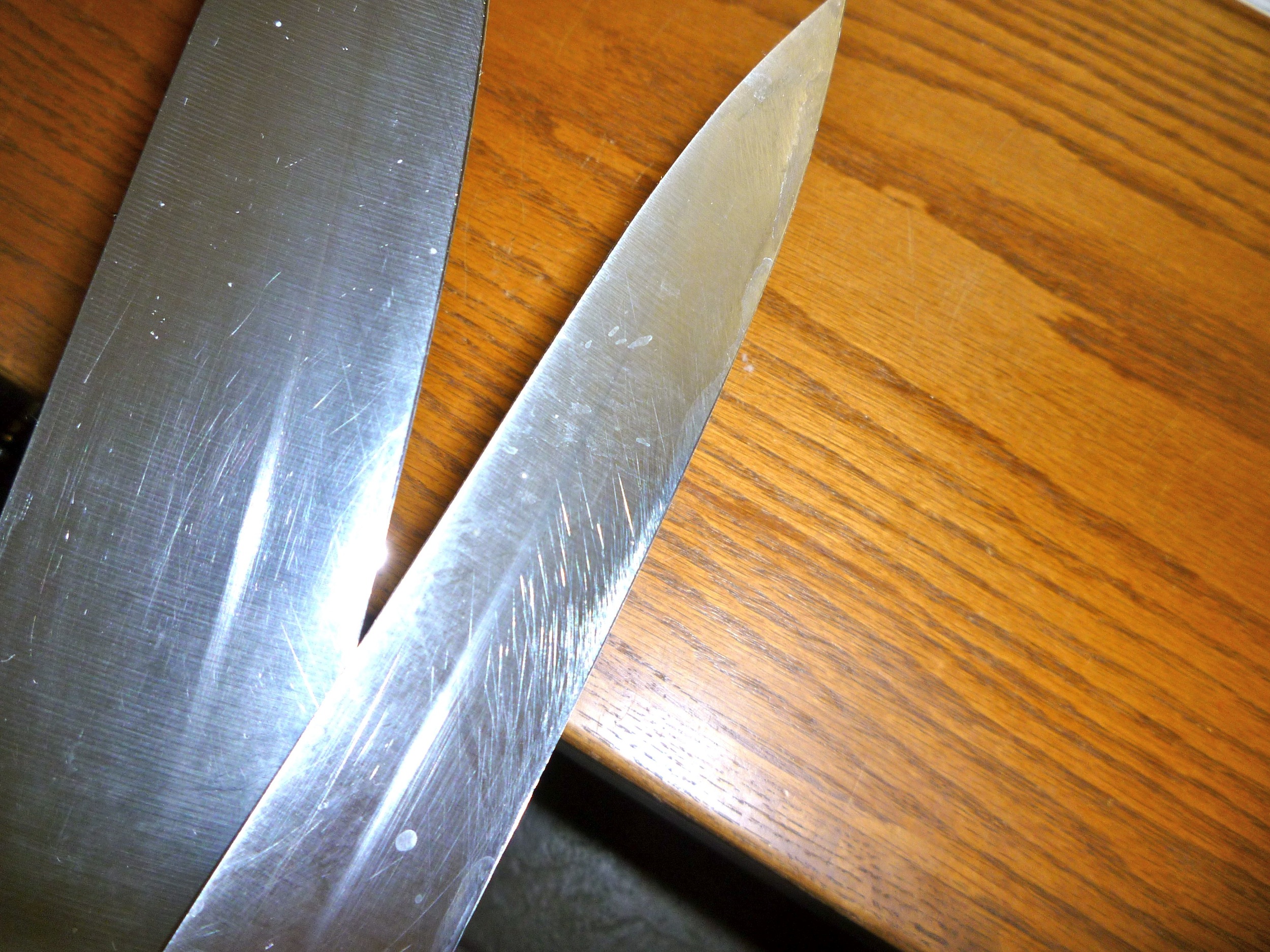 My father could put a razor edge on a knife. He taught me how to do it. But apparently I didn’t learn well… Every blade that I tried to sharpen this way ended up gouged up with scratches. They still take a fine edge, but they look like the dickens.
Never did find the lost knife . But in the process of searching, it occurred to me to wonder if those scratches could be even partially polished off.
A Google search forthwith brought up this interesting post from an outfit called 100-Year Knives.
Sandpaper! says he.
Oh, yeah? My ears perked up. Sandpaper, eh?
The guy suggests polishing a scratched-up blade much as you would sand a piece of furniture, going from coarse to fine grit paper. Then finish it off with a high-grade metal polish.
I could hear my father shimmering in his funeral urn at the mere thought of this scheme.
The coarsest paper I had out in the garage was 120 grit — not very coarse, but better than nothing. The 100-Year Knives gent suggests starting with 100 grit, then going to 200, then 400 or 600, then 1,000 – 1,500 grit, then polish. The result, shown on his site, is a blade that looks practically new.
By way of experimenting, I took the 120 grit paper to a boning knife that I love but rarely use anymore. (You can, btw, save quite a lot of money on meat by purchasing large chunks of beef, pork, fish, or lamb, whole chickens, and whole turkeys and butchering them into the preferred cuts yourself.) That knife was very badly scratched. I didn’t take a shot of it before I tried my little test, but here’s how it looks now:

It ain’t perfect. But it’s a heckuva lot better than it was. Sorry about the glare — the camera won’t let me turn off the flash. Click on the image for a better view.
This knife was in worse shape than the chef’s knife and the utility knife shown above. A few scratches are still visible, but it’s much, much better than it was. It’s not polished to a high sheen, because I don’t have any real metal polish around the house — I used a little Barkeeper’s Helper, but I think some Simichrome or Flitz will do the job a lot better.
The result is good enough to convince me it’s worth dropping by the Ace and picking up a few more packages of sandpaper in the desired grades. And some metal polish. Even Brasso probably would help, but the kind of stuff guys use to polish the brightwork on their motorcycles is what you want. Simichrome is said to be available at your local Harley shop; or, if you must, from Amazon.
The process dulled the blade on the boning knife, which normally has an edge that exceeds “razor.” So I had to resharpen it. These days I’m using one of these manual sharpeners that resembles a blade-eating electric sharpener (never use an electric knife sharpener if you have a knife you’d like to keep around for a few years):
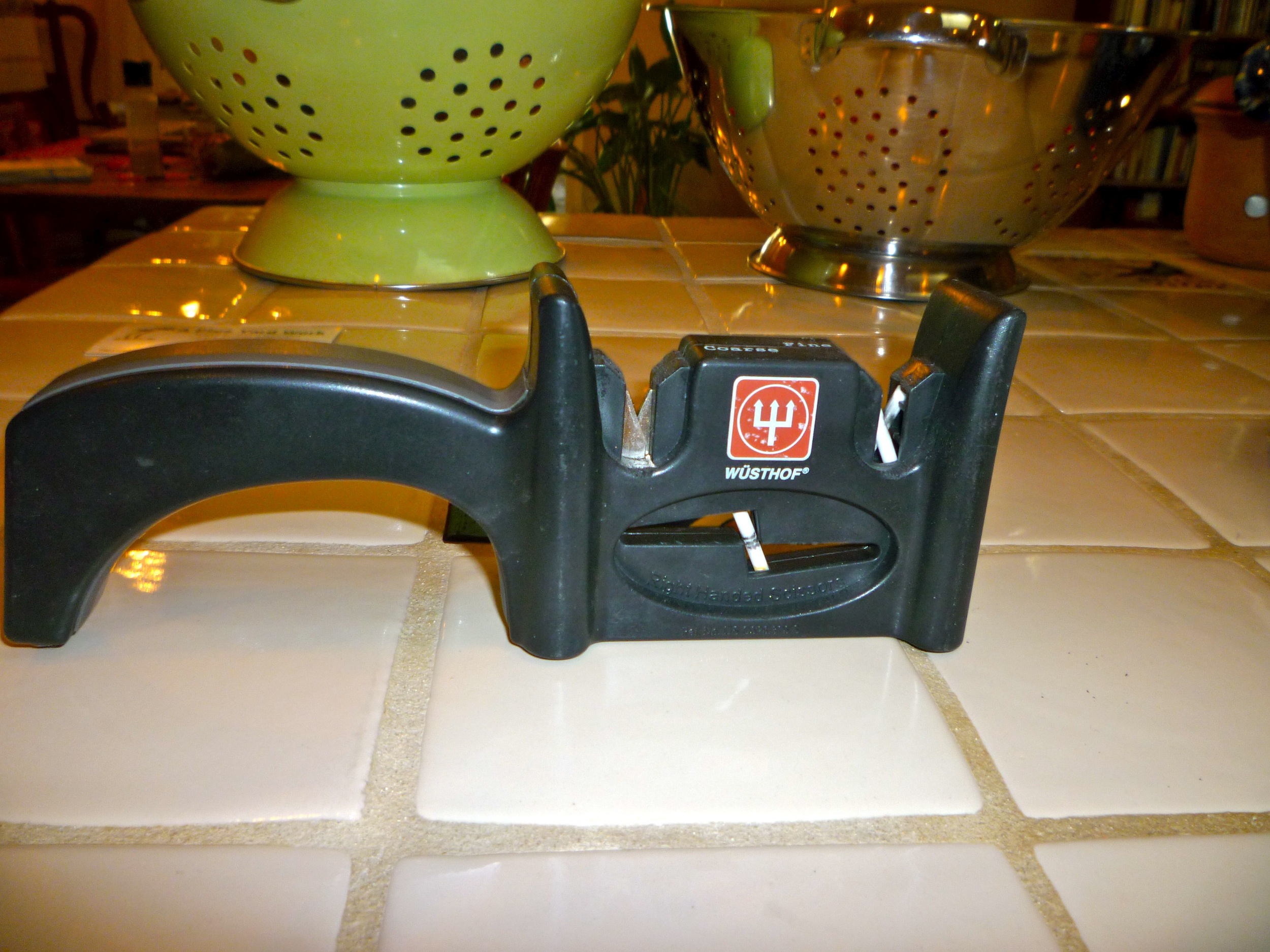 This thing puts a decent edge on your knife without eroding it into the shape of an ice pick and without scratching its sides. Mine is made by Wüsthof, but you can get them in different brands. Once you’ve sharpened the blade (left-hand slot), you hone it on a pair of ceramic sticks (right-hand side), et voila! I hone the kitchen knives after every use, and hardly ever have to do a serious sharpening job anymore. My knives all think tomatoes and raw pork are the same as room-temperature butter.
Take-away PF message: Never throw out something that you can fix.
Round-up: Too sick to dream up a title edition
Many thanks to Donna Freedman for the giveaway she’s running around the 30 Pounds/4 Months cookbook! Go on over to Surviving and Thriving and sign up — it’s easy! And you’ll get a chance to read some of her handsomely written posts, while you’re at it.
Earlier this year I remarked on the absurd cost disparity between men’s and women’s personal grooming products. Well, “pink” pricing goes way beyond shaving cream and face lotion. Like…a $20 price hike for a child’s scooter painted pink, and a $5 gouge for a back brace labeled “for women.”
If there was ever any doubt that a certain faction in Western civilization wishes to keep women in their place, this report should remove it. That not enough to convince you? Try this one.
In the Department of Dollars, a friend of mine is trying to persuade me to put about half my retirement savings into an annuity and let him manage the rest of it. I’ve been putting him off politely, because I’m happy with the money management where I am, thank you very much, and because I don’t understand annuities in general well enough to make an informed decision. Mostly, I’m wary of the costs, which he hasn’t detailed, and I’m not happy at the prospect of having a large chunk of my money tied up in an instrument that’s difficult (if not impossible) to get out of. So I appreciated this excellent, clear description of annuity pro’s and cons.
I’m not a Yuccie, but I do covet this car! Luckily, the cravings of an eccentric 70-year-old academic are unlikely to plant the Kiss of Death on Toyota’s pride and joy. In this part of the world, you need at least a ton of metal between you and your fellow homicidal drivers. So the next Dog Chariot is likely to be a Ram 1500, since Toyota has discontinued the Venza. But…how cool IS it!
At year’s end, Revanche counts her blessings. Possibly the sub-text to this amiable post is the fact that those of us whose families have been in the US for several generations haven’t much of a clue to how good daily life really is here.
In the mood for a mystery? Here is a truly bizarre story.
And on that strange note, I’m taking myself, the dogs, and the worst cold of 2015 back to bed!
Happy New Year!
Cookbook’s at Amazon; Print Version on the Way!
The printer says the page proofs for 30 Pounds 4 Months are in the mail. I imagine that package will arrive before Christmas. So with any luck (assuming I didn’t mess up anything in the design and layout!), the print version of the cookbook will be here right on time to rescue us all from our holiday food frenzies! 😀
At any rate, if you want to get started NOW, you can grab the digital version at Amazon.
