Coffee heat rising

Yard Sale, II

VickyC ended up clearing about $700 on the Big Yard Sale Adventure. We held the sale open again yesterday (Saturday) from about 7:00 a.m. to around 3:00 p.m., and she sold a great deal of Stuff.

We also ended up having a lot more fun yesterday, because we met a whole bunch of interesting people. On Saturday folks have time to stop and chat.

yardsaleThe sorta-gentrifying neighborhood of shotgun houses and 1920s bungalows where VickyC lives is extremely diverse, populated not only by wanna-be Yuppies, penniless now but one day to be affluent, but also by many Mexican immigrants who communicate through their English-speaking young children. A Sikh temple is a-building down the street, and so quite a few Sikhs live in the neighborhood—an interesting and friendly set. Then, for reasons unknown, a LOT of urban Indians dwell in the area, most of them Navajo or at least identifying with the Navajo nation. A number of impoverished artists also live nearby. All of these people love to shop in yard sales.

An appealing teenaged boy came by in his Sikh robes, two dollars to his name. He bought a few things and coveted—ooohhh how he coveted!—the bass guitar and huge amp that VickyC’s boyfriend had contributed to the event. Of course, the $550 asking price was out of the question. He left his phone number and asked VickyC to ask the boyfriend to call to discuss. This, as it developed, was serendipitous.

The young parents from across the street dropped by with their 15-month-old baby. Dad is fully engaged in neighborhood politics. He stopped to discuss his scheme to create a newsletter that he hoped would be free of the acrimony that has developed over the years as the result of resistance to an old-timer who wants everything his way (so we were told). In the course of a long conversation, we learned a lot about the neighborhood activists, the demographics, and the City’s machinations for and against the large area included in the neighborhood association’s territory.

canyondechellyA Navajo couple dropped by with their young teenaged daughter. They, to tell the truth, were slumming, Sunday driving on a Saturday afternoon by yard-saling through a part of the urb that they considered shaky enough to be dangerous.They lived in Chandler, where they had set up household so they could send their kids through good public schools, in the absence of the same on the Res. Very mainstream middle-class in appearance, they attributed the quality of the school system and the paucity of commerce on the Res to the entanglements of many overlapping layers of government bureaucracy and observed that both of their children were doing exceptionally well in the Chandler schools. They did, however, say they probably will retire to the Res after the kids grow up.

The high point of the day was a 40ish Navajo woman who befriended us with a great deal of chatter and much shopping. She loved VickyC’s mom’s taste in clothes, and she selected about $60 worth of stuff (at a buck apiece). In the course of time, she told us a great deal about herself and her life, talking much more than one expects from Southwestern Native Americans, who tend to be quiet people. It seemed to me that something was not quite right, and eventually she revealed what it was: shortly after she had lost a five-week-old baby, she had fallen out of a moving pickup on the Res and sustained a near-fatal head injury. She survived by dint of brain surgery in a New Mexico hospital (where she had to be airlifted), but it took a year of therapy before she could speak normally and walk. She was very affable and explained to us how she would ceremonially free the clothing of the dead woman from the spirit that might remain and return her (the spirit) to her home at VickyC’s. Eventually she walked home and then returned with some ceremonial items that VickyC could use to assist with this process; she explained how to use them and what all those customs meant, she said, “in your way.”

She waited around most of the day for her husband, who was junketing with his workers, to arrive with some cash. During this time, she folded clothes and kept us company. As one might expect, he was less than thrilled with the plan to fork over $60 or $70 for used valuables. VickyC dropped the price for the mountain of clothing she’d selected to $20 and he relented.

By this time, it was getting late. VickyC announced she was closing the show and started dragging stuff out to the curb, where she intended to leave it for free. When hubby heard this, his enthusiasm rose. Now he started to make his own selections of used valuables, among which, to VickyC’s delight, was an oak entertainment center she had not unloaded. A Mexican woman was also there when the “FREE” announcement came down. She loaded up all the clothes our Navajo friend rejected, along with stacks of kitsch and old cosmetics.

I suggested VickyC call the Sikh kid, since he also coveted a number of valuables but had run out of cash. He appeared in an instant, delighted to get a Giants athletic jacket, a bunch of other baseball clothes, and various tschochkies not to be missed. (What is that kid going to do with that stuff?)

These folks virtually vacuumed the front yard! By the time we were done, all we had to do was haul the trash to the bins in the alleys and carry the tables back inside.

So, it was a great success. To celebrate, we went to dinner at one of those urban underground restaurants that no one knows anything about but everyone should. If you’re ever in Phoenix, it’s the Piccolo Cucina at the corner of Oak and Seventh Street. Don’t miss it.
🙂
hágoónee’ for now

Photos:
California Yard Sale
by S. Michael Miri

Gerardo the Heroic

Ahora que Dave’s Used Car Lot, Marina, and Weed Arboretum is cleaned up—however temporarily—I felt encouraged to thin out the Jungle whose purpose is to screen the view from my front window so I don’t have to see that dump.

Before...
Before...

Gerardo, aware of this winsome craving, came by the other day and observed that it was time to clean up the trees and shrubs. “Claro que sí,” I said, in some sort of English. Before long he had three dudes out there, cutting, trimming, digging up, and hauling. “No fútbols,” said I, meaning I did not wish to see trees or brush shaped like soccer balls. “Of course not,” said he, in some sort of Spanish.

They hacked and they heaved, they nipped and they clipped, they filled Gerardo’s truck chock-full of thorny life-threatening limbs.

“You’ve let these things go too long,” said Gerardo, in some sort of Spanglish. “They should’ve been shaped properly a long time ago.”

“Yah, don’t I know it,” I said, in hypereducated English. “Jes’ do the best you can.”

They shaped and they trimmed and they dodged and they hefted. They packed impossible amounts of stuff into Gerardo’s truck. Three hours later, they had the yard looking pretty darned good. Gerardo, after all, does know how to prune desert plants so they stay looking like desert plants. You just have to say to him, “Keep your eye on that guy and that guy and that guy over there, ’cause you’re the one who knows how to do it right.” And then he sees that they do it right.

...y despus
...y después.

After all this heaving around, they whipped through the property and performed their regular monthly ablutions: blowered up the leaves and raked the gravel and cleaned up all the pavement and carried off the leaves and debris. As they fired up the truck to drive it, groaning, off to the dump, Gerardo presented his bill: $110.

!Dios mio! I couldn’t believe it. Gerardo’s regular bill is $75. That meant he charged, for all that extra work, $35. That’s something like ten bucks an hour, for three workers.

How does the man survive?

How can you pay such a man? For sure, the Christmas bonus has to be a gigantic gift card to Home Depot (assuming that outfit has no strings on its cards that will rip him off). Better yet, though: M’jihito has decided to punt on the scheme to xeriscape the Investment House, since we can’t afford desert landscaping just now, and instead to cultivate the devilgrass (Tejano for “bermudagrass”) to form a lawn of sorts. Between now and spring, I’ll hire Gerardo to put in a winter lawn, which will keep him busy until the heat comes back up. If he’s smart (which he is), he’ll prepare the ground so the bermuda will take right over when the days grow long, and then he’ll have another job to add to his clientele.

Hallowe’en: “It’s the neighborhood”

Some time back, shortly before the real estate bubble started to blow up, I asked a Realtor why a house in the tract a block to the south of mine should be worth $60,000 or $80,000 more than my house, when mine is newer, its rooms are larger, its lot is nicer, and its interior had been updated more recently. She sniffed and remarked, “It’s the neighborhood.”

Sniff, indeed!

Well, there may be something to that. This evening I took Cassie for a walk during the height of the Hallowe’en tricking and treating and, as usual, walked down into that area. The difference between my neighborhood and that one was striking.

First, to get there you have to cross a feeder street, one that’s not so busy you can’t jaywalk across safely but that does carry some traffic. The road was hectic with people carting their kids in from the unsavory districts to the west and north, where no parent in his or her right mind would let the kiddies visit the local crack houses and meth factories in search of “treats.”

My neighborhood north of this asphalt dividing line had almost no children, but the slightly more affluent neighborhood to the south was alive with kids in costume.

In my neighborhood, almost every house had its front lights off (except for the occasional security light outside a garage) and the front windows shut up tight. In the other neighborhood, residents were out in droves, sitting at tables in front of their homes and doling out candy from big bowls. At three houses, the grown-ups were drinking wine and partying companionably on the front porch or driveway as the little visitors went from house to house to show off their outfits and collect their loot.

Think of that! The neighbors talk to each other! What a quaint idea.

Heaven help us, they also speak to poor folks. Now that is outré.

I walked over into La Maya’s part of the area, a block closer to the truly desirable addresses. Her house is worth about $150,000 more than what mine is worth—maybe more than that now, after Dave’s Used Car Lot, Marina, and Weed Arboretum was given away for practically nothing at auction. Interestingly, that neighborhood was just as hermetically sealed as mine: most houses had their lights out, and none of the locals were to be seen in public. Precious few kids, either.

So there you go: what makes a neighborhood is the neighbors.

Maybe when you’re looking to buy a new house, you should wait until Hallowe’en and visit all your candidate areas. Look for one where the residents are outside enjoying the little kids and each other—that’s a good neighborhood!

Foreclosing on the neighbors

In an odd way, the foreclosure of Dave’s Used Car Lot, Marina, and Weed Arboretum amounts to a kind of foreclosure for the neighbors, too. There’s the obvious effect that when the lender unloads Dave’s house at a bargain-basement price, our property values will drop into the basement, too. Actually, they were already headed for the basement: now they’ll just ride on down to the sub-basement without getting off the elevator.

But there’s a much larger effect: Dave has been financially distressed since he divorced a year or so ago, and his emotional depression has shown in a sharp increase in his native slovenliness. He never was into anything that might be called “pride of ownership,” but over the past year, his normally trashy lot has become a real eyesore. Also, as it develops, Dave has been cultivating a public health hazard.

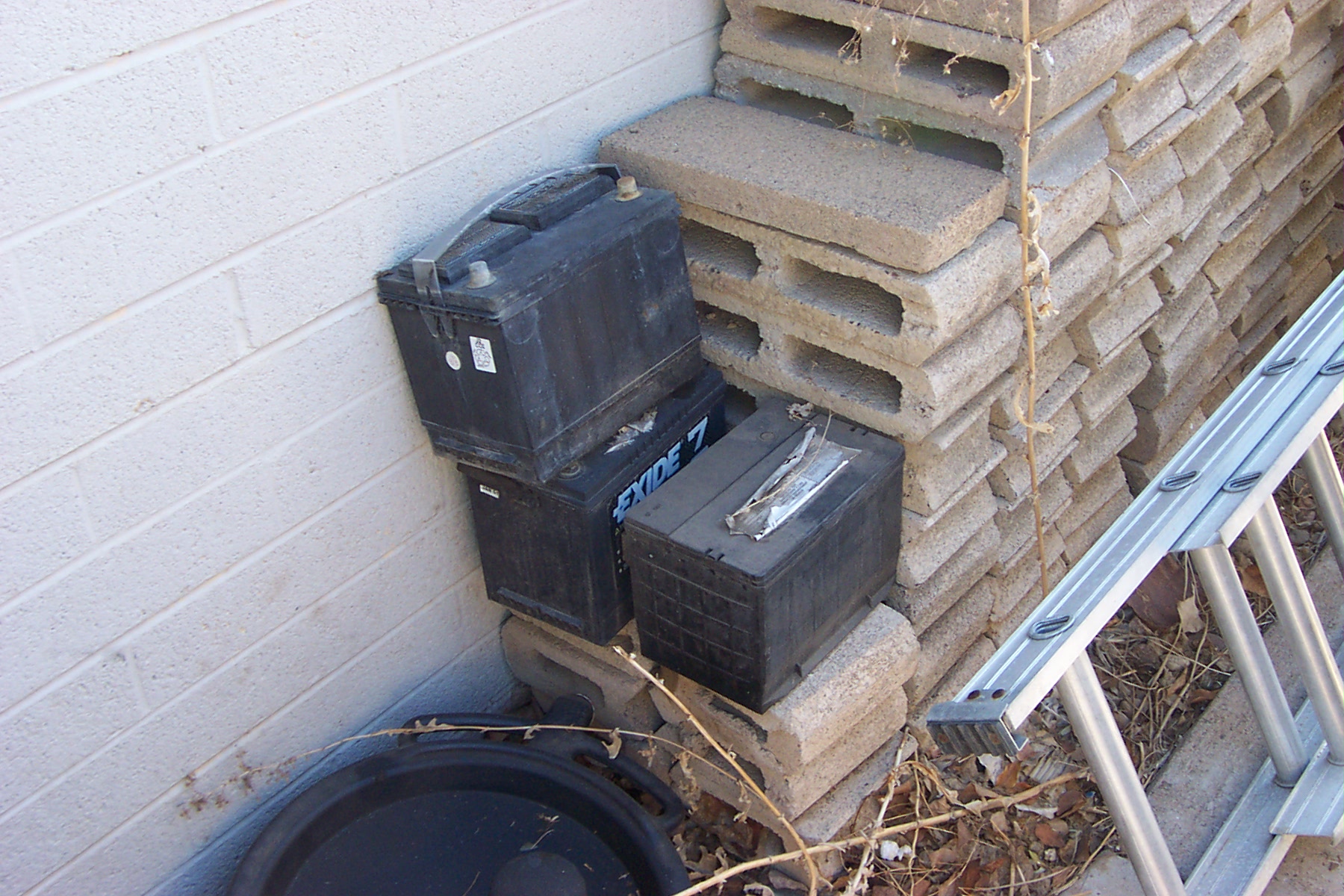
SDXB came by this morning, and out of curiosity we visited the abandoned house. Both gates into the backyard, from the front and from the alley, are unlocked and easy to open. The backyard is chuckablock full of debris, old chemicals, bottles of pool acid, old batteries, and stuff highly hazardous to kids. We have, for example, these fine gasoline cans, located behind an open tool shed replete with bottles of old insecticides.

Mighty nice, eh? How would you like your kids to get into this stuff?

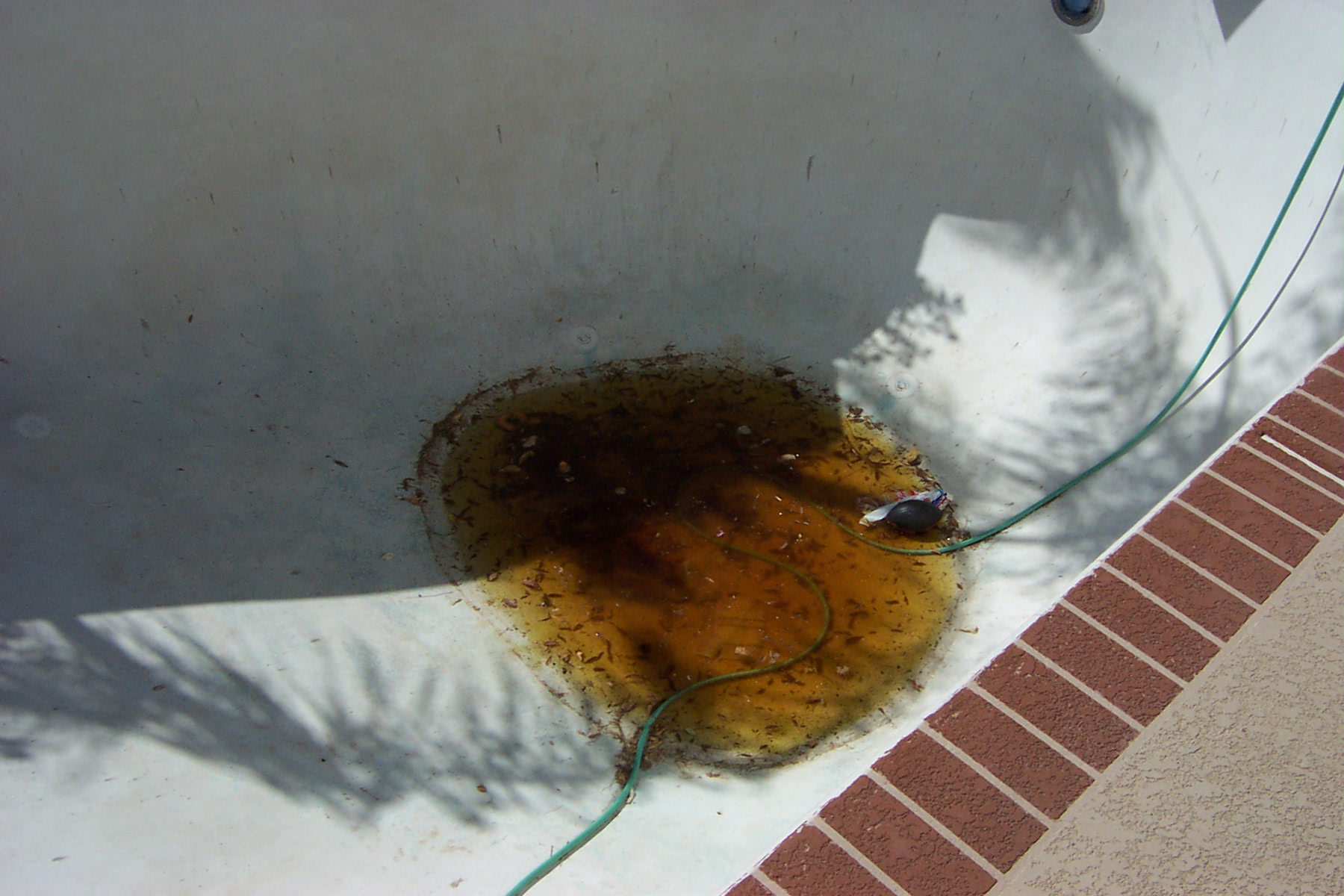
Ah, yes. Then we have the issue of the swimming pool. The pool has been drained; evidently has stood empty for quite some time. Though it’s enclosed within a wrought-iron fence, it’s easy to enter: the fencing ends at a screened porch whose two exterior doors have been ripped off, creating a nice corridor through which the curious may pass without obstruction.

Once you’ve passed through the aluminum structure, where, by the way, you’ll find a heavy-duty battery charger with enough juice to flash off big sparks and give you (or the kiddies) one heck of a zap, you come to this:

And at the bottom of this concrete-lined hole in the ground you find a collection of lost toys marinating in a fine little mosquito-breeding Okeechobee Swamp:

It explains where all the nasty little biters have been coming from for the past several seasons: straight from casa David to su casa.

Maricopa County, where we have been dwelling cheek-by-jowl with Dave, has a growing problem with West Nile virus, a disease carried by mosquitoes. And as we know, mosquitoes breed joyfully in standing water. Every year more and more people come down with this ailment, and every year we read of several deaths related to it. The most vulnerable to serious complications are the elderly.

Dave’s next-door neighbors are in their nineties.

I am in my sixties; many of the locals who have died of this disease were between 60 and 65. The most recent death I’ve read about was of a man in his 80s. My house and yard have been overrun with mosquitoes for months. This, evidently, is where they’ve been coming from. My house is clear across the street—imagine what the mosquito swarms have been like for the old folks next door to Dave!

After you’ve enjoyed the scenic view, don’t miss Dave’s old battery collection on your way out:

Maybe an enterprising kid can get a little extra mileage out of one or more of them, using the handy-dandy battery charger left on the back porch.

And as we say good-bye to Dave’s Used Car Lot, Marina, and Weed Arboretum, we pass by the famous Weed Haystack, still gracing the front driveway as it has from time almost immemorial:

Dave's Weed Haystack

Always visible from the street and from front yards in all directions, this fine landmark remains as a symbol of everything Dave has done for his friends and neighbors in Royal Oaks.

Hm. Maybe I could sell guided tours.

Long before Dave’s lender foreclosed on him, Dave foreclosed on the neighbors. He foreclosed on our property values, on our safety, and on our health. I guess we have to say thank you to the irresponsible and unethical lenders who forked out $320,000 in loans against a property worth about half that and handed it over to a recently divorced man who hasn’t held a regular job in years. If they hadn’t sunk him over his head in debt, Dave and his pet mosquitoes would have stayed in that house forever.

Foreclosed!

Poor old Dave, proprietor of Dave’s Used Car Lot, Marina, and Weed Arboretum, is finally moved out, having spent a week and used the services of three male friends equipped with pickups, a flatbed, and SUVs to haul off his collected junk. He’s posted a do-it-yourself “For Sale” sign in the front yard (“Drastically reduced!”) and ridden off into the sunset, leaving his weed garden behind.

This afternoon some kinda seedy-looking guys climbed over the weed haystack in the driveway to ogle the peeling batten around the eaves. Evidently they were calculating what it would take to revive the decrepit house to its former glory…or at least to rentability. Early in the evening, a father came by in the wake of his toddler’s tricycle. Dad and son broke into the back yard through the side gate and disappeared into the weed jungle. The kid’s trike is gone now, so either they came out and went on their way or the cockroaches carried the hardware off.

Old Dave, as we learned, was foreclosed. My neighbor and I found that out when the notice was mistakenly slapped on her front door instead of Dave’s. He borrowed $320,000 against the place. Zillow values it at around $307,000. Even though it has a pool (soon to be a mosquito pond, no?) and a good-sized corner lot, there’s no chance it’ll fetch that much. Another foreclosure in similar condition around the corner sold for $268,000.

In a way, I’m sorry to see Dave go, despite the mess he lived in. The trashed condition of his property and his habit of parking a used-car-lotful of rolling stock on the front lawn affected the property value of houses all around him, and that was irritating. But at least Dave was quiet. I dread what’s going to end up in that dump next.

O.K. There’s a remote chance someone will buy the house for a song, fix it up, and live in it. More likely, though, some speculator will grab it out of foreclosure, throw a cheap coat of paint on the outside and some apartment-house carpets on the floors, and rent it out. This will add to the already thick population of rentals in the neighborhood. It will join the place that houses Biker Boob, a Hell’s Angel who roars up and down our residential street on his unmuffled Harley and who uses the garage to conduct a shade-tree mechanic’s operation, complete with LOUD heavy-duty shop equipment that he starts up at 7 a.m. every weekend and operates until after 11 at night, and the shack whose out-of-state owner rents to SEVEN unrelated adult men, all of whom park their cars on the front yard and none of whom is interested in hacking back the knee-high weeds on the property.

The other possibility is that the new owner will be yet another of those folks who buys on the cheap, thinking he’s found a bargain, without having a clue to what’s involved in maintaining a forty-year-old tract house. Once they get moved in and discover how much it costs and how much work is involved in taking care of one of these places, they just let it go to pot.

Either way, the result is the same: a run-down house on a run-down lot, dragging down property values in the our little six-square-block development. Add to this recurring phenomenon the City’s kind decision to rip out a whole row of houses to make way for the train tracks, and you can see if you want to move up but stay in town, you’re flat out of luck. There’s no way you can afford a comparable (or even a lesser) house in a better-maintained neighborhood that’s located in the central part of the city. The only way to get back into the middle class is to move way, way out into the sprawl on the outer fringes of the metropolitan area.

You, too, can drive two hours each way to work. You’ll love it. It’s the American way!

The Hallowe’en grinch

What do you do about Hallowe’en?

I get a big boot out of seeing the kids in costume. But I’ve become pretty curmudgeonly about having swarms of kids, teenagers, and even adults show up at my door asking for a handout. Several things make this custom problematic.

Most obvious, of course, is the cost of candy. You have to get the kids products that are individually wrapped, because many parents, wary of nut cases who lace treats with “tricks” of one sort or another, won’t let the kids eat it unless it’s in a manufacturer’s package. It’s pretty expensive, especially if you don’t eat the stuff yourself. Which I don’t. Any candy that doesn’t get handed out to trick-or-treaters gets wasted. I hate that. It makes me feel like I’m throwing money in the trash.

Next, there’s the issue of out-of-neighborhood families trucking their kids into more affluent areas in hopes of scoring fancier stuff. My neighborhood abuts a very tony district—we form a buffer zone between an area of upper six- to lower seven-figure homes and a couple of gang-ridden slums. So we get the overflow of kids being trucked into the swell neighborhood. Well, I wouldn’t let my kids run loose in the areas to the west and north of us, either, so I can’t blame the parents for bringing them to a part of town they may perceive as safer. But what you’ll see is twenty kids jammed into the back of a pickup and dumped on the street in front of your house. Some years, a hundred kids will show up at the door; some years, none. Just depends on which street the freeloading parents decide to use as a drop-off point.

I don’t mind giving candy to the neighbors’ kids, but…OK, ungenerously!…I resent having every kid in Sunnyslope show up at my front door demanding a handout.

When M’hijito was little, one friend’s parents used to keep a stash of expensive, healthy treats for the neighbors’ kids and a big bucket of the cheapest, grodiest junk they could get for the traveling freeloaders. Worked, I guess…but something about that doesn’t sit very well with me, either. Is it OK to rot little kids’ teeth and contribute to their budding diabetes just because the kids are poor?

And finally, there’s the safety question. This neighborhood has had three home invasions that I know of—probably more that haven’t been gossiped about. I don’t open my door to strangers. Really, you’re crazy to do so. Why should I make an exception for hordes of out-of-neighborhood candy tourists? Especially when many of them are not kids. I don’t feel safe doing that.

In my cranky old age, I’ve taken to turning off the lights in the front part of the house, which discourages people from ringing the doorbell. It’s too bad…but the cost, the abuse of hospitality, and the risk kinda militate against it.

Hallowe’en! Bah, humbug!

😉