
Scrutinizing the budget now that this month’s bills are all paid… Several extraordinary costs—those Heath dishes, for example, and a pair of shoes, and a trip to the car mechanic’s—ran the American Express budget $325 into the red. But in theory, all of them combined shouldn’t have overtaxed that budget. So…WTF?
In addition to those two extravagances and the car repair, I’ve been spending with gay abandon at Costco: $407.39 diddled away in that place!
And what on earth, pray tell, might I have purchased with this munificent amount? I’ve been strictly on the wagon for the past three months, so it didn’t go to my favorite potables. Mostly food and household goods, I think: the lifetime supply of paper towels. And the $75 or so for the underwear extravaganza. Haven’t bought toiletries. Haven’t bought pool tablets. Haven’t bought Brita filters or blue jeans or replacement toothbrush heads or a lifetime supply of laundry detergent. Looks like the main costs were large packages of chicken thighs (at 99 cents a pound, a better buy than anyplace else where I shop), pork, produce, the paper goods, and clothing.
Probably paper towels and toilet paper and detergent, purchased in bulk, are a little more cost-effective than the same goods bought in smaller quantities more often at grocery stores. However, a funny thing happens on the way to the Costco: Sure, a giant container of paper towels lasts four to six months. It sets you back $15. But then next month you need toilet paper: $20. Next month after that, you need chlorine tabs for the pool: $80. And so on to infinity. If every month you’re buying a lifetime supply of one thing or another, then each month you’re spending more on groceries and household products than you would at an ordinary retailer for smaller amounts that would only last a week or a month.
Although over the long run you might spend more at a grocery store for a specific product than you would, unit-wise, by purchasing a gigantic supply at Costco, because each month you buy a new lifetime supply of something else, each month’s bills are likely to be higher than they would be if you equalized purchases over time.
What that suggests is even though you’re paying less per unit for certain products, you’re actually paying out more each month as you have to replenish different products month by month.
By comparison, during the budget cycle just ended, I spent only $35 at Safeway and $68 at Trader Joe’s. Admittedly, I haven’t felt well and so haven’t eaten much—mostly I’ve grazed off the Costco stash. But still..one wonders.
I decided to try to limit Costco purchases to $200 a month. Which…well, really, shouldn’t that be more than enough?
This led me to consider what routine purchases are available only at Costco, and what things might be bought somewhere else in more manageable quantities at more manageable ongoing prices. Videlicet:
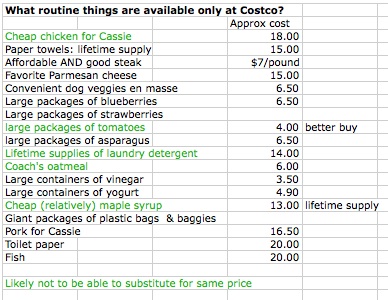
Some of these items are hard to find at other stores around here, or can’t be found in the same quality or for the same price, or both. I’ve marked those in green.
There also are a number of things I buy on occasion at Costco because they don’t seem to exist in any other stores or because, as in the case of the chlorine tablets for the swimming pool, Costco far underprices its competitors:
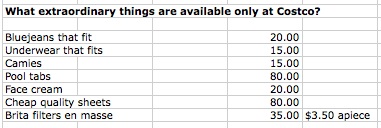
Bed sheets comparable to the sets you get at Costco, which come with four pillowcases BTW, would cost far more in other stores unless you caught them on sale. Anywhere else, it’s almost impossible to find either underwear or denim jeans that fit a normal adult woman. Face cream is expensive at Costco but downright outrageous elsewhere. So it goes.
I’m none too sure what these things would cost at non-warehouse stores. But I’d be willing to bet that when you buy less, you pay less at the checkout stand, even if you’re paying more per unit. In some cases, you’d have to pay a fair amount more. For example, I wouldn’t consider buying fish at Safeway; probably the only other source of acceptable fish in town is Whole Foods. Don’t even ask what they charge for the stuff.
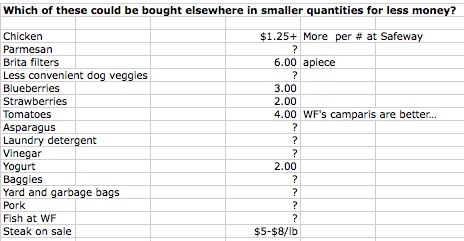
If I limit spending to $200 for the September/October budget cycle, what could I buy between now and the end of the month-long cycle?
I’ve already spent $104 at Costco this month. That leaves $96 to diddle away:
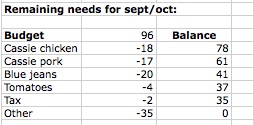
That’s not unreasonable, I think. It provides enough meat to last the dog for the rest of the month (since canids need about 2/3 of their food to be in the form of animal protein, a 25-pound dog consumes a surprising amount of fresh meat). My blue denim jeans are wearing out, frayed at the cuffs and faded at the knees—the height of style for younger things, but not, I’m afraid, for moi. So pretty quick I’ll need a new pair. Arizona doesn’t charge tax on food, and so the 10% soaking applies only to the clothes. And…that even leaves something for one or two other purchases! Buying the rest of my food—mostly produce, since at least two months’ worth of beef, fish, and chicken reside in the freezer—shouldn’t cost much at Safeway, Trader Joe’s, or Ranch Market.
What think you? Does it make sense to try to stay on budget by spending more per unit on less product?
Before they became Costco, our warehouse stores were called “Price Club” – and they were nicknamed “$100 Club” because you couldn’t seem to get out of there without spending $100!
For us spending more per unit is less about staying on budget than it is about not being wasteful or eating too much junk food. I’ve found I can’t buy a box of Skinny Cow ice cream bars. I will eat all of them in a week. They’re about $0.80/bar if you buy the whole box. Instead I go to the store each time I want one and buy 1 Skinny Cow for ~twice the price. Since I’m lazy I only do that once a week. But more importantly I eat ice cream once a week instead of 6 times =)
Yes, I remember Price Club!
LOL! My father, for whom “cheapskate” was a badge of honor, dearly loved Price Club. He would buy their house brand of beer…it was awful, at once watery and skunky, but because it didn’t cost much, it must be just fine.
And I used to buy my son’s shoes there when he was in preschool, until the day I noticed that one shoe had five pairs of lace grommets and one shoe had six.
Costco appeals to a broader group of consumers, IMHO.
Agreed! If something like that is in the house, there’s nothing I can do to keep from overindulging. I don’t eat a lot of ice cream (although having discovered that, weirdly, it soothes the stomach, I do have a package of it in the freezer). Wine is my downfall — and Costco’s price on wine is excellent. If it’s not in the house, I’m not going to drink it, because I’m too lazy to get off my duff and make a special trip to buy it.
One has to consider cash flow as well as an annual budget or cost per item. So, yes, it can make sense to buy smaller amounts at a higher price, or else you need to save up ahead of time before making the bulk purchases.
@ Valleycat1: Hm. That’s a good idea. You could self-escrow say, $10 to $50 a month, and in short order you’d have plenty to buy the lifetime supply of filet mignon.
One doesn’t think of this strategy, I expect, because what Costco charges for its LT supplies is relatively low — $15 for enough paper towels to last a good six months doesn’t seem like much. But $15 here and $15 there adds up fast!
Of course you’re not REQUIRED to buy a lifetime supply of something each month. And if your consumption stays equal then I can’t see how you’re coming out ahead by buying elsewhere in smaller quantities. Your consumption staying equal is the key. You can’t possibly come out ahead if you buy one roll of paper towels, one pool tablet, one pound of chicken thighs but pay more for all of them. It’s in the math.
Having said that I like the poster who buys less ice cream for more money. I love that approach. It’s the only thing that would work for husband unit and I. We once helped a relative move and were stunned at all the half eaten packages of cookies he had. We laughed uproariously and said we couldn’t remember the last time we had seen HALF eaten packages of cookies. Once open, they’re gone.
The other thing is that we simply adore Costco, love their clothes, linens and quality of meats, vegetables and baked goods. And quite frankly our idea of quality entertainment is their $1.50 hot dog and 30 minutes of people watching outside in their food court.
My membership card will have to be pried out of my cold, dead hands. 😉
As E. Murphy points out, there is no way you can *save* money by buying fewer things for more money. You may stay within an arbitrary budget, which may be required if you are living paycheck to paycheck, but you are no doubt spending more unless the luxurious feeling of having 72 rolls of toilet paper in your house causes you to use it with greater abandon.
Don’t tell Costco, but my husband and I wait for the flyers they send out allowing you to “try Costco for a day”. They seem to send them out at least twice a year, and we head right on over and buy 6 months worth of toilet paper, towels, toothpaste, laundry detergent and just about every other non-perishable item you can think of. The total always induces heart palpitations but we 1) save money over the 6 months by not buying the TP at twice the price at the grocery store and 2) never run out of toilet paper. With the added benefit of only having to go to Costco twice a year!
@ marzy doats: Now there’s an ingenious idea!
I do love having enough TP in the house at all times. There are other products that are good to have in lifetime supplies: one of those big containers of laundry detergent, for example, lasts me for a year. If you enjoy beans, you can get enough for an army there…or enough to feed a family for months.
Regarding fish, I buy good fresh fish at Sprouts all the time. I know Tucson has Sprouts. Does Phoenix?
Love Costco for bulk purchases. With four in the house we run through t p fast. And with inflated food prices looming (Midwest drought), it’s smart to stock up on meat right now.
Yes, there’s a Sprouts down the street. Their meat selection is nothing special, and I’ve never seen fish there that looks appealing.
In the fish department, Phoenix is a long way from the sea. It’s expensive to ship fresh fish into the desert; mostly what’s peddled as “fresh” is really frozen and defrosted, not very good. If you want real fresh fish, you have to pay through the wazoo for it at AJs or Whole Foods.
I dumped my Costco membership years ago. It wasn’t worth the time and hassle to me to save a bit of money on facial tissue, toilet paper, etc. Driving to the Costco (it was not near any of the stores I usually frequent which can be reached by bicycle or walking), maneuvering through the packed aisles, and waiting in a crazy line to check out were all things I really hated. I much prefer to pay a little bit more money for paper products and have that time back in my life.
Purchasing in bulk at Costco also means that you must have the capacity to store those huge amounts of product. Therefore, it requires that one pay extra in rent or mortgage for the space to store things as you work your way through them or that one have already paid extra at one point to purchase that larger-than-absolutely-necessary house.
My sister who has been feeding a teenage boy certainly makes use of her Costco membership, so I understand that it works for some people. With my small household (two adults and pets who eat food not available at Costco) it just didn’t seem to make sense from a financial or time perspective. (Even though I did have the space to store stuff, too.)
As just one little old lady, I love Costco…but it must be said that the Phoenix metropolitan area is saturated with the things. There’s one within walking distance of my son’s house, one directly on the way between my house and the college campus, one directly on the way between my Thursday a.m. meeting and my house, and a very nice one in Scottsdale, which I could easily visit when I’m out there for meetings.
Also, because grocery stores here seem to have cut back on their product offerings (often at Safeway they just don’t have some commonplace item that I need — apparently fines herbes and H202-based contact lens solutions are now out, for example), if I’m trying to shop at supermarkets I have to run all over the city trying to find what I need.
I. hate. that!
Costco has most everything I need; specialties that they don’t carry are available at upscale grocery stores. That cuts the traipse from three or four stores to two, and since the specialties are usually wants rather than needs, the truth is it usually cuts the shopping trips to one.
Another issue in Arizona is that, in addition to a paucity of decent fish, meat in general is not very good in grocery stores. Safeway will occasionally carry decent beef, but overall the offerings are pretty blah. Costco prices its meat the same as the grocery stores do (sometimes less), but its beef and fish are far superior. And just TRY to find rack of lamb at a Phoenix Safeway, Fry’s, or Albertson’s! The chicken is about the same in quality but priced lower. The pork is decidedly better.
I think most beef sold at Costco is choice or better. Much of the beef sold at the grocery stores does not come up to that level. What’s sold as premium beef is actually choice — pretty good, but not prime (which you CAN get at Costco); what’s sold as more or less affordable is really what used to be labeled as “good” quality — i.e., suitable for braising and stewing, but pretty chewy if you tried to grill it.
I store the lifetime supplies of paper and cleaning supplies in garage cabinets; perishables go in the freezer; and canned goods, beans, pasta, and the like are kept in indoor storage. The garage cabinets and a small freezer make it easy to store all the lifetime supplies a single person could every want.
The other issue here is that I save enough on gasoline at the Costco pumps to pay for the membership. Costco significantly underprices its competition on gas.
Ah, there are some key differences in shopping that tip Costco in your favor, I see! The Costco stores within Chicago don’t sell gasoline; they may do that in the far off ‘burbs that I never visit, so it’s possible that it’s not Chicago-metro area wide.
I no longer eat meat from most grocery stores (and that would include Costco) for ethical reasons. My only sources of meat these days are some vendors at the farmer’s markets in the area or (occasionally) Whole Foods IF I feel comfortable with the score on their scale for humane treatment of the animal. Yeah, I know that killing an animal to eat it is ultimately not really “humane,” but I sort of look at it like cleanly killing after living a decent life vs. torturing first and then killing, and I prefer the former. Consequently, I eat a lot more vegan/vegetarian these days and tend to eat meat mainly when I visit restaurants that follow this same principle. (Also, I get eggs from my backyard hens and have no issues with consuming cheese…yum!!)
I feel you with this one. My grocery budget has gone all the way up to $400 for 2 weeks! I do have a 5 person family but no matter what I try it never goes down.
@ Adam: Feeding five people for $200 a week is a real accomplishment.
If they all brown-bag lunch and eat lunch at home most weekends, that’s only $1.90 per meal. It would be more than that, of course, if the kids eat at the school cafeteria five days a week or the parents eat lunch at restaurants on work days. But even if everyone on average ate breakfast and dinner at home, the cost per home-cooked meal would still be only around $2.86. Not bad!
Do you figure only food as “groceries,” or do you include the kind of household goods one would ordinarily buy at a grocery store, such as cleaning goods, toilet paper, shampoo, and OTC nostrums? A large part of my Costco bill is not for food.
We never eat out and only one child is in school(he brown bags 95% of the time). That includes all household items bought at the grocery store or our large warehouse members only store of choice(BJs). Now that you put it that way I feel like I am doing alright 🙂
Shopping at Costco or Sam’s Club definitely calls for some defensive strategies. Like you, we have a defined list of items that make sense to buy there. Most wouldn’t call Sam’s Club a haven for foodies, but it’s ironic that it’s the only place in town to find decent-sized chunks of good cheese and good sliced meats.
The go-to place for good, affordable cheese around here is Trader Joe’s. However, Costco does offer some good varieties of cheese (albeit, a limited selection) in large chunks, and their shredded fresh Parmesan can’t be beat by any other mass retailer.