Have you seen this amazing story in the Times? In short, it reports on the custom of drugging kids who have no attention deficits or psychological disorders in order to make them sit still in class. Says one doctor who advocates this practice: “I don’t have a whole lot of choice. . . . We’ve decided as a society that it’s too expensive to modify the kid’s environment. So we have to modify the kid.”
We already know that rich kids dope themselves with stimulants to enhance already perfectly fine grade averages, so as to up their chances of getting into elite universities. Now, though, as if that weren’t stupid enough, we’re talking about drugging all the rest of the kiddies…why? So they can get into the local community college? Or more to the point, so they’ll sit down and shut up while their teachers try fruitlessly to wrangle “classes” of thirty or more grade-school children?
As a culture, we now drug our citizens from nativity to senility.
What do you take at this point in your life? Dollars to donuts, you’re on something. It’s not surprising: 90 percent of Americans take drugs for one or more ailments, most of them described as “chronic.”
If you’re not swallowing pills every day, you’re an odd duck. I speak from experience. Because of a familial tendency to stay away from doctors unless I’m sick or hurt, I’m not on any medication. And every time I go into a new doctor or dentist’s office or talk to a new insurance agent, where they make me fill out a two-page checklist confessing to any of scores of diagnoses and then list the prescription drugs and OTC nostrums I’m supposedly gulping down, the staff invariably expresses astonishment.
“You’re not taking anything?”
“Uh…no.”
“That’s amazing!”
I’m sure.
Yesterday an insurance agent called to try to talk me into changing my Medicare supplemental carrier. She said I would have to undergo low-level underwriting, since, after your first enrollment period, Medicare supplement insurers do not have to accept Medicare recipients willy-nilly. She explained, as if to a child, that I would be asked to answer several questions about my health problems. What were they, by the way?
“None.”
“None? You don’t take any medications for anything?”
“No.”
“You don’t have diabetes?” (Flabbergasted tone.)
“Well, no.”
Jayzus.
This kind of thing started when I was about 40. At first, no one could believe I wasn’t on hormone replacement therapy. Being a skeptic, I willfully refused, despite my gynecologist’s assurance that if I would just take these nifty little estrogen pills I would be protected against cardiac disease for the rest of my life, I would be able to screw anything that wore pants until I toppled over into the grave, and my face would never get wrinkles.
No joke. He bought the HRT salesman’s pitch, hook, line, and proverbial sinker.
Soon no one could believe I wasn’t on beta blockers, Drano in a pill (that would be the stuff they foist on you to prevent osteoporosis, which of course you’re going to get because you’re a postmenopausal woman), antidepressants, cholesterol meds, blood pressure meds, megavitamin supplements, estrogen, calcium supplements, vitamin D supplements, or any of the myriad woo-woo herbal snake oil concoctions that grace every grocery store and drugstore’s shelves.
Do you realize that Benadryl is routinely used to sedate and “calm” elderly residents of care and nursing homes? I take it myself, on evenings I think I’d like to sleep past 3:00 a.m., when the internal alarm clock goes off. It knocks you out quickly and effectively. But the stuff isn’t used in care homes to help people sleep; it’s used to keep the inmates under control, because when you’re not sleeping after you’ve dropped one of those nifty little pink tablets, you’re in a haze. And it has a particularly dire side effect for the elderly: it can cause cognitive dysfunction (we of an earlier generation call that “senile dementia”) or aggravate it if the person already suffers underlying dysfunction.
It’s used on old people who don’t need it for the same reason Adderall and the like are used on kids who don’t need it: to make them compliant within an institutional setting.
And why is any of that stuff used routinely? To enrich pharmaceutical companies, by and large.
Particularly telling, I think, is the cost of prescription meds in this, the most overmedicated country of a medicated world: U.S. residents pay six times what Canadians pay for the same drugs, and many times more than that for the same drugs sold in in other countries. Big Pharma has a vested interest in seeing to it that every one of us gulps down as many pills as possible. All the time. And Big Pharma has deep enough pockets to make that happen.
I suspect that about 90 percent of the drugs we’re all expected to take—to get on at a certain age and stay on for the rest of our lives—yes, about 90 percent of it is unnecessary. Some of these chemicals no doubt are not even very good for us—witness the late, great miracle of HRT. We have got to be the most overmedicated population in the history of humanity!
Do they keep us alive longer?
I’ll bet not. Not unless you have a truly life-threatening disease such as diabetes or cancer, one that can be treated successfully with long-term pharmaceutical therapy.
My great-aunt and great-grandmother were Christian Scientists, a little wacky in the head about what God would and would not elect to do. Their peculiar religious beliefs led them to abjure doctors and medications—not such a strange idea for a couple of women who grew up in the late 19th century, when the practice of medicine was akin to the practice of voodoo. Neither of them ever took a medication in her life. And they each lived to their mid-90s. Great-Granma hosted a dinner party for a dozen people, scrubbed the kitchen floor at midnight, and then went to bed and died in her sleep. Great-Auntie died a few days after returning from a trip to Hawai’i.
My father, who smoked and drank and had what people in our time would regard as a pretty hard life, lived to 85, as did both of his brothers. They did not take pills. My father’s idea of medication was a dram of Scotch. His brother Ed did not smoke, did not drink, and had a quiet enough life with a quiet enough wife in a quiet enough Dallas suburb. His brother Charles smoked and drank and had what people in our time would regard as a damn hard life. They all lived to exactly the same ripe old age, kicking vigorously right up to the end.
If you needed to take drugs to stay well and alive, then my father, my uncles, my aunt, and my great-grandmother should have croaked over at about 50, no?
It’s a brave new world, my friends, a brave and dystopic one where all of us think we need to gulp down pills to make it through our days to the end of our God-given lives.
If there is a God, may She help us all.
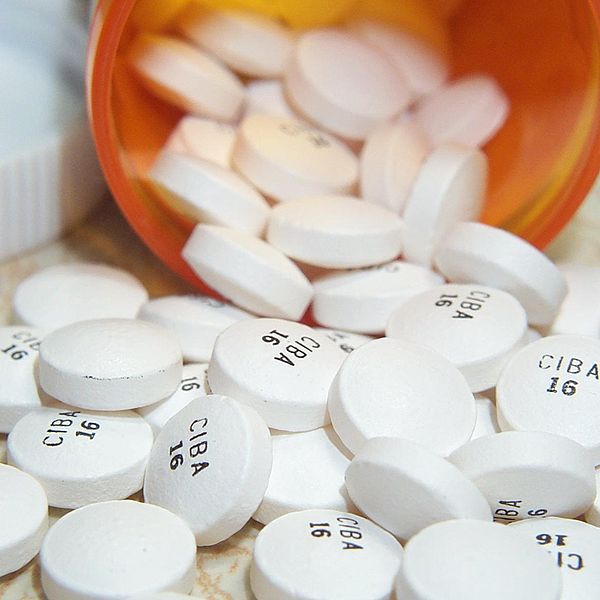
Image: Ritalin. Sponge. GNU Free Documentation License.