Coffee heat rising

Of Dentists, Trees, and Retirement Pay

So yesterday I ran over to the dentist’s office to get my teeth cleaned. As you’ll recall, I canned Delta Dental when it became clear that Delta’s huge deductible, its $20 copays, and its skimpy coverage would combine to cost as much as or more than what it would take to simply pay the darned dentist out of pocket.

When I explained to him that I’d dropped the dental insurance, that I’m permanently unemployed, that I’m over the hill, and that I can’t afford to make separate paid trips to his office just to chat with him about what he plans to do, he cut his fee by 10 percent. This resulted in a significant reduction in the amount I owed him: from about $170 to about $140.

This was somewhat cheering.

The arborist came by in the afternoon to look at the damage inflicted by the idiot roofers. He was not pleased by what he saw.

As to the stump of the major branch those clowns chopped off the desert willow, cutting out a good quarter of the crown and stealing much-needed shade from the front courtyard, he opined that left the way it was it would die back, rot, and leave the tree vulnerable to bacterial infection and insects. To head off this fate, he cut it all the way back to the trunk.

I’m still dead furious about the damage to that beautiful tree, but it least now it looks better cosmetically.

The SOBs did the same thing to the paloverde in back: hacked off a chunk of a thick, major branch, this one casting shade on the west side. I’m afraid that little antic will make the westside deck unusable in the summer. Before they pulled this stunt, I actually was able to sit out there in the shade even when it was very hot. But now too much sun will pour down on that area to make it livable anytime after about mid-April. Just flicking infuriating.

He cut back that branch to a point where he thought the tree might be able to stop the mortification of the damaged area, although he made no guarantee. He said it will die back some. If it starts to die back further than a certain point, which it certainly could, then that entire limb will have to be removed, too.

Amazingly, he performed these small bits of tree surgery for free. I offered to pay him at least a trip charge; he said how about $10 for the gas.

So that was pretty astonishing. Now I’ll have to hire him to come back and do some serious (and seriously well-paying…) work as soon as I have the money. If I ever do. LOL!

Speaking of money, I haven’t received my 2011 back sick leave payment (RASL), which was supposed to be disbursed in February. The woman who runs that program took herself a nice long vacation this month; she’s not supposed to get back until today, when of course I have to spend the entire day in the classroom or lurking on the campus between classes.

State retirees who elected to participate in the 403(b) plan rather than the state’s pension fund are required to take a drawdown from investments to remain eligible for all three payouts of their RASL. I’m concerned that she’s decided the $1 a month that Fidelity told me was OK is NOT OK, and that she will announce she’s decided I’m “not retired” and will refuse to pay me any further.

This is another stage in the endless runaround the state deals out to its retired employees. Every time I asked someone in the state GAO (which administers the RASL program) what was the minimum amount I could draw down, I was told to talk to the people at Fidelity. Every time I asked someone at Fidelity, he would say he didn’t know or he would find out and get back to me. Obviously, “get back to you” is run-around talk for “flake off, please.” Finally I reached a middle-management type who claimed that you could take as little as $1.00 a month and still remain eligible for RASL, and that a number of Arizona state retirees he works with have done exactly that.

Nevertheless, given that the money hasn’t shown up, I expect the RASL administrator to announce that the buck a month doesn’t qualify, thereby giving me the shaft in the biggest way possible. It’s a fitting good-bye from state service.
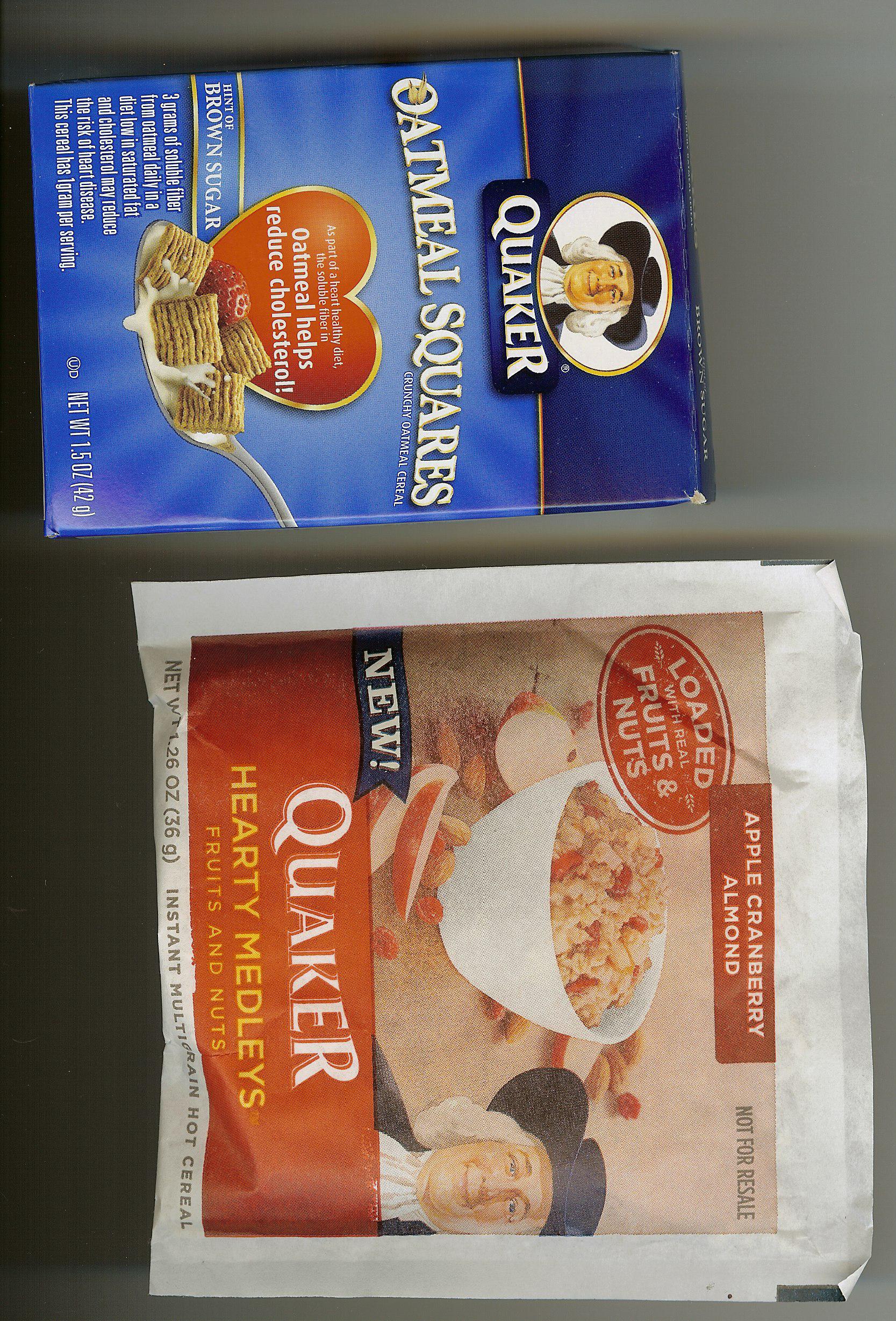
“Healthy” Junk Food: We spend MONEY on this?

Ewwww! One of the door-to-door litterers hung a bag with two minipackages of Quaker cereals on my front gate. I don’t eat processed junk cereals, and so was about to throw them out when I thought…wait! Maybe this is something I could eat between classes on Tuesdays and Thursdays.

There’s no decent food on campus (decent by my lights, anyway—I don’t eat junk food, and that’s about all that’s sold in the student union, except for a few pathetic attempts at salads). The stretch from 7:00 a.m., when I have breakfast, to 3:30 or 4:00, when I get home, is a long one, and I get awfully hungry. So hungry that the instant I get into the house I fix a big dinner and then overeat. The overeating at mealtime is what keeps the weight on, I suspect.

So, I go to look at the ingredients in the minipackage of Quaker Oatmeal Squares:

whole oat flour, whole wheat flour, brown sugar, sugar, maltodextrin, malted barley extract, molasses, salt, and then a list of the same ingredients that appear in a bottle of multivitamins.

Maltodextrin is a form of sugar. Malted barley extract is a type of sweetener which also contains a form of sugar.

Sooo…what we have in this little box is some ground oats and wheat (very cheap), five doses of sugar(!), and some spray-on vitamins. Oatmeal Squares, sold as “heart-healthy” and so by implication good for you, is largely, if not mostly, sugar.

Yuck! Why do people put stuff like this in their mouth?

Well, the answer is probably that they think it’s good for them (“2 grams of soluble fiber from oatmeal daily in a diet low in saturated fat and cholesteral may reduce the risk of heart disease,” it says here). And they probably think it’s inexpensive food.

What does this stuff cost? At the Safeway, with the Red Card membership discount: about $2.50 for 12 ounces. That’s twenty-one cents an ounce, which at first glance seems pretty cheap. But really. It’s an awful lot for a vitamin pill sprinkled over some heavily sugared grain.

You’d do a whole lot better to buy a box of real, actual oats. Takes about five minutes to cook them, and when you pour the stuff in your bowl, you get the whole three ounces (or more)…not the one ounce that resides in a single serving of Oatmeal Squares. If you like your cereal sugared up, at least you know how much sugar (or honey, or maple syrup) you’re putting over the stuff.

Is there any question why Americans are overweight?

Love Drop and the Weekend Roundup

Before moving on to my favorite bloggers, let’s go to Love Drop and check out what they’re up to this month: trying to raise 13 grand to buy a service dog to help a family with not one but two autistic children. This is big, folks:

What else is going on out there?

At My Journey to Millions, Evan discovered that parenthood saves money in unexpected ways. Some of the saved cash is going to buy life insurance on the new kid; before your murmur “bad karma,” take a look at his reasoning.

Meanwhile, Revanche is still dealing with the opposite problem: parents who are growing more dependent in old age.

At the Ultimate Money Blog, Mrs. Money offers several home remedies for dandruff. Before you reach for the Selsun Blue with all its strange ingredients, try one of these first.

Donna Freedman emits an elaborate rant at Surviving and Thriving, spinning off the latest news-bleat, “frugal fatigue.” This appears to be what the herd journalists regard as the logical outcome of the late, great “new frugality” spawned as the recession-that-is-not-a-depression bore down upon us. LOL! One reason I canceled the local paper was exactly this kind of predictability.

At the Digerati Life, SVB suggests several fall-back resources for 99ers—people who run out of unemployment insurance—plus some steps you can take in advance to mitigate the effects of potential joblessness.

At Brip-Blap, Steve comes up with a nice contrarian take on net worth. Suspicions confirmed!

Mrs. Accountability is getting worried about the looming increases in prices across the board. With gasoline at $3.15 a gallon and rising, you can be sure everything that has to be trucked in or needs energy for production will also go up. For sure, it’s time to start stocking up—next week when the new budget cycle starts again, it’s off to Sprouts, Target, and Costco to replenish the food and cleaning goods hoard.

Frugal Scholar reports an ethical dilemma posed by a conversation overheard in a thrift shop. It’s an interesting post with a number of interesting implications.

Money Crush has a good post on finding part-time home-based work, in which she suggests a number of issues to consider when thinking about this as a possibility.

At Bargaineering, Marquit reports that the government is about to inflict…uhm, offer debit cards for tax refunds. I can hardly wait.

Go to Bargain Babe today to nail the amazing list of discounts, goodies, and leads to sales she just put online. It’s one treasure trove after another at that site!

KISSing the Bookkeeping

Recently Money Beagle put up a post ruminating about whether his bookkeeping system, which entails subtracting earmarked funds against net worth, is maybe a shade on the overcomplicated side. I’ve been thinking the same thing about my own baroque shekel-counting schemes: this stuff is getting out of hand! As one of MB’s readers remarked, it may be time to apply the KISS principal: Keep It Simple, Stupid.

Bank accounts grow like topsy around this place. Right now I have four personal bank accounts, a joint checking account with M’hijito, a business checking account, and a PayPal account for the business. To keep track of credit-card charges, I use yet another spreadsheet. Then there are the spreadsheets for the budget: one for monthly nondiscretionary expenses and one for discretionary spending. Taken together, these little fellows have spawned eight spreadsheets for me to keep up-to-date.

These were relatively easy to handle in Quicken, because Quicken links accounts so that when you make a transfer from one to another it will automatically register the transaction in both accounts, and because it’s very easy to reconcile an account in Quicken. But now that I’m keeping my books in Excel, reconciliation is an old-fashioned headache, and transfers require me to manually debit one account and credit the other. It doesn’t sound like much extra work, but when you have to do it, you find it’s easy to lose track of stuff. One already has enough pains in the tuchus in one’s life without having to deal with some more.

How to decomplicate this?

Well…unclear.

In the first place, at the time I was laid off, I had a $14,000 emergency fund, which I stashed in my checking account and used as a “cushion,” ensuring I would never overdraw the account and eliminating the need to keep track of it someplace else. Since the market had crashed with a resounding thud, I really didn’t want to invest this money, because I was afraid of losing even more than the $180,000 that had already gone down the toilet.

After a difficult year of trying to live without pulling down anything from the remnants of my life savings, the market has pretty well recovered and savings are nearing their former state of normalcy.

So, in the fall I let my financial manager know I could not continue to live on less income than my base expenses and I would have to start taking a drawdown from investments. He suggested that instead of incurring a taxable event each month, I should use the after-tax money in the emergency fund, since in reality there’s plenty of money in taxable savings to cover emergencies. So I’ve been using about $1,100 a month of that 14 grand to supplement Social Security, providing enough to pay the bills before the unpredictable and unreliable pay from adjunct teaching comes in. To manage this, I opened a tiered money-market checking account to hold the amount remaining from the original 14 grand; from that I disburse the $1,100 to regular checking once a month. I figure this fund will be exhausted by September.

Adjunct teaching pay has to go to cover the mortgage on the downtown house. My initial plan was to transfer only enough to cover my share of each month’s payment to M’hijito’s and my joint checking account, which exists to hold cash for the mortgage. To keep from diddling it away on daily expenses, I started stashing teaching income in the money market account. Obviously, though, to keep track of those two items—the fund I was now depleting for living expenses and the money for the mortgage—and ensure I didn’t accidentally spend some of one fund on the other purpose, I needed another spreadsheet, one that would keep track of the mortgage payment fund. Now we’re up to nine spreadsheets. Make that ten: there’s one tracking investments, too.

Then something over $11,000 came in from the insurance company to cover hail damage. This money had to be carefully sequestered, because if I diddled it away there wouldn’t be enough to pay the swarms of workmen. Reluctant to open yet another account, I stashed it in the money market account, along with the mortgage fund and the dwindling cost-of-living fund. This added to the potential for confusion exponentially, requiring yet another spreadsheet.

Meanwhile, the bank account holding the self-escrows for annual tax and insurance payments (I have to set aside $325 a month to cover property tax, car insurance, and homeowner’s insurance) also held the summer stipend I got for developing the online course last year. The summer money would, I hope, carry me through what I expected would be four months in 2010 with less income than outgo (it devolved into five months, but that’s another story). There’s now just enough summer money left (if my arithmetic is right) to cover half the cost of the new pair of prescription glasses.

Okay. That’s the “system” as it stands. Is there a way to decomplicate this system?

Now that we have a permanent loan modification, it’s clear that the amount I’m earning during the academic year will more than cover a full year’s mortgage payments. The departmental chair has assigned me two sections to teach next summer, the proceeds of which will be gravy.

So, New Plan #1: transfer 100% of September-May teaching income to the joint account as it comes in. Let M’hijito figure out how to allocate it, with his share, to cover the mortgage. Use the summer pay (June-August) to cover the extraordinarily high costs of living in Arizona during a 115-degree summer, and, for a change, actually run the air-conditioning when typing on a keyboard will raise a sweat.

New Plan #2: At the end of each month, transfer any money left from that month’s income into the savings account for discretionary spending.

These two strategies will hugely plump up monthly savings, which is used for things like clothing, car maintenance and repair, and house repairs. In the winter, there’s often $100 or so left; in the summer, a fair amount should remain from the teaching income—possibly enough to add up to around $3,000, plenty to buy clothes, keep the aged car running, and cover small emergencies.

Decomplicating benefits: Moving all academic-year teaching income directly into joint checking eliminates the need to keep track of how much of the money-market account’s balance should be held aside for the mortgage. That takes one moving target off the field. Transferring whatever remains in checking at the end of each month allows me to see, at a glance, what’s in savings to cover unplanned expenses.

Once the glasses are paid for, all that will remain in the Tax & Insurance account will be dedicated fully to paying tax and insurance. This will decomplicate another spreadsheet; here, too, the bottom line will show how much is available to cover those exorbitant costs.

And once the bills for the roof, the new air conditioner, and the exterior painting are paid, all that will remain in the money market account is the balance of the survival savings. When that’s depleted, the money market account can be closed. w00t! A whole spreadsheet gone!

By the end of the summer, here’s how I expect this to look:

Still complicated, but at least it shouldn’t take 10 spreadsheets to keep track of it.

Speaking of those spreadsheets, why do I need ten of the damn things? Right now I have two workbooks, one tracking cash flow (in all those bank accounts!) and credit-card charges and one tracking the budget, along with various schemes, projections, and retrospective summaries. Why am I doing this?

I think I’ll collapse these into a single workbook, leaving all the fevered calculations in a separate file. This will allow at least allow me to move back and forth between cash flow and the budget, rather than keeping two files open in Excel to enter routine transactions. This will reduce the number of pages where I regularly enter numbers from sixteen to five. That is, from these (some of which have been defunct for over a year!)…

to this:

And that, I suppose, is as close to minimalist as I’m gunna get.

Crockpot Chicken Stock, Avgolemono Soup, Braised Sauerkraut

If you have a nice large crockpot, you’ve got a gadget that calls out to make you some wonderful chicken stock, a glorious base for home-made chicken soup and delicious stuff to cook with in general. Making stock in your slow cooker is easy as…well, pie.

You need:

A chicken carcass or collection of bones from baked, roasted, fried, or barbecued chicken; the more the better
An onion
One or more garlic cloves
A stick of celery
A carrot or two
Water
White wine or sherry (optional)
Fresh or dried herbs to taste: thyme, chervil, parsley, fines herbes, tarragon, basil, rosemary…whatever you have in the pantry or in the garden

Trim the root end off the onion and then cut the onion into chunks, skin and all. No need to peel off the papery skin. Coarsely chop the garlic, not bothering to peel the cloves. Wash the carrot—don’t bother to peel that, either—and cut it and the celery into coarse chunks.

Place the chicken bones into the crockpot. If using a carcass, you may want to break it apart into large pieces. Add all the vegetables and herbs. Add enough water to cover everything. If desired, add a generous dollop of white wine or sherry with the water.

Turn the crockpot to low, cover, and go away. Allow the whole mess to simmer all day long, or, if you prefer, all night.

After many hours have passed, turn off and unplug the crockpot. Set it on the counter next to the sink. Place a large bowl in the sink and set a strainer over the top of it. Ladle the liquid and cooked ingredients into the strainer, using the back of the ladle to press the liquid out of the cooked stuff and through the strainer as thoroughly as is practical. Discard the exhausted cooked solids.

Allow the bowl of stock to cool uncovered until it’s reasonable to put the bowl into the refrigerator. Once you can get it into the fridge without disrupting the temperature inside, cover the bowl and allow the stock to chill for six or eight hours or overnight. This will cause the fat, which floats to the surface, to congeal.

When the stock is thoroughly chilled, remove from the fridge and simply peel or ladle the congealed fat off the surface. Discard it.

You now have a bowl of very tasty low-sodium, low-fat chicken stock, which can be used on its own as unadorned chicken soup or used in recipes asking for canned chicken broth.

I happen to be very partial to…

Avgolemono Soup

This easy and tasty dish is Greece’s answer to Jewish penicillin. Into a pan or microwave-safe bowl, ladle as much home-made chicken stock as needed for the desired number of servings. Heat it to serving temperature. Add some cooked rice or pasta, and then squeeze the juice of half a lemon into the broth. Stir and serve hot. Season to taste with salt and pepper. If desired, sprinkle a little chopped parsley and Parmesan into the soup.

And just the other day I had a great deal of success with this:

Braised Sauerkraut

In a strainer, drain and rinse a bottle, can, or bag of sauerkraut. Place this in a pot large enough to hold it with some room to spare.

Cut a seeded apple into bite-sized chunks. Toss these into the sauerkraut. Flavor with about a teaspoon of fennel seeds and a quarter- to half-teaspoon of dried thyme leaves. Add enough chicken broth to just cover the kraut.

Bring the ingredients to a simmer and then hold at the simmer over low heat for forty-five minutes or an hour. The apple should be cooked soft and the kraut should be mellow in flavor.

Serve hot or cold with sausages, pork, chicken, duck, or whatever suits your fancy.

When I’m not planning to use the broth immediately, I like to freeze it in one- or two-cup containers. Keep it handy to use in any recipe that calls for chicken broth. Also, the next time you have another chicken carcass, defrost and add some of the old broth to the liquid for the new crockpot stock, creating an even richer and more delicious product.

Image: Rooster Portrait. Muhammed Mahdi Karim. GNU Free Documentation License

Time to Buy a Big-Ticket Item?

Yipes! Inflation is about to rear its hideous head, or so we’re told. Manufacturers are threatening to raise prices as much as 15 percent between now and this fall. The reason for yet another kick in the ribs to folks who are unemployed, underemployed, and furloughed is the rising cost of commodities from cotton to copper to foodstuffs.

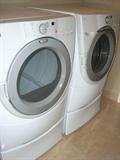
Well, if that’s the case, now may be the time to buy pricey goods such as appliances, especially if you’ve been putting it off until you can afford it. In another couple of months, you’ll be able to afford it even less. 🙄

My dryer has been dead for so long I’ve lost track—running safely only on “Air Dry” for the past year, anyway. Haven’t replaced it because I quickly learned that I’d just as soon hang the clothes on the line. But before I put away the comforters for the summer, I will need to wash them, and that is the one chore that will require a fully functioning dryer. The comforters need to be batted around inside a warm dryer to fluff them up.

At least…umh…I think they do. Maybe I’ll try it on Air Dry before springing for an $850 dryer.

Meanwhile, though, the washer is also about to give up the ghost. It no longer will spin the water out of a load of laundry. Last night I pulled out a wad of sopping wet jeans. Stuffed them back into the washer and ran the spin cycle again, to exactly zero avail.

Annoying.

Think of it: eight hundred and fifty bucks for a $325 appliance! What a flickin’ outrage. Every time we get another energy-efficient, green “improvement” to our lives, it ends up either costing us through the wazoo or, like the infinitely plungeable toilet, just flat not working. According to that article, we can expect Whirlpool (which makes most Sears appliances) to jack up its prices by 8 to 10 percent, as of April 1. That would be a price increase of 68 to 85 dollars, plus the 9.3 percent tax extortion: $74 to $93 all told…before the delivery charge.

That’s probably enough to justify accelerating the purchase of a washer, rather than waiting until the thing stops dead.

I’m thinking I’ll buy the dryer through Craig’s List, since it looks like I’ll hardly ever use it. But the washer is something I’d like to have for its entire lifetime (especially since they’re now designed to crap out in seven years). So I guess I’ll buy that new.

But it frosts my cookies.

How about you? Will you consider buying a big-ticket item sooner than later, knowing the prices are about to jump significantly?