Before moving on to my favorite bloggers, let’sgo to Love Drop and check out what they’re up to this month: trying to raise 13 grand to buy a service dog to help a family with not one but two autistic children. This is big, folks:
What else is going on out there?
At My Journey to Millions, Evan discovered that parenthood saves money in unexpected ways. Some of the saved cash is going to buy life insurance on the new kid; before your murmur “bad karma,” take a look at his reasoning.
At the Ultimate Money Blog, Mrs. Money offers several home remedies for dandruff. Before you reach for the Selsun Blue with all its strange ingredients, try one of these first.
Donna Freedman emits an elaborate rant at Surviving and Thriving, spinning off the latest news-bleat, “frugal fatigue.” This appears to be what the herd journalists regard as the logical outcome of the late, great “new frugality” spawned as the recession-that-is-not-a-depression bore down upon us. LOL! One reason I canceled the local paper was exactly this kind of predictability.
At the Digerati Life, SVB suggests several fall-back resources for 99ers—people who run out of unemployment insurance—plus some steps you can take in advance to mitigate the effects of potential joblessness.
Mrs. Accountability is getting worried about the looming increases in prices across the board. With gasoline at $3.15 a gallon and rising, you can be sure everything that has to be trucked in or needs energy for production will also go up. For sure, it’s time to start stocking up—next week when the new budget cycle starts again, it’s off to Sprouts, Target, and Costco to replenish the food and cleaning goods hoard.
Frugal Scholar reports an ethical dilemma posed by a conversation overheard in a thrift shop. It’s an interesting post with a number of interesting implications.
Money Crush has a good post on finding part-time home-based work, in which she suggests a number of issues to consider when thinking about this as a possibility.
At Bargaineering, Marquit reports that the government is about to inflict…uhm, offer debit cards for tax refunds. I can hardly wait.
Recently Money Beagle put up a post ruminating about whether his bookkeeping system, which entails subtracting earmarked funds against net worth, is maybe a shade on the overcomplicated side. I’ve been thinking the same thing about my own baroque shekel-counting schemes: this stuff is getting out of hand! As one of MB’s readers remarked, it may be time to apply the KISS principal: Keep It Simple, Stupid.
Bank accounts grow like topsy around this place. Right now I have four personal bank accounts, a joint checking account with M’hijito, a business checking account, and a PayPal account for the business. To keep track of credit-card charges, I use yet another spreadsheet. Then there are the spreadsheets for the budget: one for monthly nondiscretionary expenses and one for discretionary spending. Taken together, these little fellows have spawned eight spreadsheets for me to keep up-to-date.
These were relatively easy to handle in Quicken, because Quicken links accounts so that when you make a transfer from one to another it will automatically register the transaction in both accounts, and because it’s very easy to reconcile an account in Quicken. But now that I’m keeping my books in Excel, reconciliation is an old-fashioned headache, and transfers require me to manually debit one account and credit the other. It doesn’t sound like much extra work, but when you have to do it, you find it’s easy to lose track of stuff. One already has enough pains in the tuchus in one’s life without having to deal with some more.
How to decomplicate this?
Well…unclear.
In the first place, at the time I was laid off, I had a $14,000 emergency fund, which I stashed in my checking account and used as a “cushion,” ensuring I would never overdraw the account and eliminating the need to keep track of it someplace else. Since the market had crashed with a resounding thud, I really didn’t want to invest this money, because I was afraid of losing even more than the $180,000 that had already gone down the toilet.
After a difficult year of trying to live without pulling down anything from the remnants of my life savings, the market has pretty well recovered and savings are nearing their former state of normalcy.
So, in the fall I let my financial manager know I could not continue to live on less income than my base expenses and I would have to start taking a drawdown from investments. He suggested that instead of incurring a taxable event each month, I should use the after-tax money in the emergency fund, since in reality there’s plenty of money in taxable savings to cover emergencies. So I’ve been using about $1,100 a month of that 14 grand to supplement Social Security, providing enough to pay the bills before the unpredictable and unreliable pay from adjunct teaching comes in. To manage this, I opened a tiered money-market checking account to hold the amount remaining from the original 14 grand; from that I disburse the $1,100 to regular checking once a month. I figure this fund will be exhausted by September.
Adjunct teaching pay has to go to cover the mortgage on the downtown house. My initial plan was to transfer only enough to cover my share of each month’s payment to M’hijito’s and my joint checking account, which exists to hold cash for the mortgage. To keep from diddling it away on daily expenses, I started stashing teaching income in the money market account. Obviously, though, to keep track of those two items—the fund I was now depleting for living expenses and the money for the mortgage—and ensure I didn’t accidentally spend some of one fund on the other purpose, I needed another spreadsheet, one that would keep track of the mortgage payment fund. Now we’re up to nine spreadsheets. Make that ten: there’s one tracking investments, too.
Then something over $11,000 came in from the insurance company to cover hail damage. This money had to be carefully sequestered, because if I diddled it away there wouldn’t be enough to pay the swarms of workmen. Reluctant to open yet another account, I stashed it in the money market account, along with the mortgage fund and the dwindling cost-of-living fund. This added to the potential for confusion exponentially, requiring yet another spreadsheet.
Meanwhile, the bank account holding the self-escrows for annual tax and insurance payments (I have to set aside $325 a month to cover property tax, car insurance, and homeowner’s insurance) also held the summer stipend I got for developing the online course last year. The summer money would, I hope, carry me through what I expected would be four months in 2010 with less income than outgo (it devolved into five months, but that’s another story). There’s now just enough summer money left (if my arithmetic is right) to cover half the cost of the new pair of prescription glasses.
Okay. That’s the “system” as it stands. Is there a way to decomplicate this system?
Now that we have a permanent loan modification, it’s clear that the amount I’m earning during the academic year will more than cover a full year’s mortgage payments. The departmental chair has assigned me two sections to teach next summer, the proceeds of which will be gravy.
So, New Plan #1: transfer 100% of September-May teaching income to the joint account as it comes in. Let M’hijito figure out how to allocate it, with his share, to cover the mortgage. Use the summer pay (June-August) to cover the extraordinarily high costs of living in Arizona during a 115-degree summer, and, for a change, actually run the air-conditioning when typing on a keyboard will raise a sweat.
New Plan #2: At the end of each month, transfer any money left from that month’s income into the savings account for discretionary spending.
These two strategies will hugely plump up monthly savings, which is used for things like clothing, car maintenance and repair, and house repairs. In the winter, there’s often $100 or so left; in the summer, a fair amount should remain from the teaching income—possibly enough to add up to around $3,000, plenty to buy clothes, keep the aged car running, and cover small emergencies.
Decomplicating benefits: Moving all academic-year teaching income directly into joint checking eliminates the need to keep track of how much of the money-market account’s balance should be held aside for the mortgage. That takes one moving target off the field. Transferring whatever remains in checking at the end of each month allows me to see, at a glance, what’s in savings to cover unplanned expenses.
Once the glasses are paid for, all that will remain in the Tax & Insurance account will be dedicated fully to paying tax and insurance. This will decomplicate another spreadsheet; here, too, the bottom line will show how much is available to cover those exorbitant costs.
And once the bills for the roof, the new air conditioner, and the exterior painting are paid, all that will remain in the money market account is the balance of the survival savings. When that’s depleted, the money market account can be closed. w00t! A whole spreadsheet gone!
By the end of the summer, here’s how I expect this to look:
Still complicated, but at least it shouldn’t take 10 spreadsheets to keep track of it.
Speaking of those spreadsheets, why do I need ten of the damn things? Right now I have two workbooks, one tracking cash flow (in all those bank accounts!) and credit-card charges and one tracking the budget, along with various schemes, projections, and retrospective summaries. Why am I doing this?
I think I’ll collapse these into a single workbook, leaving all the fevered calculations in a separate file. This will allow at least allow me to move back and forth between cash flow and the budget, rather than keeping two files open in Excel to enter routine transactions. This will reduce the number of pages where I regularly enter numbers from sixteen to five. That is, from these (some of which have been defunct for over a year!)…
to this:
And that, I suppose, is as close to minimalist as I’m gunna get.
If you have a nice large crockpot, you’ve got a gadget that calls out to make you some wonderful chicken stock, a glorious base for home-made chicken soup and delicious stuff to cook with in general. Making stock in your slow cooker is easy as…well, pie.
You need:
• A chicken carcass or collection of bones from baked, roasted, fried, or barbecued chicken; the more the better • An onion • One or more garlic cloves • A stick of celery • A carrot or two • Water • White wine or sherry (optional) • Fresh or dried herbs to taste: thyme, chervil, parsley, fines herbes, tarragon, basil, rosemary…whatever you have in the pantry or in the garden
Trim the root end off the onion and then cut the onion into chunks, skin and all. No need to peel off the papery skin. Coarsely chop the garlic, not bothering to peel the cloves. Wash the carrot—don’t bother to peel that, either—and cut it and the celery into coarse chunks.
Place the chicken bones into the crockpot. If using a carcass, you may want to break it apart into large pieces. Add all the vegetables and herbs. Add enough water to cover everything. If desired, add a generous dollop of white wine or sherry with the water.
Turn the crockpot to low, cover, and go away. Allow the whole mess to simmer all day long, or, if you prefer, all night.
After many hours have passed, turn off and unplug the crockpot. Set it on the counter next to the sink. Place a large bowl in the sink and set a strainer over the top of it. Ladle the liquid and cooked ingredients into the strainer, using the back of the ladle to press the liquid out of the cooked stuff and through the strainer as thoroughly as is practical. Discard the exhausted cooked solids.
Allow the bowl of stock to cool uncovered until it’s reasonable to put the bowl into the refrigerator. Once you can get it into the fridge without disrupting the temperature inside, cover the bowl and allow the stock to chill for six or eight hours or overnight. This will cause the fat, which floats to the surface, to congeal.
When the stock is thoroughly chilled, remove from the fridge and simply peel or ladle the congealed fat off the surface. Discard it.
You now have a bowl of very tasty low-sodium, low-fat chicken stock, which can be used on its own as unadorned chicken soup or used in recipes asking for canned chicken broth.
I happen to be very partial to…
Avgolemono Soup
This easy and tasty dish is Greece’s answer to Jewish penicillin. Into a pan or microwave-safe bowl, ladle as much home-made chicken stock as needed for the desired number of servings. Heat it to serving temperature. Add some cooked rice or pasta, and then squeeze the juice of half a lemon into the broth. Stir and serve hot. Season to taste with salt and pepper. If desired, sprinkle a little chopped parsley and Parmesan into the soup.
And just the other day I had a great deal of success with this:
Braised Sauerkraut
In a strainer, drain and rinse a bottle, can, or bag of sauerkraut. Place this in a pot large enough to hold it with some room to spare.
Cut a seeded apple into bite-sized chunks. Toss these into the sauerkraut. Flavor with about a teaspoon of fennel seeds and a quarter- to half-teaspoon of dried thyme leaves. Add enough chicken broth to just cover the kraut.
Bring the ingredients to a simmer and then hold at the simmer over low heat for forty-five minutes or an hour. The apple should be cooked soft and the kraut should be mellow in flavor.
Serve hot or cold with sausages, pork, chicken, duck, or whatever suits your fancy.
When I’m not planning to use the broth immediately, I like to freeze it in one- or two-cup containers. Keep it handy to use in any recipe that calls for chicken broth. Also, the next time you have another chicken carcass, defrost and add some of the old broth to the liquid for the new crockpot stock, creating an even richer and more delicious product.
Yipes! Inflation is about to rear its hideous head, or so we’re told. Manufacturers are threatening to raise prices as much as 15 percent between now and this fall. The reason for yet another kick in the ribs to folks who are unemployed, underemployed, and furloughed is the rising cost of commodities from cotton to copper to foodstuffs.
Well, if that’s the case, now may be the time to buy pricey goods such as appliances, especially if you’ve been putting it off until you can afford it. In another couple of months, you’ll be able to afford it even less. 🙄
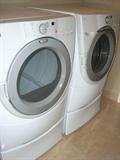
My dryer has been dead for so long I’ve lost track—running safely only on “Air Dry” for the past year, anyway. Haven’t replaced it because I quickly learned that I’d just as soon hang the clothes on the line. But before I put away the comforters for the summer, I will need to wash them, and that is the one chore that will require a fully functioning dryer. The comforters need to be batted around inside a warm dryer to fluff them up.
At least…umh…I think they do. Maybe I’ll try it on Air Dry before springing for an $850 dryer.
Meanwhile, though, the washer is also about to give up the ghost. It no longer will spin the water out of a load of laundry. Last night I pulled out a wad of sopping wet jeans. Stuffed them back into the washer and ran the spin cycle again, to exactly zero avail.
Annoying.
Think of it: eight hundred and fifty bucks for a $325 appliance! What a flickin’ outrage. Every time we get another energy-efficient, green “improvement” to our lives, it ends up either costing us through the wazoo or, like the infinitely plungeable toilet, just flat not working. According to that article, we can expect Whirlpool (which makes most Sears appliances) to jack up its prices by 8 to 10 percent, as of April 1. That would be a price increase of 68 to 85 dollars, plus the 9.3 percent tax extortion: $74 to $93 all told…before the delivery charge.
That’s probably enough to justify accelerating the purchase of a washer, rather than waiting until the thing stops dead.
I’m thinking I’ll buy the dryer through Craig’s List, since it looks like I’ll hardly ever use it. But the washer is something I’d like to have for its entire lifetime (especially since they’re now designed to crap out in seven years). So I guess I’ll buy that new.
But it frosts my cookies.
How about you? Will you consider buying a big-ticket item sooner than later, knowing the prices are about to jump significantly?
How do you feel about backing up your computer data in the Cloud? Basically, we’re talking about using someone else’s servers as a gigantic external hard drive for your data storage.
One of the guys in my business group, a PC tech, urges friends to use Carbonite, a service that offers unlimited backup capacity (“no limits on your backup storage space”!), a powerful encryption program, and ongoing automatic backup, all for $55 a year. That seems amazingly cheap for unlimited storage.
Just now I’m using Apple’s ME.com, which puts an icon in Finder that effectively works as an external drive. It gives you 20GB of space (you can upgrade, if you can afford it), you can use it to back up data from mobile devices, and you get MacMail with it. Annual cost is $99, which is kinda high…but on the other hand, I’m not getting rid of my years-old mac.com address, because so many of my friends and business acquaintances have it. I’d lose a lot of contacts if I dumped the e-mail now, and so in effect the 20 gigs of storage in the cloud comes with the overpriced mail system. Although it can synch all your devices and allow you to access your Mac from a remote computer, as far as I can tell ME.com does not have an automatic backup feature. Uploading an entire directory can be excruciatingly slow. However, backing up just a file or two is fast and simple.
Apple also provides a system called “Time Machine” with an automatic backup feature, but as far as I can tell, it only backs up files to a hard drive; apparently it doesn’t yet talk to ME.com.
Backing up your data to the Cloud has a lot of advantages, the main one being that when the burglar steals all your computer gear or the house burns down and melts your desktop, your laptop, and your external drive your data will be safe somewhere else. Because it’s “out there” with the Truth, you can access the stuff from any computer, so you don’t have to carry a flash drive or hard drive around with you. And as we know, all hard drives eventually fail, whether external or internal; moving data to the cloud lowers the probability that you’ll lose data in a hardware crash.
On the other hand, IMHO relying on someone else’s servers is a bit scary. I’m not real confident about any of these outfits’ hacker-proofness. Carbonite encrypts your data so thoroughly that if you lose your password, you’re SOL, because no one there can recover a password. ME.com is protected only by whatever password you cook up. As we know, no matter arcane you try to be, passwords can be highly vulnerable.
What do you think about the advantages and trade-offs of backing up data to the Cloud? And if you’re storing your backups online, what system are you using?
Well, not much: student papers will come in on Thursday, needing to be turned around by the following Tuesday. But all things said and done, reading 50 comp papers is one heckuva lot better than hauling back and forth across the freeways to Tempe ten times in the cheery company of my fellow homicidal drivers.
Spent the better part of the weekend in the company of my friend KJG, now also a certified escapee from the Great Desert University. She went over the wall a few months ago, and like me is only just beginning to fully unwind from the stress of working in a psychologically crushing environment. It truly takes a good year to recover from the effects of spending eight or ten hours a day in a place where management works at making everyone miserable.
You realize…? There are therapists in this city who specialize in counseling GDU employees. Is that or is that not amazing?
Saturday I drove out to her house, way on the far west side (halfway to California). She and her husband, a firefighter, have built a lovely home on an acre of land out there. She’s very, very good at gardening and housekeeping; now that she’s home all the time, the place looks gorgeous.
KJG worried, as the opportunity for her to retire approached, about no longer contributing to the household income. She actually felt guilty about the prospect. Yesterday, though, she remarked that she no longer feels that way: “We have plenty,” she observed.
Indeed. And as a matter of fact, to pay for the gardening, housekeeping, cooking, and homemaking services she does could cost them more than she was earning at GDU. Sometimes having one member of a couple not work costs the household a great deal less than it would appear at first glance.
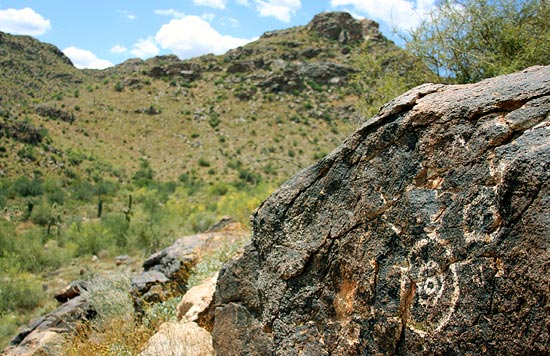
We took the dogs for a hike in the White Tank Mountains, which was quite an adventure for Cassie the Short-legged Little Corgi. KJG has a well trained and mellow doberman, one of whose steps equals about ten of a corgi’s.
The day was so gorgeous, there were quite a few people out, although not so many that the trail seemed as crowded as those in town. We did run into one chucklehead with a gigantic bulldoggy looking critter, probably a mastiff mix. He stood aside and cooed, “Don’t worry, he’s fine!” Of course the instant KJG approached to pass them, his huge dog lunged for the dobe, who, though generally a laid-back sort, wasn’t inclined to take any guff. Fortunately, Kathy is a good dog handler and managed to get by without contact. As she and her dog reached the other side of this obstacle, the doberman turned around, glared back at the guy and his mutt, and emitted a deep, alarming growl: Make my day!
And so we see again the uses of a small dog that can be picked up. Because Cassie only weighs 25 pounds, I could pick her up, climb off the trail, and wait for the guy and He’s Just Fine to go on their way.
Why do people take animals like that on narrow public paths?
That notwithstanding, it really was a beautiful morning and a nice hike.
Later we junketed around to several big nurseries on the westside—the area still has surviving pockets of agricultural land, some of which are occupied by wholesale nurseries whose proprietors will allow the general public to wander around. Then we took it into our heads to look at model homes in the very few surviving new-home developments.
And that was something to see. If you’re in the market for a new home in the Southwest, now is the time to buy! They’re practically giving the things away. We went into a set of Shea Homes models—Shea is reputed to be one of the better tract builders in Arizona—where we found several very attractive designs in what appeared to be pretty decent construction. Interestingly, the lots in this tract were sized for human beings living in single-family homes, with enough space between the houses to allow air to circulate. For $177,000, you can buy a large, intelligently laid out house with lots of big, bright, airy rooms, a kitchen to die for, and a master bathroom best described as “sybaritic.” Of course, by the time you added the amenities that made the models desirable, you’d be pushing three hundred grand… But it was clear that for about what my house would sell for, you could get the basic floor plan plus a few upgrades that would be hard to retrofit—the top-quality cabinetry, for example—and then over the next few years make the improvements you’d like as you could afford them.
For me, the disadvantage (besides the noise from the F-16s flying out of the nearby Air Force base) is the enormous distance from everything I like to do. It’s almost an hour’s drive from the central city. Moving out there would mean the end of choir participation, the end of the regular jaunts to AJs and Whole Foods, and the beginning of impossible drives to the nearest community college.
But it was fun to look at the houses. It really would be perfect if you could get Shea to build one of those places on an infill lot.
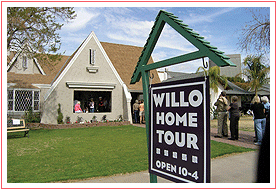
Sunday KJG drove into town, because we wanted to go on the Willo Historic District tour. This has become quite a shindig! They’d blocked off the feeder streets one street south of where I used to live, and the street where my son’s two babysitters used to live was filled with vendors’ booths. We came across one of my choir coconspirators, a lovely alto who owns Ecocentricity, an environmentally conscious shop right in the middle of the Willo commercial fringe.
She was selling a big purple purse one of her suppliers had made from a 1970s leather skirt. It was incredibly cute, and the leather was so soft and light the thing hardly seemed to weigh anything. The price was a bit stiff, though—ninety bucks. Coveting it, I set it aside to think it over while we were walking.
The day grew warm, though, and before we could get back to the Ecocentricity booth, we faded. Ended up going to lunch at our favorite uptown restaurant instead of wandering back whence we’d come.
In the real estate department, I really do miss my beautiful old house in Willo. Occasionally, I think I’d like to move back there. However, the historic district designation and the huge demand from affluent DINKs has pushed the prices out of my range. Oh well. It’s a lot of work to keep those old places up, anyway.
At Evensong my choir friend told me that the purse had almost sold three times, but she still has it! So I’ll probably drive down to Ecocentricity today, after I call the arborist to see what he can do about the trees damaged by the idiot roofers.
I intend to bill Crown Roofing for the cost, and also to post a report about the tree assault on Angie’s List. Every time I look at my poor tree in front, I could just cry.
The afternoon rising to the high 70s, had a nice snooze on the hammock before heading out to Evensong, where we listened to another of our music director’s awe-inspiring organ recitals and then sang a couple of really nice pieces for the service. That was fun.
After Evensong I went to the wine and cheese reception, where whom should I meet but a fellow who works for Pearson Publishing. This outfit contracts to my partner in business crime, Tina, who does project management for them. Turns out this guy writes science and tech textbooks for Pearson—he’s got a fulltime job with them, but because they allow him to work from home three days a week, he’s able to live in town, instead of out in the sea of houses that is Chandler, where the megapublisher’s Arizona quarters are located.
The guy started as a high-school teacher in one of the top science and technical high-schools in the Washington, D.C. suburbs. He says the school was outperforming most other schools and had a nationally top-ranking science program. When the No Child Left Behind legislation kicked in, the faculty were informed that they had to stand down from what they were doing and instead focus on getting their kids to pass the standardized exams—whose standards were lower than what the kids were already achieving.
This lock-step dumbing-down degraded the school’s quality—it no longer ranks at all in science and technology—and so demoralized staff that many people quit. He said that the year he left, 25 other teachers also departed.
Pearson pays quite nicely…given the cost of textbooks, they can afford it. You can be sure this guy is earning more than he did at teaching, and pretty clearly America’s school system lost some talent. Ohh well.
Anyway, the guy has a fair amount of music background. Maybe he can be persuaded to join the choir. He seemed like a nice man who’d fit in well.
Then it was back to the Funny Farm for a 9:00 p.m. stroll through the neighborhood with Cassie, a nice wrap-up for a fun weekend.