Exploring the Internet for new-to-me sites dealing with things monetary, I recently came across a number of interesting blogs. Check these out:
Carpe Diem, by Mark J. Perry, an economics and finance professor at the University of Michigan’s Flint campus. Lots of interesting material pops up here, some of it raw data or close to it, but usually things that seem to have some meaning. Recently, for example:
Econbrowser, by economics Professor James D. Hamilton at UC San Diego and public affairs and economics professor Menzie Chinn of the University of Wisconsin, Madision.
Would you like to share leads to thoughtful and interesting sites that are outside the PF bloggers’ niche, or outside the niche your own blog occupies? Please let us know in the comments below!
Tomorrow it’s off to the high country for a daylong break from summer’s cabin fever. Back Saturday!
Ever have one of those “CLICK” moments, when the light switch snaps on and the brain floods with Insight? They always seem to occur belatedly.
It recently dawned on me, as I was thinking of something other than how I’m going to get by during these summers of unpaid work, that an obvious source of summer funding is sitting right out there in plain view.
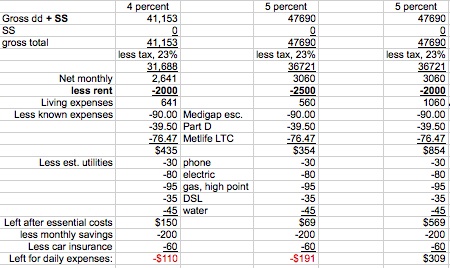
For a retired state employee to collect the many thousands of dollars owed for unused sick leave (“RASL”), she or he has to be taking a drawdown from accrued retirement savings—i.e., from the state pension fund or from the 403(b), whichever plan applies—over the three-year period in which the RASL money is paid out. By the time my job terminated, I’d never heard a straight story about how much or how little that drawdown had to be. So, in the absence of any credible facts, I decided to make it $500 a month—amounting to a $389 net.
That was more than I wanted to take out, given the goal of waiting till the stock market recovers some of the $180,000 lost from my savings, but not anything like 4 percent of total retirement savings. So…what the heck.
Time has passed. In that interim, I learned that the drawdown can be anything. Even, say, one dollar a month. That revelation was made by a guy at Fidelity not long before the end of spring semester. Since I didn’t think I could get by on Social Security and bankbook savings alone during the three months summer of full unemployment, I decided to delay cutting the drawdown until September, when a little teaching pay will start dribbling in again. Good thing—without the $389/month net drawdown, by now I’d be deep into the emergency fund. With it, I’m still in the black and, barring another unexpected repair bill, should stay that way until pay starts again in the fall.
But the black ink flows by dint of penny-pinching. And you know what? I’m tired of it. I was pinching pennies through the spring semester, so tightening the belt over the summer means real Scrooge tactics. As I write this, it’s 85 in my study and 90 degrees in the kitchen; the power bill for this month still may break the piggybank. Over at La Maya’s house, whence I just came, it’s cool and comfortable indoors. It really would be nice if my house could be so cool that the dog and I can breathe without panting. And it would be mighty nice not to have a $300 repair bill represent a minor catastrophe.
So. What we have here is 12 months of drawdown, of which 9 months are redundant. When I cut the drawdown to $1 a month in September and leave it that way until May, what will happen is $4,500 of tax-deferred savings won’t be spent. It’s money that I originally figured would have to be spent, so in a way we could regard it as usable dollars. The plan here is to draw a buck a month during the academic year and $500 a month ($389 net) in the summer.
What if instead I drew enough down in the summer to create a net of $1,000 a month? That would require a gross withdrawal from the 403(b) of $1,300 a month.
I’m already going to withdraw $500/month in the summer of 2011. To make it $1,300, I would have to take out an additional $800/month.
$800 x 3 = $,2400
But over the nine months of 2010–11 that I take effectively nothing out of the GDU retirement account, $4,500 of “spent” money will not get spent.
$4,500 – $2,400 = $2,100 to the good
In other words, although I won’t preserve all of that $4,500 saved by cutting the drawdown to $1, I’ll still be $2,100 further ahead than I would be if I continue the present $500/month drawdown until all the RASL payments are disbursed in February 2012.
Meanwhile, during the summer months, the $1,000 net drawdown added to the $975 net Social Security payment would yield $1,975 a month to live on.
That’s $575 less than came in while I was teaching three sections, but still one heckuva lot better than the $1,364 I’m trying to get by on now, during the costliest season of the year.
Of course, the only reason I’m getting by this summer is that last semester the $389 net drawdown plus the $1,574/month net teaching pay added to the Social Security left a little money in the checking account at the end of each month. Enough had accrued over four months of frugal living to almost support me while nothing but Social Security and the piddling drawdown comes in over the summer. However, I’d only be running $65 in the red, or $195 for the entire summer. It’s very likely that $195 will be left over at the end of nine months, even with the drawdown cut to a dollar a month.
How likely is it?
By the time the spring semester ended, I was about $2,500 in the black. Subtract $389 a month from that: $2,500 – ($389 · 4) = $944. Prorate that amount over the 2011 summer months to get about $315 a month. In fact, by $2011, there should be twice that much, because the monthly accrual will have occurred over two semesters, rather than this year’s single semester of earnings. $315 x 2 = $630 a month in savings for summer survival.
$ 630 left from living frugally over 9 months
+1,000 summertime net drawdown + 975 net Social Security
$2,605 net summer funding
– 1240 nondiscretionary expenses – 800 discretionary expenses
$565 theoretically left each month
How can I count the ways I doubt that? Nevertheless, even if this estimate is two or three times too generous, I could afford to run the air conditioning! And without having to try to keep discretionary expenses to $500!!
Matter of fact, with $565 a month left over, I could afford to go someplace to get out of this unholy heat for awhile! In theory, that would amount to $1,695 of summer vacation money. Holy mackerel! That would put me up in Santa Fe for almost a week!
Assuming I take my shopping cart and sleep under a freeway overpass…
Speaking of the scheme to cut the $800/month discretionary budget to $500 over the summer, that one didn’t work. The $300 air-conditioning repair pushed the June-July expenses for that budget cycle, which ended yesterday, right back up to $800. In fact, I spent about $12 more than $800.
It could have come out of monthly diddle-it-away savings. However,
a) that comes under the heading of robbing Peter to pay Paul; and b) I’m trying to revive that savings account, which was much impoverished by the clothing spree and the glasses fling. It will take another three months to recover from those spending frenzies.
So, I decided to cover the AC repair bill with cash flow. {sigh}
Pretty clearly, it’s unrealistic to think I can cover discretionary expenses on $5o0 a month. Most months I don’t spend $800, but on average since January I’ve come in only $42 under budget. To get day-to-day costs down to $500 a month, I’d have to stop eating.
And it must be said: not living like an anchorite would make a 112-degree day a lot more tolerable.
One of next fall’s English 101 students e-mailed yesterday. This is a kid who was in one of my other courses and decided to take the upcoming class because she liked my style (read: she got a good grade). She asked how much we will be using the textbook and then said she went to the bookstore and found it was selling for $150. She’s not eligible for financial aid this semester and says she doesn’t think she can afford that much. She’s doing the best she can, she adds, to stay out of debt.
A hundred and fifty bucks. For a freshman comp book. That, my friends, is a $30 paperback.
It would be one thing if the book contained a lot of difficult-to-typeset equations (though most publishers use LaTex for that purpose—works like magic, and it’s freeware!). And it would be one thing if the book contained a lot of expensive four-color graphics. Or if writing a freshman comp book required a great deal of arcane and difficult-to-acquire knowledge.
But none of these apply. When I say this thing is a $30 paperback, I’m not kidding. It’s printed on decent paper and it does use color on almost every page. But otherwise…
Graphics? There’s little in this book that can’t be done with an ordinary word processor, and nothing in it can’t be accomplished—easily—with InDesign.
Permissions? It doesn’t cost $150 a copy to get permission to reprint a few sample articles. When I published my textbook, The Essential Feature (which, BTW, sells for a mere $40), I was amazed to discover how many publishers will give away rights to reprint if you murmur the words “and my publisher is a nonprofit.”
Expertise? Research clout? Gimme a break! This is a freshman comp book! A smart graduate student could write it. A competent junior editor in her 20s could write it. What is required is basic literacy, an acquaintance with mechanics and the structure of essays, and passing familiarity with MLA style. That’s it. This is not Laboratories in Mathematical Experimentation: A Bridge to Higher Mathematics!
Lordie.
So I say to the kid, “The school just started a book rental program. Call the bookstore and see if you can rent the thing.”
Says she, “I did. They told me this text isn’t included in the rental program.”
I call up Amazon.com on the computer. Lo! One vendor is peddling the thing for $14.95 used. New copies are going for as low as $40, though most sellers try to extract $80 or $90. This morning I see the $14.95 copy is gone—hope the kid snagged it. If not, she may manage to snare the one that’s selling for $17.90. That’s more within reason.
Even at $90, a book like this is a shameless rip-off. But in the “shameless” department, what excuse is there for campus bookstores to gouge kids $150 for a book that’s overpriced at $90?
The departmental chair told me we are required to order the book and we are required to use it in the classroom. When he heard that another faculty member remarked to me that she knew of an instructor who was not having his students buy the book but instead was using material freely available on the Internet (yes, Virginia, everything in this book—even most of the essays used as examples—is available on the Net), he demanded, with arched eyebrow, to know who this guy was. Luckily, I didn’t catch his name.
Not that I’m suggesting any collusion with a rapacious textbook industry. To the contrary. A department can’t have every faculty member wildcatting Internet sites as study material and hope to maintain any pretense of academic integrity. The chair would fail to do his job if he didn’t see to it that all the courses came up to the standards set out by the institution.
Nevertheless, it’s not surprising that young people commonly graduate from college $40,000 in the hole, more debt than they’d incur by purchasing a Lexus sedan. At $150, this textbook would cost my student almost two-thirds of what she’d pay to register for the course!
So, if you have a kid on the way to college, or you’re en route to those ivied precincts yourself, what can you do to protect your checkbook?
• First things first: As soon as the bookstore puts the next semester’s texts on the shelves, pay the place a visit. Note all the required texts, and write down their ISBNs. The ISBN is a number that appears on the copyright page, usually on the reverse side of the title page; it’s unique to each specific edition of a book. The ISBN for The Longman Writer, for example, is 978-0-205-7399-8. Knowing this number will ensure that you get the correct edition—in the case of this book, that’s important, because earlier versions do not include the revised 2009 MLA style guidelines.
• Next, the path of least resistance is to check Amazon.com. Enter an ISBN in the search function and it will bring up the correct textbook. Buy used. It’s much cheaper. As we’ve seen, even though new prices are less than you’ll pay in the bookstore, even at Amazon they’re out of reason.
• If you don’t want to own these objects (and really: why should a freshman comp text collect dust on your bookshelf from now until you die?), google “textbook rental.” Thanks to our handy ISBN, we see that The Longman Writer can be borrowed for a semester from Chegg.com for $26.49, about what the book is actually worth.
• Speaking of borrowing, check the campus library. Often faculty members put textbooks on reserve. Even though you can’t take it home, few textbook reading assignments require more than an hour or two.
• And between you and me, at 10 cents a page for photocopying, you could xerox the entire Longman text for $68.20, considerably less than the bookstore wants for a new copy. Though I’m asking my students to read many chapters in this thing, I’m not testing them on the entire book. A smart student with an advance copy of the syllabus (generally available at the departmental office) could buy a copy from the bookstore, photocopy the relevant sections, and then return the thing before the deadline to receive a full refund.
Ethical? Legal? No. But when publishers and retailers are openly ripping off 19-year-olds, I wouldn’t feel too bad about a little larceny. You can always plead self-defense…
• If you bought the book, resell it at the end of the semester. Check online for resale opportunities that will return more than the campus bookstore will pay you. Remember that you can resell the book on Amazon, possibly for more than you could get on-campus. Enter the ISBN, check the amounts people are getting, and compare with the figure the bookstore is offering. Don’t stop at Amazon; textbook renters often buy used books, as do other marketers—google “buy textbooks” to bring up a variety of sites. Sell to the highest bidder.
Oh, I’m getting all worked up over this. It makes me so angry! The textbook business, which ought to be an altruistic endeavor, has turned into industrial exploitation of a captive audience, made even more inexcusable by the buyers’ youth and financial naïveté.
If you’re a kid, don’t put up with it!
If you’re the parent of a new college student, teach your student where to find textbooks at reasonable prices, and help them to find ways get supplies from sellers that don’t steal from them.
A few days ago, La Maya and I made a run on a couple of estate sales. The first place was disappointing—looked a lot better in the online photos than it was. But at the second place we both found some loot.
Check out this fine junk:
That pan, which I’d call a brazier or braising pan, was part of a large set of aluminum-core stainless steel. Wolfgang Puck. Not a bad pan, not the best, but more than good enough for government work. Similar Wolfgang Pucks on the market are going for $30, which is what I paid for the entire collection of valuables.
These folks decorated in the 1980; hence lots of blue and pink. The blue and pink mugs seem to be pretty good quality stoneware. They’re not signed, but they’re high-fired and in good condition. There actually are four of them–two are in the dishwasher just now.
My beloved yellow-and-blue mugs from Pier One have crazed on the inside. They still look pretty on the outside, but the cracked interiors have soaked up enough coffee and tea stains as to be more or less uncleanable, this side of soaking them in Clorox. An exercise in futility: bleach the stains out and the next time you pour a cup of tea, you have the map of the crevasses of Mars again. These dated pink-and-blue fellows will do until I spot (and can afford) another set that inspires love in my heart.
And in spite of the equally dated pink and blue design on the little Italian dish, it has some real charm. Seen in a context completely devoid of pink and blue, it ceases to cry “1988” and looks like a sweet little decorator item.
The Chantal knockoff teakettle is a Kuhn-Rikon. The amount they charge for those things new is a little on the startling side. On the other hand, the newer models look like they’ve undergone some improvements. This one is all stainless steel, including its (wonderfully loud!) whistle and its handle. It’s not surprising that the steel whistle would get too hot to pull off without a potholder. But the handle? You can’t touch the handle, either, after you’ve boiled water in it.
Come on! All my stainless pans have steel handles that stay cool unless you put them in the oven.
So that was disappointing. The blue Le Creuset that resides in the kitchen now (and will continue to reside there) has a plasticoid handle and whistle, both of which stay cool on the stove. You can grab the whistle with your bare hands the instant live steam stops shooting out. Part of the connection that holds the handle on has chipped, moderately alarming, but it’s been like that for a couple of years and shown no sign of falling apart.
That model of Le Creuset was the perfect teakettle: pretty design, no ersatz early-American look, audible whistle, easy to use, well made. Well, naturally, like any manufacturer, the instant Le Creuset sensed it had made a perfect product, they yanked it off the market. That kettle is no longer available. Of course.
Speaking of bargains and near bargains, how d’you like my new dining room chair covers?
Mwa ha ha! Bet you can’t guess where that fabric came from!
Might be nice...but who knows?
I’ve been searching for something to go with the orange wall (which is not, as the picture suggests, puce) that would look Southwestern, Provençal, or Mediterranean. Nothing. It’s either hideous flowers or bizarre geometrics or ghastly colors.
Drove all over the city looking for fabric. Nothing. A couple of places online had some pretty fabrics, but most of them were a bit on the oh dear! side. Some that looked really neat online could have been anything by the time they arrived in the mail and spread themselves over the chairs.
Not so long ago, M’hijito and I went lurking in Pier One, searching for a small desk of the sort he envisioned but could not see on this earthly plane. And lo! There I found the fabric.
What was it? Curtains.
Window curtains. Not only that, but they were on sale! I got them for a nice discount.
Why didn’t I think of this before? A curtain is, at base, a length off a bolt of fabric with hems on four sides. One panel provided enough to cover all four chairs, and then some.
There’s enough left over to make Cassie a collar. If I could just find some interfacing. Doesn’t anyone sew around here anymore?
Don’t you love it when people let it all hang out, in public? One of the joys of living in a big city is that people act up in front of God and everyone, knowing they’ll never have to see any of those folks again. Endlessly entertaining, and it’s free!
This afternoon I drove up to the fancy Costco at Paradise Valley Mall, there to return a couple of things and pick up two or three grocery items to tide Cassie and me over until the current budget cycle closes on the 20th. One of the objects I needed to return was fairly large, so I parked the car and snagged a grocery cart from in front of the store. Under the store’s portico, a woman’s voice reverberated off the concrete walls and overhang. A middle-aged woman with a toddler in a cart and another young child in tow was haranguing a young man, who looked like he was struggling to hold back tears.
Passersby were pretending nothing was happening, chatting and going about their business, as though women with small children holler at young men on the front stoop of Costco every day. Like me, presumably, they were trying not to hear, but it was impossible to block out all of her tirade.
“You’re 26 years old!” she went on. “I have other kids to raise now…”
The 26-year-old looked stricken. The scruffy-looking girl who was with him—the current love of his life?—looked like she was trying to will herself invisible. This child had some mileage on her, part of it over rough roads.
I dodged inside. In due course, the returns clerk forked over $200 and then took the cart with the junk in it. When I walked back into the 110-degree heat to collect another cart for the day’s shopping, the little tableau was still there. The curtain was rising on Act V. The woman, presumably the young man’s mother, continued to harangue. The soft-spoken young man’s words could not be heard, but the older woman’s certainly could. He did not interrupt her as she launched into another tirade.
It’s hard to guess what he did to set her off. Probably asked her for money, or maybe to take him in while he was weathering a spate of hard times. Though he was a clean-cut kid, he had a whiff of the loser about him. Maybe had a drug or drinking problem, maybe out of work, maybe broke, maybe some or all of the above. Maybe she was trying to practice some tough love. Or maybe she was fed up and had decided to wash her hands of him.
On the other hand… How would you turn out if you had a witch of a mother like that?
Moving on, it was back into the store and out of earshot.
Half an hour or forty minutes later, I exited those air-conditioned precincts, pushing a cartful of goods before me. The dragon lady was gone. But the young couple were still huddled on the concrete ledge outside Costco’s front door. He was smoking a cigarette, never a sign of high intellect among the under-60 set.
“Maybe you could find an apartment there,…” the girl was murmuring to the boy, whose expression looked every bit as despairing as it had while the older woman was yelling at him.
Soap opera in real life!The Dumb and the Feckless, episode 12,134. I love filling in the story of these urban dramas. Here’s my theory of the plot:
♦ The woman is the young man’s stepmother. He is the child of her last husband (not the current one) by a prior wife. Her former husband disappeared into the Amazon jungle while on a fling with a Brazilian floozy.
♦ An affable leech, the youth has succeeded in nothing except accruing a spectacular collection of traffic tickets, a few of them for DWI. Oh, and he’s very good at making babies:
♦ The two small children are his, by two loserly mothers. The volcanic woman and her current husband were saddled with the care of these kids when the infants were removed from the parental custody by Child Protective Services.
♦ Having been convicted on one of the DWI charges, our hero finds the felony that now appears on his police blotter makes it impossible for him to get even a minimum-wage job. He therefore has asked her either for money or for free lodging.
♦ She has decided, on the advice of her therapist, to quit “enabling” him. Hence her strident rejection of his request, whatever it may be. She hopes this will push him into fiscal and social responsibility. Maybe he’ll get a job, pay off his debts, settle down, and quit making her crazy.
♦ This is the first time she’s behaved as though she’s seriously saying “no” to him. Hence his shocked and dumbfounded grief.
Several elements remain to be explained. For example:
♦ Why were the two young people still outside the Costco after the older woman was long gone? Did she leave them there to find their own way home, wherever that might be?
♦ Or did they arrive in a different vehicle?
♦ If so, how did they know to find her at the Costco, or when she would be there?
♦ Were they stalking her?
♦ Or did they just accidentally run into her there? If the latter, what would possess him to ask her, then and there, something that would set her off like a Roman candle?
♦ What effect does it have on a toddler to hear his mother (caretaker?) berate his older brother (father?) before a crowd in front of a Costco?
What think you, readers? What’s the real story? And is it a money story?
Yesterday I had reason to revisit the website of the American Society of Journalists and Authors, a worthy organization where I was a member for some years. Eventually they jacked up their dues so high that I felt I could no longer justify paying them—you probably get value received from $200 a year (plus, plus) if you live in New York, but those of us out here in the hinterlands miss out on much of the group’s benefits.
Nevertheless, I see they have a new refinement in place, a job bank purporting to connect prospective clients with members. As the pitch for membership observes, one or two assignments would more than pay for your dues.
On the other hand, I’ve never had much luck with freelance job banks. Someone’s always ready to underprice you. And given the East-Coast orientation of this outfit, I suspect most of the customers are based somewhere around New York and feel no interest in working with an obscure scribbler out in the Wild West. So, I’m not at all sure it’s worth rejoining.
Come next January, some better ways to earn more cash have gotta be in place. The Social Security earnings limitation will expire then—because I’ll reach so-called “full” retirement age in May, I can earn around $30,000 between January and May, and after that, as much as I can get anyone to pay me.
Truth is, if both of next fall’s classes make, I’ll exceed the earnings limit this year, too. It’s so low, you have to work at not making too much. So, in November or December, presumably I’ll have an entire Social Security check withheld, to be returned to me in much diminished form the following January. That will mean I’ll have to dig into my emergency fund to survive that month.
I’m going to have to find better ways to make money. Freelance editing is not what you’d call a lucrative endeavor. Blogging earns even less—with Funny now bouncing up the front page of the top 100 PF blogs, yesterday it earned all of 33 cents. That would give me a pay rate of about a 50 cents an hour. Clearly, if I’m going to keep blogging, I’m either going to have to come up with a better way to monetize the site or simply quit running ads on it and invest that energy in some other endeavor.
Teaching is bringing in some money, but it’s piddling. The school paid me $2,400 to design and build the online magazine writing course this summer, which sounds great until you figure how many hours I’ve put into it.
So far I’ve attended 15 hours of workshops and spent about 5 hours in other meetings plus about 10 hours in one-on-one training sessions. Over the past 9 weeks, I’ve probably spent, on average, 3 or 4 hours a day, five days a week, in front of my computer building the course, for a total of 27 to 36 hours. (As a practical matter, I work 7 days a week, but let’s err on the side of conservatism.) Drive time to the campus, all told, probably comes to about 5 hours. So what do we have?
Just about what I was earning by the hour at the Great Desert University…except the course isn’t finished. I still have to read god only knows how many hours of lecture into the audio function, and those lectures need to be accompanied by visuals, which I’ll have to concoct with my scanner and then mount online. Probably at least another 20 or 30 hours of prep time remain.
I should be thankful; at GDU all this prep work would be done for free.
Still, it’s far from enough to live on.
Freelance editing brings in about $250 a month, except on the rare occasion when some random client pops up.
Blogging has dropped off from about $200 to about $150 a month.
So, what can I do to “work smarter”?
Foremost on the list: get a job. I’m going to have to start looking for paid work that produces a regular income, to start in January when the government will “allow” me to earn a middle-class living.
At my age, however, it is profoundly unlikely that anyone will hire me to do anything. Other options?
Teaching: Hustle more classes in the spring, preferably at better-paying institutions.
GDU pays a Ph.D. something over $3,000 per adjunct class. Two classes at GDU (the max they’ll hire adjuncts to teach) plus three classes at a community college would yield about $13,200 a semester. Five sections a semester amounts to a crushing workload, meaning I would have to stand down off all other paying work. Total gross would be $26,400; added to the Social Security, I’d earn $41,400, about $2,000 under the median household income in Arizona.
Another possibility: start now sending applications to schools out of state; an online course can be taught from anyplace, and I do have some impressive-sounding credentials. Pay would be very low.
Blogging: FaM is beginning to have some value as real estate. Try selling ads to companies, or selling editorial space to PR reps. Potential income: unknown. Probably not much.
Editorial work: Put more money and effort into hustling business. Try to target some corporations that might have money to hire editors for in-house publications. Potential income: same as above.
We’re brought back to job. I need to get a job. Too bad I’m too old for pole dancing.
Anybody got any other ideas? What can you do to make a steady, respectable living when you’re too old to get a job? And when no matter how qualified you are, 300 people, 299 of them younger than you, are applying for every opening in your field?