As Veteran’s Day comes our way, time to honor and pray for our troops in the way of danger. Last term, one of my best students re-upped to serve in Afghanistan. Last I saw of him, he was headed out the door to catch a plane. If there’s a God, may She keep them safe.
And, lest you’re young enough to wonder if America ever was involved in a just war, take some time to read this.
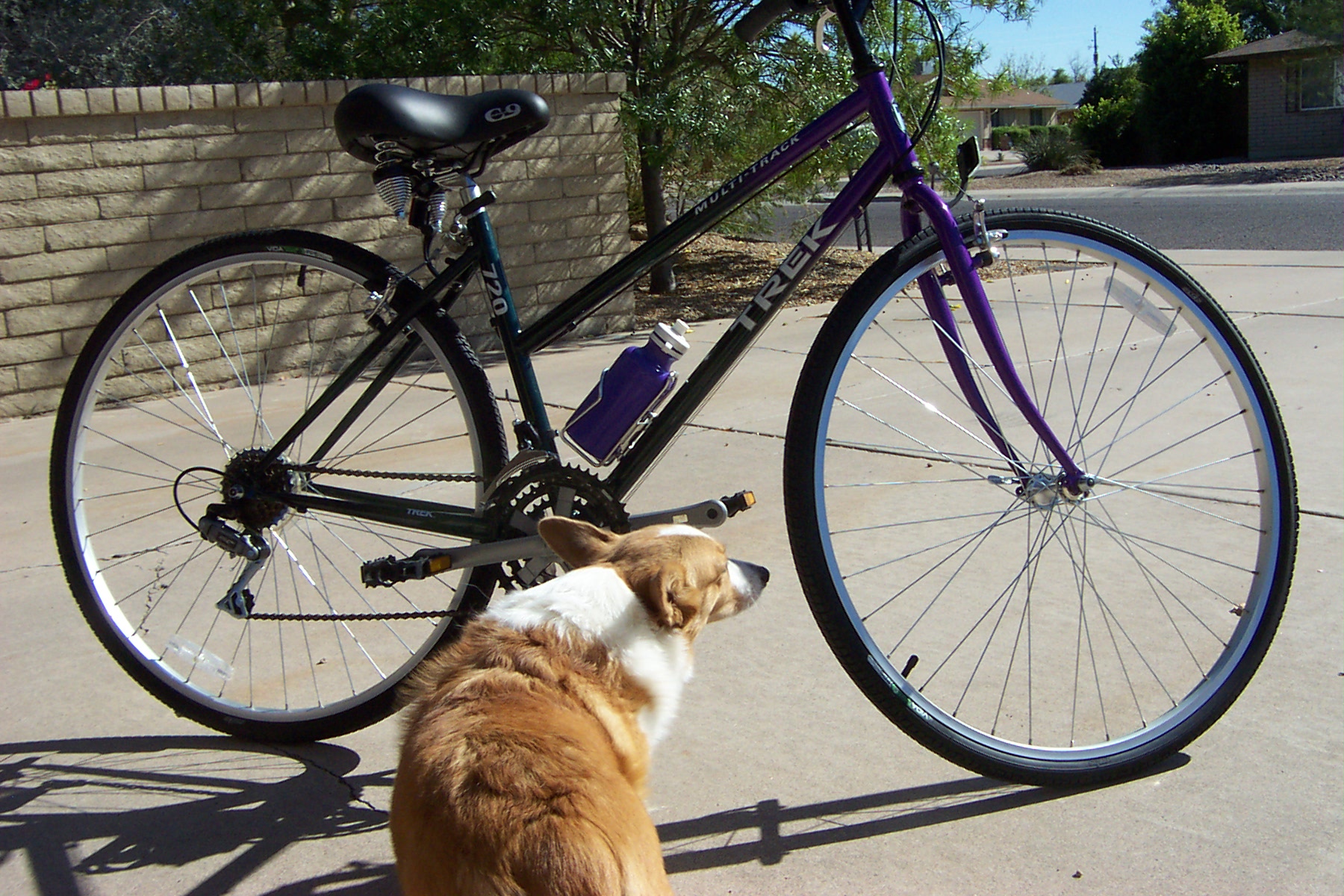
Look what my friends in the choir gave me over the weekend!
(Click for an enlarged view)
My friends Joan and Lee offered me this beautiful purple bicycle, which happens to be exactly what I’ve been looking for and exactly what I can’t afford. These things cost something over $500 these days. They bought a pair of bikes about 16 or 18 years ago, because they were living in a nice house near the canal, which has been turned into a miles-long linear park with bike paths. They said they only used the bikes a half-dozen times or so, and then the things became garage sculptures.
Well! Can you imagine?
I took it over to my favorite bike shop, where they dusted it off and fitted it out with new tires, mega-puncture-proof innertubes, and a sort of bicycle Barcalounger for a seat. The bike guys much admired it. They were amazed that it was in such good condition. One of them said he used to sell that model, and that it looks brand-new.
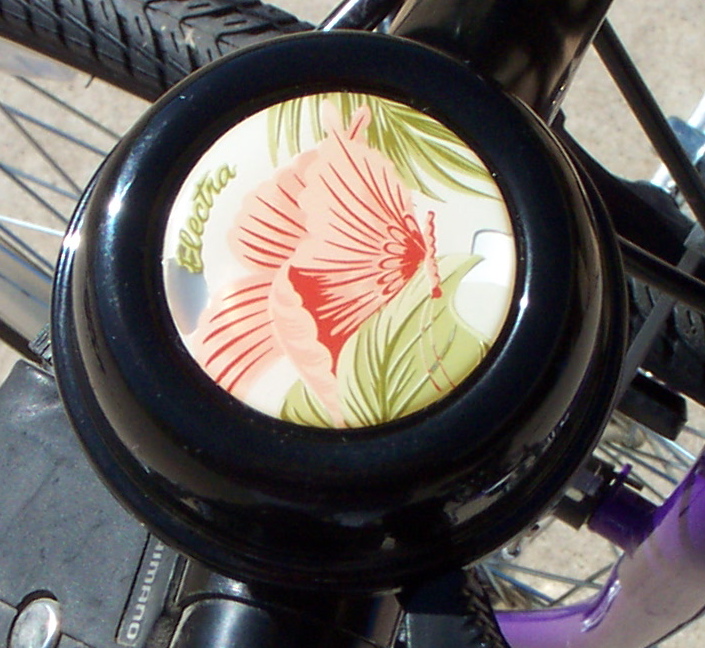
Check out this little doodad I found:
It’s a little bell for binging at pedestrians so as not to catch them unawares when you come up behind them. Cool, eh?
I’ve been wanting a bike with gears for a long time, to make it possible to ride along the canal. The bike path goes under the roads, so that to get out from beneath the underpass you need at least three speeds. On my old beach cruiser, I have to get off and push the thing uphill out of the underpass, which isn’t much fun.
So! This will allow me to go for miles and miles. SDXB rides in from Glendale following the canal; it goes all the way through Scottsdale into Tempe.
Now I’ll be able to get the exercise that has been so direly lacking in my life the past few years. If there’s a blood pressure problem (it’s beginning to look less likely), a few hours of long-distance riding a week in addition to the daily dog-walking should take care of it. My friends may have given me more than a bicycle…they may be giving me several more years of healthy living!
Yesterday afternoon while I was driving around I happened to pass by Outrageously Pricey Gourmet Grocery Store and heard the siren song of the bakery department…
Apple pies are calling,
Come to me,
Come to meeeee….
Who could resist?
Well… Truth is, I’m not crazy about sicky-sweet foods, though I do like apple turnovers, especially when they’re made with puff pastry. Once in the store, I’m eyeballing the turnovers and thinking, “That sticky-looking white frosting gunk they’ve drizzled on there looks like it’s mostly sugar. Ick!”
Still wanted a pastry; just not that pastry. As I was about to leave unsatisfied, I recalled that I used to make my own apple turnovers with frozen puff pastry and fresh apples. And they were pretty darned good. So! It was straight to the frozen food department, thence to produce, and then out past the checkstand for only $7. A package of frozen puff pastry shells and a couple of gala apples and I had stuff for not one, not two, not three, but six turnovers, for the price of one and a cup of coffee!
You can use the frozen pastry sheets, too. If you’re only cooking for one or two, though, the inchoate shells are convenient, because they let you defrost only enough for one or two servings. They’re incredibly easy.
You need:
frozen pastry shells or sheets
an apple
a few pecans, walnuts, pistachios, or almonds
sprinkle of nutmet, cinnamon, or both
turbinado sugar
flour
Preheat the oven to about 400 or 425 degrees.
Defrost as much frozen pastry as you need. One pastry shell rolled thin will make one good-sized turnover. Flour a clean cutting board and rub some of flour on a rolling pin.
Set the pastry shell (or small piece of pastry sheet) onto the floured board and roll it flat and thin, rotating the pastry dough a couple of times in the process.
Seed and cut up the apple (peel it if these are for guests). Break or chop the nuts into small pieces. Set some sliced or chopped apple and nuts in the center of the rolled-out piece of pastry. Sprinkle on a little nutmeg or cinnamon—or both, if you like. Fold the pastry over the filling and seal it around the edges by pressing the tines of a fork around the outside edge. Poke a few holes in the top with the fork, and set the turnover on a cookie sheet. Sprinkle the top with some crunch turbinado sugar.
Bake 15 or 20 minutes in a fast oven, until brown and delicious. And voilà! Apple turnovers, better than you can buy at the bakery, and cheaper!
Is it possible for a glimmer to be dark? Here’s what I mean…
I consider the prospect of advanced old age to be extremely dim. You’re old, you’re sick, you hurt all over your body, and you’re alone. Because our culture does not promote caring for aged adults en famille, you’re probably going to spend the last years of your life in an institution—at best a life-care community that provides a simulacrum of independence, at worst a nursing home that’s really an expensive prison for the infirm and the frail. I’m not looking forward to it. Indeed, I so don’t look forward to it that I quietly hope not to live more than another ten or, at most, fifteen years.
Last night some choir friends invited me to join them as a guest at a meeting of the church’s social group for the radically aged. It was something to do…well, it fit in with the new scheme to get out of the house. So I went to dinner with them at the church.
It started out as a quiet evening. Most of the folks there were pleasant enough but reserved; they looked like they felt less than thrilled to be there but, like me, had nothing better to do. After a while, though, perhaps under the influence of a little wine, the people at my table started to chat. Turned out they had interesting things to say not only about their own wide experiences but about current events and phenomena. So it turned out to be a nice enough thing to do.
What struck me about the group was that we had a roomful of very elderly people—most, I’d guess, were in their 80s—who are living in their own homes. Unlike my father, who checked himself into a life-care community called Orangewood immediately after my mother died (he had been lobbying her to go there before she fell ill, but she resisted), none of these folks seemed to feel they need the shelter of an institution to get on with their waning lives. Nor do any of them appear to be dependent on their adult children. They’ve managed to preserve their autonomy in various ways, and evidently those ways are working.
I used to think my father could have engineered most of Orangewood’s benefits at a lot less cost without having to give up his freedom. For example:
• He could have moved from his house into a smaller apartment or condo, eliminating yard care and reducing the amount of housework.
• For a very reasonable price, he could have hired a housekeeper to clean said smaller space once every two weeks, the same frequency he got at the old-folkery.
• He could have stocked his freezer and refrigerator with prepared meals from Costco and Trader Joe’s, as these folks reported doing. This would eliminate the need to go to a communal dining hall every day for a bad meal of starchy, salty, sugary steam-table food.
• For what Orangewood cost by the month, he could have hired a taxicab to schlep him from pillar to post every day of his remaining life, mooting the concern about not being able to drive in old age.
• Orangewood had hobby rooms, a pool, and a limited array of other small amenities. But he already lived in Sun City, whose amenities by comparison are vast. And, for residents, free: no need to fork over an “endowment” of your entire life’s savings.
The only advantage Orangewood provided, for the $30,000 buy-in fee and the $1,000+ monthly fee, was guaranteed access to a decent nursing home. Unhappy experience showed that, at least in the Phoenix area, getting access to even vaguely acceptable nursing care when you actually need it is damned near impossible. Consequently, it does make sense to put oneself in line for a nursing home well in advance of need. However…the trade-off that you have to make for the privilege is huge.
Some time in the near future, I’m going to have to think about unloading this house and moving someplace that requires lots less maintenance. I’d like to wait until the real estate market turns around, if it ever does. M’hijito and I will have to figure out what to do about the upside-down investment we made before I can do anything. And I’d like to wait until my son decides where he’s going to be if and when he finishes his proposed graduate program. If he goes back to San Francisco, then I probably would be better off moving to Sun City than staying in the decrepifying central districts of Phoenix. Sun City is safer, it has more amenities for the elderly, and the surrounding infrastructure is newer and more upscale.
But those concerns aside, finding a bunch of really older people who are managing to take care of themselves just fine, thank you, is encouraging.
Lest any regulars feel puzzled when they encounter this: I just enabled WordPress to turn off commenting on posts over 30 days old.
Funny is being flooded with spam from those obscenely underpaid Third-World workers who are hired to enter advertising comments on random posts, presumably found by Web-bots. Because they’re live human beings typing real (but irrelevant) comments and entering real-looking (but fake) names and e-mail addresses, they get past the spam-catchers. This garbage adds mightily to the 100-plus messages a day that come pouring into my in-box; I’m getting tired of deleting the stuff—it just absorbs time and pushes up the annoyance quotient.
{sigh} Most of these are coming in on pretty old comments. I don’t want to disable commenting or make it password-protected, so I’m hoping this strategy works. If not, I’ll have to shorten the window for commenting to two weeks.
Anyway, if you get a message saying it’s too late to comment on some post, you’ll know what’s up.
So yesterday I met with SDXB to borrow his digital blood-pressure monitor. Among other things. We met at Infamous Overpriced Gourmet Grocery Store over coffee and then went for a hike in the mountain preserve maintained by the City of Glendale. When we got to the park, he handed over the machine.
Interesting little device. It operates on batteries. You strap a cuff thing around your arm, attaching it with Velcro, and then push a couple of buttons. It blows up the cuff until you feel like your arm is gonna go numb and then beeps a while as it measures your systolic and diastolic blood pressure, throwing in your pulse rate as a lagniappe.
So by way of showing me how to use it, he lashed me up in the thing and punched the appropriate buttons. Resulting figures: about 140 over 80, borderline hypertension. That was what appeared at the doctor’s office, occasioning this expedition. I knew SDXB had a monitor, since he’s been gulping blood pressure meds for years. Instead of ponying up $100 or so for my own, I thought I’d borrow his, at least until we know whether I have to be on the damn pills, too.
Okay. Now he wants me to demonstrate that I’ve learned how it works. I reapply the cuff and punch the buttons.
Lo! Two minutes after the 141/80 reading, I’m down to 124/78.
Well, that can’t be right, we figure. So we try it again: 120/77.
What?We guess the last two figures are more or less accurate, since I was nervous about the gadget (I just hate this stuff!), and because some a**hole cut me off as we were driving from coffee to the park, swerved into the park ahead of me, and grabbed the parking place SDXB had passed up for me to take. The park was crowded, and I don’t like fighting for parking. And a**holes in any environment, on the road or elsewhere, tend to send me through the roof. Presumably those factors combined to create the higher figure, after which I must have calmed down.
Sounds good, doesn’t it?
But… Yesterday after I got home, out of curiosity I tried using it again. The first reading was an astronomical 158/130! That’s higher than any doctor’s gadget has ever registered, despite the fact that I hate few things more than I hate being in a doctor’s office.
Error? So I tried it again. Two minutes later, we’re down to 139/84, a drop in systolic presssure of 19 points between 11:13 and 11:15 a.m.
Interesting. What happens if you run the doodad a third time? Magically, you get a new reading of 129/70, a ten-point drop in one minute.
I tried this experiment twice more during the day, since the docs had asked me to check my blood pressure at different hours. Same thing happened: I got readings that ranged from 120/75 to 148/86 in a matter of minutes.
Either something very strange is going on with my body or this contraption has an accuracy problem.
I surf the Net and discover that, for optimal accuracy, digital monitors need to have fresh batteries. SDXB had said the batteries could run down over theperiod the doctors want me to indulge in this exercise. So, when I got up at 4:00 this morning, I changed out the batteries.
This resulted in sort of normal figures. Sort of. The high was a pleasing (but not very credible) 122/78. But a second test, two minutes later, came up with 106/70, barely higher than the average corpse’s. And, if we buy this at all, a 16-point drop in exactly one minute. Another 60 seconds later, it was back up to an almost healthy 113/69.
{sigh} I don’t know what to make of all this. If anything. It may be that I need to buy a new machine—SDXB’s is several years old. Really, I don’t want to spend $70 on something that’s totally unnecessary. But on the other hand, I don’t want to be stuck on medications that are totally unnecessary for the rest of my life, either. Or not get the meds if they are necessary.
It’s possible that Medicare covers blood pressure monitors. I’ll have to ask today or tomorrow. But then I’ll still have the hassle and expense of having to schlep it to a doctor’s office and get it calibrated—and who knows what they’ll charge for that privilege? Like I have nothing else to do and nothing else to spend my money on!