We thought we’d make a few bucks for groceries. Empty out the closets, haul the most egregious dust-catchers out to the driveway, and watch the junk fly out the door and the dollars fly into our pockets.
Down at the store
So KJG made the long trip in from the White Tanks with a carful of valuable, priceless discards. Given the number of burglaries and break-ins we’ve had here in the neighborhood, I asked her to bring and display her doberman pinscher, the mellow but amazingly scary-looking Holly, who happens to enjoy the presence of Cassie the Corgi.
Shortly after the crack of dawn we stuck up our signs along the main drags bordering the neighborhood and planted more signs on the feeder streets directing the hordes of buyers to the site of the Big Sale. Before I could get back to the house, KJG was already entertaining buyers. This looked promising.
Promises, promises…
Those were the first of three or four rafts of lookers, one of whom was the neighbor across the street. Almost no one showed up.
It might have been that a 110-degree day was dawning. Or it might have been that not one dusky face appeared among the throngs of potential buyers. The reign of terror emanating from the nastiness that pervades Arizona politics has cleared out and frightened away the working-class Latino population who made up the majority of yard-sale shoppers here. Demographics in the tenements across the road have shifted from mostly poor-white and Hispanic to mostly poor-white and African American. Yard saling in these parts is a cultural thing, not much shared by the latter two groups.
Executive office
Whatever. By the time it got hot enough to close up shop we each had sold almost nothing. I made $6; KJG made a few bucks more than that. We piled all the unsold merchandise (34 shirts, 5 pairs of pants, 3 sweaters, 2 skirts, 3 pairs of shorts, 1 dress, 12 glasses, 2 mugs, 2 picture rames, 3 seat cushions, 1 Hoover Floormate, 1 shark floor sweeper, assorted motorcycle parts and tools) into the Dog Chariot and carted it off to St. Vincent de Paul. Good-bye to all that!
Afterward, we went to lunch.
I made six bucks on the sale and paid ten bucks for a very nice small meal. Net profit: -$4.00.
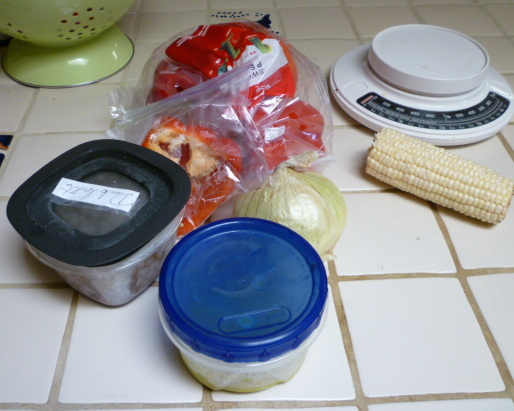
Nothing would do the other day but what I had to shovel out the fridge and use some of the lifetime supplies of Costco produce before it spoiled. Three and a half bright red bell peppers and one cob of fresh sweet corn surfaced among the loot. Out of curiosity, I decided to try making a red bell pepper soup.
It turned out so well that now I’m craving some more, having finished it off at last night’s dinner. Here’s how it came down:
You need:
• an onion • several ripe, red bell peppers • small amount of good vinaigrette dressing (bottled or home-made*) • one or more cobs of corn • one or two cloves of garlic, chopped • broth or water (I had about two cups of duck broth) • small amount of olive oil • salt and pepper to taste • for garnish: yogurt or sour cream; fresh or dried herbs
How to put it together:
Preheat a backyard grill or the broiler in your oven.
Coarsely chop the onion and sauté it gently in the olive oil until it is nicely soft and caramelized. Near the end of this process, add the chopped garlic. Cooking the onions should be a fairly slow process; this releases their sugars and makes them quite delicious.
With a sharp paring knife, slice the corn off the cob. Set aside.
Remove the stem from each pepper by slicing around the stem’s circumference and gently pulling out the stem and seeds. Try not to poke a hole in the sides of the pepper while doing this. Rinse out the seeds and drain the water out of the peppers. Now pour a few drops of vinaigrette into each pepper and gently swish around to coat the inside.
While the onion is cooking, place the bell peppers over a hot grill or run them under the broiler. If you’re using your oven broiler, put the rack down about a third of the way, so the peppers won’t be too close to the heat. You’d like them to cook a little while singeing.
Occasionally stir the onions. Keep an eye on the peppers. When the skin begins to blacken, remove from the heat. While the peppers are hot, peel off the blackened skin. You can facilitate this by putting the peppers inside a paper or plastic bag (personally, I would avoid plastic, but each to his own) and letting them sit for a while. In this instance, I had no problem peeling off most of the skin without that step.
Coarsely cut up the peppers and add them to the browned onions. Add broth or water to cover. I used about two cups; the amount is not set in stone.
I happened to have some duck broth in the freezer, left over from last December’s Christmas feast. Because we smoked the duck, the broth was smokey-flavored. This created an interesting effect. Next time, though, I’d probably use chicken broth or, maybe better, just plain water. The roasted peppers have a distinctive, appealing flavor that should be allowed to shine through. If you wanted some extra flavor in the liquid, you could add a little sherry or white wine to the water.
Allow the peppers, onions, and liquid to simmer together in the pan for a while, until any crispness is cooked out of the peppers. This, too, is a forgiving process. You could let it simmer for a half-hour or so.
Now run the cooked ingredients through a blender. I have an immersion blender, which worked perfectly for the purpose. Purée to make a lovely hot chowder. Season to taste with salt and pepper.
Finally, add the corn to the hot purée. Let this sit for a few moments; the residual heat from the soup will cook the corn a little without overcooking it. If you like your corn really soft, either use canned corn or put the purée back on the heat and simmer the corn in it for a few minutes.
And that’s it. To serve, add a spoonful of yogurt. If desired, sprinkle with fresh or dried herbs, such as chives, tarragon, or herbes de Provence, or fines herbes.
* How to make vinaigrette dressing
The classic “Italian” or vinaigrette dressing consists of one part tart stuff (vinegar, lemon juice, or lime juice) and three parts oil (I prefer olive oil, but any good vegetable oil will work). To suit your taste, add herbs and a minced clove of garlic. Whip or blend. Here, too, I use the immersion blender, obviating the need to chop the garlic finely and creating a rich, creamy dressing. But you can put the ingredients in a jar with a lid and shake them together, or you can just whap them up with a fork or wire whisk.
I just keep getting fatter and fatter. The other day I carelessly stepped on the scale (normally I try to avoid tripping over land mines) and discovered I’d gained another three pounds.
Even the dog is getting fat around this place. They say if you hang out with fat people, you get fat, too. Probably explains it: poor Cassie the Corgi now weighs almost 26 pounds. The vet thought she was a bit on the chunky side at 23 pounds.
Three pounds…that’s 13% of her normal weight. {sob!} I’m only 8% over my normal weight, if you assume a certain old-lady bagginess as “normal.”
Well. What to do about this dismal state of affairs…
I picked up my old Atkins diet book, whose regimen did work, a long time ago. But looking over it, I thought this is just too damned drastic. I suspect that putting your body into a state of ketosis can’t help but have some overall metabolic effects, some of them likely long-term. I’m getting too frail for antics like that. And as for the dog…why would an all-meat diet do anything but add weight on a nonobligate carnivore?
Funny in her misspent youth
Fortunately, when you’ve been lumbering around the block since the early Cretaceous, you have a lot of experience to inform your present exploits.
Exempli gratia: Some years ago when I was still feeding my dogs kibble, I bought a new cup measure to dole the stuff out. I’d been using a one-cup Pyrex measuring cup. Each dog ate about a cup of kibble, plus a chaser of cooked meat. One day the glass cup broke, and I replaced it with a plastic measuring cup from the grocery store. It was about half the size of the Pyrex thing. Its markings were just little molded ridges in the plastic, not bright red enamel as on a Pyrex cup. Not being able to see the markings clearly, I assumed it was a one-cup measure.
Fast-forward a few months: The German shepherd resembles nothing more than a beer keg with feet sticking out. Sort of how I look now.
So I decide to put the hounds on a diet. In the course of making some English-major calculations to figure out what diet rations would amount to, I try to read the measures on the plastic scoop. Take my glasses off, hold the thing up to my nose…holy mackerel!
It wasn’t a one-cup measure. It was a two-cup measure. I’d been feeding the dogs twice as much as they were supposed to be getting!
Instantly I dropped them both back to their regular ration. Within about three months, they were back to their normal weight, and they stabilized there.
So. Let us extrapolate from animal experimentation to human healthcare:
Of late, I’ve noticed that every time I get up from the table, I feel like I have a bowling ball in my belly. Either something is very wrong—as in we don’t want to go there—or I’m just flat eating too much. Maybe, as I’m getting older and spending wayyyy too much time in front of the computer and way too little time hiking up and down mountains, just maybe I need less food than I’ve been eating. Maybe even lots less.
What would happen if, every time I went to dish up the chow, I put half as much on the plate as I’ve been in the habit of eating? And what if each day I drank exactly half as much of the caloric drinks I favor?
So, for breakfast, instead of the usual two pieces of bacon, two pieces of toast, and four or five frozen strawberries blended into two generous glasses of orange juice, I had one piece of bacon, one piece of toast, two strawberries, and one glass of juice?
To my mind, two slices of bacon shriveled down to three bites apiece and two slices of toast don’t exactly add up to overeating, but maybe it is. I do get up with a bowling ball in my belly, and on that ration I don’t start to feel hungry again until one or two in the afternoon…a long haul from 6:00 a.m.
What if instead of my usual two cans of beloved foamy-delicious beer or two cocktails or two glasses of wine, what if the daily booze ration were cut to one serving? Then I wouldn’t feel deprived (how can anyone live without a drinky-poo with dinner???), but I’d still be consuming half as many booze calories.
Oh, the ingenuity!
So, a few days ago I started with this experiment. Have I lost weight? No…but it’s only been four days. Haven’t gained any more, which I take as a good sign.
Interestingly, the reduced breakfast still left me with a lead weight in my belly. The reduced lunch/midafternoon snack created less of that effect, but I still felt stuffed after eating. Dinner…oh, it’s hard to avoid running amok at dinner. How I love dinnertime!
The beer has lasted a long, long while, though: when I thought I was all out and felt too tired to schlep to the grocery store for a new fix, lo! One more can lurked in the refrigerator door. 🙂
It appears that I’m either overestimating what “half-off” the normal rations means, or “normal” has been maybe three times too much food instead of only twice too much. Last night I grilled some scallops on the gorgeous new gas barbecue. Usually I would cook four to six. Figured I should have three, since one was pretty small.
3 grilled sea scallops
about a palmful of frozen peas, defrosted, cupped in…
two leaves of butter lettuce
two small tomatoes, cut up
garlic roquefort vinaigrette
1 glass of ice water
Result: stuffed! Absolutely gorged. Could barely haul the bowling ball away from the table. Clearly, I could have done just fine with two scallops and one tomato.
This is weird. Not only is cutting the rations not leaving me hungry, I’m still feeling overfull after what seems like a small meal. However, I am getting hungry faster…after the reduced breakfast, I’m ready for lunch at noon.
So this morning I tried cutting back even further:
2 pieces of butter lettuce
a spoonful of a bean salad marketed as “Texas caviar”—very tasty, BTW
2 frozen strawberries
1 glass orange juice
decaf coffee
Thought I: this is gonna leave me lightheaded with hunger!
But nay. After the tiny breakfast, I feel comfortably full. Not sick with overeating, but like I had a decent meal without eating myself stupid.
Now we know how this is going to work: the Half-Off Diet means really, truly half of what one has been in the habit of eating and drinking. Not half plus…oh, I don’t think two scallops will make it, but half. Half halfHALF!
Let’s watch this process and see if it works.
Meanwhile, what about the dog?
Well, first she’s gotta quit getting doggie treats while I’m eating. She’s been extorting a bribe to leave the human alone while it’s trying to sit quietly. That “insurance” policy is hereby canceled.
Reducing the amount a small dog eats, especially when you’re preparing food and not dishing up fake food from a bag, strikes me as problematic. We know she’s been getting too many calories from the doggie treats, and we know that in this heat she hasn’t been getting enough exercise—by 9 a.m. the sidewalks are hot enough to burn her feet, and they stay that way until well after dark.
So I think she needs to get a little less starch, maybe fewer veggies (which she probably doesn’t digest efficiently anyway), and more low-fat meat.
That roasted chicken we’ve been getting from Costco? Cassie and I love it and usually share one a week. There’s a reason it’s so succulent and delicious, despite being no more “real” chicken than the stuff you buy off the counter. They’re certainly injecting it with something, and dollars to donuts the “something” is rich in salt and fat. For the foreseeable future, we’ll grill our own chicken, thank you.
And beef will have to be a lot less fatty than ground chuck. After this, if I can’t get bargain meat that’s tough as an old boot because it has little fat in it, we’ll pass on the beef. Maybe I can get SDXB to shoot us some venison…just have to be careful he doesn’t know who’s gonna be eating it. He does kill a lot of rabbit out there in Sun City…I’ll bet I can persuade him to give me a few for, uhm, hassenpfeffer. Right.
This will be a challenge, because he doesn’t kill the jackrabbits—he doesn’t think they’re good to eat, and he thinks the cottontails are more destructive. But he will take out those voracious cottontails. Mm hmm.
Dog diet, then:
No more doggie treats
Less starchy stuff, especially bread
Faithful ingestion of the daily vitamin
Lower-fat meats of all kinds
More exercise, lots more exercise
Ditto the human.
Anyone want to make this a challenge? Tell me your goal, try the Half-Off Diet, report your weekly weight loss to funnyaboutmoney {att} mac {dott} com, and every Saturday or Sunday I’ll post our results.
Some Half-Off Recipes would be good, too…share your minimalist meal plans along with your progress!
The term Half-Off Diet™ and the strategy entailed in it are trademarked and copyrighted. All rights reserved.
Okay, at last the electric bill arrived. This is the first full month’s summer bill I’ve had since I replaced the dratted programmable thermostat with a plain boring digital thermostat. So! The question is…
Did replacing the programmable headache thermostat with something that does not require advanced training in computer programming result in bankruptcy?
And the answer is…. Well, define “bankruptcy.”
The August 2009 bill, when the programmable thing was supposed to heat up the house during the day and cool it down at bedtime and then let the temperature drift back up when I would supposedly be unconscious in bed, was $257. Since the highest summer bill in previous years had been $229 and rates had held steady for several years, that was pretty darned breathtaking.
Since then, Salt River Project has raised its rates about 10 percent. So, in theory, this month’s bill should be around $282, approaching break-the-bank levels.
And the real bill WAS... $239.08!!!!
Wooo-HOOO! Almost $20 less than last year’s monster bill, in spite of the rate hikes!
Isn’t that something? This summer has been a little cooler than 2009, but not much—we’ve still had long stretches of 110- to 115-degree days. Except for the last two weekends, when rains drove early-morning temps into the 80s, the AC has been pounding away, all day and all night.
I figure the difference has to do with the thermostat, since the midsummer weather doesn’t vary much from year to year. After the programmable thing was installed last year (May 2009), the June bill was $49 higher than the June 2008 bill; the July 2009 bill was $36 lower, and the August bill was $28 more.
After seeing the June gouge, I ratcheted the temperature in the house way up, and so that may explain the drop in July. But I didn’t turn it down in August—and in fact, August is usually less scorching than July. And August 2009 cost almost $30 more than the prior August. So there’s no clear explanation for the $36 saving in July of 2009.
April and May were temperate this year, and so the bills that came in May and June were fairly low, reflecting the fact that I left the AC off most of those two months. June started to heat up, so the bill that arrived in July shot up through the roof: $11 more than the same month last year.
The programmable thermostat came off on July 2, and so the bill that came today is the first non-programmable thermostat month of 2010: $20 less than the bill for the same period in 2009.
How did I work this little miracle without the wonders of the silicon chip?
This new thermostat has a function called “Save.” When you press the “Save” button, it remembers the setting you started with but pushes up the temperature in the house by five degrees. So, I’ve had the thing set at 79 degrees for nighttime use, and, as soon as I stumble out of bed, I’ve been hitting the “Save” button on the way to the bathroom. This keeps the daytime temperature at 84.
That’s approximately what I was doing with the programmable thermostat, only ratcheting it up to 85 during the day, down to 76 around 6:00 p.m. so it would be cool enough to sleep by around 9:00 or 10:00 p.m., and having it go back to 80 about midnight.
So really, now there are more hours when the temperature is in the tolerable range (85 really is uncomfortable in a shut-up house full of stale air) than with the programmable number, but the bill is significantly lower.
Check out Richly Reasonable’s small tour de force,In or Out Burger? Cruising the Internet in search of some material for a post, she ran across an article from an apparently disinterested source claiming that a McDonald’s hamburger costs no more than a burger made at home.
Breaking out the calculator, she begs to differ. This lady is an accountant, and so her results are a bit more credible than my English-major math. You need to see what she concluded.
There are many benefits to eating in. IMHO, the financial aspect amounts to the least part of the matter. The fact is, if you’re even a halfway decent cook, home-cooked food tastes better. I like the occasional grilled hamburger, but I can’t stomach a McDonald’s…eewww! A McDonald’s patty doesn’t even taste like meat to me. Put it inside a flavorless balloon-bread bun and slather it with institutional garnish, and what have you got? Not anything you’d want to put in your mouth.
Also, even though you don’t know where your groceries have been before you get them, at least you do know how the food was stored and prepared after it arrived in your kitchen.
My ex- and I used to eat out all the time—three to five times a week. After I left him, I took up with SDXB, who had been a multi-award-winning investigative reporter. He refused to eat in restaurants, partly because he was famously frugal but mainly because he had once done a series on what goes on in the restaurant kitchen. Because of what he learned in that project, he simply would not eat in restaurants.
I spent several years with this man, who loved to cook. The result was that I came to dislike restaurant food. The truth is, it’s not very good! Now I still enjoy eating in a few restaurants, but, with the exception of one family-run Mexican joint, they’re way too expensive to enjoy more than once every month or two.
It’s a matter of breaking a habit. When you start fixing your own meals with real, unprocessed food, you discover that most restaurant and junk food is not very good, just as you realize, six or eight weeks after kicking the soda-pop habit, that sicky-sweet soft drinks don’t really taste very good or, a year after quitting cigarettes, that tobacco smoke stinks.
Once that particular light dawns, the cost is irrelevant: today I wouldn’t drink a glass of pop if it was free and I had to pay for water. Nor, given a choice, would I prefer to eat out than in.
La Maya and I were doing some recreational estate-saling the other day when we came across this throw at an otherwise unexceptional site.
Said she: “This looks hand-made.”
“Couldn’t be,” said I. “There’s another one over there, across the room, just like it. They must be convincing machine-made replicas from China.”
About then, along comes the lady who’s running the sale.
“The owner,” says she, “sits in front of the television and knits these as a hobby. She says it’s her ‘therapy.’ She just keeps making them, and she wants to get rid of them. She’s selling them for what the materials cost.” The price was $35.
On closer inspection, you could tell that $35 really was about her cost. The wool is very nice—extremely soft and warm. The throw above doesn’t appear to have been blocked, but it would be easy enough to do that yourself with a flat piece, and probably wouldn’t cost much to have it done professionally. The work is very nice…
There were four of them scattered around the house. I wish I’d bought more than one now, to give one as a gift. My mother used to knit and crochet—she was very good at it. And while buying the yarn was a lot cheaper than buying a hand-knit sweater at a shop, for sure good wool costs something.
At any rate, it’s going to be wonderful next winter, when the inside of the house gets chilly. I can’t wait to curl up on the sofa under it.
You, Too, Can Score This Loot!
Estate sales generally are better than yard sales. They happen when someone dies, moves, or just decides to clear out a lifetime’s collection of stuff that’s too good to give away for free. These days, foreclosures make for an ongoing bonanza. You can prospect online at this site: just click on your state and then your city for a list of upcoming sales. Estate sales are conducted by professionals who are in the business of organizing housefuls of junk and pricing the goods to sell. Often these outfits will post photos, so you get a good feel for whether a sale has anything to offer that interests you.
Just now I’m looking at one that pictures a practically new front-loading washer & dryer set, a high-end stainless-steel dishwasher, and a stainless-steel bottom-freezer fridge with French-style doors. These people are also selling what looks like an antique love seat upholstered in pristine gold brocade fabric, if that’s your taste.
Many of the dealers maintain e-mail lists. If you find a dealer that consistently has good sales and good prices, ask to be included on their list—they will send you notices of upcoming sales, often with photos. There’s an outfit here, for example, called Angels in the Attic. They must be somewhat selective about what jobs they’ll take on, because almost all their sales have at least some interesting items, and their prices are generally very reasonable.