Coffee heat rising

Annual Windfall Arrives

The state direct-deposited the $4450 it owes me for this year’s installment on my RASL (retiree unpaid sick-leave). Very nice…but what to do with it?

I’d figured to put $2500 of it in the Roth IRA and invest the rest in the brokerage account. This would plump up my retirement savings by another few thousand bucks. On the other hand…

I’m already in retirement. What we have here is a chunk of post-tax money in an era when income from Social Security and teaching doesn’t cover all my expenses. Right now I’m drawing down post-tax savings at the rate of $1093 a month to ensure that ends will be met, come what may. This left me, at the end of February when utility costs were nil, with a surplus of a grandiose $181, after all the bills were paid and transfers made to the savings accounts that hold funds for taxes, insurance, and extravagances like clothing and shoes.

Since I’m already having to draw down de facto savings (just not out of investment accounts—yet), does it make sense to invest this money only to have to start drawing it back out of the investment accounts in another few months? Just now, my projections show I’ll run out of after-tax savings in September, assuming I use my summer-school pay to cover utility bills and then spend the remainder on trash like a new washer and dryer or a new crown to replace the broken one. Videlicet:

Suppose, though, I were to fold the RASL into the survival fund and do the same with the post-utility bill net summer pay? Let’s imagine, too, that a miracle happens and I get another two courses  next summer, netting three grand after the high-season utilities are paid:

This has a sterling advantage: it allows me to live on post-tax savings, minimizing 2011 and 2012 tax bills while my IRAs and brokerage accounts continue to grow (assuming any growth is left after the Libya unrest settles down—a big assumption, for you can be sure whoever takes control will not be our friends). This year, I do need to roll the pre-tax money out of the defunct whole life policy into the brokerage account; so far only post-tax funds have been withdrawn from that. It’s earning all of 1 percent (at best) at Northwestern, and so needs to be transferred to investment accounts, which have been averaging 5 to 7 percent the past few months. That need grows urgent, as inflation is about to spike, big-time. Living on money in savings will reduce my tax liability for that rollover.

The second strategy will require me to defer the dental crown indefinitely, and also to try to fix the ancient washer or to replace the washer only, not the dryer. I will not be able to use summer earnings to cover those needs, nor could I start stashing summer pay to save toward a new car, which I’ll be needing one of these days. Soon.

Of course, there’s no guarantee that I’ll get two sections to teach in the summer of 2012. But even if that doesn’t happen, I could in theory hang on until the end of July without having to draw down from investment savings.

In theory.

Thinking about Sustainability

On the way home from yesterday’s interminable visit to the Mayo, I dropped by a friend’s shop in mid-town Phoenix, a serendipitous little brainchild that morphed from a nonprofit thrift store to a wonderful design, clothing, art, and gift store featuring nothing but sustainable crafts and products. More about my friend Loral later: I’d like to feature her in Funny’s “Entrepreneurs” series.

Meanwhile, check out what she sold me!

This gorgeous purse is made of a 1970s leather skirt. Remember how we used to make purses out of jeans and denim skirts? Well, the crafter who designed this, Shannon Wallace, came across a buttery-soft purple (♥love!♥) leather skirt and used it to build this wonderful, incredibly lightweight bag. It has a silken lining, and the skirt’s pockets morph into handy exterior pouches for the bag. It’s actually reversible—you can turn it inside out and have the wild fabric lining on the outside. But being a sucker for purple, I’ll probably keep it this way. The gaudy flower is detachable; I’m thinking I may move it to one of the handles.

KJG and I came across it while we were doing the Willo Neighborhood Tour–my friend’s shop is in darkest Willo, and so of course she had a booth for the tour. I was going to pick it up when we finished the tour, but we both pooped out a distance from the booths. Hence, the visit to retrieve the purse, not quite on the way home from the Mayo, which from downtown Phoenix is halfway to Payson.

So while I was exploring Loral’s shop, she showed me this amazing patch of wood cellulose and cotton, called a Skoy cloth.

It is said to substitute for not one, not two, but 15 rolls of paper towels! You get it wet and use it as a kitchen rag/sponge, and supposedly you’ll never have to use another paper towel as long as you live. Loral said she tried one and was convinced. Well…nothing would do, of course, but what I had to have one of those.

Amazingly, the thing actually works as advertised! Maybe better than advertised. I just tried it on the kitchen counter, which once again had acquired a fine haze of olive oil and dirt, and by golly, the tiles are shining. It also cleaned the brightwork around the sink better than I’ve managed in many a moon—with no special products.

Visiting Loral’s shop and imbibing her enthusiasm for sustainability left me thinking about ways that I might waste less paper, use less gasoline, spread fewer chemicals around, live a little lighter on the asphalt-covered land.

Pretty soon the City is going to stop picking up the garbage in the alleys, instead inflicting yet another barrel on residents to roll out to the front curb and requiring everyone to dump their bulk trash in their front yards. My plan is to get rid of the blue recycling barrel at that time, since I don’t have room to store two big barrels in the garage and there’s noplace in the yard I wish to grace with an extra garbage bin.

To accomplish that, I hope to start producing a lot less recyclable trash than I’ve been doing. So…have begun thinking about how to live a less trash-intensive lifestyle. The trick would be to avoid bringing stuff into the house that has to be thrown out or recycled. Among the strategies that come to mind:

• Use cloth bags or reuse plastic bags for grocery shopping and small sundries from hardware stores, drugstores, and the like.

• Buy products in bulk. Even if something comes in plastic and cardboard, obviously if you can buy a larger store of the product, one package is better than a half-dozen.

• Get off mailing lists.

• Buy food at farmer’s markets and other local merchants who use minimal packaging.

• Cancel newspapers; read news online instead.

• Read books on a Kindle or similar hardware.

• Substitute ordinary household products such as vinegar and baking soda, often available in bulk, for commercial chemicals. Package them in your own reusable squirt bottles.

• Use steam, not a mop and harsh chemicals, to clean.

That’s just a few ideas. Many folks have made an art of low-impact living and can offer more and better strategies. But it’s a start.

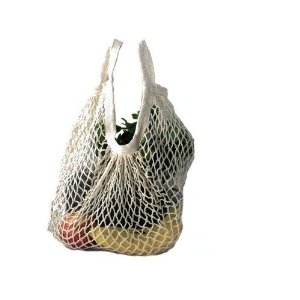
With Trader Joe’s and now even Safeway peddling “green” reusable shopping bags, it’s surprising that Americans haven’t discovered the wonderful string bags we used to see in England. I had a couple of them, which would roll up and hide in a tiny corner of a bag, briefcase, or pocket. None of the shopkeepers up and down the streets, to whom one repaired every day or two because one’s flat didn’t have a refrigerator large enough to hold a week’s worth of groceries (nor did one have a car to carry that much stuff in, anyway), ever imagined handing out paper or plastic bags to customers. That you would bring your own bags was a given.

The beauty of the string bag is that it expands almost indefinitely. I could easily fit two or three days’ worth of goods in just one of them. Two would hold a lot of food.

Amazon offers a couple that resemble the version the English carried around: This one from EuroSac…

And one from Simple Ecology that comes in colors and costs two and a half bucks less.

And there’s a variant designed with a shoulder sling, also from Eurosac…

Any of these will hold a lot of stuff and take up hardly any space in your purse, briefcase, or car trunk.

Costco, my primary source of groceries, household products, and casual clothing, already eschews bags. But they pack your stuff in cardboard boxes, which take up a lot of space in the trash bin and are a nuisance. They’re too heavy to lift out of the cart, so I have to unpack each one, repack it into the plastic bins in the back of the van, and then once home unpack and carry the stuff indoors one, two, or three pieces at a time. My plan, then, is to get a bunch of string or fabric shopping bags, ask the Costco staff to pack the junk in those, and let Costco keep the cardboard. Maybe if enough of us do that, Costco will ask their suppliers to ship in less wasteful containers.

Maybe we can all use less wasteful containers!

Gasoline Costs Putting a Crimp on Life

{sigh} I had to turn down an invite to meet SDXB and NG in the West Valley on Friday. They want to go to some goofy event at the Ben Avery Range where enthusiasts of antique guns get dressed up in Wild West clothes. I’m sure it’ll be fun, but I just can’t afford the gasoline to drive out there.

Gas is now over $3.25 a gallon here. I paid $3.29 for an emergency purchase, shelling out $15 to get to where I needed to go before I could afford to fill up the tank. When this month’s budget cycle restarted, on Monday, Costco was charging just $3.11 at the outlet where I filled up; that racked up $40.

I’ve budgeted $100 a month for gasoline, but that would normally cover only trips to and from the college and the four trips to Scottsdale I have to make each month. But this week I’ve had an extraordinary number of schleps to the East Valley: Earlier this week to Scottsdale Fashion Square to pick up a little ottoman I’d ordered months ago from Crate & Barrel; then today to the Mayo at 140th Street and Shea, an unholy long drive that will be stretched because I have to come back by way of McDowell Road, many many miles south of Shea Boulevard; then out to Scottsdale again tomorrow to give a dog & pony show to my business group, then race to the client’s to pick up some work, then fly back up to the campus at 32nd Street and Union Hills.

Ugh. Most of today and tomorrow will be spent driving, and I’m guessing all those junkets will burn half to three-quarters of a tank of gas.

This morning’s journey to the Mayo will take place during the darkest rush hour (driving into the sun, naturally), and so hypermiling will be pretty much out of the question. In a culture where normal people charge up to signals at 45 mph and then jam on the brakes at the red light, drifting toward a light with your foot off the gas freaking drives your fellow homicidal roadhogs screaming insane.

Some of our fellow citizens around here are literally homicidal, so one has to be careful.

You’ll recall “hypermiling” from the 2008 run-up in gas prices, right? The idea is to get around using as little gas as possible by applying an array of conservation techniques to your car and driving habits:

• Try to avoid applying the brakes any more than absolutely necessary. Watch the traffic flow ahead and, when red lights start to glow, coast to decelerate. Try to reach traffic stopped at the light as it’s beginning to move, so you don’t have to start up from a dead stop.

• Accelerate from a stop slowly. It’s a car, not a jackrabbit.

• When starting from a dead stop, allow the car to idle forward for a second before stepping on the gas.

• Use the cruise control to maintain speed on the freeway and on steadily moving surface streets, and use it to accelerate and decelerate. Use the “coast” and “acc” functions to slow and speed gently. Try to keep your foot off the gas pedal as much as possible. But n.b.: don’t use cruise control on an uphill grade.

• When approaching a grade, speed up a little (stay sane about this) to build momentum; then allow the car to slow as it climbs. Use the downhill grade to get back up to your cruising speed before resuming the cruise control.

• Never drive faster than 60 mph on an urban freeway. Try to keep your speed at around 55 mph. Stay in the slow lane and take it easy.

• If it looks like you will have to stand for more than 30 seconds (for example, at a long stoplight, in a gas station line, at a railroad crossing), turn off the engine.

Using these techniques, I’ve managed to extract about 25 mpg from my aged Toyota Sienna. That’s not bad, since it normally makes about 16 mpg in the city, and maybe 20 on the open road. But it’s still expensive to drive to Hell and back every day.

The real trick to hypermiling? Stay out of your car!

😉

Of Dentists, Trees, and Retirement Pay

So yesterday I ran over to the dentist’s office to get my teeth cleaned. As you’ll recall, I canned Delta Dental when it became clear that Delta’s huge deductible, its $20 copays, and its skimpy coverage would combine to cost as much as or more than what it would take to simply pay the darned dentist out of pocket.

When I explained to him that I’d dropped the dental insurance, that I’m permanently unemployed, that I’m over the hill, and that I can’t afford to make separate paid trips to his office just to chat with him about what he plans to do, he cut his fee by 10 percent. This resulted in a significant reduction in the amount I owed him: from about $170 to about $140.

This was somewhat cheering.

The arborist came by in the afternoon to look at the damage inflicted by the idiot roofers. He was not pleased by what he saw.

As to the stump of the major branch those clowns chopped off the desert willow, cutting out a good quarter of the crown and stealing much-needed shade from the front courtyard, he opined that left the way it was it would die back, rot, and leave the tree vulnerable to bacterial infection and insects. To head off this fate, he cut it all the way back to the trunk.

I’m still dead furious about the damage to that beautiful tree, but it least now it looks better cosmetically.

The SOBs did the same thing to the paloverde in back: hacked off a chunk of a thick, major branch, this one casting shade on the west side. I’m afraid that little antic will make the westside deck unusable in the summer. Before they pulled this stunt, I actually was able to sit out there in the shade even when it was very hot. But now too much sun will pour down on that area to make it livable anytime after about mid-April. Just flicking infuriating.

He cut back that branch to a point where he thought the tree might be able to stop the mortification of the damaged area, although he made no guarantee. He said it will die back some. If it starts to die back further than a certain point, which it certainly could, then that entire limb will have to be removed, too.

Amazingly, he performed these small bits of tree surgery for free. I offered to pay him at least a trip charge; he said how about $10 for the gas.

So that was pretty astonishing. Now I’ll have to hire him to come back and do some serious (and seriously well-paying…) work as soon as I have the money. If I ever do. LOL!

Speaking of money, I haven’t received my 2011 back sick leave payment (RASL), which was supposed to be disbursed in February. The woman who runs that program took herself a nice long vacation this month; she’s not supposed to get back until today, when of course I have to spend the entire day in the classroom or lurking on the campus between classes.

State retirees who elected to participate in the 403(b) plan rather than the state’s pension fund are required to take a drawdown from investments to remain eligible for all three payouts of their RASL. I’m concerned that she’s decided the $1 a month that Fidelity told me was OK is NOT OK, and that she will announce she’s decided I’m “not retired” and will refuse to pay me any further.

This is another stage in the endless runaround the state deals out to its retired employees. Every time I asked someone in the state GAO (which administers the RASL program) what was the minimum amount I could draw down, I was told to talk to the people at Fidelity. Every time I asked someone at Fidelity, he would say he didn’t know or he would find out and get back to me. Obviously, “get back to you” is run-around talk for “flake off, please.” Finally I reached a middle-management type who claimed that you could take as little as $1.00 a month and still remain eligible for RASL, and that a number of Arizona state retirees he works with have done exactly that.

Nevertheless, given that the money hasn’t shown up, I expect the RASL administrator to announce that the buck a month doesn’t qualify, thereby giving me the shaft in the biggest way possible. It’s a fitting good-bye from state service.

“Healthy” Junk Food: We spend MONEY on this?

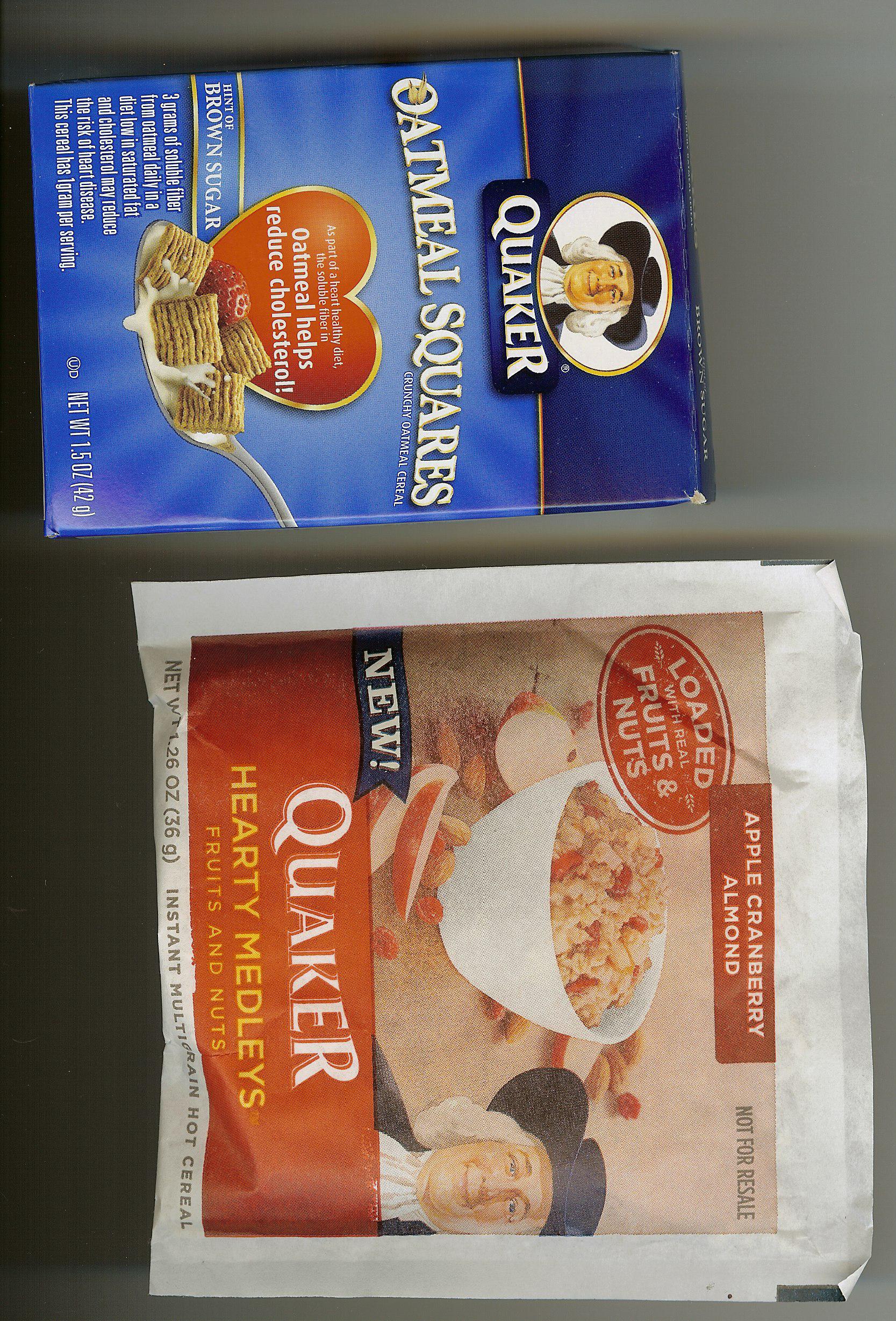
Ewwww! One of the door-to-door litterers hung a bag with two minipackages of Quaker cereals on my front gate. I don’t eat processed junk cereals, and so was about to throw them out when I thought…wait! Maybe this is something I could eat between classes on Tuesdays and Thursdays.

There’s no decent food on campus (decent by my lights, anyway—I don’t eat junk food, and that’s about all that’s sold in the student union, except for a few pathetic attempts at salads). The stretch from 7:00 a.m., when I have breakfast, to 3:30 or 4:00, when I get home, is a long one, and I get awfully hungry. So hungry that the instant I get into the house I fix a big dinner and then overeat. The overeating at mealtime is what keeps the weight on, I suspect.

So, I go to look at the ingredients in the minipackage of Quaker Oatmeal Squares:

whole oat flour, whole wheat flour, brown sugar, sugar, maltodextrin, malted barley extract, molasses, salt, and then a list of the same ingredients that appear in a bottle of multivitamins.

Maltodextrin is a form of sugar. Malted barley extract is a type of sweetener which also contains a form of sugar.

Sooo…what we have in this little box is some ground oats and wheat (very cheap), five doses of sugar(!), and some spray-on vitamins. Oatmeal Squares, sold as “heart-healthy” and so by implication good for you, is largely, if not mostly, sugar.

Yuck! Why do people put stuff like this in their mouth?

Well, the answer is probably that they think it’s good for them (“2 grams of soluble fiber from oatmeal daily in a diet low in saturated fat and cholesteral may reduce the risk of heart disease,” it says here). And they probably think it’s inexpensive food.

What does this stuff cost? At the Safeway, with the Red Card membership discount: about $2.50 for 12 ounces. That’s twenty-one cents an ounce, which at first glance seems pretty cheap. But really. It’s an awful lot for a vitamin pill sprinkled over some heavily sugared grain.

You’d do a whole lot better to buy a box of real, actual oats. Takes about five minutes to cook them, and when you pour the stuff in your bowl, you get the whole three ounces (or more)…not the one ounce that resides in a single serving of Oatmeal Squares. If you like your cereal sugared up, at least you know how much sugar (or honey, or maple syrup) you’re putting over the stuff.

Is there any question why Americans are overweight?

Love Drop and the Weekend Roundup

Before moving on to my favorite bloggers, let’s go to Love Drop and check out what they’re up to this month: trying to raise 13 grand to buy a service dog to help a family with not one but two autistic children. This is big, folks:

What else is going on out there?

At My Journey to Millions, Evan discovered that parenthood saves money in unexpected ways. Some of the saved cash is going to buy life insurance on the new kid; before your murmur “bad karma,” take a look at his reasoning.

Meanwhile, Revanche is still dealing with the opposite problem: parents who are growing more dependent in old age.

At the Ultimate Money Blog, Mrs. Money offers several home remedies for dandruff. Before you reach for the Selsun Blue with all its strange ingredients, try one of these first.

Donna Freedman emits an elaborate rant at Surviving and Thriving, spinning off the latest news-bleat, “frugal fatigue.” This appears to be what the herd journalists regard as the logical outcome of the late, great “new frugality” spawned as the recession-that-is-not-a-depression bore down upon us. LOL! One reason I canceled the local paper was exactly this kind of predictability.

At the Digerati Life, SVB suggests several fall-back resources for 99ers—people who run out of unemployment insurance—plus some steps you can take in advance to mitigate the effects of potential joblessness.

At Brip-Blap, Steve comes up with a nice contrarian take on net worth. Suspicions confirmed!

Mrs. Accountability is getting worried about the looming increases in prices across the board. With gasoline at $3.15 a gallon and rising, you can be sure everything that has to be trucked in or needs energy for production will also go up. For sure, it’s time to start stocking up—next week when the new budget cycle starts again, it’s off to Sprouts, Target, and Costco to replenish the food and cleaning goods hoard.

Frugal Scholar reports an ethical dilemma posed by a conversation overheard in a thrift shop. It’s an interesting post with a number of interesting implications.

Money Crush has a good post on finding part-time home-based work, in which she suggests a number of issues to consider when thinking about this as a possibility.

At Bargaineering, Marquit reports that the government is about to inflict…uhm, offer debit cards for tax refunds. I can hardly wait.

Go to Bargain Babe today to nail the amazing list of discounts, goodies, and leads to sales she just put online. It’s one treasure trove after another at that site!