Hm. When you’ve been around since the Cretaceous and spent part of geological time overseas, you could turn a fair amount of a map red. Let’s check it out.
Well. In spite of all that gallivanting, I’ve only visited 9.77% of the world and 50% of the U.S. Unfortunately the site doesn’t offer maps of Wonderland or Oz, no part of which I seem to have missed…
Each of our blogging friends asks where we would like to go after this. The strange thing is, I feel almost no desire to travel anymore. I guess people are supposed to want to spend their retirement bouncing around the world. Even if I could afford it, I’m pretty much done with my expeditions. To my mind, traveling is a lot of work—crowded, inconvenient, occasionally scary, and these days very invasive of your privacy. It’s interesting to have seen all those places (I guess), but in fact I live in a place where everybody else wants to visit. Why go galloping around when you already live in a destination?
I’d like to go back to New Mexico. I adore Santa Fe and the whole area around there. And I think I’d like to explore the south of France. But the rest of it? meh!
Today is the first day for not one but two new classes, a section of English 101 and the new online magazine writing course. Well, actually, the mag course officially started yesterday, but not much is going on other than to answer the occasional plaintive “I can’t make Blackboard work” message.
LOL! Neither can I, kiddo!
These eight-week courses are great. Because they move right along, you don’t have to pad them with a lot of time-wasting busywork (if it’s busywork for them, it’s busywork for you, too—you end up having to read the stuff!), so you get through the essential course material in a timely way. If the section that just ended is representative, the shorter format attracts more ambitious and motivated students, so you have better retention and overall better effort on the part of classmates. And if one of them turns out to be a shade on the troublesome side, you get them out of your hair quickly, instead of having to deal with a problem child through 16 long weeks.
Offer letters were supposed to have gone out yesterday, so when I get to campus one should be waiting for me. We’ll see if the Boss has granted me the much-needed three sections next semester, and if more than one of them will be in the eight-week format. We’re doing a repeat of the magazine writing course in the spring, the current one having filled right up. So I’m hoping he’ll clone my fall schedule, which has been pretty easy to deal with, work-wise.
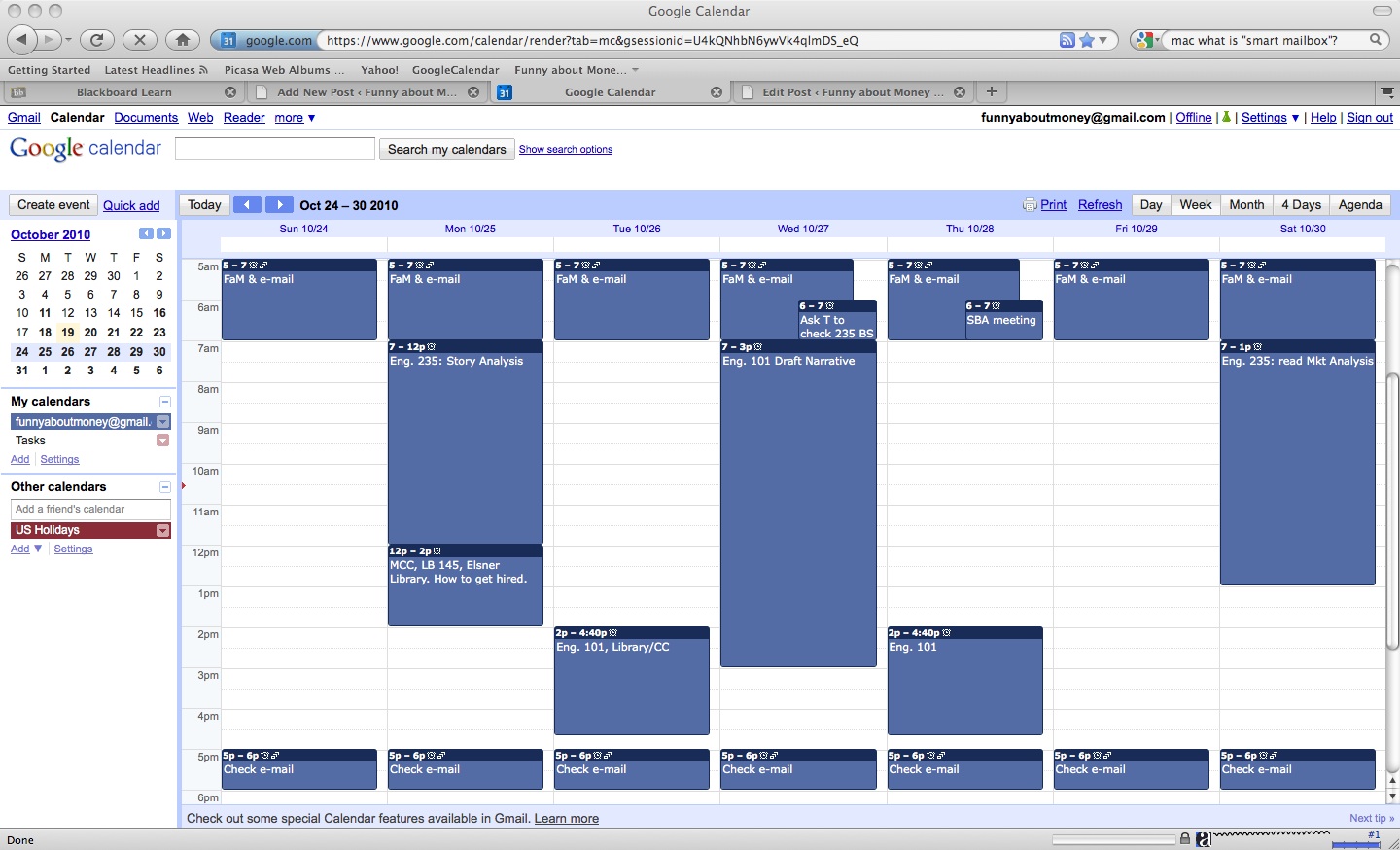
Some time back I came up with the idea of managing time by blocks dedicated to specific activities. This weekend I engaged a new tool for the purpose—offspring of a Doh! Why didn’t I think of this before moment. Google’s calendar is perfect for dedicating chunks of time to particular types. You don’t have to be logged in to an Outlook account to get it to give you a reminder; it’ll ping you through any e-mail address. And the calendar, IMHO, is somewhat easier to use than Outlook’s.
Over the weekend, I went through my semester calendar, noted each due date, estimated the amount of time required to grade each assignment, figured out when I could devote that much time to it, and then entered the assigned slabs of grading time into Google Calendar. The result:
(Click on it for an image large enough to see details)
It remains to be seen, of course, whether I’ll actually stick to this scheme. If I can, it should help to get the workload under control.
One way or another, though, it presents an interesting little revelation. Look at how much time is left free after I’ve supposedly done all the work associated with these two courses and FaM!
What, one wonders, have I been doing sitting in front of a computer 14 hours a day?
Well, one thing is answering the e-mail. Five new messages have come in during the ten minutes or fifteen minutes it’s taken me to write this much copy and upload that image. I’m constantly diddling with the e-mail. So I’ve decided that I should take a leaf from other bloggers’ books and limit e-mail reading to early morning and late afternoon. And just this moment, it’s {click!} Off with MacMail! Command-Q: Quit Mail!
The other vast time-waster for me is cruising the Internet. It’s hypnotic. I spend way too much time cruising news sites (CBS Marketwatch: Dow is down 1.2 at 11,010, but eek! it was down below 11,000 earlier today) and reading other people’s blogs. When I’m working during the school year, I need to get a grip on that. There have to be better ways to spend those nice clear spans of free time!
The other day I took the opportunity to enter a comment, at a business blog, that alluded in passing to my favorite conspiracy theory; to wit: over the past two or three decades, we have been watching the deliberate erosion of the American middle class.
Don’t believe it? Well, skepticism is healthy.
But consider…
• If you can’t get access to affordable medical care (exorbitant insurance premiums do not qualify as “affordable”), you’re not in the middle class, certainly not by the standards of any other developed country.
• If your access to health-care services and to a health care provider of your choice is limited, you’re not in the middle class.
• If the quality of education in your local public schools is so poor that you have seriously entertained the possibility of homeschooling—not for religious reasons but because you’re concerned for your kids’ literacy, their safety, or both and you can’t afford private school—you’re not in the middle class.
• If you counsel your children to get a vocational diploma in college instead of a full education that will inform them of the history and significance of their culture because you’re afraid their bachelor’s degree will qualify them to stock the shelves at Borders, you and they are not in the middle class.
• If you’re not on track or ahead of schedule to accumulate enough savings to live on through your old age without benefit of Social Security, you are not in the middle class.
• If you’re driving a clunk because you can’t afford to buy a newer car now, you’re not in the middle class.
• If you buy your clothes at Goodwill less for the entertainment value than because you feel you shouldn’t spend the money on new clothing, you’re not in the middle class.
• If you were to lose your job tomorrow and you know the likelihood of replacing it with a job that pays about the same is low to nil, you’re barely clinging to the middle class.
• If jobs in your industry are increasingly being outsourced to Indonesia and waypoints, you won’t be in the middle class much longer.
• If you would rather use department-store cosmetics but you get your makeup at the drugstore because you cringe at paying department-store prices (though you happen to know there’s no real difference), you’re not in the middle class.
• If what you do for a living is a dying vocation (and there’s more!), you’re not long for the middle class.
• If you live in a big coastal city and you don’t earn a six-figure income, you’re not in the middle class.
• If you live anywhere else and earn less than $40,000 or $50,000 (depending on the region), you’re not in the middle class.
• If you are the breadwinner in your house and you earn what a typical teacher earns, you’re not in the middle class.
• If you and your spouse or partner depend on both your incomes to maintain a middle-class standard of living for your household, you as individuals are not in the middle class (check out the book from which this article was spun).
• If your spouse or partner earns enough to maintain your household in middle-class splendor while you earn pocket money, your companion is in the middle class and you’re not.
Still think you’re living in the middle class? Or even in Kansas, Toto?
It’s hard to deny that our country is polarizing economically as radically as it has polarized politically. I personally don’t think it’s an accident. We could argue over conspiracy theory and over the reasons and the fixes until we’re all carted off from the poorhouse and delivered to the nursing home. But there it is. IMHO it has little to do with technology and nothing to do with the recession. There’s been more to this than has met the eye…for quite a long time.
Is any one office chair perfect for everyone? Experts in ergonomics will tell you “no.” The perfect office chair for you depends on many factors, such as your height, weight, posture, areas of pain, and what your chair will be used for. How many hours per day will you be in it? And does your work entail computer, phone, or paper work? As you can see there are many variables.
As a doctor of chiropractic my main concern is the patient’s posture. Recent research has shown a direct relationship between many health problems and a forward neck posture. With more and more people spending more and more time on computers, cell phones, and other electronic devices, health problems are beginning to pop up. Some of these health conditions include disc herniations, loss of concentration, reduced immune function, and cardiovascular, respiratory and gastrointestinal problems.
Human bodies were not designed to sit in chairs for hours at a time, yet this is what our modern age has brought us five to seven days a week for six or eight or more hours per day. Welcome to the wonderful world of health problems and premature aging.
So, since you’re spending most of your waking hours sitting in front of a desk, it’s in your interest to find the best office chair for your body. An ergonomic chair gives you the most adjustable options for your body. But these chairs have so many options to select! If you are looking for the best office chair for yourself, what are the guidelines you should use?
What is Ergonomic?
The term “ergonomics” comes from two Greek words: ergo, meaning work and nomos, meaning natural laws. Ergonomics works with your body’s makeup so the chair fits your body’s posture.
A correct office chair for you should be adjustable in many ways to fit your body.
• The chair should rotate 360 degrees. • The depth of the seat should be adjustable. • The chair height should be adjustable. • The chair seat should tilt front and back. • An adjustment to tighten or loosen chair seat tension should be available. • The chair’s back should tilt front and back. • Arm height should be adjustable up and down. • The distance between the arms should be adjustable in and out. • The arm pivot front and back should be adjustable. • A lumbar air pump should be available.
Some specialists in ergonomics frown on chairs with arm rests, because they may make it hard for you to get close enough to the computer. This is another matter that depends on the user’s size, body characteristics, and preferences. Each workstation problem can be solved by working with a specialist in ergonomics.
Putting Your New Chair to Work
Once you have chosen your chair and it feels great, you must integrate it into your workstation. Although many believe that the chair you’ve chosen is the most important device in your workstation, there are other factors to consider.
The overall workstation, including chair, desk, computer, and desktop tools, can be the most modern and up-to-date in the industry, but if you abuse it, you will have health problems. With your ergonomic chair, some of these problems are easy to solve. For example, when you sit at your workstation your computer should be in front of you. The top of the screen should be no further than 24 inches from view, controllable by chair positioning. Don’t forget to use a glar- reducing screen, which helps with eye strain. Arms and hands on your board should be relaxed and just below the level of your heart. Knees should be either level with or slightly higher than your hips. All of these can be made correct with your new ergonomic chair.
The height of your work surface should be between 24 and 32 inches. This is a variable based upon the individual’s height. Raise or lower chair or work surface to find the most comfortable position.
Now Get Up!
You have your chair and work surface perfect, right? Now consider one other thing.
Sitting at your workstation for hours without moving causes stasis, which for individuals may mean vascular problems, muscle tightness, headaches, fatigue, and numbing of the work brain. The solution is to get a kitchen timer or something similar and set it for 30 or 45 minutes. When the alarm goes off, simply get up, walk around your workstation, and take a few deep breaths. This will do wonders for you and your job.
A proper office chair can mean the difference between a comfortable place to work that is safe, healthy, and productive or drudgery blighted with repetitive strain injuries and postural health problems.
Go find yourself an ergonomic chair and enjoy your job and a healthy life.
Images:
Aeron Chair. Public domain.
Computer Workstation Variables. Integrated Safety Management,
Berkeley Lab. Public Domain.
Have you seen what Andrew at Money Crashers has gotten up to? He’s created an elaborate tool for ranking personal finance blogs. He runs nine metrics through an algorithm to calculate what he believes to be an accurate rank for each of 368 sites.
How does it compare with Wisebread’s Top 100 personal finance blogs? Well, I’m not techie enough to deliver an informed opinion, but that won’t stop me from holding forth anyway. Wisebread, from what I understand, shows site rankings by seven metrics, but bases its rankings on Alexa. By clicking on the appropriate link, you can also view listings by Technorati rank, subscribers, link authority, and compete scores.
Money Crashers’ ranking apparently combines nine metrics to come up with an amalgamated ranking taking all of them into consideration. You can view the ranking by any single metric by clicking on its icon at the top of the columns (at least, I think that’s what it’s doing…but i are a english major, i are not a i.t. guru).
Some of the likely suspects appear at the top of each ranking: Get Rich Slowly and The Simple Dollar, for example, rank among the top five in both tools. Some are radically different; Yakezie, for example, appears as number 8 in Wisebread’s and number 300 in Money Crashers’ listing.
At the moment, Funny ranks 76th at Wisebread and 182nd at Money Crashers. If I’m understanding correctly that one of them ranks solely on the basis of Alexa and the other works a bunch of sources into its ranking, then I’m inclined to suspect that Money Crashers’ figure is probably closer to reality. Alexa measures only visits to your site by people whose browsers have the Alexa toolbar. Until Financial Samurai had the idea of recruiting PF bloggers to use it by way of jacking up their Wisebread rankings, most Alexa subscribers were webmasterish sorts. The Alexa ranking, IMHO, is severely limited by the number and interests of the folks who download and activate the toolbar.
Kinda fun to contemplate the stats, though, isn’t it? And don’t you love that little piggybank in the MoneyCrasher’s badge, over there in the right sidebar??
Finally done with all the English 101 stuff, the grades finally entered in the District’s system. Let’s hope nothing there comes back to bite. That’s a forlorn hope, of course: as anyone who teaches anything knows, someone has to make an exception of himself. Every. single. time. So let’s rephrase that: let’s hope that whatever comes back to bite isn’t a pit bull. 😉
We now have three days until class starts again, this time not one but two eight-week gigs: the magazine-writing course and another English 101 crew. People are already turning in stuff for the magazine course, it having gone online a few days early, for their convenience. Oh well.
Having been sick for the past two and a half weeks with some sort of indigestion and heartburn paired with an unending headache, I’ve been madly self-medicating. Started with my usual subtractive medicine: stop ingesting things I love that I know are probably bad for me. Getting rid of the coffee helped some—alas. One of the small things that makes life worth living, or at least tolerable, is starting the day with a delicious cup of top-quality French-press coffee. But it must be admitted that the stuff keeps me awake at night, contributes hugely to the tooth-clenching, and does annoying things to the gut.
Then it was off the sauce—damn it. The other small thing that makes life worth living is celebrating the end of the work day with a beer or a glass of wine. But we suspect that daily tippling is not good for our health, or at least not good for our moral standing. After I snuck back into the grocery store two days ago to purchase a Murphy’s stout to go with dinner, the instantaneous and unmistakable protest from the belly showed, beyond a shadow of a doubt, that there will be no more swizzling for the likes of me!
I’d been using a generic version of Pepcid AC, which was laying around the house because the vet recommended it for the dog, who occasionally would barf in the weeks after I got her. This stuff did so little that it soon became apparent it was doing nothing. So yesterday when I was at the Safeway I picked up a package of omeprazole, the stuff that’s in Prilosec. The pharmacist said it had virtually no side effects.
Right.
These days I don’t take anyone’s word for that, so looked up a non-woo-woo study to check the side effects and their incidence rates.
HOLY God! Headache? Chest pain? Severe diarrhea? Severe stomach pain? Pancreatitis (some fatal)? Esophogeal candidiasis? Liver failure (some fatal)? Liver necrosis (some fatal)? And on and on…
Like I’m not sick enough?
So we’ll be returning that stuff to the store.
Moving on, I turned to the woo-woo pages, where I learned that a tisane of sage leaves and hot water has been used for centuries to treat indigestion and heartburn. Supposedly, too, chewing up and swallowing a half-dozen blanched almonds calms your stomach. We’re also told that raw apple is imagined to be soothing.
Well, what the heck. I happen to have a sage plant growing in the back yard, almonds in the freezer, and a lifetime supply of apples in the fridge. None of these things is known to cause necrosis of the liver.
So I picked some sage leaves, made a tea of them, and then blanched some almonds. Surprisingly, munching the almonds seemed kind of calming. Probably all in my head, though.
The sage tea, however, actually did seem to work to good effect. Can’t say it cured anything, but after drinking it, I did feel quite a bit better.
This morning, having awakened queasy again, munched some more almonds, brewed some more backyard sage tea, and took the dog for a walk. When we returned, I ate some of the rice I’d fixed for the dog’s cuisine, and afterward felt OK.
So, who knows? Maybe the stuff helps. Or maybe the passage of time helps (three weeks seems like a lot of passaging…but when you get old, your body heals very, very slowly). Experience suggests that these little ailments will do one of two things: kill you or go away on their own. Not much exists in between.
Old age. 😀 It’s not for the young or the faint of heart.
Right now a gigantic pot full of chicken carcasses and the bone from a chuck roast (found yesterday for $1.69/pound!! and converted to hamburger) is simmering with onion and herbs to make a glorious stock for future soups, which we hope also will be duly therapeutic. So good…
How to Make Leftovers Stock
You can make this in a slow cooker, but for some reason I think the stuff tastes better when it’s made in a pot on the stove.
Save a bunch of bones from chicken, beef, lamb, and pork—toss them in the freezer till you’re ready to use them.
When ready to spend the better part of a day keeping an eye on a slowly simmering brew, break out a large stock pot. Skim the bottom of the pot with olive oil. You’ll want to start this process in the morning, BTW.
Then coarsely cut up a fresh onion—no need to peel it—and brown it gently in olive oil. Add some cut-up celery and carrot. Toss in a couple of garlic cloves. Add herbs to your taste—I used some dried fines herbes and (what else?) the sage leaves wilted when I made the sage tea. Anything will do nicely.
When the onions have lightly browned or fully caramelized, depending on your mood and how closely you were watching the pan, add your collection of bones. Cover the whole mess with water.
Turn the heat to medium high. This is the only time you’ll need to hang around the kitchen. Keep an eye on the pot, and when it just comes to a boil, turn it down to low. Cover and go away.
Allow the broth to simmer for hours. Many hours.
When you get around to it, much later in the day, turn off the heat and heave the pot over to the drainboard next to the sink. Set a large bowl in the sink and place a strainer over it. Ladle the broth and cooked stuff into the strainer, draining the juices into the bowl. Use the back of the ladle to press as much of the broth out of the bones & veggies as you can. Discard the used-up bones and veggies.
You now have a stock that you can use for any number of delicious things, either to cook with or simply to eat as a light soup. You can add stuff to it to make a sturdier soup—pasta, rice, veggies, barley, whatever. A little white wine or sherry gives it a very nice flavor.
This is not real stock, which has to be clarified and reduced. But it’s sure good enough for government work!


 from which this article was spun).

