Coffee heat rising

Stormy Weather!

Wow, what a storm! Well, make that what a pair of storms! Right now the Interstate is closed in both directions, trees are down, a house is burning, water is up to our knees.

It started yesterday afternoon with quite a heavy, sharp rain. These squalls move across the desert quickly, and so within a few minutes the rain stopped and this brilliant rainbow, one of the brightest I’ve ever seen, stretched across the northeastern sky.

Rainbow2010

Thing looks like it’s coming down right in the neighbor’s yard, doesn’t it? LOL! Before this appeared, though, quite a lot of lightning, thunder, and pounding rainfall terrorized Cassie the Corgi. Moi, I was cool until a bolt of lightning crackled down right outside the back door…HOLY mackerel! We were both diving under the bed.

I thought it had hit one of the palm trees, but if it did, I can’t see any damage. Last night the skies cleared, leaving a beautiful evening for a late doggy walk. And this morning dawned clear with a few fluffy little clouds. A few…that, well.. coalesced.

About noon the skies darkened and then let loose with one of the wildest hailstorms I’ve ever seen. Vast quantities of ice fell from the clouds. By the time it stopped, the place looked like it had snowed. Here’s a view out the side door.
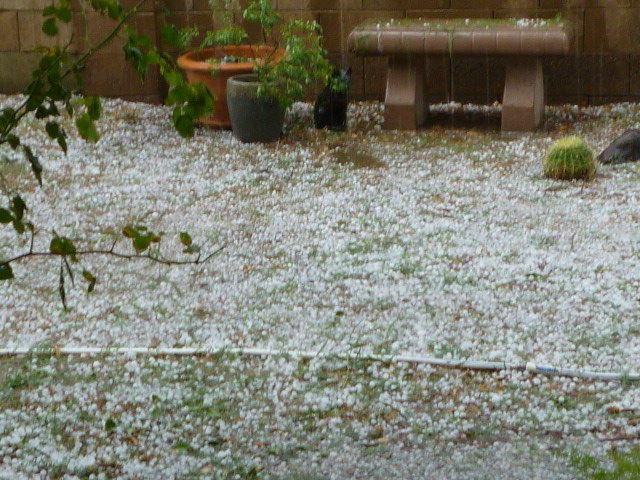
Hail2

That green stuff is not grass. It’s leaves. The hail stripped about half the foliage off every tree in the neighborhood! Inez and Carlos’s huge tree has blanketed the street and their neighbors’ yards with leaves, and my yard is covered with an even, thick layer of shredded leaves from their and my trees—front and back.
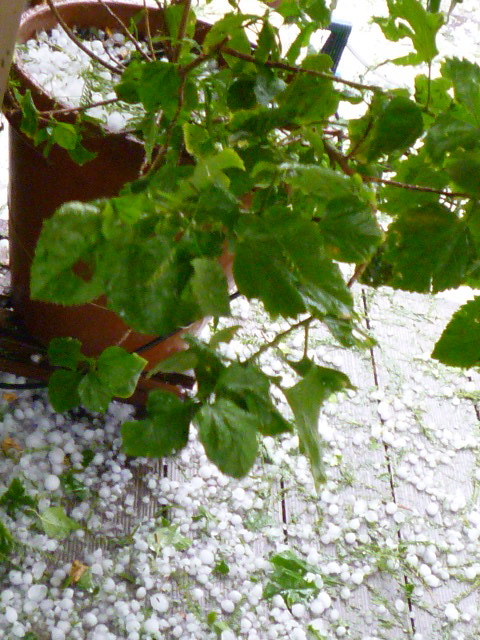
Hail3

Everything was coated with ice. Naturally, first thing after dawn this morning I’d finished putting in the last of my vegetable garden. La Bethulia’s cucumber plant was reduced to a nubbin, and the two bell peppers she gave me were shredded. They might survive, but if they do it’ll be a surprise. The millimeter-high bok choy seedlings were thoroughly thrashed, as were the tiny chard sprouts that were just starting to peek out of the dirt.

A fair amount of water fell out of the sky, too. This puddle outside the back door is almost over the threshold, which is three inches higher than the patio floor, which itself is well above grade. Another quarter-inch of rain, and I would’ve had water in the house.
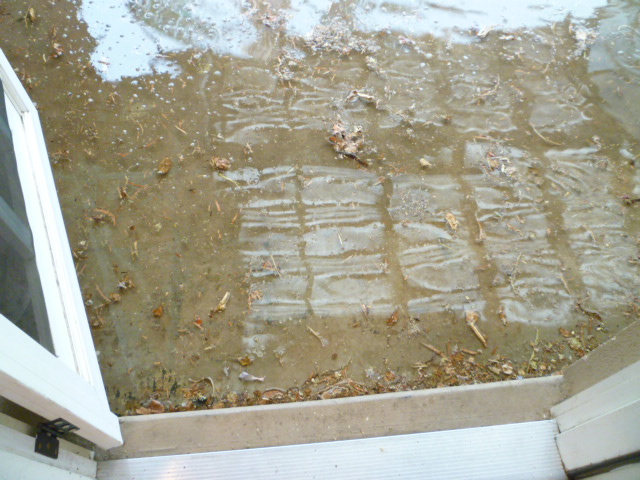
Rainwater

This storm was so extreme and so fierce, I thought it was going to break the skylights. In fact, in other parts of the city the hail did bust in car windshields, and as I write this, NPR just reported that 75-mile-an-hour winds were recorded. As the black thunderheads rolled in from the south, we could hear the same roaring sound that came out of the storm that smashed the Encanto district a couple of years ago: like a freight train barreling past. Only this was a great deal more violent than that storm, it least in our little corner of the Valley. I grabbed the dog and barricaded us into the middle bathroom, which has no exterior windows (except…ahem…a skylight…) and provides a sturdy cage of copper plumbing.

About the time the hail stopped, I had to get in my car and drive up to the campus for a meeting. What fun, driving in this stuff! Went up on the surface streets to avoid the likely chaos on the freeways. While I was going about 40 mph through thick traffic and heavy rain, some asshole thought it was hilarious to streak past me on the right so he could dive through a deep puddle at about 45 mph, fire-hosing my windshield and utterly blinding me.

This is the reason I don’t carry a gun in my car. Honestly. If I’d had a pistol, I’d have shot the sunovabitch. I certainly would have tried to shoot out his tires as I passed him while he stood in the left-turn lane (yes: after entertaining himself, he swerved across three lanes of traffic to park himself in the left-turn lane), and wouldn’t have regretted it much if a stray bullet had wandered into the driver’s compartment. No. You’re right. I have no restraint.

Where was I?

Yesh. Soon enough, the meeting adjourned and I headed back to the Funny Farm. By now more storm clouds were rumbling in. Threw some food on the stove before the power could go out, and just about the time the dog and I finished scarfing dinner, another violent hailstorm hit. We had hail at least an inch in diameter, some of it bigger. It sounded like rocks hitting the roof!

This struck right at 5:00 p.m.: perfect timing!

Power lines fell across the freeway, closing the Interstate 17 in both directions at mid-town. Underpasses flooded, and people stuck on the interstate found themselves in water up to their doors. The airport was shut down twice. Power poles went down, some of them through the roofs of utility customers’ homes.

Now it’s quiet. Quiet and finally, mercifully, gloriously cool. It’s down to 70 degrees on the back porch, the coolest temperature we’ve seen in three months.

And so, to walk the dog, and then to bed…

Calculating the College Graduate’s Course of Action

M’hijito is contemplating his future and thinking it’s time to go to graduate school, a bachelor’s degree from a  highly ranked liberal arts school fitting one for little more than working in a call center. He points out that some of his colleagues are high-school graduates, and that he’s not going any further in his present job than they are, which is exactly  nowhere. One of his colleagues, we might add, has a J.D. and is as dead-ended as the rest of them. Like Franz Kafka, M’hijito trudges off each morning to a Broterberuf in the insurance industry—a job that puts bread on the table—all the while searching for a better way to spend his life.

Really, one might say that a good degree in the liberal arts (his is in international political economics, a branch of political science) suits you for too many things. The graduate is left first with a need to continue his or her education in order to get a decent job, and second with such a broad range of possibilities that it’s difficult to imagine which is the best to choose. Or whether any one of them is a good choice. Consider, for example, all these branches in the road that confront the young man:

B.A. in poli sci + M.A. or Ph.D. in political science
Career potential
:
→ Federal, state, county, municipal admin jobs
→ Academic: community college or university
→ Politics: Legislative assistant, campaign assistant, campaign advisor, campaign consultant
→ Community organizer
→ Office holder
Time required:
M.A., 18 months to 2 years; Ph.D., about 3 to 4 years, start to finish
Job prospects: fair to good
Costs: Unclear. Apparently about $3,650 to $4,244 a semester, full time, at ASU

B.A. in poli sci + J.D., or J.D. + ancillary graduate program
Career Potential:
→ Private practice
→ Corporate practice
→ Public prosecutor/defender
→ Business executive→ Medical law (depending on specialization)
→ Academic: community college or law school
→ Government executive positions
→Insurance law
→ Environmental law (depending on specialization)
Time required: M.A.: 3 years
Job prospects: fair to good
Cost: $19,225/year at ASU; $20,895/year at UofA

B.A. in poli sci + MBA, marketing + past job experience, marketing
Career Potential:
→ Development officer, universities, schools, nonprofits, municipalities
→ Marketing executive, private industry
→ Marketing specialist, government
→ Circulation & fulfillment, publishing industry
→ Marketing executive, publishing
→ Publisher
→ Academic: community college
Time required: 18 months
Job prospects: fair to excellent
Cost: $34,900/year at ASU

B.A. in poli sci + MBA, management + present job experience, insurance
Career Potential:
→ Management & exec positions, insurance industry
→ Management & exec positions, healthcare industry, depending on specialization
→ Management & exec positions, private industry
→ Management & exec positions, government
→ Academic: community college
Time required: 18 months
Job prospects: fair to excellent
Cost: $34,900/year at ASU

B.A. in poli sci + B.S., accountancy + CPA
Career Potential:
→ CPA with national, regional, or local firm
→ Sole proprietor, CPA (self-employed)
→ Corporate employment in private industry
→ Government employment: IRS, other federal, state, and local branches
Time required: about 2 to 3 years
Job prospects: good
Cost: $34,900/year at ASU

B.A. in poli sci + undergraduate science & math + master’s of medical science
Career Potential:

→ practice as physician’s assistant
→ Academic: community college?
Time required: 4 to 5 years
Job prospects: excellent
Cost: $70,000 + cost of undergraduate make-up work in science &  math

B.A. in poli sci + undergraduate science & math + RN
Career Potential:
→ Nursing jobs
Time required: 3 or 4 years
Job prospects: good
Cost: ASU’s fully online program: $325/credit hour.  Unclear; this may be an associate’s degree or a three-year program at some schools.

B.A. in poli sci + undergraduate B.S. in nursing + RN + M.S. in nursing
Career Potential:
→ Nursing jobs
→ Nurse practitioner practice
→ Academic: community college, possibly university
Time required: 4 or 8 years; M.S. program requires need a B.S. in nursing
Job prospects: good to excellent
Cost: God only knows. Bizarrely, ASU offers the B.S. in nursing online!

B.A. in poli sci + M.S. in Public Administration
Career Potential:
→ Middle management positions, federal, state, county, municipal
→ Academic: community college
Time required: Probably about 18 months to 2 years
Job prospects: good; some jobs may be accessible with just the B.A.
Costs: Unclear. Apparently about $3,650 to $4,244 a semester, full time

B.A. in poli sci + M.A. and Ph.D. in psychology
Career Potential:
→ Private practice, therapy
→ Government, school, hospital jobs
→ Academic: community college, university
Time required: M.A., 2 years; Ph.D., 4 to 6 years, start to finish
Job prospects: fair to good
Costs: Unclear. Apparently about $3,650 to $4,244 a semester, full time
Note: Some of these programs are offered through the College of Education, which is not promising

Except for the master’s of medical sciences to prepare one to become a physician’s assistant, which in Arizona is offered only through an expensive proprietary school, cost estimates reflect what Arizona State University claims it charges. Some of those figures are fuzzy; ASU’s administration now thinks of the institution as a business enterprise, and so like any outfit trying to sell you something, it downplays costs and, for some programs, makes it difficult to figure out what the degree actually will cost a typical student.

Other possibilities come to mind. With a Ph.D. in business management, for example one can start a university teaching career in the high five figures; the doctorate in accountancy will give you a start in the low six figures.

Obviously, a doctoral degree will take a lot longer and leave him a lot deeper in debt. ASU’s business college is very expensive—the two-year course of studies for an MBA, which may leave him no more employable than he is now, costs as much as Midwestern charges to train a physician’s assistant, a job that is highly in demand. So, heaven only knows what an MBA plus a doctorate would cost. A lot. And a starting salary ranging from $80,000 to $120,000 would be low, given that kind of debt.

Even for a young man who has no burning desire to become a great international novelist, the array of potential choices is dizzying. Given that you’re going to have to put yourself in hock to qualify for a decently paying job that you don’t hate and that has some potential for advancement, which way would you jump?

A Bible of Customer Service

Frugal Scholar has been holding forth (again) about the sometimes execrable customer service at Chico’s. Really. One wonders where retailers get the people the hire, or if they deliberately train them to turn off the customers. Is it possible that there are some among us they just don’t want to do business with?

Some retailers and retail staff trainers could do with some pointers. If you’ve ever stayed at a Ritz-Carlton hotel, you know what customer service is supposed to be like. Back in the day, when I was married to the corporate lawyer, he and I in fact did linger at Ritz-Carlton  hotels on occasion…the one at Laguna Niguel, as I recall, was particularly amazing.

Well, there’s an official history of Ritz-Carlton that describes the company’s strategy for building world-class customer service. It’s called The New Gold Standard: 5 Leadership Principles for Creating a Legendary Customer Experience Courtesy of the Ritz-Carlton Hotel Company. You also can get it in a Kindle version.

Here’s my plan: We all buy a copy of this thing and send it to the president or CEO of Chico’s. If Chico’s Facebook CSR responded to their neglected customer because she noticed Frugal Scholar’s criticism (entirely possible: companies do set their Web browsers to gather online mentions, turning the Internet into a gigantic online clipping service), then maybe if all of Frugal’s and FaM’s readers sent a little hint upper management, we’d see some changes made.

😉

Time Management, Revisited

If time is money, it explains why I don’t have enough of it. Money, that is: I never seem to have enough time!

Friday (was that only yesterday?) I was reduced to spending the entire day cleaning house, having let the pigpen slide way, way too long. Dedicating a six or eight hours to dusting, vacuuming, scrubbing, and scouring gives you some time to think, and what I thought is that too much of my time has been wasted on the playground that is the Web and too little of it is used in any actively constructive way.

Not that I don’t spend plenty of time working…commenters will occasionally remark that I seem to work like an animal, and indeed, 14+ hours a day spent in front of a computer, haranguing students, driving from pillar to post, and thrashing around the Funny Farm does make for a tiring schedule. But, as I’ve observed before, I don’t think I’m working very smart. My work pattern is gestalt. Instead of focusing on specific, financially productive activities for specific periods, I’m all over the place: cruising the Web and writing and grading papers or doing course prep and editing copy and checking facts, all the while jumping in and out of the e-mail. Every day about 100 messages a day pour into just one of the four mailboxes that serve me, Funny about Money, and The Copyeditor’s Desk; I don’t have time to check all of them, but I do get pinged by  my Mac.com mailbox frequently, all day and into the night. E-mail is one of the biggest time-killers known to Personkind, second only the the Internet playground itself!

One strategy I’ve used to organize time has been listing. This works pretty well: having a to-do list does seem to prod you to get those things done, if only because you get a tiny jolt of satisfaction each time you check one off. Lately, though, the lists seem to get longer and longer. They begin to look like this one from a day last week:

¨1. Move rose, plant bulbs
¨2. Write & print donor forms
¨3. Send ads to Nanette
¨4. Remind Marshall, Jim about SBA ad
¨5. Pick up house
¨6. Build a Mac.com “mailbox” for messages to deal with ASAP
¨7. Clean floors, counters, stove
¨8. Get in touch with Evan, others
¨9. Update student grades
10. Do laundry
11. Check CE Desk mail; cope
12. Order new business cards
13. Compose Time & Charges for PPP
14. Iron clothes
15. Figure out how to copy current 101 course to new BB site
16. Copy current 101 course to new BB site
17. Change at least half of 101 exercises & quizzes to noncredit assignments; figure out adjustment in grading scheme
18. Figure out new due dates for 2nd session 101 course; mesh with 235 assignment due dates
19. Rewrite syllabus accordingly
20. Post new syllabus, due dates, and learning modules
21. Finish editing current PPP novel; compose & print statement and report
22. Water plants
23. Finish planting garden
24. Buy food
25. Fix and eat food
26. Feed dog
27. Walk dog
28. Check rat traps
29. Fertilize citrus & palm
30. Clean, shock-treat pool

Crushing! The effect of a gawdawful list like this is to shut you down. It’s so huge and so discouraging, you don’t even want to start. You just want to avert your eyes and your mind from it.

Still…none of this stuff is disposable. It all has to be done. Maybe not today. But soon. What to do?

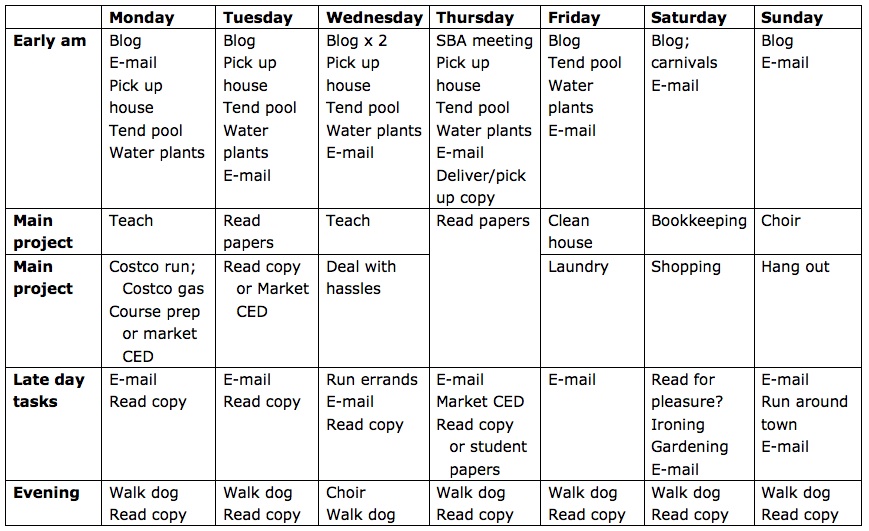
Another strategy is to build a daily schedule that will accommodate chores in focused periods. Rather than trying to accomplish a long and scattered list of tasks, such a scheme would bunch activities under various rubrics, scheduling similar chores during specific blocks of time. Here’s what I came up with:

The plan here is to build two new habits:

1. Limit e-mail to first thing in the morning and last thing in the afternoon, leaving the program turned off the rest of the day; and

2. Pick up the litter around the house every day, instead of putting it off until whenever I think I have time and feel like it.

😀 Of course, developing new good habits isn’t so easy as developing new bad habits (is the sun over the yardarm somewhere in the world, yet?).

The beauty of this schedule, if it can be made to work, is that it specifies blocks of time to market The Copyeditor’s Desk. Right now, the bulk of my income comes from teaching and Social Security: two tiny pittances combine to make one larger pittance. It’s enough to get by on—just—but not enough to live on comfortably. I’d like to build the business into a revenue generator, and the only way that’s going to happen is for me to get off my duff and network among business owners and executives who have budgets to pay for communication services and products.

The ugly of this schedule, however, is that it still prescribes 14 to 16 hours of work: we’re looking at something that starts around 4:00 or 5:00 a.m. and ends between 9:00 and 10:00 p.m. However, that’s ameliorated a bit by the loafing time shown on the weekends. Not much, but better than nothing.

{sigh} If I’m going to work this hard, I’ve gotta have more to show for it than a $29,000 gross income!

Speaking of the which, it’s almost noon and I haven’t even started to read the papers that I was supposed to have done on Thursday. ’Bye!

Want to buy that car? Don’t test-drive it!

Our friend Cary Lockwood, the automotive guru and local radio show personality, was chatting over the phone the other day when I happened to mention that I might soon be in the market for a new (or less old) car. He made a startling—and IMHO startlingly brilliant—suggestion: once you’ve narrowed choices down to two or three cars that you could be serious about buying, don’t test-drive them. Instead, rent them.

He pointed out that, in the first place, a ten-minute spin around the block and up the freeway is no way to determine whether the car fits your needs or to become familiar with its handling characteristics. And second, it’s hard to evaluate a vehicle with a salesman hanging over your shoulder pitching the thing. The test drive is one of several tools car sellers use to pressure you into buying. Even when you know this, most people easily succumb to the emotional appeal of a shiny new vehicle.

Cary observes that today’s vehicles are built to run, relatively trouble-free, for ten years or more, if you take care of them. The smart frugalist figures that the longer you can drive a car, the less it costs over the long run. I, for one, plan to drive a car for ten years or until it falls apart, whichever comes last. Because it’s a big investment and you’ll have to live with it for a long time, doesn’t it make sense to invest a few extra dollars and some time to be sure you’re making the right decision?

Rental costs for a Prius run around $40 a day—maybe less with a coupon or corporate account. The New York Times calls hybrid rental prices “excessive,” but it’s hard to assess the truth of this. Car rental companies play coy about pricing; I haven’t found one that will quote a price unless you sign up to reserve a vehicle. A survey of various sites suggests rental rates in general run  from around $38 to $150 a day. Forty or fifty bucks for an entire day of test-driving time looks reasonable when you intend to hang onto a vehicle for upwards of a decade.

Cary suggests that you take plenty of time to test the air-conditioning, the seating capacity and comfort, the gasoline mileage, and the car’s handling characteristics. You might even consider renting it for a three-day weekend, giving time to drive it under different conditions and maybe take it on the open road for a day trip. Here are a few things to check out:

• How quickly and effectively does the air-conditioning cool the car?
• If you have kids, does the interior accommodate your car seats? Don’t guess: install the car seats and observe how they fit and how difficult it is to get the car seat and the child in and out of the vehicle.
• Does the trunk or storage area hold a week’s worth of groceries? How about your golf clubs or skis?
• Can all the drivers in your family see the speedometer and other dials clearly when the driver’s seat is adjusted to fit them?
• Get in and out of the drivers’ and the passengers’ seats several times. How easy (or difficult) is it to get in and out of the vehicle?
• How responsive is the steering?
• How well does the vehicle take curves?
• Does the car accelerate fast enough to enter a freeway safely?
• With the car moving at the legal speed limit, brake hard. Observe the time it takes to bring the car to a halt and the car’s performance during braking.
• Make a U-turn. How large is the vehicle’s turning radius?
• Find a bumpy stretch of road. How’s the comfort factor on a rough surface?
• If you decide to drive the car out of town, how does the comfort in the driver’s and the passengers’ seats hold up over the long haul?
• What, really, is the gasoline mileage?

While many of these tests can be done during a standard car dealer’s test drive, several require time and the absence of a pesky salesman. Renting the model you’d like to buy is a smart way to go.

Maybe I’m too extreme about this…?

It’s not really the money. It’s the principle of the thing.

Yesterday I drove down to the dentist’s office to get a cleaning and also to discuss building a new night guard, mine having been rendered questionably useful by a couple of recent crowns. Dr. D’s practice is housed on the sixth floor of a midtown high-rise. His office is nice, but what’s really  nice is Dr. D, whose taste in procedures is minimalist and who is personally a very charming man.

Driving down there is a bit of a pain, because you have to cross over the train tracks, which involves an endless wait at the left-turn light to get onto the side street where the parking garage is located. The lightrail pretty much destroyed Central Avenue as a viable road, something one finds peculiarly annoying when one contemplates the millions and millions of taxpayer dollars’ worth of beautiful, exquisitely tended landscaping and public art torn  up and replaced with ugly railroad tracks and overhead electric lines.

To get to Dr. D’s office, you have three choices: drive down Seventh Avenue to Indian School, then over to Central and down to Catalina—a process that entails not one but two tedious left turns across the train tracks, where the light stays red for half your lifetime; drive down Central Avenue to Catalina, which puts you into a lot of slow traffic but requires only one time-consuming left turn; or drive across one of the main drags north of the train tracks on Camelback all the way to Seventh Street, then across Indian School or McDowell to Third Street, then over Third to Catalina, then across Catalina to the parking garage on Central, a round-about route that takes you more than two miles out of your way and adds four extra miles to your round trip. Not one of these strategies is ideal, but except for the latter, it takes about 15 minutes to get there.

Okay, so I get parked, ride the elevator up to Dr. D’s office, and bound into the reception area brandishing my parking ticket to be validated…and what do I see but a sign on the receptionist’s desk:

Due to a change in the building management’s policy, we can no longer validate parking. Parking fees are $1.00 per half hour.

Well, hell and damn. I don’t carry money with me! So, I didn’t have a dollar to get my car out of the parking garage! Or more like two or three bucks, because a cleaning takes about an hour by the time you sit around waiting to be seen. Maybe three or four bucks if he decided to fit me for a new bite guard, because that process takes for-freaking-ever!

I said, “It would have helped if you’d told me about this.”

She said, “I’m on the phone!”

I said, “I know,” and turned around and walked out.

When I got downstairs to the garage, the attendant would not let me out, even though my car hadn’t been in the garage longer than about eight minutes.. He proposed to write me a bill, for which their collection agency would come after me. I had to scrounge up a dollar out of quarters, dimes, and pennies, some of which fell on the ground as I was handing them to the clown (honest—I didn’t do that on purpose. But on reflection now wish I’d dumped the whole mess of them on the ground and driven off, since he certainly could have let me out of the garage under the circumstances).

I refuse to pay for parking in Phoenix. Here’s why: There’s no viable public transport. Much-vaunted lightrail notwithstanding, there really is no practical way to get around this city other than by car. My feeling is, if you want to do business with me, you provide a place to park. If your place of business makes me pay to park, I don’t patronize your place of business.

Consider: To get to Dr. D’s office on the public transit, I would have to walk from my house to an intersection with a signal where I could cross 19th Avenue, a dangerous main drag and a conduit of blight. Then I would have to stand outside a run-down tenement, famed for its incidence of crime. Within a day of the last time I picked up the 19th Avenue bus, a young woman was abducted from that bus stop and raped.

Okay, so realistically no one is going to abduct and rape an ugly old bat. What they’ll do with me is mug me. Robberies are not uncommon—thugs will stop their cars at intersections, get out, grab someone standing on the sidewalk, belt him one, and steal his wallet. No joke: this happened outside the Albertson’s just down the street.

The temperature outdoors was 105 degrees yesterday. Nineteenth is under construction, so to get across the road you have to navigate holes in the road and heavy equipment, all the while enjoying the serenade of jackhammers and diesel engines. A typical wait at a bus stop here is around 20 minutes; however, the city in its penury has cut back bus service, so chances are the wait is even longer.

Once on the bus, I would have to ride down to Spectral Mall, stopping at every corner allll the wayyyy down to 19th and Montebello. Once there, I get off the bus on the wrong side of the street and again have to cross a six-lane road through murderous traffic. The ambiance there is even more grungy than it is in my neighborhood, which at least has the vestiges of a middle-class neighborhood on one side of the road (even though the city is busy tearing out our homes.

Now I buy another ticket and wait for the train. This will entail another 15-minute stand in 105-degree heat, likely fending off the odd panhandler. The train will drop me off within several blocks of Dr. D’s office building, after another unbelievably time-consuming milk-run, first backtracking up 19th Avenue to Camelback, then across Camelback to Central, then allllll the wayyyy down to Catalina. The round trip will cost me $3.50…about what it costs to pay to park long enough for a dental appointment.

And—here’s the corker—the trip will take about an hour, one way! Yes: for $3.50, you, too, can kill a full hour making a trip that should take you 15 minutes.

So I spend two hours in 105-degree heat, round trip, standing around on the street in sketchy areas and riding elbow-to-elbow with strangers (some of whom are strange!) and pay as much as it would have cost to make a 15-minute drive and pay to park. Nothing about this system—either the vaunted and costly lightrail or the obnoxious parking fee, which the city parents think will encourage people to ride—makes me anxious to use the public transport. It’s expensive and it’s excruciatingly time-consuming. It is, in short, totally impractical, another of America’s steps along the way of its progress into Third-World living conditions.

If I lived in a city that had real public transit, the way San Francisco did when I lived there many years ago, then I would use it, or I would pay to park without hesitation. We used the buses and trolleys all the time; on the rare occasions that my mother and I drove to shopping, we expected to pay to park, and we paid to put up her car in the apartment community’s parking garage. That was part of the natural order of things.

But here we don’t have such a city. Here we have a city that, like Los Angeles, was quite deliberately designed for the automobile and that, with its city parents in the pockets of developers who have a vested interest in sprawl, continues to be designed that way. For this reason, demanding that people pay to park is unreasonable.

So, I’m in the market for a new dentist. Alas. I like Dr. D and I hate changing dentists. It’s hard to find a good dentist who won’t rip you off by trying to scare you into unnecessary procedures. It’s hard to find a skilled dental technician who doesn’t hurt you when she cleans your teeth. And getting a new dentist is going to be a pricey proposition, now that I’m no longer on Delta Dental. I could barely afford Dr. D, who proposed to give me a 10 percent discount. How I’m going to pay for some new doc, I have no idea. Probably I’m not.

But there is no way I’m going to pay to park as I go about my normal, unavoidable day-to-day errands.

Is that totally over the top?

This bit of sprawl covers 16,573 square miles!

Image: Phoenix Metropolitan Area. Wikipedia. Creative Commons Attribution-Share Alike 2.5 Generic license.