Coffee heat rising

Would you buy a house near a Walmart?

Mighty Bargain Hunter has a new money site, called Cash Commons. It’s pretty interesting: readers ask questions, others answer them, and people earn “reputation points” whose value is unclear but which make for a fun gimmick.

One of the questions, “Is having a Walmart hundreds of feet from a property a good or a bad idea,” led me to draft a response that was way too long for the site, which apparently is designed for the short & the quick. The more I thought about it, the more my response began to look like a whole new post. So I decided to cut it short there and hold forth at greater length here at FaM.

There’s a Walmart within walking distance (more or less) of the house M’hijito and I co-own in mid-town Phoenix. His neighborhood is on the low side of middling; it’s one of the few in-town areas that have been seriously thumped by the recession—in general the worst-affected districts are outlying suburbs. The main source of the property devaluation in that specific residential area, sandwiched between a slum and a very upscale district, has not been the nearby mall—also the scene of a Costco and a Target—but the many foreclosures that have driven down comparables.

The shopping center, which is extremely busy, has a correspondingly high rate of car break-ins, thefts, and robberies. So, when you look at one of those online maps of crime rates, it appears that the entire area has a high crime rate, even though the neighborhood to the east of it, where the pretty little house resides, is relatively safe. This factor undoubtedly will influence some potential buyers.

The area just to the south of it, on the other hand, consists of run-down apartments and is the scene of almost nightly cop helicopter fly-overs. A few years ago, a friend of mine, who lived in one of those dumps, was murdered in the parking lot by some guys who were trying to steal his car. The low-rent apartments were there before the WalMart went in and probably were neither created nor worsened by the nearby commerce.

Reds show high criime areas, yellow middling rates, greens relatively lower rates. The Walmart shopping center forms the bull's-eye here.
Reds show high-crime areas, yellow middling rates, greens lower rates. The Walmart shopping center forms the bull’s-eye.

The City has built a light-rail line that passes about a half-mile from the house and has a terminal in that Walmart shopping center. This has turned a substantial part of the mall’s parking into a park-‘n’-ride for those who are brave enough to leave their cars there. We are told that light-rail is supposed to increase property values in bordering neighborhoods. So far we haven’t seen that happen in the area; this could be attributable either to the scruffy shopping mall and tenement district or to the deprecession.

On a slightly tangential note, friends owned a house that backed onto a Fry’s Supermarket. In our area, Fry’s caters to a downscale crowd, and in this case that was true with a vengeance. The Fry’s and the shopping center owners were particularly insouciant about the neighboring residences. They arranged for garbage to be collected (illegally) in the wee hours of the morning (commercial garbage collection sounds like a wrecking yard—SDXB and I lived several blocks away and could not leave a window open on a nice night without being awakened by the racket) and allowed homeless mentally ill to camp in the parking lot and throw trash, garbage, and human waste over the neighbors’ walls.

At the top of the bubble, the couple arranged to have a new house built.  Lacking a crystal ball, they decided to stay in their existing home while construction proceeded, rather than selling right away and squatting in a rental until the new house was ready. We know what happened next. After the market crashed, they couldn’t even give away the old house. No one in their right mind would buy a house—or rent!—behind a Fry’s, not when far more desirable property could be had for a song. After several years of struggling to sell it or to keep it rented, they finally defaulted.

The bank hasn’t been able to unload it, either.

Extrapolating from that, I’d advise that the instant you get wind of a new Walmart or any other large commercial retail about to go in near your home, sell!

Image: Phoenix Police Department Uniform Crime Reports, Monthly Maps, Property Crimes

Why is the grass never greener…?

Am I the only person who keeps imagining the grass is greener on the other side of the fence and then, once I’m in the pasture, discovering that’s not grass—it’s Astroturf?

On the way home from Saturday’s six-hour choir workshop, what should I spot but an open-house sign (Sotheby’s: around here, that spells “if you have to ask, you can’t afford it”). It pointed to a tract of new construction smack in the middle of the desirable Seventh Street to Seventh Avenue corridor known as North Central, just a few steps away from the old-money Episcopalian church I frequent. Since the outfit that tried to install a set of pricey ersatz “lofts” directly across the street from said House of God went belly-up, leaving a partially built hulk to weather away in the middle of a weed-strewn lot, I figured this developer couldn’t be much better off.

Indeed not.

The perky blonde Realtor said the four units they’d completed had been sitting there for over a year. One of the houses had a contract on it, but if it fell through, she remarked, the developer would probably be foreclosed. When the four models were built over a year ago, she said, the developer had asked upwards of $500,000 for them. The current asking prices ranged from $365,000 to $399,000.

Interesting. Though $365,000 is $100,000 more than I can afford, it’s edging toward a killer bargain for 2,200-plus square feet in a tony in-town district. Asked if the seller would come down some more or relieve the buyer of her own house, the Realtor thought not.

The models were very nice: big kitchens with top-of-the-line appliances (including gas stoves), attractive design, landscaping included. And pretty clearly, if a person were to wait long enough, a person could buy them from the bank for significantly less than 385 grand. The infill land the developer had acquired had room for 18 houses. So far he had built four and sold exactly zero new dwellings.

Even the Realtor remarked that she would be cautious about buying in a development so far from being built out. With four models up (only one of them provisionally sold), we were looking at the possibility of living in a tract full of weed-infested empty lots.

On the other hand…for the startling monthly HOA fee, the four future owners (assuming four buyers ever materialize) could afford to grass over the empty lots and turn their surroundings into a pocket park. Or, what the heck: put Astroturf down over the whole place and never have to water it. 😉

Speaking of Astroturf, after a perusal of all four formerly half-million-dollar models, here’s what became evident:

Though the houses had common walls, the developer had the effrontery to claim they were free-standing structures with “no common walls” (so say his flyers) because they’re built with a pocket of air inside the contiguous walls.

The HOA fee starts at an exorbitant $151 a month, and all that covers is maintenance of some low-cost desert landscaping and single short asphalt road leading into the tiny tract. No insurance, no pool, no tennis court, no community lighting, no nothing. Around here, that is very high for a tiny HOA with almost no costs.

Every house had two stories. This meant no one would have any privacy, because everyone could see into at least two neighbors’ backyards and windows.

The staircases were exceptionally long and steep, with only one handrail. Sprain an ankle or have your back go out (to say nothing of, say, suffering a stroke or a debilitating heart attack), and you’d be sleeping on a downstairs sofa. And of course, everyone loves dragging a vacuum cleaner up dozens of steps, cleaning each one on the way.

The lots were so tiny that even with the houses jammed together like duplexes, each house had no front yard and a postage stamp in back. One model essentially had no back yard: its downstairs master bedroom occupied the entire back end of its lot.

In a laudable attempt to escape the snout-house look, the developer had built the garages in back, accessible from city-maintained alleys. This meant that to haul your groceries in, you had trudge across the back yard, enter through a back door, and traipse through the family room or dining room into the kitchen. Nothing like getting your exercise, rain or 118-degree shine!

The models’ backyards were landscaped. Whoever designed the landscaping hadn’t a single clue about plantings and trees. In two of the teensy yards, they had planted sissoo trees. In the biggest of the houses—one that had a studio over the garage, giving it around 3,000 livable square feet under roof—they had planted two sissoos! Sissoo trees get huge, quickly reaching sixty feet in height with forty-foot-wide canopies, and they have a fine proclivity for heaving sidewalks and foundations. They’re widely considered to be a nuisance tree. Because the yards were so minuscule, there was no way to place such a monster tree far enough away from the structure to avoid damage.

The handsome kitchens looked, at first glance, to be very upscale, but on closer inspection, the cabinetry was the same Kraft-Maid stuff that the previous owner of my house had ordered up from Home Depot and installed himself! The wall cabinets didn’t extend to the ceilings (which were not unduly high), and so they didn’t hold much and their tops functioned as efficient dust-catchers. I can testify that my cabinets do not hold a set of Costco wine glasses, which are generally too tall to fit. If you adjust the shelves so you can fit a few wine glasses within reach, you end up with one shelf space that’s too shallow to hold anything taller than a cookie sheet. For the half-million bucks the developer originally hoped to get for these places, he could’ve afforded to hire a finish cabinet maker to build some custom cabinetry.

The gas stovetops were amazingly small. Mine is not large, and I can just fit a large frying pan next to a saucepan. The design of these left even less space to array four pots and pans. At most, the four burners would accommodate only two large pans at once.

The sink was nothing special. The Koehler unit I installed in my house, with its two large, deep sinks and gooseneck faucet, is far more usable.

It was, in short a faux gourmet kitchen designed for people who eat out most of the time.

The view from the second floor revealed that most of the neighborhood consisted of aging high-density housing: old apartments dating back to the 1950s, at least one of them distinctly down at the heels. The best of the models, on the north side of the little tract, backed onto the playing field of a large public middle school. Though the traffic generated by such a school would concentrate on the other side of the building, residents of the new tract would enjoy a constant serenade of P.A. system announcements, blaring, electronic change-of-class bells, and kids hollering. The private school a half-block to the south is not served by school buses or public transportation. This means hundreds of parents parade past every morning and every afternoon, dropping off and picking up their kids.

Each house had two air-conditioning units, except for the large model with the studio over the garage, which had three. Think of that. If one AC unit generates $220 bills during a 116-degree July, three could present you with a $660 tab!

IMHO, a two-story duplex—tucked between aging apartment complexes and a large, noisy school and amazingly dubbed a “single-family detached home” because it’s separated from its adjacent neighbor by a three-inch-wide air pocket—is a far cry from my block house on a quarter of an acre with a large pool, five citrus trees, and room to grow a sissoo if one were so inclined. They may be new and they may be on the “right” side of Seventh Avenue, but they’re not worth $100,000 to $150,000 more than my place.

Astroturf. Very overpriced Astroturf.

Rain!

Rain in the desert is a wonderful thing, especially these days. This morning we awoke to a steady drizzle that started during the night. The Sonoran Desert has allegedly been suffering drought conditions for almost a decade. In recent years, reservoirs dropped to alarmingly low levels, and some lakes went dry.

Within living memory, we’ve usually seen slow, gentle rains (called “female” rains by the Indians because of that gentle quality) in the winter and hard monsoon (“male”) rains late in the summer. But during the current years-long drought, we’ve had little or no winter rain and precious few monsoons. The monsoons finally returned last summer, and now we’re getting rain in December.

Several Southwestern states engaged in a compact to distribute water from the Colorado River. The calculations for how much would be available and which states should be served first were based on historic rainfall records. And, thanks to the generous allocations of water based on these optimistic figures, development proceeded. Apace.

Until the real estate crash brought a stop to building, Las Vegas and Phoenix were the fastest-growing cities in the nation. At one point, our wise leaders were allowing builders to blade an acre an hour of precious, irreplaceable Sonoran habitat. The result is mile on mile on ugly mile of Southern California-style sprawl, endless acres of Styrofoam-and-plaster houses on postage-stamp lots that now sell—if they sell at all—for pennies on the dollar.

All of which is heartbreaking for those who love the desert and ultimately frustrating for those who invested in real estate.

But a much bigger bust is lurking. Scientific studies have shown that over the long term, the so-called “drought” conditions we’ve seen recently represent the Sonoran desert’s normal climate. In other words, the assumptions upon which the water allocation agreements were made and according to which development was permitted were wrong. When a municipality or state requires that 100 years of water be available if a site is to be developed, the calculation to arrive at that water availability may also be ersatz. No one really knows how much water will be available for how many years. So, there’s a good chance that not enough water exists in the Southwest to support the huge populations being lured into the area. The classic discussion of this issue, which has yet to be beat, is Marc Reisner’s Cadillac Desert.

If I were a young person trying to decide where to build my life in a time of global warming and the political and social unrest likely to accompany it, I would be looking at areas where plenty of water is available. While it’s true you can’t shovel heat, you can’t melt it and drink it, either. The Pacific Northwest, which is relatively unpolluted, reasonably progressive in most areas, and economically active, strikes me as a likely place to start a career and a family. Possibly the Great Lakes region, despite environmental degradation from historic mining and industrial activities, would be a reasonable second choice.

Water will be one of the great challenges of the 21st century, globally and in large parts of the United States. A young person with the flexibility to build a life where she or he wishes would be wise to take that fact into consideration.

Hallowe’en: “It’s the neighborhood”

Some time back, shortly before the real estate bubble started to blow up, I asked a Realtor why a house in the tract a block to the south of mine should be worth $60,000 or $80,000 more than my house, when mine is newer, its rooms are larger, its lot is nicer, and its interior had been updated more recently. She sniffed and remarked, “It’s the neighborhood.”

Sniff, indeed!

Well, there may be something to that. This evening I took Cassie for a walk during the height of the Hallowe’en tricking and treating and, as usual, walked down into that area. The difference between my neighborhood and that one was striking.

First, to get there you have to cross a feeder street, one that’s not so busy you can’t jaywalk across safely but that does carry some traffic. The road was hectic with people carting their kids in from the unsavory districts to the west and north, where no parent in his or her right mind would let the kiddies visit the local crack houses and meth factories in search of “treats.”

My neighborhood north of this asphalt dividing line had almost no children, but the slightly more affluent neighborhood to the south was alive with kids in costume.

In my neighborhood, almost every house had its front lights off (except for the occasional security light outside a garage) and the front windows shut up tight. In the other neighborhood, residents were out in droves, sitting at tables in front of their homes and doling out candy from big bowls. At three houses, the grown-ups were drinking wine and partying companionably on the front porch or driveway as the little visitors went from house to house to show off their outfits and collect their loot.

Think of that! The neighbors talk to each other! What a quaint idea.

Heaven help us, they also speak to poor folks. Now that is outré.

I walked over into La Maya’s part of the area, a block closer to the truly desirable addresses. Her house is worth about $150,000 more than what mine is worth—maybe more than that now, after Dave’s Used Car Lot, Marina, and Weed Arboretum was given away for practically nothing at auction. Interestingly, that neighborhood was just as hermetically sealed as mine: most houses had their lights out, and none of the locals were to be seen in public. Precious few kids, either.

So there you go: what makes a neighborhood is the neighbors.

Maybe when you’re looking to buy a new house, you should wait until Hallowe’en and visit all your candidate areas. Look for one where the residents are outside enjoying the little kids and each other—that’s a good neighborhood!

Foreclosed: Postscript

Rumor has it that Dave’s Used Car Lot, Marina, and Weed Arboretum has already been auctioned off. A neighbor called one of the numbers on his FSBO sign and was told the house just sold for $192,500.

If that’s true, it’s a disaster for me:just before the bubble started to inflate,I bought my home for $232,000. If Dave’s pigsty sold for any such price, it means my house is now worth less than I paid for it.

On the other hand, why do I doubt this story? Let me count the ways:

  • No real For Sale sign ever went up.
  • No “Foreclosed” stickers ever appeared on the doors or windows.
  • No “Auction” sign was posted.
  • Dave has been out of the place for less than a week.
  • Houses in the neighborhood, even deeply discounted for-sale-by-lender houses, have sat on the market for weeks and months without moving; it’s unlikely Dave’s would have sold in less than a week.
  • As anxious as banks are to unload distressed properties, it’s unlikely that they’d let it go for $65,000 less than a similarly trashed house went for just a couple of weeks ago.

No. This story smacks of disinformation.

Well, we’ll find out soon enough. The place is not habitable as it is, so if someone bought it, we’ll soon see workmen swarming around. With any luck, maybe a speculator will clean it up and resell it at the market price (which still exists, after all).

My estimate for clean-up and updating: about $60,000. Thirty thou’ on the lowest end; sixty thou if you wanted to do a decent job of it.

  • Clean garbage and weeds off lot: $800
  • Disassemble and haul junk storage structures, the large, dangerously decrepit wooden children’s climbing set, and other large pieces of junk: $800
  • New air conditioner: $5,600
  • Reroof: $5,000
  • Replaster large pool and replace decrepit, probably broken pool equipment: $10,000
  • Scrape and paint exterior: $1,500
  • Paint interior: $2,000
  • Recarpet: $3,000
  • Stovetop: $800
  • Refrigerator: $1200
  • Dishwasher: $500
  • Cleaning service: $200 (no one in her right mind would clean out the sty for less than that!)

There’s the bare minimum: about $30,900. That would make the place rentable, but not for much. Now let’s make the place saleable for a decent price:

  • Wall oven: $1,200 (viewed through the haze of a filthy window, the oven looks relatively new and might stay if it’s functional and can be cleaned)
  • New cabinetry and countertops: $15,000

Foreclosing on the neighbors

In an odd way, the foreclosure of Dave’s Used Car Lot, Marina, and Weed Arboretum amounts to a kind of foreclosure for the neighbors, too. There’s the obvious effect that when the lender unloads Dave’s house at a bargain-basement price, our property values will drop into the basement, too. Actually, they were already headed for the basement: now they’ll just ride on down to the sub-basement without getting off the elevator.

But there’s a much larger effect: Dave has been financially distressed since he divorced a year or so ago, and his emotional depression has shown in a sharp increase in his native slovenliness. He never was into anything that might be called “pride of ownership,” but over the past year, his normally trashy lot has become a real eyesore. Also, as it develops, Dave has been cultivating a public health hazard.

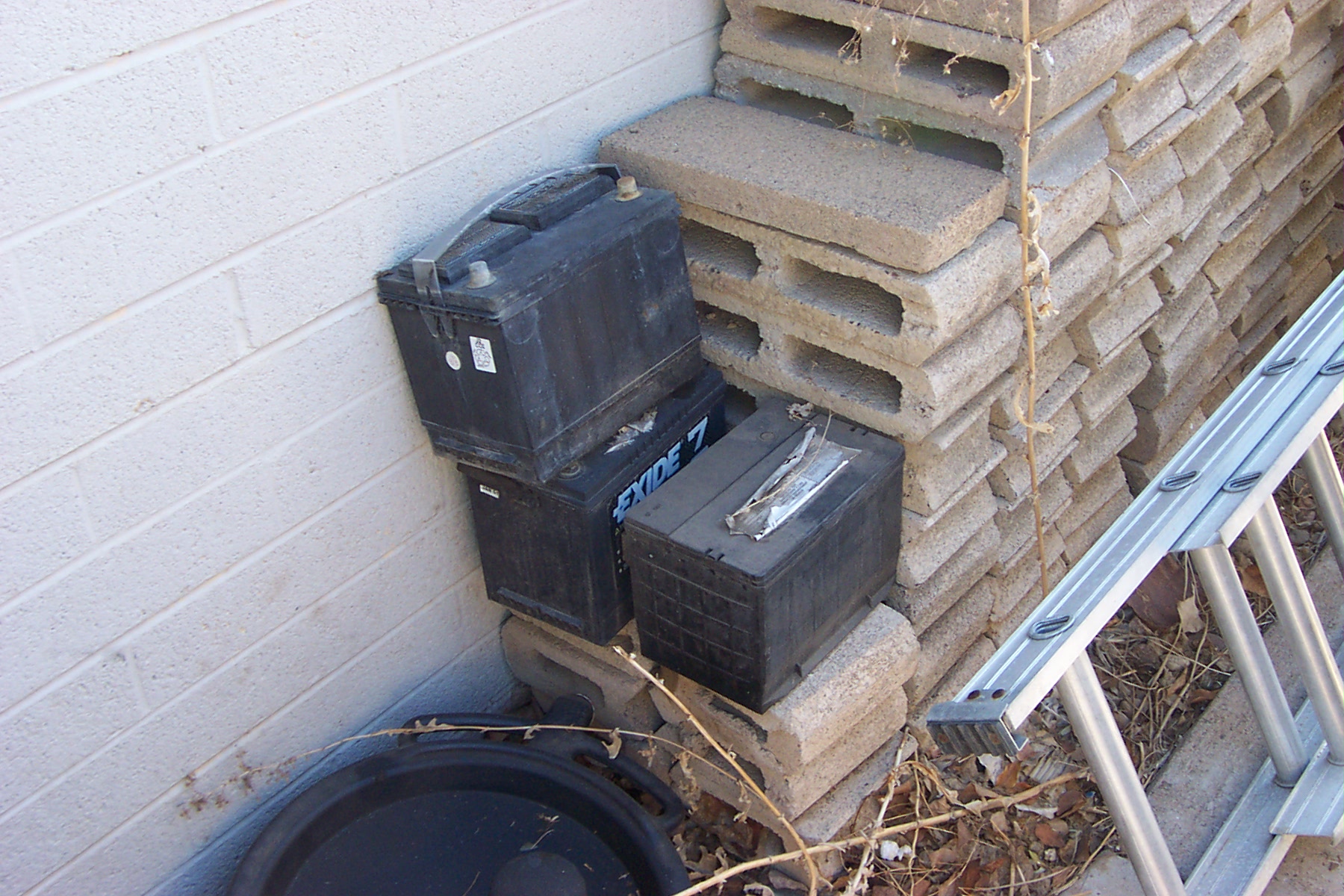
SDXB came by this morning, and out of curiosity we visited the abandoned house. Both gates into the backyard, from the front and from the alley, are unlocked and easy to open. The backyard is chuckablock full of debris, old chemicals, bottles of pool acid, old batteries, and stuff highly hazardous to kids. We have, for example, these fine gasoline cans, located behind an open tool shed replete with bottles of old insecticides.

Mighty nice, eh? How would you like your kids to get into this stuff?

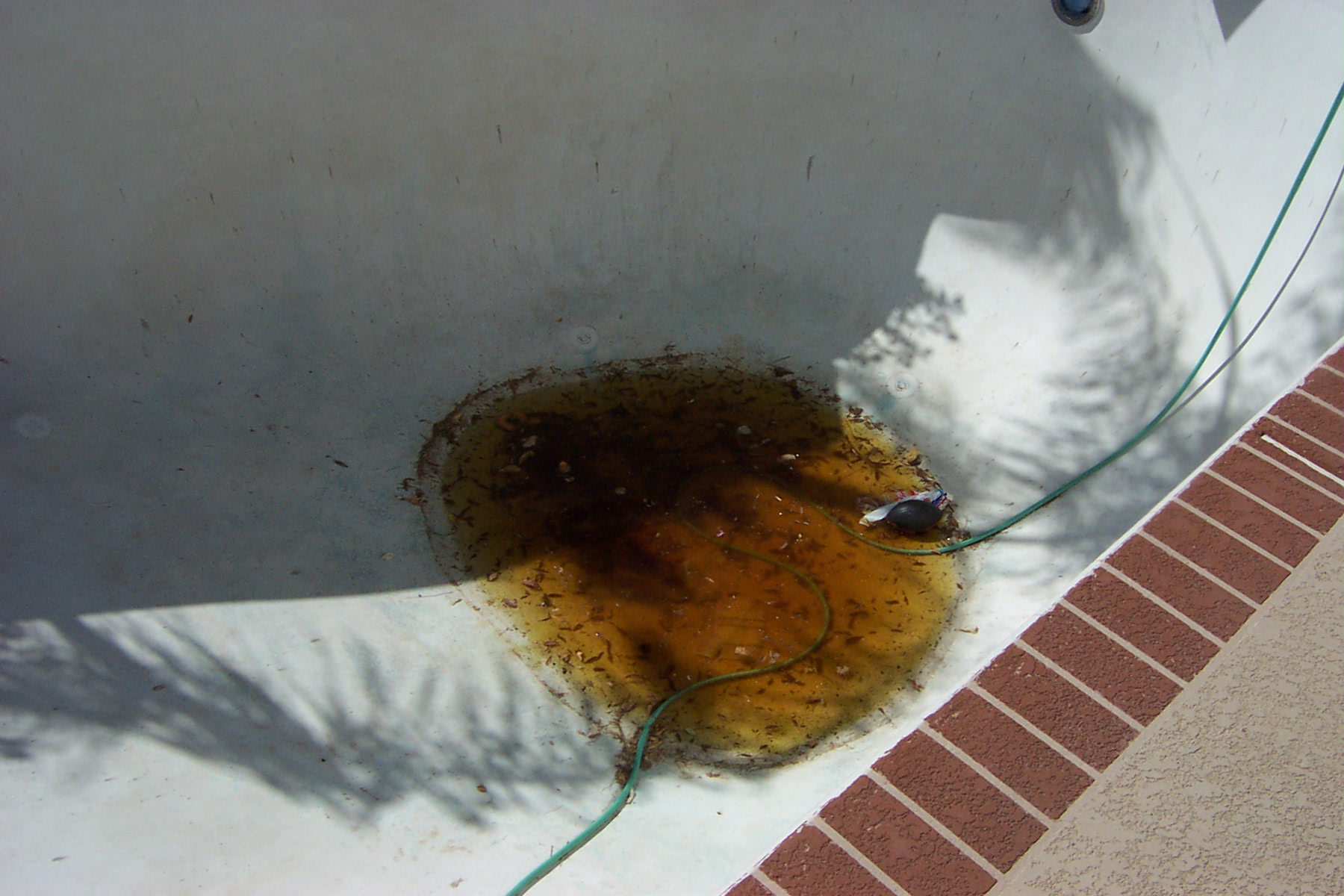
Ah, yes. Then we have the issue of the swimming pool. The pool has been drained; evidently has stood empty for quite some time. Though it’s enclosed within a wrought-iron fence, it’s easy to enter: the fencing ends at a screened porch whose two exterior doors have been ripped off, creating a nice corridor through which the curious may pass without obstruction.

Once you’ve passed through the aluminum structure, where, by the way, you’ll find a heavy-duty battery charger with enough juice to flash off big sparks and give you (or the kiddies) one heck of a zap, you come to this:

And at the bottom of this concrete-lined hole in the ground you find a collection of lost toys marinating in a fine little mosquito-breeding Okeechobee Swamp:

It explains where all the nasty little biters have been coming from for the past several seasons: straight from casa David to su casa.

Maricopa County, where we have been dwelling cheek-by-jowl with Dave, has a growing problem with West Nile virus, a disease carried by mosquitoes. And as we know, mosquitoes breed joyfully in standing water. Every year more and more people come down with this ailment, and every year we read of several deaths related to it. The most vulnerable to serious complications are the elderly.

Dave’s next-door neighbors are in their nineties.

I am in my sixties; many of the locals who have died of this disease were between 60 and 65. The most recent death I’ve read about was of a man in his 80s. My house and yard have been overrun with mosquitoes for months. This, evidently, is where they’ve been coming from. My house is clear across the street—imagine what the mosquito swarms have been like for the old folks next door to Dave!

After you’ve enjoyed the scenic view, don’t miss Dave’s old battery collection on your way out:

Maybe an enterprising kid can get a little extra mileage out of one or more of them, using the handy-dandy battery charger left on the back porch.

And as we say good-bye to Dave’s Used Car Lot, Marina, and Weed Arboretum, we pass by the famous Weed Haystack, still gracing the front driveway as it has from time almost immemorial:

Dave's Weed Haystack

Always visible from the street and from front yards in all directions, this fine landmark remains as a symbol of everything Dave has done for his friends and neighbors in Royal Oaks.

Hm. Maybe I could sell guided tours.

Long before Dave’s lender foreclosed on him, Dave foreclosed on the neighbors. He foreclosed on our property values, on our safety, and on our health. I guess we have to say thank you to the irresponsible and unethical lenders who forked out $320,000 in loans against a property worth about half that and handed it over to a recently divorced man who hasn’t held a regular job in years. If they hadn’t sunk him over his head in debt, Dave and his pet mosquitoes would have stayed in that house forever.