Cary Lockwood, proprietor of Your Auto Network and host of his own radio show on Phoenix’s KXXT, kindly invited Funny to do a segment on his program, Calling All Cars. It aired yesterday, June 19. You can listen to it by clicking here… Or check out Cary’s podcasts over here.
Cary, as you’ll recall, was Funny about Money’s first interviewee for the Entrepreneurs series. That post went over so well it eventually surfaced at the Wall Street Journal site, mostly because Cary’s enterprise and energy are so creative.
It was great fun talking with him. I hope you’ll enjoy the podcast and check out his show.
Hello! If you came here fromCary Lockwood‘s Your Auto Network Calling All Cars, welcome to Funny about Money.
Funny is about Life, the Universe, and All That Money. We talk about subjects having to do with frugality, personal money management, and the real values that matter in life. You might enjoy these posts:
What is it about Americans and American politicians that we think it’s OK to let the rich and the corporations get by with low or no taxes and then cover the deficit on the backs of the most vulnerable people in our society?
Our government, much reviled by the right for its new “progressive” leadership, is going to cut Medicare reimbursements to doctors by 21 percent!
Medicare reimbursements already don’t cover a doctor’s cost of doing business. Many doctors here won’t see patients who are on Medicare, and many more won’t take on new Medicare patients. The Mayo, where my doctor moved after “managed care” by HMOs first started making physicians’ lives miserable, will (for the time being) keep seeing you if were a regular patient before you were switched to Medicare, but it will not accept new Medicare recipients. One branch of the Mayo here in the Valley, a practice on the west side, fired all its Medicare patients and now sees no one who doesn’t have private insurance.
I expect that will be the way the main Mayo Clinic will go, too. Even though the present cut may (or may not) be temporary, the message is clear: expect a permanent version in the near future.
{sigh}The level of medical care here in Arizona leaves a lot to be desired. No doubt there are horror stories in every state in the union, but I’ll bet in many states not every single resident has a story to tell. In Arizona, unless you’re lucky enough and stubborn enough to stay away from doctors and hospitals, you’ve got a war story. The Mayo is one of only three hospitals (the last I looked) that has a top rating in national rankings of clinical care and safety.
So, when you find a decent doctor, you want to hang on to that doctor. The last thing you want is to be bounced from doctor to doctor, or to be forced to see someone whose competence you mistrust or who is too overworked to spend more than five minutes speaking with you.
It’s not “Cadillac care” to have a doctor whose skills are competent and who has fifteen or twenty minutes (or more, preferably) to listen to a patient and arrive at a thoughtful diagnosis.
This vicious slash in Medicare is going to put a lot of elderly people out on the street and yes, bouncing from doctor to doctor. If they can even find a doctor. It will push most of us into low-quality clinics or to hungry young practitioners without the experience and wisdom one needs to see in a doctor. I’m still fairly young—only just eligible for Medicare—and I’m too old to go through that. Imagine the suffering and just plain bad medical care this will inflict on people who are too frail to fight the system!
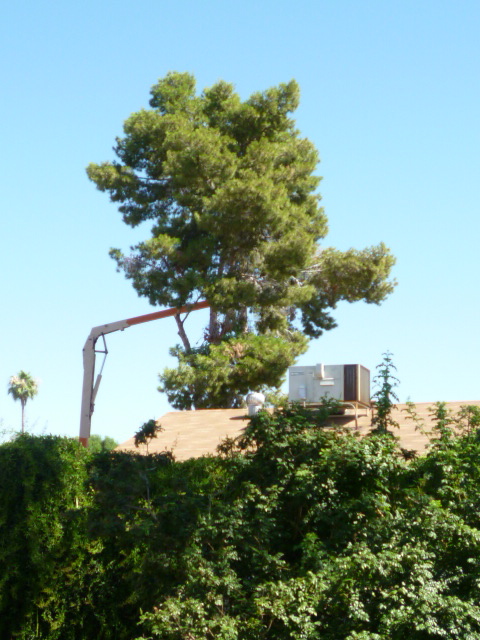
My neighbor Sally did in the vast Aleppo pine that she’s hated with verve for many years.
I understand her issue: they’re radically messy. Aleppo pines, which were very popular here when our houses were built in the 1970s, are fast-growing and more or less xeric. They tolerate heat and drought pretty well. But they get to be huge, and in the powerful winds that roar through here in the summertime, limbs the size of a whole tree will snap off and land on people’s homes.
The other drawback to this vastly shady tree is that it sheds copiously. In the summer when the monsoon winds blow through, a mature tree will cover your yard, your neighbors’ yards, the sidewalks, and the street for half-a-block around in a layer of sharp brown dead pine needles. It’s a huge mess to clean up, and neighbors of the less laid-back variety can get quite irked, especially when the mess falls into their pools.
Sally has wanted to be rid of that tree for a long time, but her companion of many years, Katherine, would have none of it. Katherine finally passed, after an unholy long, slow death from the awful aftereffects of a stroke. Sally cared for her during the decade it took for her to die, a crushing job. Sally used to say that there were many things she wanted to do to improve the house, but she couldn’t, because having workers around would upset Katherine, as would any significant change in their environment. So she’s let things go for a long time.
With Katherine gone and herself finally recovered from the exhaustion brought on by caring for an invalid, Sally has gone to town with fixing up the house. She tiled the back patio and pulled out a decrepit hot tub, replacing it with new patio space. And, alas, she got rid of the tree.
The other day three huge trucks pulled up in front of my house, and the forewoman jumped out and started eyeballing Carlos and Inez’s equally gigantic Aleppo. That tree has been well cared for—if you have them thinned once every few years, they pose little threat to surrounding structures—so I was surprised when it looked like they were going to cut it down. Soon enough, though, Carlos and Inez’s daughter came out and chased them off.
They were on the wrong street. This street and the one just to the north, where Sally lives, have the same name; one’s an avenue and one’s a lane. So they drove around the block and alit where they belonged.
At first I hoped maybe she was only having them cut out the dead branches, because that’s where they started. The tree had quite a lot of dead growth. Although they’re xeric, even an Aleppo can’t tolerate the kind of heat and drought we’ve had over the past several years. They do need to be deep-watered when temperatures get ridiculous, as they did last summer when we had a long string of 118-degree days. Quite a few Aleppos in this area have started to die back, because people just can’t afford to let the hose run on the ground for eight or ten hours and then turn around a week later and do it again.
It probably was so stressed it would have died anyway. But it’s too bad. I loved that tree. From my backyard, it filled about a third of the sky. And although it was too far away to cast shade (or pine needles) on my lot, it did soften the glare.
By mid-afternoon, the was gone. And glare was what was left: enough hot, eye-squinching sky to make your head hurt. No joke: it was actually painful to look out from under the patio cover toward the heat-soaked blank spot in the sky.
It’s not cheap to take down a tree like that. One of my neighbors at the old house had two of them taken out of her front yard, to the tune of a thousand bucks apiece. I don’t think Sally is exactly rolling in money…the reason they were living together, from what I can tell, was not that they were lovers but that they had thrown in together to pool their resources so they could spend their old age in a safe neighborhood, a pre-Baby Boom co-housing arrangement. Catherine had been a choir director; I don’t know what Sally did, but it’s pretty clear neither of them earned a lot of money during their working years.
To spend a thousand bucks to lose a big, beautiful old tree…gosh. And wait’ll she sees next month’s power bill! In this climate, a tree like that can save as much as 30 percent on air conditioning. Even at my house, the additional glare and heat pouring in through the empty space where the tree was will probably push the up the bill some.
Wish she’d at least tried cutting out the dead branches before she chopped it down.
So, after another long and amazingly workful day, I poured a tall bourbon & water to go with the (pretty remarkable!) spaghetti dinner I whipped up for myself. But could only get around half of it. Needing to take the dog for a walk, I stuck the rest of it in the freezer, thinking that after we got home, I could pour some very cold booze into a plastic cup and enjoy it while floating around the pool.
It was off to the park for some serious sniffing of doggy perfumes and then a tour around our corner of Richistan to admire the way our betters live. Back to the house to toss together a mess of beans with onion, celery, herbs, tomato sauce, and the dregs of a ten-days-open bottle of wine.
Finally, at last, it’s time to pull the chilled highball out of the fridge and head for the pool.
Chilled is an understatement. Booze iceberg, that’s what we had. Alas, I didn’t think of photographing it while it wouldn’t budge out of the upside-down glass. Here it’s mostly defrosted. But you get the general idea.
Who knew alcohol would form a boozicle? Next time I’ll drop a popsicle stick in the glass and have a handy little treat for nocturnal pool floating. 😉
Summertime, and the living is…darned scary! With no real steady pay flowing from the community college into the money bin, I get nervous, even when I know very well that the vast emergency fund sitting in the credit union will cover a full year’s worth of expenses. To start with, I don’t want to use the emergency fund for day-to-day expenses, and to end with, I’d really like to stay within the $5,739 budget (Social Security + Fidelity drawdown + leftover money from the low-cost winter months) I figure will cover me during the long, hungry summer. To do that, I see I’m going to have to revise my budget…mightily downward.
There’s not a thing I can do about the $1,240/month nondiscretionary budget: the utility bills aren’t going away, and they can’t go unpaid. And while during the winter costs came in way under that budget because utilities were low, this summer they probably will bust the budget. The highest bills will hit in August, when payment for July water and electric use comes due; I expect those costs to exceed the $125 and $225 I’ve budgeted for them, respectively. Last August I had a $257 power bill, and the utility company is socking us with an 8%+ increase this year.
The only part of the budget with any give at all is for nondiscretionary spending: food, household expenses, clothing, vet bills, dental bills, gasoline, yard and house repairs, and everything else.
After I was laid off, I cut that budget from $1,500 to $800 a month. So far, so good: since Canning Day, I’ve managed to stay on track every month but May, when I had to pay for the glasses and the clothing extravaganza.
Now the plan is to cut discretionary spending from $800 to $500.
Fifty-seven hundred and thirty-nine dollars—the amount I have to see me through the summer—amounts to $1,830 a month when prorated over the whole summer. But $1,240 nondiscretionary costs plus $800 discretionary spending come to a total $2,040 in monthly spending: a $210/month shortfall.
So, I figure if I can cut $300 a month from the discretionary budget, there should be enough to get by until teaching income returns. Even if I don’t reach that goal—which I probably won’t, because it’s pretty extreme and because every time you’re short of money every damn thing in sight breaks and the dog gets sick—if I can come close, I’ll make it through the summer without eating very far into the emergency fund.
Wow! A $300-a-month budget cut! How do I plan to accomplish this?
• Cut back on food. The beans are already soaking in the slow cooker’s crock pot. I have some beef in the freezer, a fair amount of frozen fish and shellfish, a lifetime supply of pasta, a giant container of rice, and a stack of canned salmon in the pantry. I will need to buy some fresh produce and dairy, but otherwise I mostly can get by for a month or two by eating what’s on the shelves and in the freezer.
• Conserve gasoline. I’m trying not to use the car except on the once-weekly day I have to schlep to the campus to for a course preparation meeting. On that day, I’ll do grocery shopping and any other errands that are along the homeward trail.
• Buy nothing other than food unless it absolutely can’t be avoided. No clothes, no booze, no gardening stuff, no meals out, no electronic doodads, no movies, no nothin’.
• Find free ways to entertain myself. This includes hikes, long doggy walks, swimming, TV (broadcast, o’course) and freebie video downloads, and socializing with friends.
{sigh}It’ll be a challenge. That’s about the best I can say for it.