Just climbed out of the pool—the first dip in the water of the season. Soooo heavenly! It’s still a little on the brisk side, this spring having been unusually temperate. Even today, it’s not hot enough outdoors to turn on the air conditioning. Weather has been mixed: a day or two of 90-ish temperatures will warm the water almost to the tolerable range, and then the temps will drop back into the 60s and 70s.
With the afternoon at a balmy 92 degrees, cleaning the pump pot and fiddling with the plants left me warm enough to think…oh, what the hell. Into the drink it was!
What a splendid, refreshing experience is that first dive into the water! I love it. The injured arm was not pleased at pulling through anything thicker than helium, but the rest of the body really enjoyed it.
Speaking of bodies that are happy to be alive, SDXB called this afternoon sounding like his old self. Barely two weeks out of major cardiovascular surgery, the man is walking 30 to 45 minutes around his neighborhood fairly briskly (for him, that means none of us could keep up with him). He’s already lobbying to be allowed back behind the steering wheel and planning this summer’s trips to see his daughter in Texas, New Girlfriend at her Colorado digs, and Sister in Oregon.
It’s such a joy to hear that he’s OK. We were all very alarmed when NG spread the word of the scary condition he was in. His medicos (according to His Nibs) seem to concur that, since he sustained no damage to his heart, he should recover fully and expect to live at least another 15 or 20 years. One of his doctors said he should be able to do “more” than he has… Heh heh heh… But does the guy know what SDXB has been doing? “More” would be on the order of superpowers.
So I told him I expect to go along on his next hike to the bottom of the Grand Canyon. And well, yes…he’s already planning that, too.
Godlmighty. I’d better start getting into shape.
At last, all of my final grades are filed in the college’s system. Except for one change-of-grade form, which I’ll do next week when I get around to it, the semester is now officially over.
And even though I won’t get the three-month totally work-free vacation I coveted, things will slow down enough to allow some substantial loafing. Maybe I’ll take the Cassowary up to Sedona or Payson for some walks in the forest—that should be kind of fun. Dogs like walks in the forest.
First, though, it’s off to finish a book for one of the clients, and then back to work on the young psychologist’s dissertation.
Hm. This is retirement, eh? Interesting experience.
So I started grading 50,000 words of student efforts after breakfast this morning, right around 7:00 a.m. Racing along as fast as I could read, making no comments except for a few overall observations attached to the electronic rubrics I post in the terrifying BlackBoard, I finished sometime after 3:00 p.m. That would be eight (count’em, 8 ) uninterrupted hours of grading.
Then their scores had to be entered in the rubric forms, each of which has 20 items, and each had to be added up for this assignment’s total number of points.
Thence to Blackboard. Oh god.
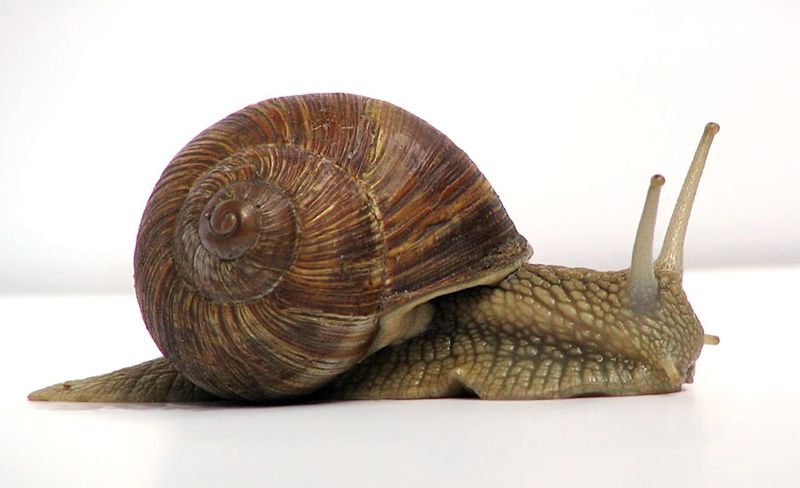
Snailus blackboardiensis
It took an hour and 45 minutes to enter all the points for all the students and then upload all the forms to all the students through BlackBoard’s arcane communication system. It is soooo…slooooowwwwwwwwww.
It took another 45 minutes fill in zeros for all the assignments that students didn’t bother to do, to copy out their total numeric scores, to compare each one to the grade equivalences, and to figure their letter grades.
None of this was helped when FireFox developed a hitch in its pants and decided it would not, no way, NOT enter anything in the ever-aggravating BlackBoard. So I had to go over to Safari, which is OK but slightly more cumbersome to use. No degree of extra cumbersomeness was in any way welcome at that particular moment.
If you are a parent of one of my students, you’ll be pleased to know that all our children are above average. What we have here, in the afternoon section, are 12 As, 4 Bs, 4 Cs, 1 D, and 1 F.
How, you ask, could so many young geniuses cluster in one classroom? Well…obviously, birds of a feather flock together!
In the community colleges, large numbers of students drop. At the first whiff of a D or F (or, among the most ambitious, of a C), the young things shoot out the door like frightened cottontails. After these clear out, the students who have a shot at success remain in the classroom.
Then we have all the devices designed to get them to show up in class. Understand, many of these students are bright enough young men and women who, at the age of 19 or so, haven’t imbibed the best of all possible learning skills. One learning skill is, as you might imagine, showing up in class. To get them there and to address the attention-deficit problem (they can’t stay awake through a full hour of lecture), I fill the days with interminable in-class activities and exercises, each of which racks up 10 points here and 20 points there. Plus, because we’re required to keep roll, they get one point for sitting in a seat and breathing—36 points (for this section) shows the young scholar surfaced in class every day.
Because I’m required to assign only three major papers in English 102, that is all I do assign. So…that’s only 300 points. By the time the semester ends, the total number of points including the three papers and the drafts and the peer reviews and the quizzes and all the exercises and doohickies adds up to something between 650 and 800 points. For this section, the total possible points came to 766. Thus over half the available points consist of busy-work and breathing exercises.
Consequently, even a kid who can’t write his way out of a paper bag can get a B in this class, if he (okay, or she) bothers to turn in the papers. To get a C, you have to cut class with some regularity; to get a D you have to work very hard to prove your incompetence, and to get an F, you have to be brain-dead. Really, when you think about it a D is a greater accomplishment than an A, because it reflects a great deal more effort.
I hate this. In the first place, I hate flunking students, some of whom do try very hard but are just not up to snuff. And in the second place I hate handing out A’s like Hallowe’en candy.
One of the things you should know about these students is that most of them are pretty bright. Some are very smart, indeed. If they’re not great at academics, it’s because they’re distracted by other concerns, because the state of Arizona’s K-12 system leaves much to be desired, or because they haven’t the temperament or patience to sit through interminable mind-numbing courses.
The best student writer I ever had the privilege to meet got a gentleman’s C in my course. OMG, could that guy write! Given half a chance and a degree from Princeton, he could give John McPhee a real run for his money. So…how come he didn’t get an A in freshman comp? He told me he simply could not bear to sit still through an hour or 90 minutes of class. He said that when he had tried, he would feel so restless and so antsy it made him physically uncomfortable.
True to form, he cut a fair number of class meetings, and he flat refused to jump through the busy-work hoops I’d set up to insure that as many students as humanly possible would rack up enough points to pass the course. Last I saw of him, he was on his way to fight fires in Montana. He promised to take a journal along and think about writing articles or essays about his experiences.
This was a man that…well, any young woman in her right mind would fall all over herself to land him as a husband. If we were still living in the cave, he would be bringing home the mammoth steaks for us all. And he also would be keeping the peace in the clan: he was a natural leader. The course, in the first place, wasn’t challenging enough for him, and in the second place, the classroom experience asked him to do something he wasn’t really suited for.
The next time I teach this course, there’ll some changes made!We’re required to assign two 750-word papers and one 2,500-word paper to the 102 classes. Twenty-five hundred words is more than three times the length of each shorter paper, and so next time around, I’m going to make that gigantic hunk of a paper worth 300 points. That will devalue all the in-class activities, so that assiduous presence and faithful hoop-jumping will not, of themselves, carry one through to a passing grade.
In addition to that, they’re starting the semester with annotated bibliographies. They. WILL. Learn. A. Style. Manual. If. It. Kills. Us. All. This activity will occupy great wads of time and also will give them a running head start on their research paper.
Next semester we’re using the “Assignments” function in BlackBoard, which (if I’m informed correctly) speeds the exchange of papers, automatically creates a grade column in the online gradebook, flags you when one of the li’l thangs has submitted a paper, and enters your grade when you’re finished reading the thing. This will speed matters along to some degree.
It also appears that BB will let you enter a letter grade instead of a numeric score and, possibly, create a running averaged letter grade for each classmate. If I can figure out how to make that work, then next fall we’ll be reverting to my old, unreconstructed SchoolMarm Grading System, whereby each hapless student starts with 100 points and gets two to six points dinged off for each crime and misdemeanor that I have told them (a thousand times!) not to do. This, oh fellow pedagogues out there, is an effective way to teach students grammar, style, thematic organization, paragraphing, and sentence structure, theories to the contrary notwithstanding. By the end of the semester, they’re all writing coherent copy with very few grammatical, punctuation, and style errors. It also has the advantage of letting you see their equivalent letter grade at a glance.
If university juniors and seniors who are mostly transfers from the junior colleges can do that, I’ll bet junior-college freshmen and sophomores can do it, too. You have to work with them, but you can get almost all of them to that level, with a few LD and ESL exceptions.
The Eng. 101 students got off too easy, too, though their grades were not quite so skewed to the higher range. Next semester, all four of their papers will be researched, including the two little Mickey Mousers that are not so required by the district. They also will start out with a cold plunge into MLA style, and in fact, I’m going to make them buy the MLA Manual, a great improvement over the half-baked composition textbooks we have in hand. I’m also going to make them learn Strunk & White, which I probably can’t make them buy but which I sure as hell can make them read online. In all its sexist pre-1970s glory.
The little pistols are going to come out of 101 knowing how to write a bibliography and enter an in-text citation, and, not only that, knowing how to write tight. And what a pronoun antecedent is. Maybe even what a subject and a verb are.
They are going to do a lot more work, and I am going to do a lot less work.
Yesterday while I was laboring through a client’s large project, in comes an e-mail from the dean of academic affairs at the college where I’m teaching adjunct for handsful of pennies and no benefits. She reminds me that I’m supposed to make an appointment for web development coaching with one of their online curriculum staff to discuss the feature writing course I’m supposed to teach online in the second eight weeks of fall semester (done that—great experience! This place has the most incredible staff!). In the boilerplate list she’s sent is a mention that I’m supposed to be paid for the course during the development phase, half upfront and half when development is done.
Huh?
Well, being a veteran of GDU, I figure that means they’re not going to pay the usual $2,400 for the three-credit course. This looks a great deal to me like a reason to cut the pay for teaching online: if you don’t have to show up in the classroom, why should you be paid the $50 an hour one gets for entertaining students on the campus?
I need that $2,400. This fall I’ll only be teaching two sections, and the full pay for both will not be enough for me to get by on comfortably. Any less, and I’ll be in deep trouble.
The main reason I dropped back from three to two sections next fall was that teaching six sections this year plus freelancing and blogging will put me over the Social Security earnings limit. The way I understand what two Social Security factotums have said is that to extract the 50% tax on income that exceeds the limit, the government withholds an entire SS check. From that, the amount they figure you owe is extracted. You get the rest back…but not until the following January!
Well, I can’t do without a Social Security check for a month, much less for several months. That’s a pretty stiff penalty for daring to earn a living.
However, what I’ll earn from teaching two sections will barely keep beans on the table. There’ll be no more frolics at J. Jill for the rest of the year…or even at Goodwill. And one unplanned expense, even a minor one, will dig into the emergency fund.
So, it’s going to be a difficult balancing act. I can’t do without full pay for one of the two three-credit courses I’m slated to teach. This news from the dean promised to knock me off the highwire.
Forthwith, I e-mailed to inquire: Soooo… How much less are they going to pay for the course?
They’re not going to pay less at all. What she was saying is that the community college district pays adjunct faculty for their time time to develop a course! And they pay the entire amount of the contract stipend for teaching the course—not instead of but on top of the pay for teaching. In other words, I will earn twice as much for teaching the online course as I would have for teaching an ordinary face-to-face course.
Holy mackerel! When we say “money happens,” we’re not kidding. This summer, instead of having no income except Social Security, I’ll have enough extra to carry me through the months when utility bills hover in the stratosphere. It’s far from what I’ve been earning teaching three sections, but it’s just about the amount extra that I figured I’d need to get through the summer without diving into the emergency fund.
And averaged out over the whole year, it in fact does provide annual pay equivalent to teaching six sections.
You realize how unheard-of this is. GDU would never in a million years pay anyone, especially not adjunct faculty, a stipend for “developing” a course. That’s course prep—it’s part of the job. It’s why I try to get each semester’s prep done before the previous semester ends. When I built the West campus’s first online course in “writing for the professions” (read: “freshman comp for juniors and seniors”), I spent the entire summer working for no pay. Three months of eight-hour days for zero dollah. And zero appreciation, too. Not so much as a f***-you-very-much. That was one of many events and conditions that led to my deep disaffection for My Beloved Former Employer.
I’d figured to spend two weeks slapping the course together and then table it. In fact, since the course doesn’t start until October—it’s an eight-week session—I planned to put off working on it until the fall and use this summer for building FaM and writing a book. This development changes that: if the district is really going to pay me (!) to prepare this course, I suppose I’m going to have to do a decent job of it. That means (gasp) actually work.
Of course, it also means I’m going to crash through the earnings limitation.
Upon reflection, I wonder why I’m worrying about that.Who cares if Social Security withholds a munificent $900? Over $16,000 is sitting in my emergency fund.
On the one hand, I don’t want to diddle away that money on living expenses. The budget is so tight that one good-sized house repair or car repair bill will gouge a hole out of that emergency fund. That stash is there to cover a major emergency that puts me in a position where I can’t work: a car accident, a heart attack, a stroke, cancer…all highly likely at this time and in this place. It is, in effect, a year’s worth of disability insurance.
On the other hand, the emergency fund has grown by almost $2000 since the first of the year, because I’m not spending all my income. I can afford to forego a month’s Social Security “benefit.” (Some of us would call that a “paycheck,” it being a payback of earned wages confiscated over a lifetime in the salt mines.) Most of the money will be returned in January, anyway. Even if it’s not returned, it won’t make much difference.
Money happens. And it’s happening at a good time—when I need it.
Good grief! This winter’s El Niño rains have so over-excited the cat’s claw that it’s decided to take over the swimming pool.
The hanging garden that inhabits the back wall and adds about three feet to its height—quite spectacular at certain times of the year—has sent out a battalion of tendrils, which are marching steadily toward the pool. This one is especially bodacious. It’s grown about an inch a day, and today it made it into the water.
Amazingly, the chlorine doesn’t seem to be harming its growing end. It has a certain weird charm, but it can’t be allowed to keep that up. Besides not being very good for the pool’s chemical balance, cat’s claw is named for its sharp claw-like appendages with which it grips rock and masonry. It can do a fair amount of damage to masonry, and so one would not like to have it residing on the CoolDeck, which is porous, fragile, and prone to staining. As soon as I crawl out from under the avalanche of work that’s landed on my head, I’ll have to get out there with a pair of scissors and cut the plant back.
Meanwhile, it’s mildly entertaining just to let it grow and see what it’ll do.
So the Dow is up over 400 points today, after last week’s bizarre drop. This worked out nicely: the rollover I made from GDU’s 403(b) to the big, professionally managed IRA arrived in Stellar’s precincts just as stocks were headed south. With any luck, the boys will have bought a lot of stuff on the cheap which is now worth a ton of money.
With any luck. But…
But I don’t like it. I don’t like volatility in general, and this particular spasm of volatility is hugely whim-whammish. Volatility tends to presage pullbacks, slowdowns, not-getting-rich periods. Yea, verily, losing pretend-money periods. Check out this interesting podcast, which pretty much reflects my sense. “Like he said.”
Yesh. A couple of weeks ago, I finally figured out how to get around the state’s prohibition on moving my money (my money, goddammit) from the university’s 403(b) plan to my IRA, where a broad spectrum of wisely calculated investments in blue chips vastly outearns the staid mutual funds that have held 16 years of retirement contributions.
As you may recall, the bureaucrat who directs the state’s RASL program (whereby the state ponies up almost $20,000 worth of unused sick leave earnings over a three-year-period) announced that if I rolled my 403(b) savings she would declare me “not retired” and deny payment of this valuable benefit. Since my traditional IRA has been known to earn as much as $8,000 in a month—but more typically makes about $1,800 to $2,000—we’re talking about sacrificing a substantial increase in potential extra earnings, probably enough to wash the 20 grand of RASL. Intensely annoying.
Well. Duh! The trick is to leave enough cash in the 403(b) to cover the drawdown until February 2012, when the last of the three RASL payments will be issued. That, in the large scheme of things, isn’t very much: only about $11,000.
So I emptied TIAA-CREF, which still held a little in an annuity that I mistakenly thought could not be rolled into Vanguard (which the university swapped into Fidelity when it dropped the Vanguard option a year after offering it), and then I rolled all but 11 grand out of Fidelity to the big IRA. This moved about 155 grand into the better-performing instrument. The bulk of that arrived in the cash fund last week.
Naturally, I was not happy to see the market take an all-time record-breaking dive. Now I feel better, at least temporarily. But I remain wary.
Nor was I pleased when the latest factotum I reached at Fidelity remarked that a lot of university retirees use this strategy to rescue funds from underperforming 403(b)s. How many times did I discuss this with how many other corporate bureaucrats there? How many of them told me they’d never heard of the State of Arizona’s you-can’t-take-it-with-you rule? And how much would I have been helped if the first guy I reached there had suggested doing this, rather than my having to figure it out on my own over three months of cogitation?
Oh, well.
We’re in the money, we’re in the money
We’ve got a lot of what it takes to get along.*
What with the dryer overheating the other day and 87 gerjillion errands and chores to do yesterday and today—no way can I stay home and watch that thing for two hours while it thumps through two loads of clothes, a load of sheets, and a load of furry dog bedding—I decided to revert to my favorite clothes dryer: a rope line strung between a couple of hooks on the rafters.
Secretly, I much prefer to line-dry the laundry. Why? Because it’s quiet! A clothes line does not nag you by buzzing raucously at you every ten minutes. Nor does it bump, thump, overheat, or use electricity. I hate buzzers. I love silence.
And, truth to tell, I rather enjoy getting things to happen off the grid. 😉
It’s hot and breezy here today. The underwear that came out of the first washer load was dry by the time the second load was done. Even the bluejeans are now about dry, so there’ll be plenty of room on the makeshift clotheslines to hang the sheets that are running through the wash right this minute.
In the duh! department, today I happened to notice the score upon score of cuphooks Satan and Proserpine drove into the rafters—evidently they were seriously into Christmas decorations. Finally, after—what? five years?—in this house, it dawned on me that those little gems were made to hang clothes on.
I use plastic coathangers, because they don’t tangle up the way wire ones do, nor do they seem to breed in the dark of a closet. At least, not as fast. Because plastic doesn’t rust, there’s no reason you can’t shake the wrinkles out of a shirt, fresh out of the washer, and hang it right up to dry. If you arrange the shoulder seam along the top of the hanger, you avoid getting those hanger bumps. And clothes hangers can dangle from the rafter’s Christmas-light cuphooks, obviating the need for clotheslines or clearing your makeshift line for sheets.
Pants can be folded neatly and either hung on one hanger if the day is hot and dry, or put up on two hangers, each pant leg over a separate hanger. They dry much faster the second way. Alternatively, you can use one of those hangers with two clips, and just clip them up by the waistband. Knit shirts can be laid out flat on the floor to dry, which is better for them than running them through a dryer.
I expected to have to run the new linens that came from J. Jill through the dryer briefly, with the heat off, to shake out the wrinkles. But no! To my amazement, the little orange shirt and the beige Capris (which I did clip up by the waistband) hung dry beautifully. They look better than they did in the store! They don’t even need to be ironed.
Towels, as we know, can line-dry up like cardboard. I personally am not fond of stiff towels. However, either of two strategies will solve that problem.
• After the towels are dry, toss them in the clothes dryer for about five to eight minutes.
or • Get all the detergent out. And we do mean ALL the detergent.
It’s amazing how much detergent remains in clothes after the rinse cycle. One reason for that, as we’ve seen, is that most of us dump way too much detergent into the washer. Using about half the recommended amount will get your clothes just as clean and give you a chance of getting the stuff out. Another reason, I suspect, is that washers are really not very efficient at rinsing out soap.
Determined that my favorite bath towel would come off the line soft and fluffy, this afternoon I ran that load through the rinse cycle a second time. Great flows of suds came out, just as much as the first time around. (My dryer hose empties into a work sink, which Satan installed over the former washer drainpipe. Don’t ask!) Then I ran it through the entire wash cycle with no detergent. More great flows of suds. Only after a third go-through in plain water did the water start to run out of the washer with relatively few suds. At that point I gave up. We’ll see how it turns out when it’s dry!
If you iron your cotton outfits, line-drying clothes that were washed in hard water produces an effect roughly like a light starch job. Pressing line-dried clothes gives you a crisp, sharp finish. I love the effect!
Does line-drying your clothes save much on utility bills? Apparently not. One source suggests the cost of drying a typical load of laundry in an electric dryer is 30 to 40 cents; 15 to 20 cents in a gas dryer. Today I washed four loads, saving at most $1.60. Since I don’t wash the sheets every weekend (just don’t have that many hours in the day!), usually I’d be doing two loads a week: 80 cents worth of drying.
Hmm… Let’s say I washed the sheets and dog bedding every two weeks. That would be 26 weeks at $1.60 and 26 weeks at 80 cents, for a total cost of $62.40 a year.
Well, saving $62.40 over the course of a year is very nice. But in the large scheme of things, pretty negligible.
The real benefits of line-drying your laundry are worth a great deal more than a few pennies here, a few pennies there: the pleasure of watching clean, fresh sheets billow in the breeze, the stress relief that comes from excusing yourself from mechanical harassment and allowing yourself to tend to the dry clothes at your convenience, the wonderful all-of-outdoors scent of clothes and bedding dried in the open air.What luxuries!
Come to think of it, though, this strategy could let me put off having to buy a new dryer for a year or so. That is something, spending-wise. I about fainted dead away when I saw the prices at Lowe’s and Home Depot yesterday. The appliance manufacturers have, as expected, edged the price of dryers up to match the extravagant cost of the new, outrageously overpriced front-loading washers. Only a couple of models were still in the $350 range (add sales tax and we’re talking $400). Most of them ranged from $500 to $1,000.
Give me a break! A dryer is a perforated drum with air blowing through it. It isn’t even worth $350! What can you possibly do to a perforated drum with air blowing through it to drive its price up to five hundred bucks?
Okay, so if we add the cost of a new dryer, now we’re talking savings: $350 + 9.3% tax + $50 delivery + $62.40 savings on the electric bill = $494.95.


 a real run for his money. So…how come he didn’t get an A in freshman comp? He told me he simply could not bear to sit still through an hour or 90 minutes of class. He said that when he had tried, he would feel so restless and so antsy it made him physically uncomfortable.
 , a great improvement over the half-baked composition textbooks we have in hand. I’m also going to make them learn