Coffee heat rising

Cookie Jar$

Sometimes I wonder just how smart it is to self-escrow funds to cover various large bills, such as homeowner’s insurance, property tax, and car insurance, and to sequester funds for emergencies. It could be that getting carried away with this strategy gives you too many cookie jars cluttering the financial countertop and two little in your main pot o’gold to maintain a lifestyle that you really could afford. Maybe.

Yesterday I was pondering how to get through the period when no paychecks are coming in: half of May and all of June. Next time the college pays me will be July 14.

This penurious period occurs, of course, just as utility bills are running up to their max—though we’ve been lucky this year with the weather. Right now, at five in the morning, it’s an incredible 62 degrees out there. It’s almost never that cool at this time of year. Still, I have had to run the air conditioning off and on, and so we can expect a bracing bill to arrive on the desk pretty quick. That, and the Mayo sent a bill for almost $400; apparently Medicare and Medigap covered rather little of the routine physical I got there a couple of months ago. And the Dog Chariot’s oil leak is getting worse—that’ll be another $200 or $300, not counting the $350 for a new timing belt. Plus the hateful palm trees have to be trimmed: yet another $350.

Anyway, while I was studying sources of funds to cover these expenses, it occurred to me that in fact I have more than enough cash in the bank to cover them. The problem is, most of it is dedicated to specific purposes. Videlicet:

Jeez. That feels  like a ton of money to me. Maybe instead of having these funds scattered in four accounts (there’s also the joint account with M’hijito to cover the mortgage payments), maybe all the money should be piled in one account, from which all expenses are paid and the devil take the hindmost.

This would have the dual advantages of making me feel a lot less broke and of massively decomplicating bookkeeping.

On the other hand, it would also have the huge disadvantage of making me feel a lot less broke. Whenever I feel flush, I tend to think I can afford this little luxury and that little unnecessity. I would be buying clothes and furnishings and expensive take-out meals right and left if I thought I had 16 grand at my easy disposal.

The $9,300 in long-term living expenses is the relict of the $20,000 of incidental savings that was loafing in the bank at the time I was laid off the job. Since last fall, I’ve been drawing it down to live on, supplementing Social Security with enough to make ends meet during the times when no teaching income happens and in fact making it possible for me to dedicate all my net teaching pay to building up a large cushion in the joint mortgage-payment fund. At a spending rate of about $1090 a month, that fund will last until almost the end of 2013, at which time I’ll have to start taking drawdowns from retirement savings. That assumes that I’ll replenish it at the end of this summer with about $3,000 from unused teaching income, with about $2,500 from the final RASL payment that comes in next spring, and with 2012 and 2013 income tax refunds comparable to what came in last April. At any rate, sooner or later that fund will go away.

The tax and insurance fund is a manifestation of raw fear: I’m scared to death of not having enough to cover the property tax and homeowner’s insurance on my house. The apparent $2064 in available “daily living expenses” funds is an aspect of the same heebie-jeebies: $1,000 of that is reserved as a “cushion” to cover accidental overdrafts and emergency expenses; so really, only $1,064 is available to cover June expenses. That will jump by a thousand bucks when the Social Security check arrives…but not until mid-June.

The diddle-it-away fund is accrued at the rate of $200 a month and is dedicated to such things as clothing and little decorator items for the house. In fact, that’s where the money to pay for those car repairs will have to come from. As you can see, one truly major hit in the car repair department would do that little savings account in, which is one reason I’m thinking I should draw down some money from a brokerage account and buy a new vehicle. But I suppose that can be delayed until the major hit actually happens. The Sienna is almost worthless now, and so waiting until it doesn’t run anymore won’t make much difference in what I’ll have to pay for a new car.

But…what if I just paid these expenses out of one large fund until that fund disappeared, and then started drawing down enough from the IRAs and brokerage accounts to live on? Wouldn’t the result be the same as covering costs out of funds that are dedicated for living expenses, for small indulgences and small emergencies, and for tax and insurance? Wouldn’t life then be a great deal simpler?

I don’t know. Really, experience shows that, at least casa mia, spending expands to fill all available funds. If I didn’t have a clear vision of how much really had to be exempted from routine spending to cover taxes and insurance, I could easily blow that money at Pier One, Willams-Sonoma, and J. Jill. I would quickly go through the diddle-it-away savings, imagining that there was always at least a couple hundred bucks sitting around to spend on “wants,” not just “needs.”

But still. It is a nuisance. And having only enough in the month-to-month living expenses account to just cover the costs of running the house, buying groceries, and running the car does make me feel like I live on the edge of penury at all times.

That may not be a bad thing. When I can no longer teach, the fact is that the amount I can safely draw down from savings will, when combined with Social Security, just barely cover living expenses. Without the teaching income, drawdowns not only will have to cover my living expenses, they also will have to pay my portion of the mortgage. If I get used to living better now, having to pull back at that time, when medical bills will be even higher than they are now (they easily exceed the 7.5% of gross income required to make them tax deductible, and there’s nothing yet wrong with my health!), is likely to be very uncomfortable.

Better to stay accustomed to living very frugally because I imagine I don’t have enough than to hit a brick wall when the time comes that I really won’t have enough. That’s the reasoning, anyway.

At any rate, things are about to get a lot better, at least for the nonce.

Thanks to the two summer courses I managed to score, enough cash will flow in to cover base living expenses this summer. Last summer, I simply did not have enough to pay the bills without biting deeply into savings. This year, all that has changed.

Moving fall 2010 and spring 2011 teaching income into the joint mortgage-paying account, combined with negotiating a lower payment, created enough of a cushion in that cookie jar to cover an entire year of payments. Should anything happen to one of us, the other one will have plenty of time to figure out how to cope.

So, I can quit over-funding that account. This summer, none of the teaching income will go toward the mortgage, and in the fall, instead of moving everything I earn over there, I’ll start paying only my portion of the monthly mortgage bills, which is less than teaching pays (when it’s paying).

That will leave a little of each paycheck in my checking account. While it’s not a lot, it’s still enough to make things a lot less tight. And one month’s pay will handily cover the mortgage costs for the December-January winter break, when again no teaching money will be coming in.

This assumes no increase in teaching income—a safe assumption, since aduncts never get pay increases. Not bad, considering that thanks to increases in Medicare and Medigap premiums, my regular nondiscretionary bills have gone up by $194 a month.

If I put that extra money from teaching (net after paying the mortgage) into the long-term survival cookie jar, I could extend the life of the survival fund by about six and a half months (assuming I get the same number of courses next year as I’ve had this year). That would delay drawdowns from retirement savings well into 2013.

After that cookie  jar is empty, if I’m still teaching I could use the extra teaching money to minimize the amount I’ll have to draw down from savings.

On the other hand… In 2013, I’ll be almost 70 years old. Not likely I’ll still be able to continue teaching then. I might make it through 2014, but it’s a long shot. The college doesn’t need to hire long-in-the-tooth retirees to staff its comp courses, given the hordes of unemployable English Ph.D.’s littering the landscape. Nor, probably, will I still be competent to ride herd on packs of 19-year-olds.

So, when I consider whether I could just use the extra money from teaching to engineer a slightly more generous lifestyle, I come right back to this hard fact: when the job ends, I’ll have to go back to living like an anchorite.

And if I’ve accustomed myself to a more generous lifestyle, that won’t be easy.

The cookie jars, in that light, serve a purpose: they ensure that I don’t get used to living in a style I can’t afford for long.

Image: American Bisque cookie jar in the shape of a rocket ship, ca. 1960. Artist’s name not given. Creative Commons Attribution-ShareAlike 3.0 License.
 

Delaying the Big Shopping Junket: It Worked!

So it occurred to me, few weeks ago, that if instead of buying most of my groceries at Costco the first day or two of the month, I were to hold off on the Costco junket until the end of the thirty-day credit-card cycle, all the emergency bills that inevitably scotch up my budgeting efforts would have happened. Then, I would know exactly how much was left to stock in food.

This required me to live out of the freezer for a month. The billing cycle ends on the 20th, and by then the fridge, the freezer, and the cupboard were about bare.

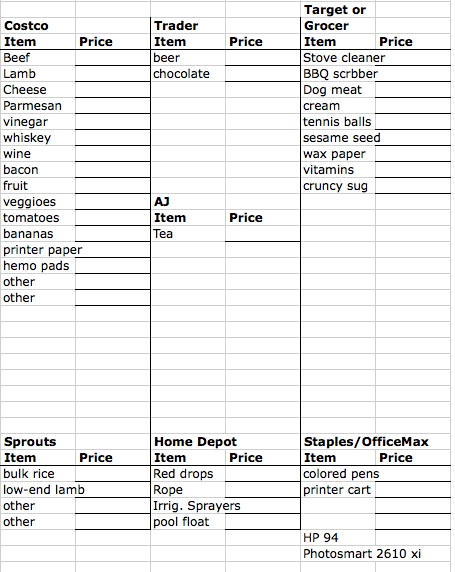
However. By the 19th I knew I had exactly $206 left in the AMEX budget (all discretionary spending goes on the American Express card and is promptly paid off, because AMEX gives me a nice kickback at the end of the year). This should in theory be plenty to cover the big monthly Costco bill, though I’ve been known to spend as much as $240 there. So, to keep a grip on that, I created a grocery list, with space to enter prices:

At the store, I filled in the blanks with the cost of each item and then, when the cart was full, whipped out the calculator and added them up.

The S-corp was to pay for the paper, but I couldn’t lift a box into the cart. I’ll order that from Amazon.com; in any event, it wouldn’t have been counted into the budget. Unlike the upscale Costco outlet I’d visited about a month ago, the ghetto store near my house still had the lifetime supply of colored pens I need for editing, and so I grabbed a package there; that also will be covered by the little S-corporation.

All told, ta da!!!!! The bill only came to $178.42. Subtract the $12.50 for the S-corp’s pens and the hit against the budget was only $166. At Target, I picked up the desperately needed tennis balls for the dog, who has loved her current set to death, adding a mere $3 to the tab. The rest of the errands were opted.

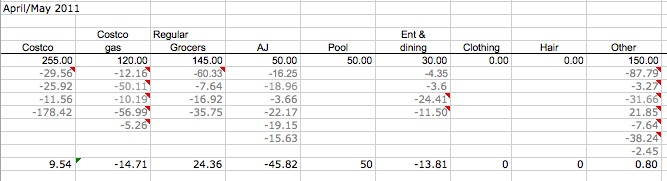
A-n-n-d…YES! This month’s discretionary expenditures came in right on target!

Lookit that! Gasoline was almost $135 this month. And that was after I’d planned every single trip carefully…there were no wasted side trips, no idle drives around the city. I didn’t drive anywhere (except to evening choir practice) without combining errands, and I took care to use hypermiling techniques to save gas. That is just beyond the pale.

I tried to keep the fillups to two, but three times I ran so low on gas I had to stop at expensive gas stations so that I could make it to a Costco. Just now the car is almost full, and since I won’t have to drive to campus again until July 5, I may not have to get another fillup during the May/June budget cycle.

In July, though, it’s going to be tough: classes meet four days a week. That’s twice the number of trips I’ve had to make this spring; presumably gas costs will rise to around $200. And that IS beyond the pale!

Fortunately, I’ve funded most of this year’s mortgage self-escrow, and so I can use all my summer earnings to live on. That’ll be refreshing.

I was stunned at the prices in Target, BTW. No food bargains in that place! Beef that’s on sale for $1.79 a pound at Safeway is going for over five bucks at Target. A container of whipping cream cost what I paid for it at AJ’s, a gourmet retailer in the Whole Foods category. Grabbed the tennis balls and ran, figuring the next day I’d head over to Safeway for the dog’s hamburger.

But back to the point: Delaying the shopping trip for a month’s worth of household and food supplies until after other costs had come in worked to keep me on budget this month. Because I knew exactly how much was left in the budget, I was able to fit buying to the budget. Had the bottom line gone over the $206 left to spend, I would have started putting back items I didn’t really need, starting with the whiskey and wine, and Cassie would have had to make do with her old, busted tennis balls.

She won’t let me throw the damn things away, anyhow. Every time I slip a raggedy old ball into a trash basket, she sniffs it out and then barks at the trash basket until I retrieve it.

The dog’s more frugal than I am!


Sticker Shock at the Grocery Store!

So after class yesterday I made a quick run on the Safeway, figuring to pick up enough to tide me over for a week. Not figuring to damn near faint dead away at the price of groceries!

Paid $60 for about $30 worth of food. Only food: no cleaning goods, no paper goods, no personal products, no wine, no beer, no coffee, no tea, none of that. The checkout guy was actually about to charge me $80, until I produced the Safeway red card, by which Safeway promises to give me a fair price in exchange for the personal disinformation I enter on an application form. We could say, actually, that Safeway charged my deceased German shepherd, whose telephone number (oddly enough) is the same as that of Safeway’s regional headquarters, a mere $60 for $30 worth of food.

Two and a half bucks for a head of romaine. Yea, verily, $2.50 for a head of any kind of leaf lettuce, including the pricey hydroponic stuff! After some cogitation, I realized that a large package of prewashed baby lettuce was cheaper by the ounce than a tough old head of clean-it-and-cut-it-yourself romaine. A dollar sixty-nine for a pound of apples (I got one, count it, (1), Jonagold apple at a bargain price of $1.49.

For Cassie, I found chicken hindquarters at 99 cents/pound, no “EXTREME VALUE!” since they’re full of bones. I’ll use the bones to make stock, of course. But still… Also got a package of “EXTREME VALUE!” boned pork for $1.59 a pound. These were the two cheapest items on the meat counters.

The pork, actually, looks pretty nice: it’s good and lean. Tonight I’ll cook it all up, have some of it for myself, and cut up the rest for Her Dogship. These two packages should last her about ten or twelve days. Assuming I refrain from eating much of it.

What sixty bucks bought was…

1 box of lettuce (large!)
1 bag frozen spinach
1 bag frozen mixed veggies
1 bag frozen bean/veggie/rice mixture
1 pound bacon
1 bunch fresh asparagus, about a pound
1 bunch green onions
1 head cabbage
3 bananas
1 cucumber
1 apple
32 ounces plain yoghurt
4.4 pounds pork
4.9 pounds chicken
1 package baking chocolate

Exclusive of meat for the Queen of the Funny Farm, this stuff is gonna last about a week or ten days, with luck. I have some fish and a couple small pieces of steak in the freezer, a lot of beans on the shelves, and enough cleaning supplies and toilet paper to last six months. If I don’t buy any more bacon this month, I might manage to go as much as two weeks without another grocery-store run. But I seriously doubt it.

My plan for this budget cycle is to wait until about two days before the cycle ends before making the monthly Costco run. Normally, I raid the Costco in the first day or two of the budget cycle. Because I’m about out of food and household supplies by then, I often spend upwards of $250 on this junket. Invariably some unexpected zap occurs shortly after that, making it difficult or impossible to stay on budget for the rest of the month. What I’d like to do this time is scrape along until the end of the month and then head for Costco, knowing at that time how much remains in the budget to spend. Otherwise, don’t go into Costco at all.

The theory, such as it is, proposes that one may be less likely to run out of money at the end of the month if one holds off on large routine shopping trips until the close of the budget cycle.

Now, it remains to be seen how well this theory does when tested by reality. However, I think I can eat out of the freezer and from relatively inexpensive purchases until pretty close to the ending day of this month’s budget cycle, which will be May 20. Today is April 28, a week into the current month, and this is the first grocery purchase I’ve made. Two more supermarket junkets would carry me through to the proposed month-end Costco run.

An end-cycle Costco spree would stock the larder for a good two to three weeks, delaying the need for much grocery shopping until more than halfway through next month. Thus that retiming of the Costco run could set me up to save a little on groceries, because I’d make fewer trips to supermarkets than I’m having to do this month. The problem is, I’ll be very surprised if, in a month when housekeeping supplies run low, it would be possible to stay much under $380 at Costco.

Just now I have $501 left in the cycle that started April 21. Assuming the two projected grocery-store trips also cost around $60 apiece, I spend another $55 or $60 on gasoline, I don’t get my hair done, I don’t go out to eat, and no little surprises pop up, that should leave around $321 for the proposed May Costco raid.

Sounds like a lot, eh? But last month I spent $362.10 at Costco, not counting the gas purchases. The previous month: $394.70. The month before that: $399.43. So, if that expenditure drops to $321, it’ll be a noticeable improvement.

Can it be done? Sure, if I don’t buy any booze. I buy almost all my wine at Costco; by the time you factor in a tax rate of almost 10 percent, that comes to around fifty bucks a month.

$362 – 50 = $312

Well within the desired range.

😀

If you don’t want to spend money in stores, stay out of stores!

Image: Store aisle. No artist given. Creative Commons Attribution-ShareAlike 3.0 License.

Liveblogging the Budget

So, here I am, back at the dentist’s office, cooling my heels until he can squeeze me in to deal with the latest little emergency. God only knows how much this will cost. Nothing, I hope. But we don’t bank on hope, do we?

Saturday night the filling he installed a month ago—less than a month ago—crumbled and fell out. with any luck, he’ll stand behind his work, since I haven’t been chewing ice or cracking walnuts with my molars.

However, in all honesty, I suspect he can’t be blamed. The pain from the torn rib muscle has revived my bruxing habit. Well, the bruxing probably never goes away: I’m sure I still clench my teeth on the rare occasions when I’m sleeping. But in the past week, when every minor task like lifting the dog’s dish off the floor has brought a surge of agony, I catch myself clenching my teeth to force myself to keep moving through the pain. When you unconsciously clench, your bite can exert a pressure of 140 pounds per square inch, which no doubt doesn’t help a filling compound.

What with the cost of gas and the ever-rising grocery bills, I no longer can stay on budget. Over the past few months, I’ve run $200 to $320 over budget every month, at first because of the occasional extravagance like the shoes and the cheap jewelry and now simply because it’s costing every penny budgeted just to live. One modest extraordinary expense puts me in the red—and since the budget includes $100 to $150 for unplanned expenses, that means the base cost of living has risen about $100 to $170 a month.

To make up the difference, I’ve been raiding monthly savings (a.k.a. “diddle-it-away money”). But that is a very finite source. If the overspending continues at that rate, my little mini-emergency fund soon will be gone…and then what?

I can use my tax refund, I suppose, but that also is finite.

Welp, it looks like this is what’s gonna have to happen here:

1. Must replenish that short-term emergency savings account; and
2. Must get spending under control.

Putting money back into savings turns out to be relatively easy: instead of transferring a paycheck over to the joint mortgage payment account, I just moved it into the ravished savings account.

I’ve been putting all my community college pay into a joint account with M’hijito, which holds money to cover current and future mortgage payments. Since my share is $8,604 a year and I net $10,800 when I’m teaching three sections a semester, obviously I’m earning more than enough to cover that bill.

Yes. The operative phrase there is when I’m teaching three sections. There’s no guarantee that I’ll always be able to teach three-and-three. First, the school has no obligation to hire me to teach the maximum number of sections available to adjuncts; and second, even when the chair assigns me to teach three sections, if one class doesn’t make, then I don’t get paid for it. The magazine-writing section is particularly iffy. Each semester we’ve watched with bated breath, expecting it to crash in flames. So far it’s always filled at the last minute, but in any given semester there’s a good chance it won’t make. A course load of three-and-two would net $9,000, a scant $400 more than the amount needed to pay my share of the mortgage.

So…as you can see, raiding my pay for $916, the amount I grabbed last week, is ill-advised.

I will use my summer pay (net $3,840) to live on while the extreme heat here pushes living costs to extreme heights. But that won’t begin to materialize before mid-July. In the interim, the horse starves while the grass grows. During the second half of May, all of June, and the first half of July, I’ll have exactly zero income other than Social Security, and so will have to live on savings. And that means I can’t be running over the budget.

So. “Must get spending under control” surfaces as the most important part of the two strategies, and the most difficult.

These budget overruns have been happening while utility bills are very low. I’ve hardly run the heat all winter, and in the past couple of weeks only turned the AC on a few times to knock the heat in the house down enough to sleep at night. Air-conditioning bills will add about $140 a month to the power bill and about $50 a month to the water bill.

How to make $190 materialize out of a budget that’s stretched to the max? Well…not sure.

Avoid driving, to the extent possible.

All the extra cost here is coming from gasoline. As much as I try to keep it down, what was an $80/month bill just a few weeks ago has jumped to $120+ per month. The weekly trips to the Scottsdale Business Association’s breakfast meetings will end when summer school starts in July, since I’ll have to be in front of a classroom by 7:00 a.m. four days a week. I may have to weasel out of those sooner, though. It’s a wash, though: the school’s about as far away as the restaurant where SBA meets. All errands will need to be folded in with trips to campus, and shopping will have to take place along that route.

What this means in practical terms: I can not drive anyplace for socializing, curiosity, or fun.

Cheapie down the food bill

More beans, less meat. Unfortunately we’re coming to the end of the season when veggies will grow in my meager garden, so lettuce and other veggies will have to come from the grocery store. I’ll need to buy produce of lesser quality from cheaper stores than Safeway.

Quit drinking all beer and wine.

That one’s a no-brainer.

Short the dog on the quality of her food

Watch the ethnic stores, which sometimes run a little cheaper, for inexpensive chicken and pork.

Let the hair grow out.

Gonna have to give up on the short hairstyle, I’m afraid. Long hair doesn’t have to be cut every four to six weeks.

Reinstitute the detailed, tightly categorized budgeting system for discretionary spending.

I’d thought I could get rid of the OCD stuff and just keep a running tab: $800 – x, y, and z as the costs came along. But apparently that’s giving me a false sense of confidence. I need to know, at any given time, how much I’ve spent on items like gas, food, clothing, and the like, and how much is available to spend. This does allow me to shift spending in response to unplanned expenses and increased costs.

I figure I drink three bottles of wine a month and maybe three four- or six-packs of extremely fancy beer. At $10/bottle, the wine is running $30 a month, and the $9 packs of beer would add up to $27 a month, for a total, with tax, of  $62.35.  No haircut represents a saving of $50 a month. We’re at $112 right there. Since gas prices sure aren’t gonna go down and I’m already restricting my driving as much as possible, about the best we can hope for is to keep the monthly gasoline bill stable. That’s leaves $78 a month that will have to come out of groceries, at least until my summer pay starts. But let’s remember that, absent unplanned expenses, I’m already running as much as $170 over budget, before the summer bills hit. So the real amount that needs to be economized, with sumer y-cumin’ in, could be somewhere between $178 and $248. A month.

Wow! That’s a lot of beans, eh?

§ § §

Update

Well, no. That wasn’t the new filling that crumbled and fell out of my mouth two days ago. It was the tooth itself.

That’s right. About a quarter of the tooth just fell apart and broke off, for no good reason other than old age and probable bruxism.

So. Instead of one new crown, to replace the chipped crown I’ve been delaying fixing because it’s not doing any harm, now I need two new crowns. The broken molar is in the upper jaw directly above the crown. If my jaws are going to fit together right, both crowns need to be fixed. Now, not later.

For the crowns alone, not counting a new $350 night guard, the tab will be $2,695! And now I’ll have four gold teeth glinting in the sun every time I smile or open my mouth to speak. Lovely.

That’s my entire tax refund!

I’d planned to use that to help me get by during the two months when no pay will be coming in, and then use whatever remained to further delay the time that I’ll have to take a drawdown from my brokerage and IRA accounts.

It’ll have to be done as soon as they can get me in. With the sharp edges smoothed off, my teeth no longer fit together evenly, so my bite is lopsided. Just imagine the headache, jaw pain, and ear-buzzing that will cause.

Oh well.

It’ll certainly make this year’s medical bills tax-deductible, too, just like 2010’s.

😥

Image: Effect of bruxism on an anterior tooth. No artist given. GNU Free Documentation License.

Are You Cutting Gas Use? CAN You?

Crude oil is selling at over $106 a barrel this morning. Yesterday one of my students reported that gasoline has reached $4.50 a gallon in L.A.; at least one station was charging $4.75.

Paradoxically, the Times observes that people don’t seem to be cutting back on driving this time around. That writer speculates it’s because the nation is better prepared for surging gas prices, thanks to more fuel-efficient vehicles.

Right. We all ran out and bought Priuses the minute the stock market crashed and we lost our jobs.

Au contraire, O Respected Journalistic Establishment… I suggest something quite different is at work: most people have already cut back driving and gasoline use as much as they can, and so there’s not much room for more savings. Most of us haven’t done it by buying new vehicles, because it’s not cost-effective to do so: add the increase in insurance premiums and registration taxes to the breathtaking cost of a car or truck, and it would take years for the junk to pay for itself in gas savings—even at five bucks a gallon.

Americans don’t change their driving habits much in response to fluctuations in gas prices— and IMHO, we don’t because we can’t. We have to get from point A to point B, and because most cities in this country have no useful public transportation, we’re forced to drive. Few of us are fond of driving, and we grow less fond as gas prices bite deeper into our wallets. The truth is, we’re already not driving any more than absolutely necessary.

Don’t know about you, but that’s certainly true in my precincts. When the economy crashed and I lost my job, one of the first things I did was to limit the number of days a week I’ll drive. And on those days, I carefully plan my route to hit the few stores I have to shop in: Costco, a grocery store, and Home Depot are on my way home from the campus, so I do all my shopping on the days when I have to teach.

In a normal semester, I teach two days a week: Monday-Wednesday or Tuesday-Thursday. So the bulk of my driving is done on those two days.

I have to attend choir rehearsal Wednesday nights, but the drive to the church is short and doesn’t consume much gas. Same drive has to be made Sunday morning; my son lives just a few blocks south of the church, so I often visit him after the Sunday songfest.

In fact, I’m now beginning to think I can bicycle down to the church on Sunday mornings, if I can find a place to lock up the bike. Won’t do it at night…but there is a bike path of sorts that would make it pretty easy to get down there in the daylight. That would limit routine driving to two days a week.

And I’ve reverted to the hypermiling techniques we learned way back in 2008, which can squeeze more than 25 mpg out of my 18-mpg clunker. Today is the 13th: only seven more days until the new budget cycle starts. On its second fill-up of the month, my car still has more than half a tank of gas left. That means I’ve got a fair shot at making it all the way through to the 20th without having to refill.

It’s now costing me $100 a month to run my car. That’s as much as I can afford to budget and still have enough to eat. With twice-monthly visits to the filling station, I have to cut off the pump at $50, whether it fills the tank or not. Lately, this has meant that in fact, I’m not buying enough to fill the tank. But that was sometimes true before the current run-up in oil prices.

Driving less? No, I’m not driving less…because I’ve already cut my driving back as far as possible!

What about you? Are you driving less? If not, why not?

Image: Oil well in Lubbock, Texas. Flcelloguy. GNU Free Documentation License.

Hemorrhaging Money!

Lenten Thanks: Day 2

I thank God for my friends, those who live near and far, people I’ve met in teaching, on the choir, and through blogging. They are the gems that brighten my life.

Lordie! Money is pouring out of my bank accounts like it was water! One blinding expense after another: the $615 for the paint and repair job; $81 for the paint itself, another $98 for the light fixtures and junk from Lowes; $100 for a season’s worth of chlorine tablets for the pool; $97 for the little self-indulgence at Ecocentricity; $250 at Costco to restock the dwindling grocery cache; $78 for gasoline…gaaaahhhhh!

Even after paying for the $97 for the purse out of the diddle-it-away savings account, I have $29.43 left to last until the end of the current credit-card budget cycle: that’s another 11 days!

The $615 will also have to come out of that account, I expect. No word from the insurance company about whether any or all of that will be reimbursed. Sean the Adjuster probably hasn’t recovered from the shock yet. Actually, I sent the invoices for the paint and the light fixtures, too, so there’s an outside chance that the $179 for those items will come back. Someday. Not, presumably, in time to pay this month’s AMEX bill, though.

Hm. Half a tank of gas left, and today was the last day of class before spring break. If I can minimize driving, I just might stretch the gas long enough to last until the 21st. Running low on meat for the dog, which means least one grocery store run, but that won’t consume an entire half-tank. A single grocery run, however, could easily consume the $29 remaining in the budget, though; especially if it includes a meat purchase.

There seems to be no end to the extraordinary costs. I haven’t had the nerve to open the bill from the Mayo for the copays and whatever Medigap didn’t cover. More than $29.43, I’ll bet! Then starting the first week of the next billing cycle, a series of visits to a physical therapist begins, in an effort to help the injured shoulder that never healed fully from last year’s fall and dislocation—presumably a copay hit every time I walk through that door. And a trip to the dentist to smooth off the broken, jagged molars and build a new night guard: bare minimum 400 buckolas. And the turn signal on my car is broken, and the hinge on the visor has worked loose so the thing falls down in front of my face every time the sun gets in my eyes, and a chip in the car’s paint needs to be touched up…who knows what that will cost?

Then there’s that security door I’d really like to buy.

Well, by the time $615 is sucked out of savings, there won’t be anything left for a security door. Guess I’d better not count on the insurance replacing that amount. {sigh}

On the bright side, the electric bill arrived: only $58!!!!!

That is one of the lowest power bills in recorded memory. Last year the March bill was $65. It dropped to $57 in April, after the month of March passed without my having to turn the heat or AC on once. Last month I did have the heater on a few times, and once or twice I forgot to turn it off when I went to bed. So evidently the new unit actually is going to save a few bucks on the electric bill.

And the new accountant issued forth my tax returns: $3002 coming back to me and $1,500 back to M’hijito for the mortgage interest deduction. That certainly helps our cause.

Not only that, but her bills were just slightly more than half what the defunct tax lawyer charged to do the personal and corporate returns last year. Even after paying for both sets of returns, I still end up with $2,500 to add to this year’s survival fund. She’s more aggressive than T.L. and is willing to claim many more deductions than I’ve done in the past. So this is a distinct improvement.

That $2,500 plus the $3,700 left from RASL after topping off the Roth IRA plus the projected net $3,000 from next summer’s teaching will delay my having to draw down retirement savings until November of 2012. After that, according to my famously sophisticated calculations, I still may not have to pull out 12 drawdowns a year, as long as I’m working and as long as I can continue to land two sections each summer.

In 2012, after the short-term survival savings run out, I’ll have to make two drawdowns to live on. In 2013, if I get a comparable tax refund and if I manage to teach three and three in the academic year and pick up two sections in the summer, I might only have to take seven drawdowns. So that would be nice. The less I have to take out of retirement savings, the longer I can live on those funds after I’m too feeble to keep teaching.

Our Hero

So. In spite of the impression that more money than Croesus could imagine is flowing out of the coffers, I guess I can’t complain.

Image: Scrooge McDuck. © 1981 Carl Barks. Link to Wikipedia.com.