Coffee heat rising

The BUDGET: First step

So step one for the new Re-Budgeting Scheme is now accomplished.

If I’m gonna start budgeting again, I’m gonna need to have a budget. So it’s off to Excel, the classic tool of the numerically obsessed and the arithmetically challenged.

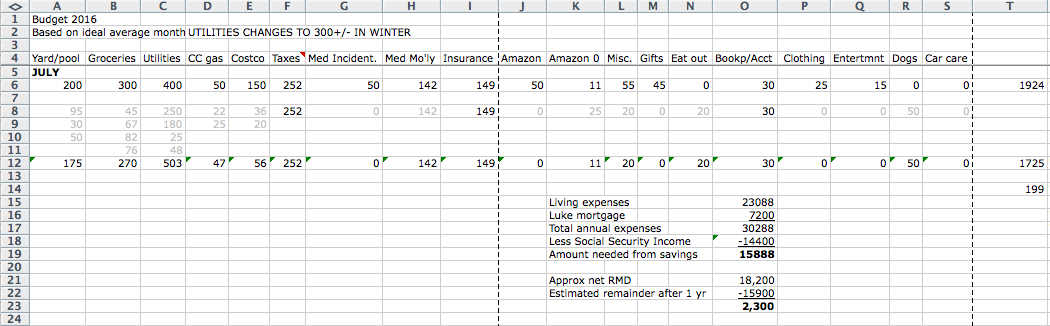
In this draft of the new scheme, monthly figures are arranged horizontally, rather than in a single column per month. This JPEG may not be very scrutable on a web page; try clicking on it for an enlarged version.

Budget 6-2016 2


The header row lists all the spending categories that consume my annual mite. Some of these things are paid annually: taxes, for example, homeowner’s and auto insurance, and some of the healthcare policies. Even though they’re actually paid when they come due, in order to account for them, they’re prorated monthly. Effectively the money is not available for monthly spending, even though it’s in the bank.

The greyed-out figures in this image are theoretical entries, since July has yet to occur. The bottom line (row 12 here) will represent the amount spent in each category in a given month. The figures on the far right total, horizontally, the amount available (row 6) and the actual amount spent (row 12). The bottom figure in column T ($199 here, as an example) represents the difference between row 6 (amount available) and row 12 (amount spent).

We shall see if that latter figure is ever expressed in positive numbers….

Utility bills will drop to around $300 in the four winter months. They probably will exceed $400 this month and next, given the early heat and now early humidity. And unless we get some old-fashioned summer afternoon rains — which we rarely see anymore, thanks to the paving over of paradise — the water bills also will exceed budget between now and September.

All told, estimated living expenses should add up to about $23,100 annually. The mortgage on the downtown house, which my son and I are copurchasing, runs $7200 a year, for a total of about $30,300 a year.

Alas, Social Security covers less than half that.

Net RMD (required minimum drawdown) from the big IRA is a little over $18,000. I’d prefer not to use that to live on, but it looks like there’s no choice. So, unless living expenses can be cut, the net amount left at the end of the year should be around $2,300.

Not great… I’d hoped to be able to reinvest a fair amount of the RMD, but evidently that’s not going to happen unless something upward of 10 grand can be withdrawn from the S-corp. This will require a lot more editorial work to come in.

So… Can savings be found in this budget, without having to sell the house and move to abhorred Sun City?

To start with, I expect the Costco bill will drop significantly. I’ve canceled the unwelcome Citibank Visa cards, which will require me to write a check or use a debit card to shop there. The extra hassle will be enough to discourage casual shopping there. After this, I’ll go into the store only to buy a few very specific items that are hard to find elsewhere.

This afternoon I bought a $50 cash card at Costco to cover next month’s gasoline, so I won’t have to use a debit card at the gas pump. Since I no longer have to traipse to a job in Tempe — and because prices are so low now — gas bills have dropped to around $45 a month. That will increase, of course, as oil prices rise, but for the nonce, fuel for the car is within reason.

I could cancel Amazon Prime. But…it’s not very much, prorated monthly. And as I scribble, I’m sitting in front of an episode of Downton Abbey, which of course I’ve missed, in the absence of a television. Amazon’s offerings are better than Netflix, and it doesn’t seem to require software that won’t run on my computer or (so far) any other techno-weirdnesses. Since I have no other source of entertainment, it seems to0 bad to get rid of it.

But if it has to go…well, it just has to go.

Laundry can be soaked and washed by hand, and then run through the short, cold-water rinse & spin cycle. That will save a few pennies on electric and gas. I already hang most of the clothes to dry, so there’s not much to be saved there.

The dogs can do without their vaccinations. The vet’s office says they’re not due this year. And in fact, after they’ve had a number of shots, there’s really no need to keep getting more. Most of them confer lifelong immunity, or nearly so. At any rate, the problem is moot until this time next year. Thank heaven for small mercies.

Clothing is easy enough to cut — I surely don’t need any more right now. Future purchases can happen at My Sister’s Closet, a second-hand store fed by Scottsdale socialites. It carries some very nice examples of last year’s latest styles.

Eating out will have to go. There’s not much of that, but it has been sneaking in now and again. No more of it!

Groceries: No more frolics at Whole Foods. Food will have to come from Fry’s, Target, Walmart, and Safeway. There are a few things I’ll still need to get at Costco — chicken, for example, is usually cheaper there than anywhere else, and the pork, which is quite good, is rock bottom.

That’s about it. My lifestyle is already pretty frugal. It’s hard to see what more to cut without selling the house and moving somewhere cheaper to maintain.

And that, I hope to avoid…

Next step: to put this scheme into action.

What IS your freezer trying to say to you?

So I was finally reduced to cleaning out the chest freezer that resides in a back room. It was due for a clean-up when the whole stupid boob thing arose. During the year of surgeries that ensued, that chore was relegated to such a back bar that it was forgotten. And since then I haven’t much given a damn about anything unrelated to staying alive from day to day without losing what remains of my mind.

But now that I’m well again — for the moment — it seems good to catch up with the 87 gerjillion jobs, chores, obligations, and minor survival tasks that have gone by the wayside. One of those was shoveling out the freezer.

Quite a job: but it’s now done, and to finish up all we’re doing right now is waiting for the thing to cool back down into the sub-zero range so we can haul the food out of the refrigerator’s freezer, where we jammed it, and put it away neatly.

It was a serendipitous juncture at which to take on this chore: just as I was thinking about whether I want to continue shopping at Costco at all, and if so, to what extent.

How so, serendipitous? Well, because this freezer, itself a Costco product, accrues Costco purchases as a closet breeds coat-hangers in the dark. Videlicet:

FreezerFood
Click on the image for its full detailed glory

Whenever I buy a lifetime supply of meat — say, steaks or pork — I cut up the contents into meal-size portions and freeze them in individual packets, which go into small ziplock bags to be stored inside larger ziplock bags. Very handy.

Problem is, after the late, great gut surgery, a physician’s assistant informed me that I would never again be able to eat grilled meat, fried meat, roast meat, crisply cooked vegetables, raw vegetables, or salads. Whatever I would be able to tolerate would have to be cooked into mush, puréed, or dumped out of a can. Since I had subsisted on grilled meat, grilled veggies, and salad for quite some time, as you can imagine this bit of news rather killed my appetite.

So a great deal of food that was stashed in the freezer has just sat there for the past year or so.

Recently, though, it has come to my attention that

a) salad greens make the belly feel better, not worse;
b) grilled steak, grilled chicken, grilled fish, and grilled veggies have no ill effect;
c) I no longer give a damn one way or the other, anyway; and
d) To avoid going broke at the Costco and the grocery store, I might as well eat whatever is in the house.

Hence, the freezer-cleaning frenzy.

When I shoveled the thing out, this is what I found:

17 pieces of steak
4 hamburger patties
2.5 pounds of ground bison meat
2 gigantic bag of sea scallops
3 open packages of fish, each containing several servings
1 serving of leftover barbecued spareribs
4 packages of doves
1 pair of lamb ribs from a deconstructed rack of lamb
4 pieces of vacuum-packed yellowtail tuna

All told, these came to 43 servings of fancy protein.

This doesn’t count any of the other stuff in there: the collected bags of expensive flours donated by a choir friend; the sacks of frozen veggies; the this, that, and the other.

Since I don’t eat meat or fish every day, 43 servings amounts to at least two months’ worth of dinners. Probably more.

So…what is my freezer trying to say to me?

Quit buying food at Costco!
Moron! Do not ever spend $396 on groceries in a single month, ever again!

Seems like a fairly clear message…

LOL! Clearly, I won’t have to buy any meat except the usual cheapo dog schlock for the foreseeable future (at my age, “foreseeable” does not stretch not very far into the fog).

Have you cleaned out your freezer lately? Does it have a message for you?

Re-budgeting

All right. It’s true: I’ve neglected the budgeting over the past some months. Years. WhatEVER. More interesting obsessions came along, and I got bored with entering every little purchase in a spreadsheet by way of keeping the spending within bounds.

The thing is, when you do that, it does help to keep your spending under control. When you realize you have enough money to get by in the manner to which you have frugally accustomed yourself and so you decide to quit with the minutiae, that’s when your spending gets out of control.

The whole stupid Costco credit card thing and the adjunct concern about having to use my debit card or checkbook to shop there led me to think about how much money I actually spend at Costco.

How much DO I spend there, anyway?  And what if I stopped buying things at Costco altogether, it being the Mother of All Impulse Buy Vendors: would monthly expenditures drop?

Conveniently, the last time Intuit “updated” its online Quickbooks, they put it way beyond my meager techno-skills. I can’t use it at all, and only keep my accounts there for WonderAccountant’s convenience. So — here’s the convenient part — I happen to have an Excel workbook in which I’ve been keeping a shadow account of debits and credits, so that W.A. can tell who checks have been written to and what for. And come the end of May, six months of said debits and credits were neatly recorded.

Ergo…it was very easy to create a spreadsheet showing all expenditures of every variety and then sort them by vendor and by category. Then I averaged expenditures for each category over six months. What I discovered was pretty amazing.

The largest monthly expense, not surprisingly, is my share of the mortgage on the house my son and I co-own in lovely central Phoenix. That’s not something I can do much about, although it is a bone of contention with the financial advisor, who hates it.

Spending May 2016

Over the past six months, maintenance of the house and pool have racked up the highest average monthly expenditure (i.e., total up all the costs and divide by 6). Four reasons for that:

The $758 bill for the pool pump repair
A couple hundred bucks on new shelving for the work shed, much needed
And, after two years of neglect, I decided to buy plants and several beautiful (expensive!) Talevera pots to revive the outdoor sitting areas and gardens where I like to hang out.
There was a plumber’s bill in there, too…

Groceries, at an exorbitant $396, run a distant second to the house & pool. That’s even more astonishing than it seems, because in fact I buy most of my food, household products, and personal products at Costco.

There are two categories for tax-deductible medical bills: Med 1 (a) comprises one-time purchases — a prescription, for example, or a dentist’s visit. Med 1 Annual covers Medigap (Medicare supplemental insurance), Medicare Part D (prescription drugs), and long-term care insurance. If you combined those two categories into one, medical costs would come in third, after groceries, at a breathtaking $335 a month.

Costco, then, at “only” $283 a month, is actually fourth in average monthly expenditures. Without the pool pump repair, it probably would move up a notch, to third — any way you look at it, homeownership ain’t cheap.

Total expenditures for the house insurance, the car insurance, and an umbrella policy average $149 a month, probably not too exorbitant in context with the other spending categories. Once you get past those top eight expenses (mortgage through insurance), other spending is fairly modest.

Can you believe that $3 average over six months of car maintenance? 😀 I forgot to take the Dog Chariot in for its oil change between December and May! It’s still running. There is no freaking way I’m buying a new car!!!!! When it falls apart, I’m trading the pile of metal in on a mule.

So…when you add it all up, if you include the mortgage on the communal house, I’m spending $3140 a month, significantly more than I can afford. Without the mortgage (which is paid from funds I don’t use to live on), my actual living expenses come to $2540 a month.

Since my net Social Security income is $1200 a month, that would seem to pose something of a problem…

In fact, in the absence of the adjunct teaching income, I use a portion of the annual RMD (required minimum withdrawal) from a large IRA to live on, but when you include the $600 for the downtown house, you come up with a total spending figure just about equivalent to the entire RMD.

Since I would like to be able to reinvest as much as I can of that RMD, pretty clearly I’m going to have to cut expenses.

The $396 on  groceries is the first candidate in that department. It’s pretty inexplicable. Presumably it’s happening because I shop a lot at Whole Foods and at AJ’s, a local fancy grocery store. I’m not buying much of the dog food in grocery stores — Costco has good prices on chicken and especially on pork. I did start buying a fair amount of my meat at WF and AJ’s, because their offerings are far superior to anyone else’s, at least most of the time.

As a matter of fact, though, yesterday I picked up a spectacular grass-fed Black Angus steak from the quick-sale shelf at the Safeway: 30% off an already discounted price. If I would bestir myself to stumble into Safeway at the right time of day on the right day of the week, I could stock the freezer a lot more cheaply than I do.

I can’t do a lot about the utilities. Even though that entry ranks among the highest, the figure you see there is pretty modest — it reflects the winter months, when I don’t run either AC or heat and when not much water is needed to keep the xeric landscaping alive. Over the summer, it’ll be almost twice that much.

Gasoline is pretty cheap, between the low prices and the fact that I don’t have to drive across the city to go to work anymore. I hardly drive at all, really. As long as prices stay down, a $50 cash card from Costco will cover that monthly budget item. That obviates the problem of how I’m going to buy cheap Costco gas without their hateworthy new CitiGroup Visa card.

Then we have the issue of the medical costs. For older Americans, this is often — maybe we should say “typically” — one of the largest expenses. The older you get, the more things go wrong with you. And Medicare, though it’s a big improvement over Obamacare, isn’t cheap. Especially when you’re permanently unemployed.

A big bugaboo for all of us old folks is long-term care. A nursing home can pauperize you in a matter of months — one hopes to die before one gets sucked into one of those places. While I was working at ASU, I bought long-term care insurance, but after I was laid off the job I lost the right (heh!) to increase the monthly payments so as to have the insurance payout keep up with inflation. That hasn’t discouraged the company from raising its premiums by bracing amounts each year, so that now I’m paying $132 a month for insurance that will not cover me if I’m unfortunate enough to get locked up in one of those places.

That’s $1582 a year. Supposing that I manage to stay out of nursing care until I’m 80 — another 10 years — if I were to put that much into a savings account, I’d have $15,820 to fork over to custodians.

Right now, today, the typical cost of a nursing home in this area ranges from $2232 to $6572 a month. God only knows what it’ll be in 10 years. Lower-end homes are real holes, so figure that if you’re lucky, you’ll spend maybe $4000 to $5000 a month — today. That’s $48,000 to $60,000 a year!

Obviously, 10 years of savings accrued by canceling the long-term care policy and banking the premiums wouldn’t cut it.

Most people don’t spend years in nursing homes. They either recover and go home after a few months or, with any luck, die within a few months.

But… Oh, yes.

But: some people end up in those places for month after month and year after year. The proprietors clean their pockets of every single asset they have, forcing them to sell their homes, cars, stocks, artwork — everything — to keep themselves in an institution. Then, once the person is utterly destitute, the state takes over…but that means moving you into one of the low-end holes the inside of which we would all hope never to see.

If you’re one of the “most people,” then obviously long-term care insurance is not the best of all possible bets. But if you’re among the unlucky — and the woods are full of them — then LTC coverage will stave off the evil day that you’re completely broke, keeping you in a halfway decent place until you die. Unless, of course, you’re very unlucky, indeed.

It’s a gamble: one in which you bet against an insurance company that you’re going to lose in the game of life.

So, reflecting on this state of affairs, I gazed upon the spreadsheet and wondered where I can cut costs.

Number 1: I’d like to try staying out of Costco for the next six months, just to see what happens. I might go in there to pick up the lifetime supplies of toilet paper and paper towels — it’s such a luxury not to have to buy those things every time you turn around.

It’s a little hard for me to believe the grocery bills would go up if I quit buying things in Costco, especially if I would stick to Fry’s and Safeway for food and household items.

Amazon seems to be soaking up rather more money than one would desire. I could cancel the Amazon Prime — and why are they gouging me for something called “digital services” when I’ve never even been able to figure out how to download a movie from their cloud??? It would take a lot more Amazon orders than I make to save the equivalent of the monthly cost for Amazon Prime.

Shopping a little more consciously would cut the grocery bills. In the past I’ve cut routine bills simply by being aware that I need to be careful and by keeping close track of how much I’m spending, and where. I should be able to cut at least $100 from the cost of grocery-store junkets.

I could go back to the habit of never eating in restaurants. Period. Doesn’t seem like a $35 saving really justifies never, ever eating out. But…maybe. Every little bit helps.

If I drop the long-term care insurance, that will save $132 a month. But I think the commensurate risk would be unacceptable.

The only way to cut the really big expenses — house and pool, taxes, insurance — would be to move out of this house. A place without a pool would still require maintenance, but not as much. If I moved to Sun City, property taxes would drop by two-thirds and insurance would drop by half. However, utilities would rise, probably by 50% to 100%: Sun City is served by the rapacious Arizona Public Service, whose power bills are extortionate. Those houses out there were built before power cost much, and so they’re poorly insulated and expensive to air-condition.

And of course, we do have to deal with the fact that I don’t WANT to live in Sun City.

So WTF? Do I have a plan?

Yeah.

  1. Avoid Costco. Buy a cash card once a month for gasoline, and while there pick up a month’s worth of dog meat and restock paper goods as needed.
  2. Also stay out of Whole Foods. Purchase “organic” frou-frou at Trader Joe’s and Sprouts. Buy more food and household items at Fry’s, Target, and the new neighborhood Walmart down the street.
  3. Don’t buy any more clothes of any description.
  4. Next time an expensive repair happens to that pool pump, replace the thing.
  5. Quit eating in restaurants.
  6. Keep track of expenditures on a weekly basis. Budget specific amounts for categories and try to stay on budget.
  7. Dump the Amazon Digital, whatever that is.

If I could spend $240 a month less, that would bring my living expenses down to $2300: equivalent of my net Social Security plus net former adjunct earnings ($1100, prorated over 12 months). If The Copyeditor’s Desk keeps chugging along the way it has of late, it can disburse $1100 a month, allowing me to live on SS plus earned income.

Then the only part of the RMD that would be consumed would be the $600 a month for the downtown house, and that would leave a substantial amount of the RMD, after taxes, to reinvest in savings instruments.

Baaad Human! Bad BUDGET-BUSTING Human!

So after two glorious months of running way under budget, I seem to have decided to make up for lost time: along comes an $1818 bill from AMEX.

[Gasp!]

Studying the charges, we wonder what have we done to deserve this? Hmmmm…

$147 at the Costco: nothing out of the ordinary. That’s the start-of-the-month stock-up, and it’s under $200. You  hafta allow that getting out of Costco for less than two hundred bucks is a rare accomplishment.

Forty-six bucks to El Bravo, our favorite Mexican restaurant. Whaa? I must have paid both tabs.

Williams-Sonoma: $276.90!!!! Holy shee-ut. Well, that’s the set of stainless — two sets, actually, since W-S only sells sets in four place settings. Okay. I’ve been well pleased with those, though. In fact, I think I like them better than the silver I so highly resented having to put away, thanks to the politically correct “improvements” in dishwasher design. And I’ll tell ya: $277 would pay for about three forks in that Christofle, now locked in a closet somewhere.

Leslie’s Pool Supply: $70. I have no idea. Presumably supplies of some sort.

Leslie’s Pool Supply: $120. Ugh. I bought a lifetime supply of chlorine shock treatment, having grown weary of driving over there every time I turn around. The algae was coming back, thanks to my neglect. Pool looks darned good right now! 😉

All Saints Episcopal Church: $100. Donation in the form of a silent auction purchase.

All Saints Episcopal Church: $90. Lordie! I thought we were required to buy a ticket for the dinner at the auction, at which we were to sing. Turns out many choir members did not. Apparently it wasn’t a requirement at all.

[Redacted]: $75. Christmas gift for son.

Shane: $78. Not the most expensive hair stylist in town, but getting there.

Otro Cafe: $24. Lunch with a friend. Probably should’ve invited her to lunch here…

So how do these add up? Let’s assume the $70 Leslie’s bill was something I couldn’t avoid — delete that. All the rest: highly optional.

Et voila: $732 in unnecessary or extraordinary expenses. That’s just about the amount the budget has been busted.

Is there a frugalist message here? Probably more than one…

 1. Reconsider the wisdom of buying lifetime supplies of stuff, even if it’s something you will use over time and will have to buy over time. Ten or twenty bucks once a month will not bust the budget the way a $120 bill can.

 2. Stay out of the goddamn restaurants!!!!!!!!!

 3. Make do with what you have.

 4. Do not run with a high-powered social set whose members can afford to drop $190 without blinking. When you are pore folks, know your place and stay in it. 😉

w00t! Out with Costco, Out with the Big Amex Bill!

Last month’s Costco AMEX bill showed up a couple day’s ago. It was only $660!!!! That’s about 2/3 of its budgeted figure, and probably the smallest AMEX bill I’ve ever had!

The reason for this miracle, I think, is that ever since the last of the endless round of surgeries, I’ve lost interest in eating well and lost interest in shopping at Costco.

Any trip to Costco is likely to turn into an impulse-buy carnival. Whenever I’m in that store, I’m tempted (and usually cave to temptation) to buy 18 times more stuff than I need at the time and three or four things that are just too, TOO neat to pass by. Because, after all, we know they’ll be gone by the next time we get to Costco, eh?

Instead, I’ve been buying at grocery stores, Walgreen’s, and Target, and only buying as much as I need at any given time. Whereas you’d think that buying in bulk would represent a cost savings, apparently it doesn’t. At least not in the short run. It might, if you only bought things that are cost-effective in bulk — the paper towels and the toilet-paper, for example. But Costco’s meat (for another example) is no cheaper than grocery-store meat, and most of the other stuff, while appealing, isn’t something that you just have to have.

A second, probably lesser reason is that I’ve taken to occasionally paying for things with a debit card, so as to get a few dollars back in walking-around cash. Without the teaching job, I have no reason to traipse to the credit union to deposit checks twice a month (after the District gave away all our private information to hackers, forcing me to close my checking account and get a new one with a new account number and to put a freeze on all my credit-bureau accounts, I canceled the direct-deposit). So a debit payment works to provide a little cash now and again.

But I don’t think I’ve paid more than about $150 or $200 that way. Even if I put $200 on the debit card, that’s still only about $860: way under the $1100 budget.

Telling, eh?

Of erotica and budgets…

walrus&carpenterglass20Lacking cabbages and kings to talk about, let us consider erotic lit’rachure and budgeting.

To start with the budget: the AMEX bill came in: only about $2100. Before you faint dead away: that includes the $1200+ for a new crown, plus $158 for routine dental cleaning.  If that’s correct (and I have no reason to suspect it’s not), then it means this month I spent all of $742 on regular expenses.

That’s some kind of a miracle: normally I budget $1100 to $1200 for day-to-day costs. So in reality I’m only about $1,000 over budget despite some $1350 dumped into the dentist’s coffers. Hallelujah.

I guess.

As a practical matter, this came about because my nose has been glued so tightly to the grindstone that I haven’t been frolicking around in places like Costco. Really, all of the standard supplies like paper towels, TP, and  olive oil are stashed in gay abundance. Trips to grocery stores suffice for almost everything else.

And also as a practical matter, it means I’m not eating very well. I hate grocery stores and will put off going until I’m totally out of everything, and that means most of the time there’s no fresh produce in the house: no veggies, no fruit, no salad stuff. Instead of eating, I’ve been browsing out of the cupboards: rice, pasta, cheese, canned this and frozen that, whatEVER. Not very good for one.

Oh well.

This afternoon I decided to do a little research on the market for erotica lite, preparatory to writing a short essay to post on LinkedIn (thereinatupon, i hope, to garner some attention from my august colleagues in publishing).

Interestingly, there appears to be surprisingly little data, except for information kept hidden by Amazon. We can see that the market is quite large and has been booming for at least a decade. However, who exactly comprises said market remains to be seen.

A few studies dating back to the 1990s suggest the market is largely female. One set of statistics, whose provenance is decidedly shady, suggests the median age of female erotica readers is around 30. Well, I’ll believe it when I see it, and I ain’t seein’ it there.

However, some more serious studies published in scholarly journals suggest that very probably a large portion of the readership consists of women. We can deduce a few characteristics  of Racy Writing that particularly appeal to women. They tend to like “romance,” which is broadly defined in these studies as stories that involve a relationship. They like stories in which one or both characters are hurt and comforted. And they apparently like the racy passages to be part of the plot. A study of “slash”–a contemporary phenomenon that involves imagining popular characters such as Harry Potter or Captain Kirk in gay or lesbian tales — showed that 60% of readers/hobbyist writers (again mostly female) liked PWP: “porn without plot.”

Moving along… It was off to find some sources for the proposed annotated edition of  The Romance of Lust.

Uh-oh...
Uh-oh…

Ohhh those Victorians! I found a bunch of stuff, some of which I just ordered up from Amazon. Most hilariously, those folks were into sexy furniture, notably technological marvels that comprised all sorts of mechanical wonders. Some of it is truly bizarre.

I’ll leave that to your imagination (which may not be up for the task, if you’re even remotely normal). But rest assured, when my version of the Romance is ready, you’ll be able to read all about it in the headnotes!