Coffee heat rising

The Economy: How Pessimistic Are We?

A gold brick

The other day we heard reports of widespread pessimism about the economy. Unemployment is dropping, the stock market is up, and the economy appears to be growing. But nevertheless, the number of Americans who think we’re headed for Hell on a skateboard has risen some 13 percent. The price of gold is shooting toward the stratosphere, supposedly because investors worldwide are losing faith in the dollar’s strength and because the person on the street is having to sell her earrings to pay her mortgage. Meanwhile, the value of residential real estate continues to plummet, the drop so extreme that it suspiciously resembles the dread double-dip. Experts say this will continue until foreclosures abate, another way of saying “no end in sight.”

Be scared. Be very scared.

It’s not surprising that gold bugs would scuttle for shelter under the gilded refrigerator after the startling threat by Standard & Poor to downgrade the United States’ credit rating if the politicos don’t quit squabbling and do something to repair the wounded economy. If I could afford some gold, I’d probably be squeezing under there with them. On the other hand, I’m not in any rush to pawn my earrings.

Let’s get real.

Yesterday, U.S. stocks ended at a three-year high, a sharp recovery from the drop after the S&P’s dire warning. The Wall Street Journal, hardly a bastion of liberal Pollyannism, attributes this to consumer optimism (!) and strong earnings by “industrial heavyweights.”

Elsewhere, observers suggest that the S&P’s pronouncement could work to improve the country’s debt outlook. A credit downgrade, if it happened, would erode investor confidence in U.S. companies worldwide. The one-in-three chance of such a disaster just might push the demagogues on both sides of the political aisle to set aside ideology long enough to work together to resolve the debt problem. In that case, treasury prices could rise as spending is cut and taxes are increased. And if a downgrade actually did happen, causing the stock market to drop around 6 or 8 percent, investors would flock to safer havens: government bonds.

It’s worth remembering, though, that the state of the national debt may not be as dire as we’re led to believe. Writing at TPM, Brian Beutler notes that by historical standards, the debt is nowhere near as desperate as people think, and he provides graphs to prove it. He points out that the problem we need to address is unemployment:

The Bureau of Labor Statistics provides the data that suggests Congress’s priorities are out of whack. Currently, civilian unemployment is higher than at any point in the post-war period save for a brief spike in the early 1980s when the Federal Reserve briefly used contractionary monetary policy to fight inflation. Already its clear that unemployment is falling much more slowly than it did in 1981. And when people get back to work, revenues will climb, and deficits will shrink on their own.

As for real estate, despite the Bloomberg report that puts Phoenix at the bottom of a declining market, an April market update based on Arizona MLS listings reveals that the total number of active listings has dropped and sales are up 26 percent over the past 30 days. The supply of homes on the market here is now down to what has traditionally been regarded as normal, a 3.8-month supply. Meanwhile, in another hard-hit real estate market, Florida’s Miami-Dade County, March sales are are up 84 percent over March 2010 sales, largely driven by foreign investors.

So, it would appear that pessimism is in the mind of the beholder.

Me, I’m feeling a great deal less grim than I felt at this time last year. As ill-paid as it is, work seems more abundant: despite skyrocketing food and fuel costs, eight sections of comp and writing courses at the community college will support me in the style to which I intend to remain accustomed, and if the budding new client relationship works out, The Copyeditor’s Desk will be set for quite awhile. The happy stock market has revived my retirement savings nicely. Despite the dismal loss on the downtown house and the drop in value in my own residence, my net worth is $21,660 more than it was in August of 2007.

How about you? Are you feeling better, worse, or pretty much the same about the economy, compared to your sentiments a year ago?

Can You Support Your Parents?

Lenten thanks, Day 18

Thank God for Franklin D. Roosevelt.

So the Republicans are getting ready to go after Social Security and Medicare. Some of their followers don’t even seem to be rational. Here’s one who remarks that if Social Security goes, “no one is going to be hurt by it.”

Yeah. No one but the kids.

You know, if it were not for Social Security, I could not stay in my home. I wouldn’t be able to pay the property taxes, and pretty soon the County would come and evict me. I would be living on the streets right now, today. The house my son is living in would have been foreclosed by now, since without my salary and Social Security, we wouldn’t have a hope of making payments on the upside-down mortgage. And that is with a retirement nest egg that’s 3.3 times larger than the average 50- to 60-year-old’s.

In a culture where families fly apart as the kids reach adulthood, where the elderly are objects of disdain and discrimination, where you’ll have a tough time getting a job if you’re laid off at 45 and no chance at all if you’re in your 60s, where a man is considered not a man if his mother lives with him, where the elderly are expected to live on their own until they’re sent off to a nursing home, who exactly is going to take care of the old folks when they can no longer work?

Without Social Security and Medicare, my choices would be to depend on my son to house me, feed me, and cover my healthcare costs or to live on the street until I die, which would happen in short order. Ours is not a culture like Revanche’s, where young people expect to care for their parents no matter how much strain it puts on their own lives. Most Americans would expect their parents and troublesome siblings to fend for themselves.

This is true for a large portion of the elderly in our country. Get rid of the so-called “entitlement” programs—into which we have paid all our lives—and you’ll end up consigning huge numbers of older Americans to dire poverty. Responsibility for supporting them will fall to their adult children, who don’t have the resources to care for elderly, unemployable parents.

Will you be willing to take your parents in after they can no longer work? Oh, you say you don’t want Mom and Dad living in your spare bedroom? You don’t want them in your face all day, every day, telling you how to raise your kids and how to live your life. Well, then, are you prepared to pay their rent? Can you cover the property taxes on their paid-off home?

And when you discover the cat food in the pantry (they don’t have a cat, interestingly enough), will you shell out a couple hundred a month to buy groceries for them? When you find out that they’re too frail to get groceries for themselves, will you run to the grocery store once or twice a week and stock up on microwavable food for them?

Are you willing to pay for your parents’ healthcare? Sure you are. But can you? Can you afford to buy insurance for an elderly person who already has chronic health problems? And if they can’t get insurance at all (which they can’t, because of the chronic health issues), are you in a position to pay for their health care out of pocket? You do know, no doubt, how much treatment for a heart condition costs?

How many of you who are younger and midlife adults see yourselves, seriously, as willing and able to care for your parents when they get too old work? Take a look at these excellent young people who are coming up behind you…see any of them planning to support Mom and Dad in old age?

In the post linked above, Revanche asks readers if they have a plan for taking care of their parents when the old folks can no longer care for themselves. Do you? If you’re under about 35 or 40, you’d better get one.

And by the way, who’s going to support you when you get too old or sick to work, and the stock market crashes right at the moment when you can no longer hold down a job?

Image: Elephant near Ndutu Lodge. nickandmel2006. Creative Commons Attribution-Share Alike 2.0 Generic license.

More to Come…

Lenten thank, Day 12

Thank God I don’t still live in Saudi Arabia!

My mother, who was a low-key enthusiast of Edgar Cayce and things mystical, used to say the Apocalypse would come from the Middle East. She used to say a lot of things…but why not? It’s gotta come from someplace, after all.

We’re now engaged in another war in another Middle Eastern country, where we’ve been at war longer than we were during World War II. The entire region is erupting, a development which does not bode well.

IMHO, if we don’t free the West from dependence on Arab oil, we will see something very like an apocalypse, because that is what the collapse of a dependable, cheap energy supply will do to our economy. Someone else once said it better: a hard rain’s a-gonna fall.

But…maybe it’s just the mean virus speaking. It was a long, dark night.

Now I have to run to teach two classes—mercifully, they’ll be parked in front of computers today. By the end of the day, though, a lovely guest post should be ready to mount. Meanwhile, don’t take any wooden nickels!

Betcha didn't think there was such a thing, didja?

Image: ColWilliam. Public Domain.

The Incredible Lightness of Our Economy…

Yesterday SDXB and I hiked to the top of a hill in a desert preserve park on the west side of town. In the fine, clear weather, we could see for miles in all directions. And what could we see? Sprawl.

Mile on mile on mile on mile of sprawl, most of it cheaply built housing for people who don’t earn much (the median household income in Arizona is around $47,000—not great, when you figure for most households it represents two people’s salaries). In square miles, the city is now larger than Los Angeles, the avatar of ticky-tacky sprawl.

When you consider the sheer size of the population, it’s amazing that the cost of living here is relatively low. The reason for this much-ballyhooed low cost of living is low wages. The business interests that control the local government see to it that right-to-work laws keep wages down. Phoenix residents earn well below national medians. In Arizona, for example, educators and librarians earn about $5.20 an hour less than than the median national pay in their trades. In the legal profession, hourly pay is $14.23 below the national median for comparable work. Healthcare practitioners earn almost $6 an hour less than their counterparts elsewhere.

What are all these people doing here? Today,  hard to tell: the most recent figures I can find are dated 2005. Since then, many residents have moved away, as jobs have disappeared and homes have been foreclosed.

But in 2004, about 8 percent of greater Phoenix metropolitan area workers were employed in construction. If you added in those who working in “financial activities” (presumably in banking and lending) and in trade, transportation and utilities, you come up with 617,000 people: that’s 36 percent of the workforce.

So when Arizona was booming, over a third of its population was employed in building and selling houses. In other words, what we were doing was employing people to build and sell houses for people who build and sell houses.

The data above don’t count people who work for construction suppliers like Home Depot, lumber yards, masonry suppliers, plumbing and electrical supply houses, and the like; it may not include groups such as Realtors, interior designers, landscape designers, and nurserymen; and it certainly doesn’t include government workers engaged in building inspection, environmental oversight (such as it is), transportation planning, and tax collection. In 2004 the largest employer was the state of Arizona, followed, as a distant second, by Walmart.

Well, obviously, if the proper study of Man is Man, then the proper economy of humankind is serving other humans. Still, something seems oddly circular here, not to say unduly limited. Our problem in this state is that we don’t produce much. Through much of the twentieth century, our economy was based on the Three C’s: Cotton, Cattle, and Copper. All of those activities made something. Generally the manufacture wasn’t what you’d call environmentally friendly, and in fact these enterprises tended to siphon resources out of the state to the moneybins of vastly wealthy men back East. However, something at least came of it all.

Tourism, which arose in the early part of the century, eventually expanded to join the Three C’s as a major economic engine. And then: Construction.

To accommodate this fourth C, our august leaders made a conscious decision to rid the state of agriculture, reroute water to the cities and suburbs, and pave over the fields with asphalt, concrete, and stucco. What all the sprawl-dwellers were going to eat was never explained…we needn’t worry our pretty little heads about that, eh?

Yesh. Allegedly responsible civic and state leaders quite deliberately decided to create the vast, overweening, and ultimately disastrous fungus upon the land that anyone can see from the top of any of the low hills in the valley. It was as though they studied Los Angeles, identified everything L.A. did wrong, and then chose to do that.

An economy that produces nothing and does nothing other than feed on itself is doomed. IMHO, we’re seeing that doom, here as in Las Vegas and in other Southwestern cities. Our leaders took us down this path; our citizens didn’t seem to have the sense to realize where we were going, and now…here we are.

Wonderful magazine! And a new FaM feature

A week or so ago I stumbled upon a copy of a publication I hadn’t seen in quite a while: The Economist. It was hidden among the bundles of tabloids and advertising packages disguised as women’s magazines that abide around Safeway’s cash registers. Picked it up…thought, electrified, hallelujah! The Brits have still got content!

Content? OMG does this thing have content: real, full-length ARTICLES, not blurbs, not squibs. And they’re about issues that matter, not movie stars’ sex lives! The thing contains actual reporting (you remember? facts, and lots of them?). And when commenters editorialize, they have something to say…they don’t blather.

It’s a miracle.

So I grabbed it off the counter, brought it home, have been reading it all week long. Today on the way home from the Mayo* I stopped at a Whole Paycheck to pick up a couple of items that aren’t available in regular supermarkets around here, and what should I find but a new issue of the thing.

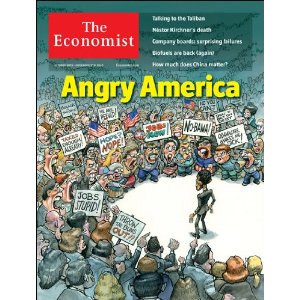
It’s always enlightening to listen to what observers in other countries have to say about American doings. This week’s cover story is “Angry America,” the centerpiece of reportage on the elections nationwide. Says an unnamed editorialist:

It takes an effort these days to recall the thrill that surged through the world [the world!] when Barack Obama was elected America’s president. It was not only that he was the first black person to assume the globe’s greatest office. He seemed to be preternaturally thoughtful, dignified and decent; a man who could heal America’s wounds at home and restore its reputation abroad. Though too many were swept away on a collective longing to see hope triumph over experience, none of it seemed wholly unreasonable at the time. Yes, many thought, he can.

Didn’t we, though? What a perfect nutshell summary of the desperate optimism so many of us clung to.

Two years later, the magnitude of the let-down is palpable everywhere; and at home the president is caught in a vice. To many on the left, he is a cowardly compromiser, whose half-baked plans to get America back to work have done little to help those who voted for him, and whose health-care and financial reforms were gutted at the behest of special interests. To many on the right, he seems a doctrinaire spendthrift who has squandered trillions of dollars on wasteful bureaucracy, mortgaging the future while failing to grapple with the present. To centrists who backed him, including this newspaper, he has been a disappointment, his skills as a president falling far short of his genius as a campaigner.

Geez. Two years in four sentences.

And ain’t it the truth? Certainly for those of us whose wing-nuts rotate counterclockwise, it’s disappointing that Obama did not stand firm, that he caved to the right and its industrial controllers. Where healthcare was concerned, his position should have been all or nothing: if he couldn’t get a single-payer system, he should have let the whole mess revert to the status quo and let the voters enjoy another round of higher premiums for less coverage. About Afghanistan, he should have pointed out, firmly and repeatedly, that he is not the man who got us into Afghanistan, nor is he the man who lied to take us into Iraq when we should have been going after bin Laden in Afghanistan and Pakistan; he should have reminded everyone why we invaded Afghanistan and why we cannot just turn around and walk away.

Interestingly, the Brits have a more sanguine view of President Obama and his accomplishments to date. “In our view,” says The Economist, “the rage directed at Mr Obama is overdone.”

Overdone rage seems to be very  much in vogue here, these days. About the main source of that rage, the editor continues,

The slow pace of job re-creation is primarily the result of consumers and companies trying to rebuild their finances. Balance-sheet recessions always take time to recover from. Mr Obama is guilty of promising that the pain would be over sooner than was ever likely. But he did not cause the bust, and he deserves more credit than he is getting for steering America clear of a much worse fate, especially considering the constraints of a political system designed to make big changes difficult. He was right to go for a big, bold and immediate stimulus plan. He has been right to resist, with minor exceptions, calls for a wave of protectionism. He is guilty of having no credible medium-term plan to reduce the deficit. But then nor do the Republicans; and it was they, after all, who oversaw the tax cuts, the entry into two wars and the financial collapse that are the source of most of America’s gigantic deficit.

. . . He was correct to try to deal with a dreadful system that leaves tens of millions of Americans without access to health cover, though he should probably have postponed doing so until the economy had recovered.

Just so. Here, too, Obama or his press secretary and machine should have been blowing his own horn. These facts should have been talked up in the press—at endless length and at the same volume at which the anti’s have been shouting.

The United States, whose concerns grow  more parochial as the country loses economic and political clout, is only one part of the world on which The Economist reports. Each issue is sectioned into departments that cover specific regions: The Americas, Asia, Middle East and Africa, Europe, Britain. Every part of the publication is full of well crafted, solidly reported articles. Since so much of its content informs the sort of thing I write for Funny about Money, I think I’m going to have Funny’s parent entity, The Copyeditor’s Desk, subscribe to it. Just now they have a bargain rate going on.

It’s not cheap, but for something that brings this much high-quality reporting straight to your door once a week, it’s worth it.

And this brings me to…

Something New for Funny about Money

Got a new idea: I thought it would be cool to have a separate page that would list some of the products I’ve found and would like to recommend because they work well, meet a special need, or just are nifty, and also some of the goodies friends have told me about.

After some rumination, during which I tried to figure out if I could make an RSS feed to a single regularly updated page within FaM and learned that nooooo, that won’t work, I decided to recycle the dormant Half-Off Diet site. I don’t happen to feel like buying yet another domain name, so for our purposes I’m just going to keep the URL, but rename the site Funny and Friends’ Picks.

The RSS feed at the upper right will show recent posts. Eventually I’ll try to put together an index in a separate page on Funny about Money, so you can see an alphabetical list of products and services featured there. For the nonce, though, a category list will appear at Picks, so if you’d like to see if we ever talked about, say, immersion blenders, you could click on “small appliances” or “household gadgets” (whenever they come up…I’ll have to enter a post on a given category to make it appear in the list). When there’s an affiliate link for Amazon, I’ll include it, but not all entries lend themselves to that. For example, soon I’ll post a link to La Maya’s paintings, which of course are not available through the Gigantic Virtual Warehouse Store.

I think this could be a fun and maybe even a useful service to FaM readers. I hope you’ll take time occasionally to browse through it, and if you have any ideas for stuff to include, e-mail me at funnyaboutmoney {{at}} gmail.com, or just leave a comment here.

🙂

* So what happened at the Mayo? I showed up there bright and early this morning, half-starved, to be poked and jabbed. A few hours later, the doctor’s nurse called to report on the test results: all completely normal! No H. pylori, no anemia (i.e., no ulcer and probably no cancer), no liver malfunction, no pancreatitis. Someday I may even be able to have a glass of wine again. Meanwhile, as the body winds down from the mighty dose of stress delivered by three months without enough income to cover base expenses followed by Social Security ripping off a whole month’s worth of pay and leaving me a thousand dollars short for a fourth month, I’m beginning to feel a lot better. It looks like I’m gunna live to write another blog post, after all.

Back to the Future…

{sigh} We have seen the future, and it is…the Dark Ages. The Party of No has wrested control of the U.S. House of Representatives from the Party of the Half-Baked. No hope for relief from the metastasizing mean-mindedness and outright viciousness that have invaded our body politic is to be found, anywhere.

Here in Arizona, voters have approved a measure that exempts citizens and businesses from the national healthcare plan. The comically moronic Governor Jan Brewer (she of “uhhhhhh………..tee hee!……..uhhhhhmmmmmm”) was re-elected, of course, and the craven pol who presided as superintendent of public instruction while Arizona’s school system sank to the bottom of the national rankings is now, God help us, the state attorney general.

Now I’ll have to say, I wasn’t pleased with Obama’s healthcare plan. Without a national option, it’s just another iteration of what we already had: it threw us into the lion’s den with a pride of hungry insurance companies. We needed an option to make something like Medicare available to everyone who wished to accept it. Medicare is expensive — even after the state’s insurers raised their rates, my employee plan cost an eighth of what I’m paying to be fully covered under Medicare. However, for what I’m paying, coverage is better. If I fall ill and have to go doctors frequently, my overall costs will be much lower. Requiring everyone to sign up for full coverage with private insurers while blocking insurers from shafting people who really need care simply guaranteed that everybody’s costs would go up, coverage would be no better than what we have, and the well-heeled insurance industry would be joined by every other well-heeled industry in mounting a no-holds-barred campaign against the Obama administration.

Accepting compromise on healthcare was stupid. If the Democrats couldn’t swing a national healthcare option, then they should have dropped their plan until they could.

As for the Afghanistan mess: We were in Afghanistan long before Obama came along. Matter of fact, it seems to me we entered the war in the Middle East because a certain pack of lies emanated from a previous administration. Afghanistan was where the perp was hiding, but instead of going after him, we took it upon ourselves to depose a dictator who was formerly our ally, not because he was much of a threat but because, said our then-President, “This is the guy who tried to kill my dad.”

So…now we have in office some folks who think it’s acceptable to stomp on the head of a woman who disagrees with their doctrine.

Time to get out our brown shirts and iron them. And if you still believe you’re in the middle class, say good-bye to all that.