
Coffee heat rising

The Next Inn on the Journey of Life

Lately I’ve been considering where I’m going to live during the next and presumably last stage of my life.

It’s a question that was brought into sharper focus when I fell and hurt myself badly enough that I couldn’t easily take care of my home or myself. The shoulder still isn’t healed—but even though it hurts quite a lot, on and off, all the physical work around this house still has to be done. Caring for the pool (a daily project), dealing with the quarter-acre yard, cleaning and maintaining a four-bedroom house…they all represent physical labor. And there’s no one here to help. Just now I ache all over my body, as though the shoulder pain spread to every other joint all the way down to the toes. But none of the work can be put off just because my back hurts.

Clearly, I’m not going to be able to care for this house for many more years.

Then there’s the issue of the costs. Property taxes can go nowhere but up, and at $2,000 a year they’re already at the border of what I can afford. Because I have retirement savings, I don’t qualify for the cap on taxes for the elderly. Though the new AC repairman clearly was trying to scam me, the truth is that sooner or later the HVAC unit will have to be replaced, to the tune of around $6,000. The interior needs a paint touch-up, and the exterior will have to be repainted sometime in the next five years. There’s a crack in the living-room tiles, an ominous development. In another five years, too, the pool will need to be replastered, a $7,000 job. Power and water bills keep going up and up. With no credible source of steady income, where on earth is the money going to come from to cover those expenses?

And who is going to take care of me when I can no longer care for myself?

This train of thought brings me to consider the best thing my father ever did for me: he moved himself into a life-care community. After my mother died, he sold his house in Sun City, divested himself of his possessions, and used the money to buy into a Baptist-run independent living community. This gave him (and later, his new bride) a garden apartment, access to hobby and meeting rooms, two meals a day in a central dining hall, and guaranteed access to nursing care.

For me as his daughter, it meant I didn’t have to take care of him as he grew older and more infirm. When he had a heart attack and triple-bypass surgery, the institution moved him temporarily to a studio apartment next to the nursing home, where an RN checked on him several times a day to be sure he was taking his meds and to coax him to eat. And after he had a stroke, the only medical practitioners who would care for him and respect the wishes he had expressed in his living will were the staff of nursing home at the life-care community.

It wasn’t ideal. The food was awful. The doctor on the staff was ripping off Medicare right and left. The institutional setting was depressing—at least, I found it so. But it probably was better than the situation he would have faced had he tried to stay in the Sun City house for the rest of his life.

After he died, I discovered the staff had provided him with a lot more care than he had contracted to receive. A woman in the central office spent a fair amount of her time running interference with the various bureaucracies the elderly have to negotiate. As he grew more confused in age, he would occasionally mess up his checkbook; someone at the office went through and corrected his figures, balancing and reconciling them against the bank’s statements. So. He got his money’s worth, and then some.

I wouldn’t care to live where he was. They’ve torn down the garden apartments and replaced them with massive people warrens. I’m not a rabbit or a caged chicken, and I don’t want to live like one. However. There are alternatives.

My great-aunt was the one who turned my father on to life-care communities. She came to Arizona one year to visit several such outfits, which at the time were a new development. She sold her house in Sausalito and ended up in a place in Oakland—I believe it probably was this one. From what I understand, it was very pleasant. One could find worse places than the Bay Area to live out one’s last years.

Interestingly, it’s run by my correligionists, the Episcopals. Not that it matters. The Baptists were no less craven than any for-profit outfit about extracting funds from the inmates where my father lived, and I can’t imagine that would differ according to the proprietors.

The Episcopals run a number of life-care communities in northern California. There’s this rather amazing place in San Francisco, for example. I’m sure I can’t afford to live in the City, of course…hell, I can barely afford to live in Phoenix! Here’s a place in the Santa Cruz area that might be less extravagant than living in the heart of San Francisco. One in Pacific Grove, which is near Monterey, probably costs no less than the place in the City. More promising, possibly, is this one near Santa Rosa.

My aunt had enough money to be comfortably set. She and my uncle married in middle age, neither of them with children. They both worked for the California Academy of Sciences their entire adult lives, and my uncle invented the precursor to the Kodak Carousel slide projector. As you can imagine, even a small royalty would have allowed them to buy the architect-designed house in the Sausalito hills where they lived all the time I knew them.
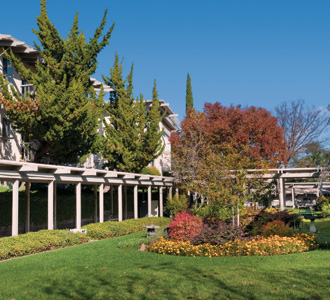
Chances are I can’t afford any of these places. My father and his wife were paying, for a three-room apartment and two meals a day, more than my ex- and I paid for a 3,000-square-foot ranch house with a pool on a third of an acre of prime North Central real estate. On the other hand, most of their food, their utilities, transportation (to a degree), property taxes, insurance, semiweekly housecleaning, landscape care, and nursing home insurance were included in the cost.

I already have nursing home insurance, though I suppose I could stop paying on that. But even with the long-term care insurance, my total monthly bills come to less than my father paid for his dim little apartment. And that was for a not-very-appealing place in Phoenix, Arizona. The cost of living in northern California is so much higher that you likely have to be a dot-com millionaire to live in one of those places.

Nothing ventured, nothing gained, though: I’m sending away for their propaganda packages.

w00t! Money about to happen?

So I’m sitting here sweltering through a crush of semester-end stoont papers when what should pop up in the e-mail but a last-minute call for someone to teach a humanities course in the first summer session at a different campus in the community college district. Money happens!

Now at last, folks, we’re talkin’ fair wage: a summer session runs for five weeks; $2,400 for a month and a week of light work comes under the heading of decent pay. Although my Ph.D. is in English, not humanities per se,  my undergraduate degree is in French language and literature. “Humanities” is a vague term that used to mean “classics” but now means almost nothing—as a practical matter, colleges will hire people with almost any degree in the liberal arts to teach these courses. And the beauty of these courses is that assessment can be largely through online tests. Naturally, one would like to assign a term paper or a couple of shorter papers, but they don’t have to be parsed for mechanics and style. People grade these things on the basis of whether the student seems to have responded to the assignment and done the reading, rather than for the student’s writing skill.

Piece. of. cake.

It would push me over the Social Security earnings limit by about $350. More than that, really, because I’ll have to take a “salary” from the S-corporation in December. However, it could be worth it: barring another market crash, I’ll have enough cash to weather a month without the Social Security payment (loss of which is one of the consequences of exceeding the limit).

More to the point, we don’t know that either of the two courses I’m lined up to teach in the fall will make. They’re set up as two eight-week sessions, back-to-back, English 101 first followed by an online feature-writing course. The idea that a freshman comp student will sign up to sit through two three-hour sessions a week verges on the preposterous. And the feature-writing course will follow a nearly identical in-class section a colleague will teach in the first half of the semester.

BTW, if anyone would like to sign up for that feature-writing class (it’s billed as “magazine writing”), it’s 100 percent online, and there’s no out-of-state tuition for online courses. If you’re a blogger, I probably would accept posts that fit the parameters of the assignments—these will include things like a profile, a straight report, an opinion piece, a brite, a how-to, a round-up, or whatever else I can dream up. The course is English 235, Magazine Article Writing; it runs from 10/18 to 12/10/2010. You can register online; from what I can tell, you need to start by getting admitted through this site. There’s a phone number: 602-787-7020.

Anyway, back on topic: I’m less than thrilled at the prospect of working away half the first real summer break I’ve had in 20 years. On the other hand, trying to get through the summer on less than half the income I’ve had this semester is a little scary, plus next fall’s semester will pay $2,400 less than I’ve been earning. The hot season pushes utility and water bills through the roof, and that coincides perfectly with the switch to Medicare, which also will elevate my health coverage bills significantly.

I’m thinking it may be worth having a month’s worth of Social Security taxed at 50%. From what I’m told, the minute the IRS finds out you’re going to exceed the annual earnings limit, they withhold an entire month’s SS benefit. From that they subtract the amount they figure you owe in the tax rip-off—but you don’t get the remainder of the money back until the following January! So the punishment for exceeding the earnings limit is effectively the loss of a full month’s SS income. That’s pretty hefty, when it represents half your net income.

But it may be worth it, to be sure there’s enough to live on over the summer. Maybe.

Sad news

Yesterday SDXB went into the hospital for an angiogram. He’d been having some mild shortness of breath, which he put down to a hangover from a severe respiratory infection he’d had a couple of months ago. The doctor, however, thought otherwise: he diagnosed it as angina, but given SDXB’s vigor and overall physical condition, he thought probably treatable with an angioplasty or a stent. He even said it was possible the examination would find nothing.

In the afternoon, New Girlfriend called to report the amazingly bad news: the arteries on the right side of his heart are 70 percent blocked; on the left, 100 percent. The doctors were astonished that he hadn’t already had a heart attack and immediately put him on support to stave one off. They want to do a multiple bypass—and by “multiple,” we mean “quadruple” may be an understatement—and they plan to do it today or, at latest, tomorrow.

It’s hard to believe. The man is not just active; he’s athletic. This guy hikes up and down mountains several times a week. When he’s not climbing, he’s swimming laps in an Olympic-sized pool, bicycling twenty or thirty miles from Sun City into Phoenix and then bicycling back, hunting, fishing, camping, or taking long walks around town. He hasn’t smoked in thirty or forty years, he doesn’t eat junk food, he drinks moderately (of late…most of the time), he keeps his blood pressure under control.

New Girlfriend, present when this news was delivered, was unnerved. A recent widow, she’s already seen one husband and a son into the grave, and she doesn’t relish going through that again.

Everyone else is unnerved, too. Sister-in-Sin is on her way to Phoenix at this moment, as is Sane Daughter. Both are extremely competent women; the daughter is a nurse, and the sister, the wife of the pre-eminent cardiac anaesthesiologist in the Northwest. I don’t know how long his daughter will be able to stay here, since she has a full-time job and a family. But his sister probably can hang in for the duration.

Given that he is pretty fit—except for the fact that he’s about to keel over dead—maybe he’ll recover fully, and maybe he’ll spring back in three months or so. It’s extreme surgery, and IMHO dubious in some cases. Circulatory disease is not limited to the arteries around the heart. My father told me, after his triple bypass, that if he had known how much he was going to suffer for the rest of his life, he wouldn’t have called for help when he had his heart attack. But he was 80 when he went under the knife; SDXB is only 70. And at 80, my father was no athlete.

So, we shall see. I hope SDXB’s health and active lifestyle aren’t ruined.

In an unguarded moment, NG remarked that they had discussed marriage and she had told him that after what she’d been through with her husband, she didn’t want ever to marry again, because she didn’t want to care for and watch another man die. But now, she said to me, she was pulled into it.

Exactly so. Few women will admit it publicly, but that’s a large reason many active, lively older women don’t take on new spouses late in life. It certainly is the main factor in my lackluster interest in men. I watched what happened to my stepmother after she married my father.

My mother died in April, when my father was 70 years old. By December, Helen had him at the altar. She was a very active, social woman who loved to travel, loved concerts, loved church-going. My father had seen the world, thank you, and couldn’t see any sense in leaving a perfectly good home to go gadding around expensively. A committed atheist, he wouldn’t go near a church and thought anyone who did was a superstitious fool. He called classical music “piddly-piddly music” and loathed sitting through a concert.

Helen’s first husband, a coronary invalid, had died of a massive heart attack while she was off leading a bus tour. She never got over the feeling of guilt for not having been at his side when he died. So, as my father grew weaker and sicker—he also became a coronary invalid—her life grew more and more constrained. They lived in a three-room apartment in a life care community. I can’t imagine—make that “don’t want to imagine”—being trapped with my father in three tiny rooms, month after month after month.

She spent the last few good years of her life dutifully taking care of a sick, unhappy, cranky old man. By the time he passed, there was nothing left for her. She was a mental wreck, and her physical health was pretty well wrecked, too.

They were married for about 14 years. Eight or nine of those were years in which Helen was still vigorous enough to continue her active, outgoing lifestyle. But that came to an end within two or three years after they married. Long before he was hit with a heart attack, my father was unable to do much. By marrying him, she traded her vigorous, if sometimes lonely, life for one as an unpaid nurse and maid. She sacrificed the last good years of her life to take care of a man who secretly wanted to divorce her.

I hope she never realized that last bit.

That sacrifice is necessary and maybe even fine if you’ve been married to a man for thirty, forty, fifty years and you have a lifetime commitment. But not so much when it’s someone you’ve met late in life, when really what you’re looking for is not to build a family but to have someone to go out to dinner and a movie with. There are worse things than loneliness. Way worse.

Old age is not for the faint of heart. That’s for sure.

Update: SDXB himself just called on the phone, sounding as bushy-tailed as usual. He said the docs have moved the surgery up to 9:00 this morning. He didn’t sound too depressed; thankful, maybe, that this discovery was made before he had a heart attack. It’s possible the heart itself is not damaged, which would mean he may make a good recovery. Brother-in-Sin is also headed into town, an excellent development: Arizona’s hospitals leave a lot to be desired, and this guy, an eminent member of the doctors’ club, will ride herd on what’s going on there.

Head-banging in the corporate bureaucracy

Godlmighty! Yesterday I realized that Fidelity never sent my April 403(b) drawdown. So now on Monday I have to try AGAIN to get those people off the dime.

What torture! I just hate bureaucratic runarounds. I hate them even more when the bureaucracy is private instead of governmental. At least with the government the employees are usually trying to accommodate you.

I have talked to CSR after CSR after CSR—every time you call, you get a different person, and you never can get through to Person 1 who told you X or Person 2 who told you Y. I have asked and been assured now three times by three different people that the drawdown required by the State of Arizona would be made correctly and would be direct-deposited in my checking account. The result is that since last December I’ve gotten two checks sent in the mail. And this month I’ve received nothing.

It just makes me so angry. We originally had the option to invest with Vanguard in its 403(b) plan. As soon as that became possible, I moved most of my 403(b) funds over there, because all my nondeferred savings were at Vanguard, whose fees are low, whose profits are handsome, and whose customer service is excellent. That lasted all of a year—I guess Vanguard must have been too competent to work with Arizona State University.

If I weren’t afraid the state would deny me the rest of my RASL, I’d roll the money over into my big IRA now. In fact, my financial advisor and I hatched a plan to have them roll a portion of the drawdown over to the IRA, but I hadn’t gotten around to doing battle with the bureaucrats about that, mostly because I wanted to see how I would get by in the summer before cutting the drawdown from $500 to $100.

Presumably, though, that wouldn’t have happened, either. The only way I’m going to get the money where it belongs is going to be to roll the entire amount over. And I’m really afraid that’s going to get me in trouble, since the woman who administers the RASL program insists that to be eligible you have to be drawing what she calls a “pension”—i.e., a monthly drawdown from the state’s 403(b) plan.

I’ve concocted a new plan, though. To wit: leave enough cash in the 403(b) fund to cover the time between now and the date the last RASL check is issued, but roll the rest of it over. There are only 22 months remaining, and so the most I’d have to leave in there—assuming I continue the drawdown I’m currently making, which I’d actually like to cut—is $11,000.

Whatever I decide to do, though, next week I’m going to have to bang my head against the bureaucratic wall again. I’m royally sick of that!

Money Happens: Planning ahead through 2011

Reviewing the first quarter of post-Canning Day finances, I’m amazed to discover that I’ve not been spending as much money as I budgeted, and not anything near the amount that’s been flowing into the checking account. In fact, on average I’ve spent about $1,100 a month less than income!

The reason for this, of course, has been the part-time teaching, which will end in May and bring in nothing for two and a half months, when expenses rise into the stratosphere.

But…but my $805/month nondiscretionary budget, which includes those soon-to-be-stratospheric utility bills, is based on the bloated summer rates. So in theory, as long as I stay within the discretionary spending budget of $800, even in the summertime I shouldn’t be spending much more than $1,600 a month. In June and July, my income will drop to about $1,390 a month (maybe less, if I put my latest scheme in action—see below). That’s about $210 short. But with $3,400 sitting there from the first-quarter budget underruns, in theory it shouldn’t matter. Those two unpaid and two underpaid months would eat up only about $420 of the three thousand bucks residing there from the first quarter.

Here’s how this shakes out:

Yipe! The average monthly net left in my checking account, income minus expenses, has exceeded $1,100 a month!

Part of this happened because Social Security has been dragging its feet on withholding income tax from the benefit it’s paying. I’ve now asked three times and am assured that in April my SS payment will be $1,008, down from $1,257.

So, in April Social Security income drops about $250; in May teaching income drops in half and in May and June drops to zero. In August teaching income starts up again, with one paycheck that month, two a month from September through November, and one again in December. Net Fidelity income is $389 a month, giving me a net income of about $1,389 in June and July. For the entire year 2010, the result looks like this:

Can that possibly be correct? This suggests that teaching 3 and 2 and collecting $385 net a month from the Fidelity 403(b) will leave me with a surplus of over $9,000 at the end of the year!

Amazing, isn’t it…

Well, the state General Accounting Office demanded that I take a drawdown from my Fidelity 403(b), lest my request to collect my RASL be rejected. This worked contrary to my purposes, because that money needed to be left in investments in hopes that during the time I still have the strength to work, it will recover some of the losses incurred during the crash of the Bush economy. So I asked for $500, the least I thought I could get away with. The net on that is $389 a month.

The fact is, now that the first of the three annual RASL payouts has been approved and transferred to my keeping, it’s unlikely the RASL administrator is going to notice what’s going on with my drawdown. So, I’m thinking I should continue to draw down $500, but have only $100 deposited in checking, rolling over the remainder to my big IRA, which is professionally managed and doing quite well. Another advantage of this strategy is that it would drop my gross income into a lower tax bracket and might insure that none of my Social Security would be taxed at all.

To get 100 after-tax dollars in my sweaty little hand, I’d have to ask for a $125 transfer to checking (i.e., $125 – 20% tax = $100). This would leave $375 a month to roll into the IRA: $4500 a year. It would look like a $500-a-month distribution, but in fact the lion’s share would be extracted from the plain-vanilla 403(b)  into my better-managed IRA with no tax consequences.

In terms of my cash flow, what would happen? Collecting $100 instead of $389 a month would remove $2,601 ($289 x the remaining 9 months) from the bottom line above for 2010:

Okay. So, what if I cut Fidelity income to $100 a month for the entire year of 2011? Could I survive? Let’s assume a 3% inflation rate for expenses, since everything but our paychecks is going up fast. In this scenario, I again teach 3 & 2 instead of 3 & 3:

Huh. Almost $5,000 left at the end of the year. These figures translate to after-tax funds I can use to pay toward my share of the mortgage ($9,000 a year) in 2011 and 2012, delaying serious drawdowns from retirement savings another two years!

So, if there’s that much play in the budget, why on earth am I working at all? What would happen if I didn’t teach in 2011 but instead collected the net $389 on a $500 monthly drawdown from Fidelity?

Yes. The Copyeditor’s Desk, Inc., would earn enough to cover the shortfall and more over the course of a year. As we come to the end of the first quarter, the corporation is holding $2,218, and I’m doing precious little freelance work! Net after a 20% tax payout would be $1,774. That’s for a single quarter in which I’ve made no effort to find work.

Teaching one section would net $1,920, more than enough to break even.

I have to ask you, isn’t that the most amazing thing you ever saw? I can’t believe my expenses are that low in this four-bedroom house on a quarter-acre with a big pool and a forest of fruit and ornamental trees.

And yes, it has occurred to me to wonder if I’m being too frugal here. Surely I can afford to get my hair done by a better stylist than the $30 guy—last week he left me with a tuft sticking out at the neckline and a kind of box-like cap on top. Possibly I can afford to buy some clothes somewhere other than Costco. Or, who knows? Maybe I could even afford a cell phone.

I don’t feel like my life is pinched. I still shop at AJs and Whole Foods; I still buy plants at the fanciest nurseries in town. So…is this money happening, or what?

In the money happens department…

This is weird.

Yesterday I sent off my tax returns, bearing news to Uncle Sam of the startling amount of money I made last year. Think of this: even though my gross income in 2009 was 2.5 times what it will be in 2010, the net that I’m living on just now is more than my 2009 net!

Is that bizarre?

The only difference is that the university was withholding money for various “benefits.” Still, none of those cost as much as COBRA or Medicare—my health insurance cost me $36 a month, a far cry from the $220 I’ll have to pony up for Medicare, which will be absent dental insurance (about $5 a month at GDU). My ASU net was reduced by contributions to the 403(b), although not by very much. When my pay was not being cut $480 a month by GDU’s furlough strategy, take-home was $3,000 a month. Today…well, check this out:

That’s teaching three sections a semester, or six sections a year. This year, though, I’ve decided to cut back to two sections in the fall, so as to be sure not to offend the Social Security nabobs by exceeding that worthy entity’s earning limitation. So, what will happen in the fall?

Almost $430 less than I was earning at GDU…but still more than what, in full bag-lady syndrome mode, I budgeted to live on. The present monthly budget is $423 less than that:

Now, during the summer when there’s no teaching income, my net will fall way below budgeted expenses…at a time when expenses expand to fill all available space. However, because I’m spending way less than $1,625 in the winter, when I have to run neither the air conditioner nor the heat (and because the discounted COBRA is significantly cheaper than Medicare, which kicks in on May 1), I think there’ll be plenty to cover summer expenses and get by fine in the fall even without the third section of freshman composition.

I figure the five summer months will cost about $1,000 more, all told, than it costs to live through five cooler months. On average, I’ve spent about $222 a month less than I’ve been bringing in this winter. That means that by the end of March I’ll have about $667 saved from budget underruns. So, I need only another $333 to accrue the extra thousand bucks needed to cover the higher summertime water and electric bills; that is, in April and May I’ll need to come in $166.50 a month under budget. Even though bills will start to rise in April, I think that should be doable!

It boggles my little pea brain that I could be netting more than I earned at GDU by teaching three piddly classes of freshman comp, a chore that most weeks occupies significantly less than half-time. That wouldn’t be possible without Social Security…or would it? This year I’m not drawing down anything like 4 percent of savings. If I were, the net would be $600 more than the gross from Social Security! So in fact, you could argue that even without Social Security I would net more in less-than-semiretirement than I did while I was working full-time.

I don’t know whether this is a statement on how little Arizona State University pays its faculty (you net less than you would scrounging together a living with Social Security and $2,400/course adjunct teaching gigs???) or on my own obsessive saving habits. But it’s weird.