Coffee heat rising

Pots & Pans Indulgence!!!!!

w00t! I bought myself a Christmas present:

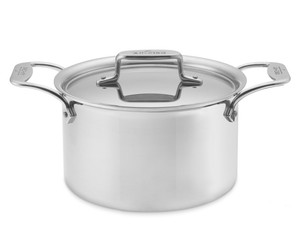
All Clad Soup Pot

Ain’t it grand? It’s a three-quart All-Clad stockpot, nabbed from Cookware & More for a mere $151.29 (shipping included).

All-Clad has become my cookware passion, and since learning about Cookware & More from Frugal Scholar, I’ve been slowly replacing old pans with All-Clad, as I could afford them. This online outfit sells seconds, which have tiny visual flaws but nothing serious wrong with them, at very nice mark-downs off the regular retail prices. The store also sells “firsts,” at about the same as you’d pay for the same pan on sale at Williams-Sonoma, especially after you’ve covered the shipping. The total for that pan and the shipping came to about $30 less than Macy’s price.

This one will replace a similar small soup pot, one of my favorites that I use constantly. It’s about 20 years old, I think.

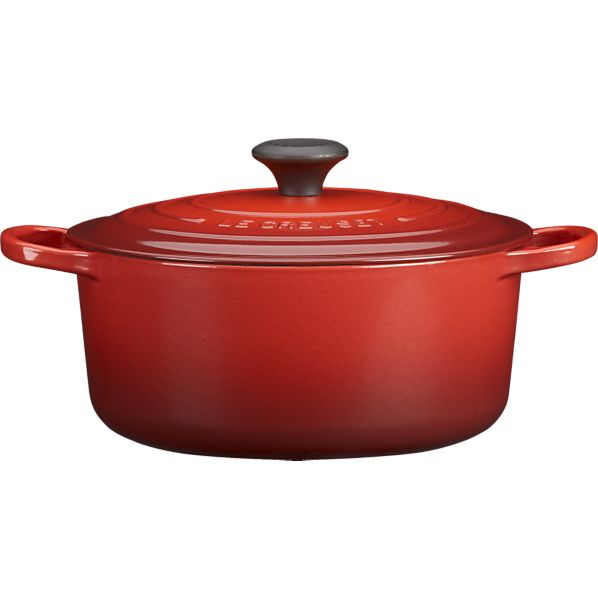
There was a period when I was buying stainless-steel pans from the Broadway to replace my old Le Creuset elephants and rhinos, which had come to feel intolerably heavy and difficult to care for. (Is the Broadway even still in business??? Apparently not… ) The Broadway had its own line of aluminum-core stainless cookware, which was pretty darned good for the time and which occasionally would come on sale at smokin’ deals. I still have a couple of those frying pans.

But when the time came that I needed a small stock pot, lo! The Broadway had quit carrying that line, and nothing they had in stock turned me on. One day, though, I wandered into Macy’s, and what should they be peddling but a little soup pot in exactly the size and shape I coveted. It was copper-cored and a little more expensive than I had in mind, but what the heck. So I grabbed it.

It’s been my favorite pan — the all-around pasta boiling, veggie-blanching, stew-braising, soup-simmering, sauce-concocting, pork-roasting, popcorn-popping pan.

Over the years, it’s had some heavy wear. I’ve dropped and dented it, enameled burnt stuff onto it and seethed the stuff off with boiling baking soda, scoured it, scraped it, and run it through three dishwashers’ lifetimes. It’s developed a hot spot, and now every time I cook anything in it (other than pasta), food scorches on one side of it. That’s getting a little tiresome. Besides. It’s not All-Clad. 😉

It’s not as pretty as the old Macy’s pan, which had a nice minimalist trimness about it. But it is All-Clad. And $151 is exactly the amount I did not spend last month from the discretionary budget…so I can afford it. I think I’m going to like it. And I’m certainly going to like not having to scrub off scorched stuff whenever I use it!

le-creuset-5.5-qt.-round-cherry-french-oven-with-lid←←Le Creuset  

Le ElephantAfrican_Bush_Elephant→→


A Little Coup at the Second-Hand Store

Yesterday I took a nice old skirt that I really love to the tailor at the cleaner’s near the restaurant where the Thursday morning business group meets. It needed a new strip of elastic in the waist.

An outlet of My Sister’s Closet, the upscale resale consignment store, is right next door. Well, I really needed some tops to replace the threadbare rags I’ve been wearing with my vast collection of Costco jeans. So, I thought, why not?

“Why not,” of course, is that place is dangerous. But amazingly, I managed not to spend much money and still came away with a major shopping coup.

Ended up at the racks and racks of second-hand Chico’s outfits. Ordinarily I don’t shop at Chico’s and didn’t, even when I had a job, because I dislike their high-pressure sales tactics and because the 1 through 3 sizing is very annoying. However, with no one hovering over my shoulder or lurking outside the dressing rooms to tell me how “wonderful!” I look in something that makes me look like a potato sack tied in the middle, I thought again, why not?

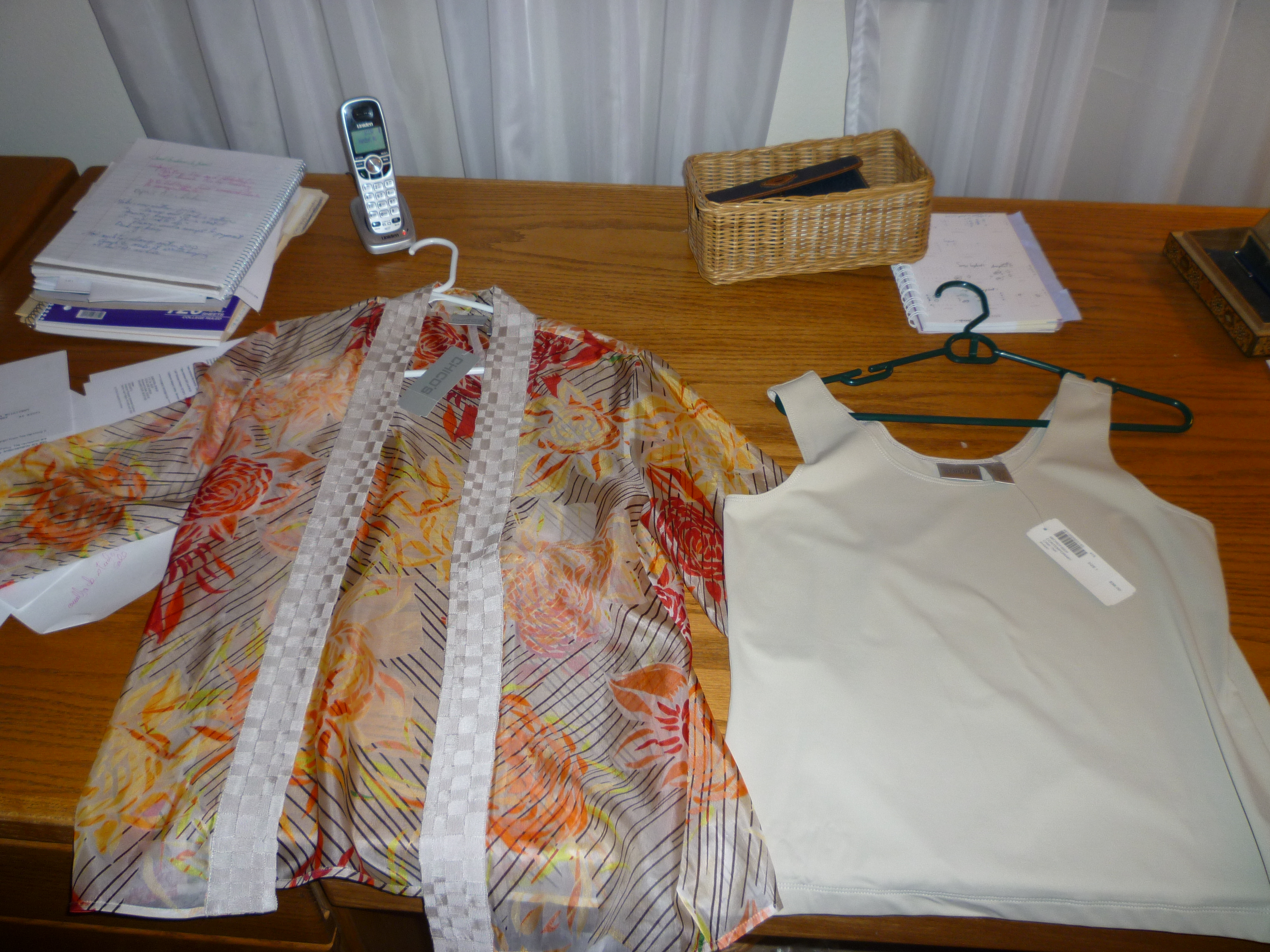
Incredibly, I found a sheer silk shirt with its price tag still on it, really pretty: they were selling it for $20. And even more incredibly, it fit. The original price was $100!

On the same hanger was a matching beige tank top, also with its original $38  price tag hanging from the collar tag: $8.95!

Can you believe????

Also in the $10 and under range, I got a nice loose-woven crocheted sweater from Jones New York and an awesome matching cami-like thing (only heavier fabric than a cami), both in deep amethyst…perfect for wearing with a red hat. 😉

And a cute little blue sweater that will look great with the blue Sanitas clodhoppers I bought a while back. Since clodhoppers are now about all I can wear, thanks to the endless foot and back agonies, I’ll be getting a lot of use out of those shoes and anything that will go with them.

And a pretty crocheted tank top that will look utterly awesome over the collected Costco camis. And a blue polyester tank that they were practically giving away.

I won’t have to buy any more clothes this winter. Except for networking group shindigs and the rare client meeting, most of the time I live in Costco’s old-lady jeans. Once class finally comes to an end, I’ll have few occasions to wear anything else. These tops will make me feel a lot less grody, and they’ll be acceptable for grocery-store runs and schmoozing with friends. The silk top with its beige tank will work nicely for those Chamber meetings.

To give you an idea of what I mean by Chico’s absurd sizing system, one of these things is a size one, two are size zero(!), and the others are size two.  A history of the chain reveals that this scheme is deliberately designed to confuse buyers about sizing: “A woman who in another store would be wearing a size 16 might be flattered to fit into a 3 at Chico’s.” Right: aren’t us customers dumb?

I’ve found that virtually none of the stuff I find in their stores fits, though it’s hard to tell with the sales staff buzzing around your head like hungry mosquitos. The same business profile reports that “Sales clerks were to make astute judgments about fit and style and also offer accessories or additional pieces of an ensemble.” LOL! That’s a polite way to put it.

At the checkout register, I remarked to the clerk that I never go in to Chico’s because I’m so put off by the high-pressure sales tactics. The sales rep laughed and said she’d been in retailing all her adult life (which, we might add, was probably about as long as mine) and that she also wouldn’t shop there, for the same reason.

“You’ll notice how they don’t have mirrors in the dressing rooms. That’s so you’ll have to go outside the room to look at how things fit in those big mirrors—and so the sales staff can get at you every time you try on anything.

“And,” she added, “those are slimming mirrors. They make you look more slender than you are, so you think the clothes look better on you than they do.” She said when she saw herself in one of those things, she thought, “That’s not me in this mirror!” And she never went back.

🙄

Well, I couldn’t say one way or the other whether that’s true. If the mirrors are “slimming,” it must mean I’m not gonna look any better ten pounds lighter than I do right now, and so I guess I can have a beer with breakfast.

But I can say that almost everything I’ve tried on in Chico’s looks awful on me, and I dislike being pestered and barraged with false flattery so much that I don’t shop there. It was interesting that at My Sister’s Closet, where sales assistance is so low-key as to be nonexistent, I found several things in their brand that I like. It may be that the clothes are OK but the atmosphere in Chico’s stores is discouraging.

Am I the only one who finds high-pressure sales tactics SO off-putting as to actually negate any impulse to buy things?


Costco: How Much Does Saving Money Cost You?

Scrutinizing the budget now that this month’s bills are all paid… Several extraordinary costs—those Heath dishes, for example, and a pair of shoes, and a trip to the car mechanic’s—ran the American Express budget $325 into the red. But in theory, all of them combined shouldn’t have overtaxed that budget. So…WTF?

In addition to those two extravagances and the car repair, I’ve been spending with gay abandon at Costco: $407.39 diddled away in that place!

And what on earth, pray tell, might I have purchased with this munificent amount? I’ve been strictly on the wagon for the past three months, so it didn’t go to my favorite potables. Mostly food and household goods, I think: the lifetime supply of paper towels. And the $75 or so for the underwear extravaganza. Haven’t bought toiletries. Haven’t bought pool tablets. Haven’t bought Brita filters or blue jeans or replacement toothbrush heads or a lifetime supply of laundry detergent. Looks like the main costs were large packages of chicken thighs (at 99 cents a pound, a better buy than anyplace else where I shop), pork, produce, the paper goods, and clothing.

Probably paper towels and toilet paper and detergent, purchased in bulk, are a little more cost-effective than the same goods bought in smaller quantities more often at grocery stores. However, a funny thing happens on the way to the Costco: Sure, a giant container of paper towels lasts four to six months. It sets you back $15. But then next month you need toilet paper: $20. Next month after that, you need chlorine tabs for the pool: $80. And so on  to infinity. If every month you’re buying a lifetime supply of one thing or another, then each month you’re spending more on groceries and household products than you would at an ordinary retailer for smaller amounts that would only last a week or a month.

Although over the long run you might spend more at a grocery store for a specific product than you would, unit-wise, by purchasing a gigantic supply at Costco, because each month you buy a new lifetime supply of something else, each month’s bills are likely to be higher than they would be if you equalized purchases over time.

What that suggests is even though you’re paying less per unit for certain products, you’re actually paying out more each month as you have to replenish different products month by month.

By comparison, during the budget cycle just ended, I spent only $35 at Safeway and $68 at Trader Joe’s. Admittedly, I haven’t felt well and so haven’t eaten much—mostly I’ve grazed off the Costco stash. But still..one wonders.

I decided to try to limit Costco purchases to $200 a month. Which…well, really, shouldn’t that be more than enough?

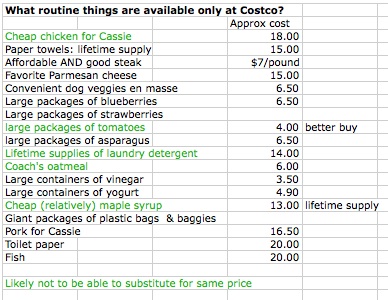
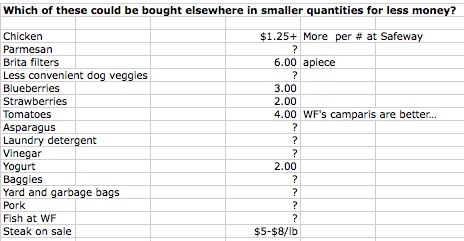
This led me to consider what routine purchases are available only at Costco, and what things might be bought somewhere else in more manageable quantities at more manageable ongoing prices. Videlicet:

Some of these items are hard to find at other stores around here, or can’t be found in the same quality or for the same price, or both. I’ve marked those in green.

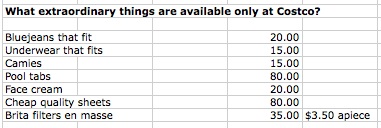
There also are a number of things I buy on occasion at Costco because they don’t seem to exist in any other stores or because, as in the case of the chlorine tablets for the swimming pool, Costco far underprices its competitors:

Bed sheets comparable to the sets you get at Costco, which come with four pillowcases BTW, would cost far more in other stores unless you caught them on sale. Anywhere else, it’s almost impossible to find either underwear or denim jeans that fit a normal adult woman. Face cream is expensive at Costco but downright outrageous elsewhere. So it goes.

I’m none too sure what these things would cost at non-warehouse stores. But I’d be willing to bet that when you buy less, you pay less at the checkout stand, even if you’re paying more per unit. In some cases, you’d have to pay a fair amount more. For example, I wouldn’t consider buying fish at Safeway; probably the only other source of acceptable fish in town is Whole Foods. Don’t even ask what they charge for the stuff.

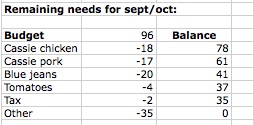
If I limit spending to $200 for the September/October budget cycle, what could I buy between now and the end of the month-long cycle?

I’ve already spent $104 at Costco this month. That leaves $96 to diddle away:

That’s not unreasonable, I think. It provides enough meat to last the dog for the rest of the month (since canids need about 2/3 of their food to be in the form of animal protein, a 25-pound dog consumes a surprising amount of fresh meat). My blue denim jeans are wearing out, frayed at the cuffs and faded at the knees—the height of style for younger things, but not, I’m afraid, for moi. So pretty quick I’ll need a new pair. Arizona doesn’t charge tax on food, and so the 10% soaking applies only to the clothes. And…that even leaves something for one or two other purchases! Buying the rest of my food—mostly produce, since at least two months’ worth of beef, fish, and chicken reside in the freezer—shouldn’t cost much at Safeway, Trader Joe’s, or Ranch Market.

What think you? Does it make sense to try to stay on budget by spending more per unit on less product?


The Great Pantie Hoarding Caper

Hot dang!!!! AT LAST Costco has decided to carry ordinary, real women’s underpants. Not a variety of girdle. Not a thong. Not some sort of athletic gear. And not your great-grandmother’s undies. Nice cute little bikinis, with lace trim, that—hang onto your hats, ladies—that actually FIT a grown woman!

It’s some sort of a miracle.

As normal women know, most women’s underpants fit only one body type: teensy and board-flat. If you’re shaped like nature built you to bear children, or if you’ve gone so far as to have borne a child or three, you need not apply to the underwear department. There’s no way most of us can find a pair of panties that fit around the rear end and don’t try to slice us in half vertically, like a laser saw in a James Bond movie.

The other day I spotted these things at Costco. Hm…DKNY…not a bad brand. Made in Bangladesh. But they’re here. No one’s going to send them back to the Third World, moral outrage being alien to our lopsided, offshored corporate economy. Why not chance them?

So I bought a package of four, brought them home, and tried on a pair.

And holy mackerel! They actually fit around my capacious aft beam! Not only that, but they’re comfortable.

Couldn’t believe it.

Next morning I jumped in the car and flew to the nearest Costco in a halfway upscale neighborhood (the store in the nearby inner-city shopping center tends not to carry stuff like this). Grabbed every box of “Extra Large” I could lay hands on. That wasn’t so many, because size 12 is considered pretty outré in the women’s underwear biz, so it’s not easy to find panties that fit women who wear what is considered the average size among American women and which, dear hearts, is flicking NOT “extra large.”

WhatEVER. 🙄

I ended up buying a total of five packages, 20 pairs, to the tune of about 75 bucks.That’s $3.75 a pair, about what you’d pay on sale for a pair of department-store panties that don’t fit in any size.

All my old underwear was pretty well shot, much of it falling apart. Matter of fact, a couple pair of Hanes panties I bought at Dillard’s just two or three months ago had already sprung holes in the fabric. I threw out every moth-eaten, flabby-elastic, never-fit-from-the-git-go panty in the drawer and neatly stacked the new goodies in there.

Provided these don’t pop holes in the seams or the fabric, too, I shouldn’t have to buy another pair of underpants for two or three years. Maybe longer. This may be the last underwear hassle I’ll have to go through for a long, long time.

🙂 When you see something that fits, grab it, ’cause you’ll likely never see it again. Especially if you found it at Costco.

Delayed Gratification and the Beloved Dishes: I want these!

I want them. Gotta have them. Want them so much I NEED them!!!!!!!

They are a few Heath stoneware bowls to replace several that have been busted, leaving my beloved set short of its original eight place settings.

Alas, however, my set is so old that Heath no longer makes dishes in the color, a kind of aqua blue. They also no longer make the larger of the bowls that came with the set, one that apparently was once billed as a “salad bowl.” Checked on e-Bay, where I found only one dinner plate in The Color, which I don’t need and which is in a different style from mine, anyway.

Interestingly, prices on e-Bay are just about the same as the prices Heath Ceramics is charging for brand-new pieces. Only trouble is, Heath’s offerings are somewhat limited. But then…so are e-Bay’s. Prices for these “mid-century modern” dishes are, in a word, bracing.

However, they’re almost unbreakable, the style is so pleasing that one never tires of them, and they last a lifetime and then some. M’hijito has my mother’s set, which he uses every day (as I use mine), and I still have the earth-mother green set my ex- and I bought shortly after we married, a ceremony performed by gaslight. I no longer use that set unless an awful lot of people come to dinner, but it’s still unchipped and unwinnowed by breakage.

Okay. Can’t get the color anymore, and for one bowl, can’t get the shape. What to do?

Well, my set is in the style that has a wide unglazed-looking rim. The native color of the stoneware is a kind of taupe, a very pretty shade that contrasts nicely with just about any glaze Heath uses. No law says that every piece in the set has to be the same color—matter of fact, at Heath’s website you see “curated” (yeah) (stop that laughing!) sets that mix & match. Why not get replacement bowls in a color that would pick up the rim on the smoky aqua plates? Like this:

For example, here’s the dessert bowl, of which I need one and would like five, in a color combination called “cocoa fawn”:

That would go exceptionally well with the foggy sky-blue set I have. In fact, it would help to tone down the turquoiseness of the blue. Could be a very desirable choice.

When I got the set, I bought only four of these, because I didn’t expect to use them much. However, as it develops, I use them all the time. I’ve broken one and so need to replace that, but if I’m going to have three in blue and one in greige, then I guess I’d like to fill out the set to eight (i.e., buy five of new bowls), so if anyone ever comes over to dinner and we need to use this size dish, everyone can have the same color.

This bowl comes in a style called “coupe,” which was introduced in the 1960s. They’re only making two bowls in the desired style anymore, one the size above, which I need, and one billed as a “cereal bowl.” That means I can’t replace the larger bowls I originally bought. The available 6.5-inch bowl looks like this:

Note that it’s a different shape. The old “salad bowl” was the same shape as the “dessert bowl,” sleeker and lower. I got them because I don’t eat cereal often and because I much preferred the leaner, crisply-lined design. But if I’m going to get a 6.5-inch-diameter bowl in Heathware, I guess this is what I’ll have to settle for. To make up for the missing bowls, I need three of these.

Let us consider the price: The dessert bowls are $23 apiece. The cereal bowls are $28. So… just to replace the missing bowls:

That’s not too breath-taking. I can afford that this month, with no problem.

However, I really do think that if I’m going to do this, I ought to get eight of each, so as to have eight in the same color to go with the eight otherwise intact place settings I already own. How much would that set me back?

Four hundred bucks. Holy mackerel! That’s pretty problematic, especially at this time of year. The August power bill will arrive this month, and it’s likely to be around $250, as high as it gets all year. And as we speak, my car is at the shop for its regular maintenance, plus I think its battery should be replaced before it craps out in some remote place, and I’ve whacked the front right wheel on curbs several times, and I hit a pothole with the same tire twice, so I suspect it’s out of alignment. And one of the rear brakes is squealing again. These things could add up to a substantial hit.

And we know—we know, because it’s a law of physics—that the instant I pony up $408 for a passel of dishes without which I probably will not die, Chuck the Wonder-Mechanic will come up with $650 worth of repair bills.

What if I bought the replacement pieces (5 dessert bowls, 3 cereal bowls) this month, and then next month, when I’ll have new cash infusions from Social Security and the junior college district, round out the collection with to bring the total up to 8 apiece? It would cost me $199 this month, and then $209 next month.

This would leave enough in the September budget to cover moderate-sized unplanned expenses, and then the October budget, which will reflect slightly lower power bills, should be able to accommodate the second order.

What we have here is an example of the frugal principle of delayed gratification. When you want something, wait.

Wait until you have the cash to actually pay for it, rather than racking up the cost on a charge card. Requires some restraint. But it keeps you out of debt, and eventually you get what you want.

 

Safeway’s Latest Gimmick: Enough, Already?

The Times takes note today of Safeway’s latest scheme to make customers think they’re getting bargains, thereby inducing them to buy more junk. The stores here in town have been pestering customers for months, trying to get us to sign up for this “program,” which creepily tracks your buying history through the red loyalty card and pitches products to you by offering alleged discounts on things it thinks you’re likely to buy. Cutely called “Just for U,” the program makes you cough up your e-mail address so the corporation can send you digitized coupons, which are loaded onto your red card. Discounts offered to you are based on your shopping habits, which Safeway has tracked and analyzed through your use of the red card.

The website where you go to sign up for this thing is short on information about exactly what it is and how you use it, for the obvious reason that there are some things you’re better off (from Safeway’s point of view) not knowing. Evidently they want you to sign up without thinking too hard about it.

These tracking programs, into which consumers are lured by purported discounts (i.e., those who don’t have a loyalty card pay more than the normal retail price, while those who agree to carry one around and let the corporation track their every purchase pay a fair price), are highly invasive. Corporations don’t want to “offer” you a loving blandishment; they want to sell you stuff, and they’ve learned they can manipulate you by spying on you and analyzing your buying habits. Retailers, for example, would  love to know when you divorce, because you’re more likely to start buying a different brand of beer then, or to purchase whole new sets of trash baskets and kitchen utensils.

This strategy has already had some not altogether benign results. One father, for example, was surprised to learn his high-school-age daughter was pregnant when Target, having divined the fact by what she bought, started mailing her coupons for baby clothes and cribs.

Target is so secretive about its snooping program that when a Times reporter looking into it sent the company’s PR people a prepublication summary of his reporting, he was told every statement was inaccurate, but they would not address any part of the reporting to enlighten him. When he tried to make an appointment to discuss the alleged inaccuracies, they refused to meet with him. When he went in person to Target’s corporate headquarters, he was told he was on a list  of prohibited visitors.

What, really, do they not want you to know about what they know about you? That question alone should tell us something.

Besides the obvious invasion of privacy, there are other reasons to object to favored-customer plans:

1. They’re elitist. You have to own a computer and, for best results you need a smart phone. Not everyone can afford a smart phone, and some people aren’t too clever with computers, either.

2. They add another layer of nuisance to shopping, an already onerous proposition: now you have to go online to check the day’s offers before you head out the door for another trudge through the stores, where you will have to check and bag your own purchases.

3. They’re budget-busters: they lure you to buy products you don’t really need. Today’s Times piece describes a Maryland woman who chose to buy a large bottle of cranberry juice rather than the smaller bottle of cran-apple juice she normally buys and to pick up a package of “discounted” Cocoa Puffs. (Yech! Is there any question why the average American consumes 156 pounds of sugar a year?)

4. Information about your private habits can be used against you just as easily as it can be used to offer you a glowing “bargain” on junk food you shouldn’t waste your money on. This data, folks, can be subpoenaed and, more to the point, it can be sold. The government isn’t allowed to invade your privacy without good reason and a court order, but we allow huge corporations to do so, and those corporations have no limits on who they can sell that information to. Your private habits not only can reveal whether you’re a pregnant 16-year-old, they also can show whether you’ve taken up your old smoking habit again, what and how much you drink, whether you eat a healthy diet or whether you favor Cocoa Puffs and sugary “juice,” whether and how often you buy prescription or OTC medications for ailments like migraines and GERD.

This information can be used against you. Do you really want your soon-to-be ex-spouse’s lawyer to get her hands on records of how much alcohol you buy or whether you buy condoms or birth control pills your spouse doesn’t ever see you use? Do you really want an insurance company to learn, secretly, about your drinking and smoking habits, or about aches and pains that could mean higher premiums or outright denial of coverage?

5. It’s fundamentally unfair to offer one person a lower price because she doesn’t know better than to allow a corporation to track her every move or because she can afford a smart phone and a computer. By its nature, then, Safeway’s favored customer scheme disadvantages the poor, the laid-off, the cautious, and the elderly.

6. They jack up prices all the way across the board. You don’t really believe Safeway is giving away stuff to everybody who consents to being spied on, do you? In fact what’s happening is all the prices in the store go up, and the so-called discounts are mark-downs off inflated prices.

Personally, I would like to see legislation prohibiting retailers from collecting, storing, or analyzing individual consumers’ purchases and shopping habits. In our present political climate, where elected leaders are purchased by well-heeled corporate interests, of course that’s never going to happen.

Welp, in my case I can’t very well take advantage of Safeway’s new spying digital coupon program, because my red card was taken out in the name of my now deceased German shepherd, and the phone number was that of the local Safeway headquarters. I got the number out of a telephone book—it was that long ago!—and I don’t even own a phone book anymore. It’s unlikely that the CIA Safeway publicizes the number of its local corporate offices on the Internet.

So. It’s a good reason to buy local. It’s a good reason to shop at stores that don’t demand you carry a card around or sign up at an online spy shop, even if you have to pay more for the privilege. It’s a good reason to grow your tobacco in the backyard.

Images:

Safeway before Opening. Mattie B from Santa Cruz. Creative Commons Attribution-Share Alike 2.0 Generic license.
Tobacco in blossom.  kevinbercaw. Creative Commons Attribution-Share Alike 3.0 Unported license