Coffee heat rising

New Washer!

Okay, the new high-efficiency high-priced washer is ensconced in the garage: a Samsung double-whammy top-loading vast-capacity VRT (must stand for “vertigo,” which is what you get when you gaze through its glass lid to watch it running). It is really a neat machine, a computer with a wash tub attached to i t.

M’hijito blew his Sunday afternoon traipsing around the city looking for wash machines and prices. We found one of these marked down at Lowe’s—$900-plus—and having seen that price tag returned to the Sears Outlet store, where we snagged a brand-new model for a mere $775. The retail price is $1100, so that wasn’t bad.

Saved even more when M’hijito volunteered to install the thing. So we had them load it into the Dog Chariot (how does anyone live without a pickup or a minivan?), hauled it home, and before long he had it hooked up and running.

We looked at the “traditional” agitator-style washers available in the stores. Junk. For $350 I indeed could have replaced my old washer, with a much lesser machine—fewer cycle options, same old clothes-ripping agitator, cheap-looking construction. The Samsung looks sturdy. No question all these electronics will crap out expensively, and that it’s better to get a machine with mechanical controls. But I’m afraid those are pretty well phased out now.

And…

Holy mackerel what a change in performance!!!!!

Got some HE detergent and tossed in a peach-colored towel that has seen better days. Over the years it had acquired a 5 o’clock shadow of ground-in grime, especially on the ends where I wipe my hands and face on it. Well, I ran that thing through with the whites and out it came, looking like brand-new! It’s bright and clean and free of any trace of gray grime.

The other clothes came out looking good, too, and much softer than they were after washing in the old Kenmore. The Samsung must not only wash more effectively, it must be rinsing out the chemicals more efficiently, too.

The crazy glass lid is a hoot. There’s something mesmerizing about watching the thing in action.

Some time back, Trent Hamm wrote a long post at The Simple Dollar more or less justifying the purchase of one of these devices, arguing that over time it would pay for itself in reliability and savings on water and power. I dunno about that. At least for small loads, it looks to me like the Samsung actually uses more, not less, water than the decrepit Kenmore did. I’ve yet to wash a large load, so don’t know if the machine uses the same amount of water for all loads, in which case it probably would save water if you have a big family. But I will say it has so many washing options, from several different water heating choices (for me it’s usually “cold”) to responses to different “soil levels” to extra spin (or no spin), extra rinse, and even a delayed start option—if you’re on your power company’s time-of-day plan, you could toss the laundry in and then set the machine to come on when the rates drop.

Love the top-loading design. Really: I have paid my dues with front-loaders and never, ever want to bend over to haul wet clothes and sheets out of something that looks like a Bendix. Without an agitator, the drum is HUGE! It will easily hold a comforter without the traditional wrestling match.

One of the complaints I saw in reviews of these top-loader things is that they supposedly tangle and wad up clothes. So far, I’ve not seen it do that. In one load, I put two pairs of jeans in, a recipe for knots in the old Kenmore. No tangles, no wads.

Consumers also complain that high-efficiency machines take half a lifetime to run a single load. However, this one has a “quick wash” cycle that takes 34 minutes, just a few minutes more than the old Kenmore’s regular cycle. And it really got the clothes clean in that time. I can’t see why you would need to run a longer cycle unless you had to wash large loads of very dirty clothes.

After the house-painting endeavor, the S-corp is going to have to repay a chunk of the money I lent it so I can pay for this thing. But I love it.

Images: Samsung top-loader, shamelessly ripped off
from Amazon (whose price is not bad…)

Old Bendix that looks just my mother’s: shamelessly ripped off the Internet.

Overpackaged! How much is this debris costing us??

I’m sitting here with a bottle of Costco mouthwash on the desk. Broke a fingernail (again!) trying to get it open. The lid is sealed down with a fat strip of melted-on plastic, the name “Kirkland” stamped on it not once, not twice, but thirty times. Now I have to get up and haul this thing into the kitchen and dig out a knife to cut the damn plastic seal off.

In the kitchen, a box of anti-acid pills resides on the countertop. Need to take one of those this morning. To get at it, I have to dig a flat piece of cardboard out of a box, wherein a half-dozen horsepills are sealed between layers of plastic. Somehow I’m supposed to push a single pill through one of these plastic layers. This being a little on the difficult side (often, as in the case with allergy  pills, downright impossible), I’ll have to walk back into the office, dig a pair of scissors out of the desk drawer, carry them back to the kitchen, and cut open the damn plastic-&-cardboard packaging. While I’m at it, I’ll probably cut all of the pills out (it’s a 14-day supply), then walk back down the hall to the linen closet, scrounge out an empty bottle that does NOT have a goddamn adult-proof cap on it, carry it back to the kitchen, fill it with the pills, and throw out the box and the layers of pill “bubbles.”

The box of horsepills came inside a larger box dispensed by Costco, which sells such things in lifetime supplies. To get at the three boxes I bought a year or so ago, I had to open a larger box, which was wrapped in plastic. So to get to ONE pill I’ve had to hack my way through one, two, three, FOUR layers of packaging. All of which made their way to the landfill, where as we speak they’re presumably blowing around in the wind or strangling small varmints.

While I’m in the kitchen, I’ll grab the bottle of topical anti-hot spot drops the vet gave me so I can apply it to the dog’s well-chewed leg. The plastic dropper bottle is encased inside a plastic prescription bottle, soon to join its friends in the landfill. Or not: that one doesn’t have a person-proof lid on it, so I may save it to hold pills gouged out of plastic-&-cardboard bubbles.

What, for the love of God, is the POINT?

Do you know how much all this trash is costing us? In dollars, that is, rather than in pure unalloyed annoyance?

People in the business will tell you that wrapping, rewrapping, and overwrapping every damn thing that gets dropped into a consumer’s  hands can run anywhere from 1% to 75% of the cost of the goods. And that doesn’t count the cost of designing the labels, and it most certainly does not count the cost of hauling the trash to the dump and storing it there. Nor, presumably, does it include the cost of the Bandaids needed to cover the knife, scissor, and sharp-plastic wounds incurred when customers try to hack free the goods they purchased.

Consider just the costs the packaging guys ’fess up to:

Plastic packaging for personal products: between 20% and 35% of the consumer’s cost for the goods.
Pharmaceuticals: around 15%
Beverages: 14% to 20% of consumer cost for goods
Nestle and P&G food and household products: 5% to 10% of revenue
Liquor: as much as 40% to 45% of consumer cost

Why are we doing this? Not because consumers so love having to hack through layers of plastic and cardboard to get at what they bought.

Way back in 2003, Piper Jaffray reported,

The global packaging industry is approximately a $433 billion market. The domestic packaging market, which is the major focus of this report, represents approximately 29%, or $124 billion of the global market…. The largest segments of the industry are paper and board and plastics, which account for 36% and 35%, respectively, of the global packaging market…. While packaging companies serve a variety of markets, the largest end markets for packaging products are food and beverage.  Food packaging accounts for approximately 40% ($175 billion) of all packaging applications.  Beverages represent approximately 18% or $80 billion.  These end markets are stable, non-cyclical, steadily growing markets that are consequently attractive, regardless of the economic climate.

Lovely. We cut our fingers, fume with frustration, fill our landfills with billions of pounds of unnecessary trash, have our taxes raised to maintain those landfills and run garbage trucks, and pay, on average, an extra 20% to 35% for food and necessaries so someone else can get filthy rich.

Apologists for this industry will tell you that individually plastic-wrapping cucumbers and packaging apples in clamshells are necessary to keep them from being damaged in shipping, and besides, you, the consumer, just love that packaging and won’t buy stuff without it.

Why do I think not? Why, indeed: I’ve been on this earth for rather more years than most, and during all that time produce and goods have been shipped, trained, trucked, and flown to market. [OHHH FOR GODSAKE! THIS DAMN MOUTHWASH BOTTLE HAS GOT A FLICKING CHILD-PROOF CAP ON IT! I CAN’T GET IT OPEN!!!!!!!]

Where were we? Yes. For most of those years, apples came in bins, not in consumer-proof clamshells. Pills came in bottles. Soda pop came in cans that you prized open with a churchkey. The same tool worked nicely to flip open a bottle of beer.

Actually, soda pop used to come as syrup. You added your own soda water to it, allowing you to decide on how strong or weak it would be.

No one ever heard of the pointless practice of sealing every single anti-acid and antibiotic and allergy pill individually inside sheets of plastic. Face cream and foundation came in bottles that let you access every last drop, not squirt containers that you can’t open and that don’t dispense all the product you paid for. Mouthwash came in jars whose lids you did not have to leave off (if you could ever get them off) when you put the jar back in the cupboard, so you could get at the product next time you wanted some of it.

The absence of unnecessary packaging didn’t seem to harm sales. People will buy what they need regardless of how it’s packaged or not packaged.

Some indications suggest that some consumers prefer not to buy overpackaged products. I certainly do, but not to such a degree that I won’t buy a product. Nor will I go out of my way to Sprouts or Whole Foods to find bulk products—even though in theory that’s one way to fight overpackaging. Burn more gas to buy less cardboard and plastic…

Here are some other strategies:

Buy larger amounts in single containers. At Costco, for example, a lifetime supply of liquid laundry detergent comes in one plastic bottle, which appears to be made of less plastic than it would take to fabricate three bottles and lids.

At the grocery store, select and purchase individual pieces of vegetables and fruits, rather than plastic bags full of onions, lemons, oranges, and the like.

Buy a head of lettuce instead of a plastic box full of precut and prewashed lettuce (which you ought to wash anyway, to be safe…).

Complain. Every Costco has a “suggestions” box. Whenever a product you want is overpackaged or challenging to break into, scribble a note on the way out, letting the management you object to that. Do the same at every retailer that foists over-packaged and consumer-proof products on you.

Make them crazy. Whenever you encounter a package that requires a box cutter to open it, ask the cashier or customer service to open it. If they refuse to do it, tell them you can’t buy it because you can’t get it open. Amazingly, some stores actually arm their cashiers with box cutters, because quite a few customers report they can’t easily break into the consumer-proof packaging. If enough people demand extra help in opening clamshells and impenetrable plastic, retailers will send the word back to manufacturers.

Before you leave the store, ask for help in opening child-proof and protect-you-from-yourself lids.

Whenever possible, buy products sold in manageable packages instead of competing products that are overpackaged or consumer-proofed.

Avoid products that are packaged in packets inside packages, such as certain snacks and over-the-counter drugs. Buy a bottle of loose generic allergy pills instead a packet of blister-packed brand-name pills—you’ll not only avoid hassle and vote with your dollars against overpackaging, you’ll save some money on the product.

Urge local and national elected representatives to support legislation to limit overpackaging. (Good luck to that! The deep-pocketed packaging industry has a huge lobbying effort under way to put the kaibosh on any such schemes.)

Shop with retailers that make some effort to limit overpackaging, such as Amazon and Walmart.

Recycle. If you’re not already recycling, start now.

Resistance may be futile, but that’s no reason not to resist anyway.

Images:

Kirkland Mouthwash: Shamelessly ripped off from Amazon.com.
Blister-packaged pills: Alex Khimich, Blister with Pills, public domain.
Overpackaged lettuce: Christian Gahle, nova-Institut GmbH, Verpackungsblister aus Biokunststoff (Celluloseacetat), Creative Commons Attribution-Share Alike 3.0 Unported license.

T-Mobile Drags Dinosaur into the 21st Century

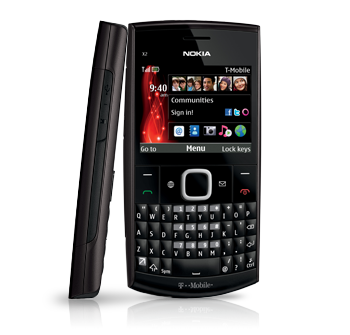
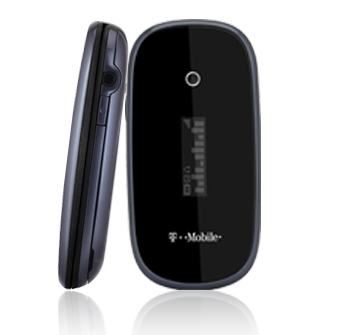
ApatosaurusWell, that was an adventure. The new Nokia phone finally arrived from T-Mobile. Of course, I knew very well that there’d be no way I could get the thing hooked up to the ambient microwaves, but I didn’t anticipate that I couldn’t even figure out how to open it to insert the sim card. So right off the bat, it was off to the T-Mobile store, which resides in a run-down Albertson’s shopping center just down the way.

They managed to get it open (turns out you need thumbnails…both mine broke off at the quick earlier this week) and set up the sim card and reinsert the battery. Brought it home and charged it up while I went on about my business, which this week has been considerable.

Next, I couldn’t get it to turn on. Kept pressing the “on/power” button to no avail.

Back to the store. Turns out you have to hold the power button down until the phone responds. Hm. How hard would it have been, dear Nokia, to have said so in your instruction booklet?

Now I go to the website to enroll in the plan of my dreams, which is not available through T-Mobile’s stores. It is so not available that live human staffers don’t even know it exists. None too available to customers, either: when I click on the link, nothing happens.

Back to the store. This time I schlepped my laptop, figuring I could attach to their wireless and, if they could just show me how, sign up from there. Well, of course their wireless wouldn’t allow me on, and they are not allowed to sign people up in the store for Internet offers. They try. Doesn’t work.

So, incredibly—hang on to your hats, Consumerism Skeptics!—one of the guys there actually offers to walk over to the next-door Starbucks, where I can get my laptop online, and get me signed up!

Can you believe that?

That is not only consumer service, it’s Consumer Service Above and Beyond the Call of Duty. I was amazed.

Didn’t take very long to get online, with someone who knew what he was doing  at hand. So I was able to send a brief text-message to M’hijito, which, as expected, spooked him. Reply: “Is this my mother?”

Well, I hope the service level remains that extraordinary. It’s a refreshing change from 21st-century business as usual!

Cost-effective Source for Eyeglasses

Some of you may recall Ms. Accountability’s reports about ordering eyeglasses online. She seems to have had a pretty successful experience. It’s not difficult to do, assuming you can extract both your pupillary distance and your prescription from your optometrist. By law, they have to give you a copy of your prescription, but because they know that the PD allows you to order your glasses online at a huge discount, they may resist. In that case you can measure the PD yourself.

For quite some time, I’ve thought this was pretty tempting, but I’d already ordered a $700 pair of glasses when I found out about it. Recently, though, Cassie the Corgi knocked my reading glasses off the beach towel where I’d set them when I went into the pool, and she sent them skidding lenses-down across the KoolDeck. Needless to say, this didn’t do them any good. But I figured I’d just have to put up with the scratches, because I can’t afford another pair of glasses now. And probably won’t be able to afford new lenses for months, if not years.

Well. A week or so ago, my son surfaced with a new pair of glasses he’d bought online. They look pretty nice—the current height of style for youngish men. Says he:

I bought them at Warby Parker. It was relatively easy; I just had to provide them with a copy of my prescription. In emailing them, it seemed like some states required the prescription to be verified, others did not. A few days later they mailed them to me. I have never heard of “glasses.com.” Here is a link to a “blogger” who shills for some other websites; he may have some insight. I bought some glasses a while ago from 39glasses.com with a coupon from his site, and they were actually around $30, I think. They were fine glasses.

Hmmmm….  Warby Parker seems to have only plastic rims, at least in the women’s department. My taste runs to wire rims, or better yet, rimless.

If that’s your feeling, too, check out Glasses.com. I went over there and was pretty amazed. They have sunglasses as well as regular Rx glasses. Shades here are not incredibly cheap; however, most prices are on a par with Costco’s, and the selection is much better.

More to the point, however, are the prescription glasses. They have the usual suspects for online optical retailers—clunky plastic things—but check this out: they have titanium rims in styles that are very nice. For only $139, I could manage to live with these, for example:

And mirabilis! They even have rimless models!

These are cute, and they’re only $99! No joke: at my fave brick-&-mortar optical shop, I paid a total of seven hundred bucks for mine. Each pair!

I think these are pretty cool. They’re not selling at the rock-bottom prices M’hijito and Mrs. Accountability have been paying. However, they’re very attractive and they look like they might have come from an upscale optician. The rimless model looks just like mine.

There are coupons available at RetailMeNot.com, Dealcatcher, and MeFindCoupon.com. Glasses.com seems to get overall good consumer reviews—mostly positive with some of the customary griping, but nothing extreme.

As soon as I recover from this summer’s financial battering, I’m definitely going to try my first online glasses purchase, and I believe I’ll start with Glasses.com.

This post’s author came along just as I was thinking about the very topic. 😉

Pots and Phones: Decisions taken

Thanks to everyone who responded to my post asking for opinions on cell phones! The hive mind, it develops, has a great deal of common sense. I’ve come to the conclusion that people who suggested an ordinary PHONE phone would suffice, for a great deal less money and waste than the proposed Android smartphone, are dead right.

What was I thinking? Forhevvinsake, I have an iPad. It does most everything a smartphone does (and in fact with a little hassle can be made to function as a phone, sort of). Why does one need a phone with a measurable IQ when one already has a gadget that can direct you to the nearest decent restaurant and allow the FBI to track your every move as you engage you in mindless games?

So, in the phone department, it’ll be an inexpensive device that will allow for talking and texting, probably from T-Mobile because there’s a store right down the street where I can go in, trap a handsome young man, and beg for advice on how to work it.

* * *

Next, the burning (perhaps literally…) issue of the teakettle.

I got to thinking about all those reports about exploding Pyrex. Though I’m pretty sure my two glass percolators predate Corningware’s sale of its glass cookware operation to an outfit that promptly offshored production to China, giving us exploding casseroles and pie-plate shrapnel, on reflection I decided that the prospect of that cute little retro pot blasting me with glass shards and boiling water was more than I cared to contemplate.

So…ugh! Back in the market for another teakettle.

Went over to Williams-Sonoma, where for $60 I could buy a Le Creuset pot that

a) is pretty enough, but…
b) is said by users not to whistle loud enough to matter; and
c) elicits complaints about easy chipping and rust.

The way the new whistling kettles are constructed, they have a cap over the spout that you have to lift by placing a finger or thumb on a little lever. But this lever is far enough from the handle that you either have to have a very long thumb (it’s made for chimpanzees, maybe?) or you have to use two hands to pour the hot water.

My old one had a heat-proof whistle that you simply grabbed with your fingers and removed to pour water. Sounds scary, but amazingly, it was easy and pain-free.

One at W-S has a lash-up on the handle that you squeeze to lift the spout cap. It was stiff and hard to work. And it looked like…yes! One more thing to break!

Target has some pretty little Kitchenaid kettles. The operative word is “little.” And they have the same issue: damn nuisance to pour water out of it.

Most of the pots have rather small lids that fit tightly and would be inconvenient to remove for refilling the pot. Refilling through the spout while you hold the handle in one hand and the lever down with the other: what part of N.U.I.S.A.N.C.E do Chinese manufacturers not understand?

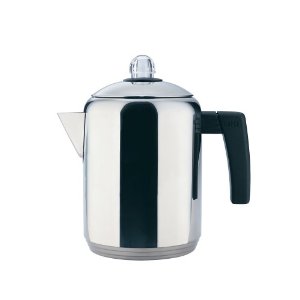
Over at Cost Plus (World Market), the same issue presented itself. However, lurking there next to the useless teakettles was…ta DAAAA! A stainless-steel Copco percolator!

No whistle, but then the old Corningware has no whistle, either. I’ll just have to get into the habit of staying away from the computer while the water’s on the stove.

The design is appealingly midcentury, and the price was decidedly right: about $25.

Now I ask you: how retro can you get?


Off the Cell Phone Diving Board!

Welp, the time has finally come. I’ve resisted buying a cell phone as long as any human being could possibly resist. First, because in the early years the month-to-month cost was just out of the question. Then as I watched the fellow humans chattering their way up and down the malls and, in a yakfest-induced haze, stumbling in front of traffic and bicycles and crashing their cars and running down small children in pedestrian crossings, I thought none of that foolishness for moi! Also, truth to tell, I have a kind of moral aversion to going around attached to a tether.

I don’t WANT to be “connected,” damn it. I value my solitude and I especially value peace and quiet. Why would I want to be jangled at or vibrated at as I’m going about my daily errands? And everyplace and everytime else?

On the other hand…

On the other hand we have the superannuated Dog Chariot, that worthy wagon resting quietly in the garage. It has 112,000 miles on it (which reminds me: time for a service appointment), and it’s 12 years old, about 175 years in people years. Every time I get into that tank, whether it’s just to drive over to the Safeway or whether to make a serious junket to Scottsdale or to my friend’s house in Waddell, I wonder if the thing is going to get there and back without crapping out. In times of yore, it wouldn’t have mattered much: car craps out, you walk to the nearest gas station and call for help on a pay phone.

But today there are no pay phones. And people expect that everyone, no matter how poor, owns a cell. And so if they see an old lady standing by the side of the road, what are they gonna do? Nothing, of course. They’ll assume I’ve called someone and am waiting for them to show up.

So, just as a matter of safety, I think I’d better have a cell phone.

Fortunately, the little business earns enough to pay the freight…with pretax dollars. Accountant says the S-corporation can justify buying me a cell phone, it needing a phone number with which to communicate with its clientele. And also fortunately, prices have come down a little.

T-Mobile has prepaid plans that offer significantly more time and power than I need, and that do not lock you in to a contract you can’t escape. For $30, I can get 100 minutes of talk time, unlimited texting, and unlimited Web browsing. And no contract harassment.

A hundred minutes is an hour and forty minutes. I very much doubt if I spend almost two hours a month on the phone! And even if I did, it appears that some of these gadgets will plug in to your wireless service, and in that mode the thing isn’t using up your “minutes.”

You have to buy your phone when you use one of these prepaid plans. T-Mobile’s prices for these devices are exorbitant: $250 for an Android phone that you can get from Amazon for $189, with free shipping.

This thing, which appears to be a slightly outdated 4G gadget, is well reviewed by consumers. As for T-Mobile’s service, it is reviled slightly less than other communications carriers. No one seems to like any of them. Conveniently, this outfit seems to have a store on every corner, so if push comes to shove you can go in and speak to a human. Not that the humans can do much for you: when you do business with the company online, you’re treated as though you were doing business with an entirely different entity from the T-Mobile that appears in strip malls. However, I did learn that you don’t have to buy the phone from them to get it up and running on their network.

Decided to get a smartphone instead of the cheapest walk-around plain telephone I could get, because that seems to be the way to extract the most value from these plans. The $30 service allows one to connect with a smartphone, so it seems kind of ridiculous to pay for service and then not use it.

In that department, the Android seems to be the most sensible way to go. The iPhone is way too expensive, because to operate it you have to buy three different plans: a voice plan, a data plan, and a text messaging plan. With AT&T, for example, the data plan will cost you $15; the cheapest voice plan, $40; and the cheapest texting plan $5 a month for 200 messages sent or received. That’s a bare minimum of $60 a month, plus gouges for “taxes and fees,” plus gouges for exceeding the allowed number of phone calls and random incoming text messages over which you have no control.

Sixty bucks a month for a phone! That is outrageous. Even if I could afford it, which I most certainly cannot, I wouldn’t pay it. Thirty is also a shade on the high side, but it’s marginally affordable.

The low-rent plans advertised by AARP are universally reviled. I’ve developed a flinch reflex around those AARP “bargains,” after the Delta Dental fiasco. And, I might add, after learning that Safeco can provide more homeowner’s and auto coverage for significantly less than The Hartford does in its AARP plan. Check out some of the hilarious yowls of rage over Consumer Cellular, one of the plans advertised by AARP. At best, opinions are mixed. Cricket? Costs more than T-Mobile; enrages customers. Jitterbug? If these customers could award negative stars, they would.

T-Mobile doesn’t appear to be any better, especially of late, although it’s highly rated by PC magazine. A Consumer Reports survey found it was less hated than AT&T but less liked than Verizon or Sprint. Verizon has a prepaid plan, but it’s $50, more than I can afford. About $40 a month is the tops. Apparently there’s no limit on the amount of time you can talk, but why should I pay $120/year more for time I probably won’t use? You do get an alleged deal on a less expensive phone at Verizon, but according to CNET you can get that cheaper elsewhere, same as you can get the Samsung Exhibit II cheaper than T-Mobile’s price.

It appears to be a toss-up. A 2011 Consumer Reports round-up, available online only to those who are willing to pay to peek, suggested smaller carriers are preferable to the large networks and plugged Consumer Cellular along with TracFone, Straight Talk, T-Mobile, and Virgin Mobile.

TracFone has cheap monthly plans, but the company’s website is opaque. You can’t tell what you’re actually going to get for $10, $20, or $30 a month. For the $30 plan, you get 200 minutes over thirty days, but evidently there’s no web-surfing, no texting??? Impossible to tell.

Straight Talk has a $30 plan with 1,000 minutes, texting, picture messages, free 411 calls, all with no contract. You have to do business with Walmart to get it, unfortunately, but it looks like a better deal than T-Mobile.

For $30, Virgin Mobile gives you 1,500 minutes (take that, Straight Talk!). It also gives you 1,500 text messages, but only 30 megabytes of Web access. Interestingly, this outfit includes the extra dings and gouges billed as “taxes and fees” in the base fee, so presumably you don’t pay more than advertised. Here, too, for just $50 you can get a Samsung phone with an actual keyboard, helpful for texting. LOL! Click on the in-house reviews for the phones, and the same reviews come up for every phone! What d’you bet their customer service is comparable?

Do you have a prepaid, no-contract monthly cell phone plan? If so, which one do you  use and how do you like it?

Update: Here’s what came of this scheme, thanks to the generous advice of readers!