You need to readthis extraordinary short piece from The Economist. Folks, contrary to popular reports, America is not skateboarding toward Hell after all. Evoking Ronald Reagan’s campaign slogan, “It’s Morning Again in America,” the author contrasts the current doom-and-gloom mode of presidential campaigning with the more realistic vision of Warren Buffett and James Fallows.
Job growth is booming, largely because of innovation and entrepreneurship taking place in large cities and rust-belt regions. Unemployment is falling, and although wages ticked down slightly in February, the average US wage still stands at $25.35 an hour.
The Economist attributes this activity to three reviving forces:
“Old industrial skills are acquiring new relevance thanks to such things as advances in materials science.” These are leading to new technologies and improvements in synthetic materials, textiles, chemicals, and weapons.
Cheap property in old industrial cities has morphed into an unexpected asset. Large companies and small businesses are reoccupying and repurposing abandoned mills and warehouses; Silicon Valley-type entrepreneurs are seeking more reasonably priced space in fly-over country, and older industries are re-opening in rural districts.
Manufacturing has risen from the dead. “Startups are beginning to transform manufacturing just as they transformed service industries. . . . New techniques such as 3D printing, combined with a rapid decline in the cost of computing power, are making it easier for small firms to compete with big ones.” Crowdfunding sources abet this renaissance by making it easier for budding entrepreneurs to raise capital.
You know, we hear so much that is negative — monstrously negative — that if you read the news much you become either depressed or crazed.
One of my colleagues remarked that a source of our daily angst is the constant drumbeat of doom and gloom, violence and hatred that sells web pages. She is so right about that. We live in an atmosphere of fear and dread. The Presidential campaign rhetoric distills that to a poisonous elixir.
Don’t drink it, friends. The Brits have got it right: “It is time for Americans to recognise that, for all its troubles, their country has not lost the ability to remake and revitalise itself.”
Well, at least someone’s trying to do something, eh? The question is…are unilateral fiats to tighten gun registration and control going to do the job?
I was glad to see the President dedicate another $500 million to mental health care.
It is, alas, a drop in the bucket. Five hundred million bucks is as nothing compared to, say, the government’s $58.7 billion outlay in 2015 for something called “protection,” or the $813.9 billion in defense spending or the $149 billion for education.
And while no, of course I do not believe anyone who has a mental illness is ipso facto a menace to society, the fact is all of the mass shootings that bring our president to tears were committed by people who were suffering insanity. Our mental health care system leaves a lot to be desired…such as mental health care. Any help there is welcome, but $500 million comes under the heading of “too little, too late.”
Should people who are stark raving mad be prohibited from buying a gun? No doubt.
How about a person who, feeling a little sad, has talked with a doctor about it and now has a diagnosis of “depression” permanently inscribed in the computerized record? That’s a catch-all term applied to anything from passing sadness to profound, pathological, long-term illness endangering the sufferer’s life. Should all of us who wish not to be “regulated” avoid discussing our blues with our doctors, lest we be prohibited from ever buying a sporting firearm or ammunition?
And will this improved rule do the trick? Let’s remember that Adam Lanza, who was seriously ill and had been for quite some time, was supplied with an arsenal by his mother, a woman who seems to have been generally regarded as a normal member of an affluent community.
The people from whom we have the most to fear, in terms of gun violence, are criminals — the type who stick up pawn shops, kidnap the employees, flee into neighborhoods, and hide in little old ladies’ garages. These folks don’t buy guns from dealers; they trade on the streets, within their own gang culture. We already have gun laws that have little effect on the availability of arms on the street. While spectacularly publicized shootings by people who have gone off the rails are alarming, they actually represent a tiny portion of the violent crime in this country. Most of it is perpetrated by people for whom regulatory control is superfluous and irrelevant.
What about the figures being bandied about to justify taking guns out of the hands of the American public? Or at least, of the law-abiding portion thereof?
We’re told 500 people die in gun accidents each year, and of those, 30 are children under five years old. You know…500 people is .00015681% of the US population. And 30 children? They comprise .00000941% of the US population, or .00015175% of children under five in this country.
Those are minuscule figures, microscopic compared to the number of people who die in home accidents and car wrecks. As a matter of fact, despite all the devices we have in place now to protect us from ourselves (I couldn’t even get into a bottle of nose spray to treat the current heavy cold!), home accidents are among the top causes of injury and death.
Are we really in a crisis situation? We’re told that “mass shootings” occur almost every day in this country. But define the term: gang-bangers shooting at each other in street fights or at drunken bashes are different from lunatics shooting up movie theaters and schools. We have a large criminal class in this country. It exists because we have serious problems of poverty, inequality, and injustice. However you define it, though, the death rate for “mass shootings” is under 5 percent of all shooting deaths in the US, and the annual rate of gun-related homicide has been dropping steadily over the past twenty years.
Hysterical reportage a crisis does not make.
Will Obama’s improved gun control regulation help stop the ongoing tragedy of suicides? One wonders.
If you’re really determined to off yourself, you’re going to do it, one way or the other. Having a gun at hand is convenient, that is true. It wouldn’t be my first choice — too messy, and too much chance of missing. But it has to be allowed that easy access to a pistol makes it too easy for an impulsive teenager to harm him- or herself in a moment of adolescent distress or real depression. But shouldn’t control of that access be the family’s responsibility? Should we all have our personal choices restricted because some people fail to keep their guns locked up?
Consider the ways your deceased friends have found to take themselves out of this mortal coil…and why:
•Gunshot to head: had a second stroke, understood what was coming, and decided he didn’t want to die that way •Tied a cinderblock to his leg and jumped into the deep end of the pool: depression, general craziness, hated his wife •Drove a car into a concrete abutment: divorce, drunkenness •Gunshot to head: depression, adolescent angst •Gunshot to head: unemployment; incurable long-term debilitating disease •Overdose: depression
This line of thought carries us straight back to the matter of mental health care, something that is sadly wanting in this country. Some people, such as the elderly guy (my father’s best friend) who shot himself after he experienced a second stroke, have good reason to bring their lives to an end. This is not a mental health issue but one of ordinary humane treatment: people suffering terminal illness or looking at a hideous downhill ride in late old age should have a right to end their lives in peace. The rest? Every one of these people needed effective mental health care, and nary a one of them got it.
The answer to the problem of suicide — and to the problem of people like Adam Lanza going on killing sprees — is to fund psychiatrists, medical doctors, antidepressants, antipsychotics, and humane mental hospitals, not to infantilize the entire adult population of the United States.
There’s a limit to how much a culture should protect its members from themselves. This aspect of the question has its parallel in other products from which we’re protected. I find myself now having to remove the caps from every bottle of household cleaner, from every OTC health nostrum, from every pool chemical, from every container of plant fertilizer, from every everything, carry them out to the garage, and break them apart with a hammer so that I can use and re-cap ordinary products that I pay for.
Child-proof caps are consumer-proof caps — they make it difficult and sometimes even impossible to use anything that they’re slapped onto, and they’re slapped onto almost every product we use today. You have to wrestle with these things whether you have a kid in the house or not. Should everyone’s life be restricted because a few people haven’t the sense to keep dangerous products out of children’s reach? Really?
Similarly, should all responsible adults’ lives be restricted because some people are irresponsible, some are criminal, and some are desperate? Or because we’re too cheap to provide universal mental health care and functional mental hospitals? Because we’re too cheap to lift the underclass out of poverty? Because we can’t be bothered to educate people in the skills of common sense?
How can I do without being spied on by Google at every damn turn? Let me COUNT the ways!!!!!
Really, the invasion of privacy that company inflicts should be prohibited by federal law. It should be effing ILLEGAL to track you around the Internet and track every one of your correspondents, too.
In fact, if Google were a government agency, it would have to get a subpoena to engage in the kind of spying into our personal lives that it does routinely. The reason it gets away with it? It’s a corporation. Because the Founding Fathers could no more have envisioned a world dictated by computer technology than they could have imagined taking a stroll on the moon, it never occurred to them to extend constitutional protections against overweening government to the real government that one day would evolve.
That would be the corporate shadow government, the one that dictates how we live, what we eat, where we work, how much we’re paid, whether we can borrow money and at what rate, whether we can insure ourselves against financial ruin in the event of accident, sickness, or natural disaster…actually, when you think about it, the one that dictates just about every aspect of our daily lives.
This morning I RSVP’ed to an upcoming meeting of a writer’s group I belong to. This group happens to have a Meetup.com site. And Meetup.com is synced with — who else? Google, of course. Within seconds after RSVPing that I would attend, in came an email informing me that Google has automatically installed a notice of the meeting in one of my several Google calendars (all of them, for all I know!) and that it will be sending me an email reminder. Lucky me! Here was a wonderful new G-service!
God damn it. Now I had to get into not one, not two, but three G-mail accounts and disable the damn calendars’ automatic notification. Yet another electronic time-suck. Really: do you need your time wasted that way? I sure don’t, and I’ll bet you don’t, either.
If I wanted Google Calendar to pester me with email reminders, I would proactively ask it to do so. The reason I don’t is that I tried Google Calendar and found it to be an endless hassle and annoyance. Annoyance annoyance ANNOYANCE! I do not WANT to be binged, pinged, and emailed for every deep breath I’m about to take. I don’t WANT Google to record every meeting I attend and every meeting I decline to attend.
So I quit using Google Calendar. I use iCal, which a) is resident on my machine and does not require me to go out on the Net to enter events, b) is easier to control, and c) can be persuaded not to make you crazy. I haven’t used Google Calendar in years.
Wouldn’t you think that would tell them something?
But ohhh no! Willy nilly, whether you love their tool or hate it, they’re going to push it in your face. That’s because they have THEIR corporate face pushed up your butt.
So why, you ask, do I use Gmail at all? No Gmail, no nuisance “calendar,” eh?
Well, because…
•I own a business and need a business address separate from my personal address. •That business needs two “addresses,” one for the publishing enterprise and one for the editorial business. •And I have a G-mail address that I use when forced to provide an email address to people I do not wish to share my address with, and to organizations that I believe are going to spam me. •If you own a small business and can’t afford your own server and an in-house IT team to run it, you don’t have much choice but to use Google. It is, in effect, the only game in town, and because of that, it’s coercive.
One of the biggest mistakes this country has made in recent history was to defang the anti-trust laws. And Google is a prime example of the reason those laws are necessary and should never be watered down.
Consider the aspects of our lives this corporation has its fingers in:
Gmail owns my thermostat, which sends them data (presumably stored someplace) about the amount of electric power I use, the number of hours per day I use the power, and the time of day I use it. Harmless? Maybe. But that’s none of anybody’s business!
Gmail evidently owns Meetup.com, which it markets to just about every volunteer and social group in the country. Every time a group sends out an invite with an RSVP, Google collects data on the group and on every member in the group: who RSVPed and, by extension, who did not RSVP. What groups I belong to and which of their meetings I choose to attend are none of anybody’s business!
Google watches your Web searches, evidently recording those, too, since it never seems to forget what sites you’ve visited in the past. None of anybody’s business!
Google publishes pictures of your home on the Internet, complete with specifics about its location and clearly showing where the doors and windows are, simplifying burglars’ lives. With a vengeance, none of anybody’s business!
Google owns Motorola Mobility, which has to do with your Android phone. How much information that’s none of anybody’s business are they collecting from that?
Google owns YouTube (which, we might add, it has nicely broken). It knows what videos you watch and which you post to your websites. None of anybody’s business!
Come to think of it, Google knows all about what you write on your websites. Of course. What you choose to post to the Internet by default becomes everybody’s business. But that’s about it.
Google owns 180 companies, many of which have reason and capacity to collect and store data about you, your comings, and your goings. It may very well be the largest spy network on the planet.
Soon it will be producing electric cars, which will track and record all your movements about your city, town, and country. Those movements are already being tracked to a degree if you have a newer vehicle that’s “connected” to the Net. But when you’re driving a Google car, bank on it: every trip to the grocery store, every trip to your mother-in-law’s, every visit to your paramour or to the local whorehouse is going to be seen and recorded.
And why is this legal? Why has intrusion into our daily lives become so routine we sheeple hardly even notice it? Pretty obvious, isn’t it: the other 99% of us can’t afford to buy Congressmen and Senators, that’s why.
When corporate America can buy the government, folks, it is the government. If you’re not mad about that, you sure as hell should be!
The Human is scarfing down an exceptionally nice lunch/dinner thing with possibly more wine than should be allowed. The dogs are begging treats supplied by an exceptionally nice (and clever) church matron who makes them by hand in her kitchen. A gentle rain is falling, and now the Human is wrapping up lunch/dinner/thing with a final glass of wine and a rich dessert of…yeah…chocolate chips.
A voice from somewhere behind the lowering clouds pierces the sky:
Celestial Voice: What do you think you’re doing?
Human:(choke cough!) Uhmm…eating?
Celestial Voice:You’ve been “eating” for half the afternoon. When exactly do you propose to get any work done?
Human:Work? I’ve already rebuilt a template for hard-copy book formatting today.
Celestial Voice:Very nice. How about you actually do something constructive, like, say, FORMAT a book? And even maybe go so far as to publish the thing?
Human:Gimme a break, Your Vastness! I spent the whole darned evening last night and half this morning singing to your Holy Magnificence and helping to hustle cash to support your devotees.
Celestial Voice:Do I look fat in this radiant gown? It’s my favorite radiant gown!
Human:Oh, no, Your…uhm, Your Radiance! You look absolutely perfect!
Celestial Voice:Naturally. I embody perfection. To the extent that there’s any body to do any embodying.
Human:Well, Your Radiance, don’t you think that since You knocked off on the seventh day, your underlings should be allowed to knock off on Sunday?
Celestial Voice:That’s a cultural construct. How do you know Sunday was Day Seven? Could’ve been Tuesday or Wednesday or whatEVER.
Human:So, does Your Radiance mean I can knock off on Tuesday or Wednesday, too?
Celestial Voice:Surely. Assuming bankruptcy is a goal coveted by your species…
{Sigh} God as academic…
Oh well.
The Entrepreneurial Human is a) too tired to breathe, and b) too depressed by current events to function.
Today is Seabury Sunday in the Episcopal tradition. Under normal circumstances, it’s entertaining: we have a delightful band of Scottish pipers and drummers march us in and out with bagpipes, quite an impressive performance.
But.
You know, we — that would be you and me, my friends — are engaged in a holy war. Most Americans and possibly even most Norteamericanos have yet to notice this, or to fully appreciate its implications. But a holy war is what we have on our hands. We are at war with an evil on a par with Hitler’s Nazism. I grew up with it: Saudi Arabia was my home throughout my childhood, and in those days I had a front-row seat to the growth of a very scary movement.
We are hated by a faction of Evil unlike anything Americans, Canadians, Latin Americans, and Europeans have seen in centuries: Evil allied with religion. Really, it’s beyond our ken. That’s what makes it so dangerous. It’s an evil that decapitates nine-year-old children, burns caged young men alive, sentences dissenters to thousands of lashes, and murders harmless civilians going about their business. Yesterday’s events in Paris spoke to that.
You understand, bagpipes and drums are tools of war. Take that bit of history, put it inside a church (holy war + holy war: interesting), and combine it with my personal opinion, which is that our only hope is to fully engage the jihadists, NOW not later, with everything we’ve got. And by everything we’ve got, I don’t mean flinging volunteers into the war machine: I believe we need to reinstate the draft so that everyone has a personal stake in what is in fact a menace to Western civilization, and so that everyone can understand on a gut level that we’re facing exactly such a menace.
Yes. I’m retrograde. But I’ll say it anyway:
We are being swept into another world war. The sooner we and our allies grasp that concept, the better our chances of survival. The longer we dawdle about building that understanding and allying ourselves in war with countries that have a vested interest in holding back the forces of darkness, the less likely we will, over the long run, prevail.
At any rate…given the religious overtones of the ISIS attacks on innocent civilians, the presence of a tool of war inside a Christian version of the House of God was, shall we say, disturbing.
So, my friends, if there is a Radiant One, instead of asking “When are you going to get of your duff and get to work,” She may be asking “When are you going to get off your communal duff and bring a stop to this?”
Dick Tracy’s wrist radiois here! You’d think we’d all be thrilled. The future has arrived.
Back in the day, when men were men and, every morning, they competed with the kids to read the comic strips over breakfast before they went off to their mill jobs, we all thought the intrepid detective’s trademark two-way-wrist radio was the ultimate promise of the future. This was the way “progress” was taking us!
By golly!
And, by golly, so it came to pass.
Now we have, among many other improvements, a handy-dandy two-way wrist radio that will convert your job from 40 hours a week to a 168-hour-a-week arrangement. No increase in pay, of course (don’t be silly!)…and by the way, your health insurance premiums will consume half your salary unless you select the $1,000 deductible.
We’re told, according to Moore’s Law, that computing technology capabilities double about every two years. And that may be so, at least for the era we live in. Over the past hundred or hundred and fifty years, a Big Bang in technologies — not just electronic, but let’s include internal combustion, nuclear power, plastics, agriculture, building, medicine, communication, transportation, and just about anything else we can think of — has transformed the daily lives of people who live in developed countries.
The other day I was thinking about that, and it struck me that most of the real, fundamental, meaningful improvement — things that made our lives more comfortable, less grindingly drudging, safer, and healthier — happened early in the twentieth century, before about 1970. Between 1900 and the last quarter of the century, people’s lives actually did improve, get longer, get healthier, get easier, and overall get happier.
But since then? I wonder. Does computer technology really make our lives better? Or just more…cluttered?
Consider, as a case in point, my father. He was born in 1909. As a young man, he drove a milk wagon behind a horse. Earned $10 a month. That, he said, was enough for a young fellow to live on comfortably.
At the age of 60, he sat in his living room and, watching his television, saw men walk on the moon.
That was a huge technological leap, of course. But it didn’t make any difference to his life, any more than it makes any real difference to our lives.
But in the interim between 1909 and 1969, technological and social changes occurred that did change the way he lived his life, much for the better. I would argue, though, that most of those changes happened by about 1950, and that most of what came afterward has been on a par with men walking on the moon, in terms of the extent to which they have changed our lives for the better.
By 1950, my father drove a car to get around. He was sailing tankers and earning a good wage at it — without so much as a high-school diploma. He earned enough to support his family and to send his kid to college without have to take out a loan. His daughter’s free grade-school and high-school education was excellent and turned her out of the 11th grade fully ready for college-level work.
He and my mother lived in modest but safe and sturdy housing. They had a machine to wash their clothes…a gas or electric stove inside the house to cook their food…an electric refrigerator with a freezer to store fresh foods…supermarkets in which to buy those foods…electric lights to navigate the night-time darkness…a vacuum cleaner…a television…a radio…a record player…a telephone…electric hand tools…antibiotics to fight off potentially fatal or crippling infections…central heating…air conditioning (of a sort)…clean, safe running water flowing from taps in the kitchen in bathroom…indoor bathrooms…an airplane to bear them across the Atlantic to a job overseas…
In 1909, none of those things existed. In 1929, not very many of them did. Between the time my father was a young man and the time he was fully settled in a new job after the war, the physical improvement in day to day life was SO vast as to make it seem that his generation had been transplanted to another world.
To what extent has the explosion in electronic technology actually made our lives betterin the sense that we are more comfortable, that our work is physically easier, that we are really healthier and better off than we were in, say, the 1950s?
Not much, that’s what I think.
It’s given us a lot of eye-goggling stuff, but most of that stuff makes no real difference in our comfort and happiness. It doesn’t add very much of real significance to our lives.
Consider: Do you really need a smartphone on your wrist to communicate with your family, your friends, and your boss? Does it really help your life to be interrupted everywhere you go by whoever thinks they need your attention right this second — while you’re driving, while you’re eating dinner, while you’re at the movies, while you’re walking the dog, while you’re shopping for a new shirt, while you’re sitting in church?
Does your car really need a cockpit full of confusing electronic equipment to get you from here to work or from work to the grocery store? Do you really need a talking GPS to tell you how to get around town? Can’t you read a map? Do you really need a phone conversation right this instant while you’re dodging traffic on a busy highway? Can you seriously not find a restaurant without Siri telling you where it is?
Does any of that gadgetry relieve you of hard labor? Make your health better? Light your way at night? Free your time to spend with your family? Give you time to go fishing?
No.
In fact, you could argue that, in a backhanded way, the exponential growth of computerized technology is dragging us backward, in terms of quality of life.
In 1950, my father could be pretty sure that what he said over the telephone, what he did inside his home, where he went when he walked down the street or drove his car from point A to point B, what he wrote in letters to friends and family was observed and noted only by those around him. Today we know that everything we do and say is being tracked. Big Brother is watching us, and there’s no such thing as privacy.
In 1950, my father made a good wage at a blue-collar job that allowed him to work up into the equivalent of management — he became a sea captain. That happened because he belonged to a mariner’s union. Today he couldn’t hope to support a family on what he could have earned without a high-school diploma…or even with one. Many young people can’t earn a living wage with college diploma, and most couples have to warehouse the kids in day care and send their mother to work, just to keep a roof over a family’s heads.
In 1950, the physical labor required to maintain a home for several people was a fraction of what it would have been in 1909: vacuum cleaners, washing machines, lawn mowers, electric lights, indoor plumbing, indoor stoves and ovens were just a few of the technological gadgets that truly did make life easier, cleaner, safer, and more comfortable. Scarlet fever, a disease that nearly killed my grandmother, was a thing of the past, as were smallpox, typhus, typhoid, yellow fever, cholera, tetanus, whooping cough, diphtheria…things we all got shots for.
Commercial airplanes made it possible for him to fly himself and his family back and forth across the Atlantic and Europe to his jobsite in the Middle East. Automobiles and interstate highways allowed him to drive us, once every two years when the company sent us home for a long leave, from New York City to his brother’s home in Texas and then to San Francisco, where my mother’s family lived, and then like a shot back across the country to La Guardia International Airport.
Radio, television, newspapers, and magazines kept us fully informed of current events and of the culture around us. Can you say the same for Google News, which adjusts itself according to your browsing history so as to show you mostly what it “thinks” you want to see and to shield you from anything that might impinge upon your comfortable bubble of semiconsciousness?
Google News is convenient, you can say that for it. But conveniences don’t make our lives objectively better; they don’t improve our knowledge or understanding or lead to world peace or feed the hungry or get us decent jobs that pay an honest wage for an honest day’s work. Something that allows you — or forces you — to work more hours for less pay does not make your life better.
To the contrary, I suggest the ubiquitous noise, the attention-grabbing, privacy-busting clutter of The Device makes our lives worse. You can’t walk through a mall, down a sidewalk, or through a mountain park without listening to someone yakking on the phone at the top of his voice and without knowing you are probably being watched and recorded. You can’t drive a modern car without knowing your movements can be tracked. Jobs that used to be done by a secretary or an assistant are now done by you. If you would have been a secretary or an assistant in 1950, today you’re waiting tables or stocking shelves — working harder for less relative pay and no benefits. Unless you’re among the top 10 percent of earners, you work more, you work harder, and you get paid less — because The Device makes all those wonders possible.
We have less time to ourselves; we work harder and longer for less disposable income; devoting one parent’s time to raising the children has become a prerogative of the wealthy, as has access to really good education. We have less privacy and more noise…
None of these improve the base quality of our lives, what my father would have called our “standard of living.” They don’t make day-to-day life significantly easier. They don’t make us more comfortable. They don’t help us to earn a better living. They don’t make us healthier or put better food on our table. Other than sometimes amusing us and filling our lives with noise and clutter, they do surprisingly little for us.
The base quality of our lives — the fundamental things that are important, such as freedom from crushing labor and a decent income and good education and good sanitation and sound homes with indoor plumbing and easy communication and nationwide highways — I don’t think those things have changed much since about 1960. None of the gadgetry we’ve developed since about 1970 has really made our lives objectively better. It’s illuminated our lives with lights and mirrors and filled our minds with noise and clutter, but it hasn’t done much for our fundamental comfort and contentment.
Image: Chester Gould, Dick Tracy. This image is from a comic strip; the copyright for the image is probably owned by either the publisher of the comic or the writer and artist who produced the comic in question. It is believed that the use of low-resolution images of the cover of a comic book to illustrate the scene or storyline depicted and the copyrighted character depicted on the excerpted panel in question, where no free alternative exists or can be created, qualifies as fair use under United States copyright law.
Yesterday I went into FIVE stores searching for a few small items. I found one, count it one, of the items I set out to buy. Scratch that: at one store I found exactly what I wanted, but I couldn’t get them to take my money. As I marched angrily out of the third store, I said to the clerk, “I’ll get it on Amazon.”
Not that I want to pay two bucks in shipping charges for a bundle of damn hairpins. But if I have to, I will.
At 20th Street and Camelback, the hub of Phoenix’s East Camelback commercial district, there’s a big old shopping center that has, to a degree, been gentrified. Several useful stores (one imagines…) are gathered there. So when you have a half-dozen stupid little errands, it’s convenient to brave the UNHOLY parking lot so as to hit three or for stores at once. Videlicet:
Petsmart: I wanted a bottle of puppy-repellent whose brand name is “Bitter YUCK!” You can get Bitter Apple just about anywhere, but in my experience, it doesn’t do much to deter dogs from chewing…in fact, the Late Great German Shepherd Anna actually developed a taste for the stuff. “YUCK” is what it says it is: truly yucky, to humans as well as dogs. Spray it on something, and the parfum de revolting will not go away soon. Get it on your hands, and good luck washing it off. It is, in a word, great.
Oh: the plan, by the way, was to spray the lamp cord that Ruby likes to choff on with YUCK, then take some clear Scotch-type packing tape and stick the cord to the baseboard, tape it up the wall to the outlet, and tape it up the inside support of the little table where her favorite edible lamp resides. I figured the combination of Gag-a-Dawg stink and sticky tape would bring an end to Ruby’s as-yet-unsuccessful efforts to electrocute herself.
So, to Petsmart.
No. They do not carry “YUCK” anymore. The only choices were some wimpy “natural” bullshit stuff and Bitter Apple bullshit stuff. Faced with no choice, I came away with a bottle of Bitter Apple, a product that I did not want. At this point, I had yet to realize that almost everything I needed was going to have to be ordered from Amazon — if I’d known I was going to be racking up charges at Amazon, I wouldn’t have bought the effing Bitter Apple. In fact, I may take it back the next time I’m in that vicinity.
Next destination: Ulta, the mega beauty-supply store, open to the public. My hair is now long enough that I can wrap it up in a fine elegant bun on top of my head. First time I surfaced at the church in this “do,” I got a slew of compliments on how grand it looked. And now that the weather is warming, I’d like to get the fur collar off my neck.
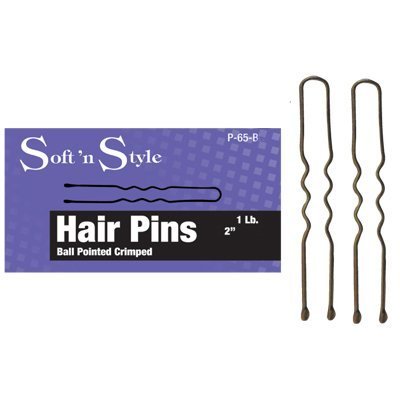
Pinning such a bun up can be done with regular bobby pins, which I happen to have. But bobby pins are fingernail-breakers and tooth-chippers. I would like to have the type of pin that’s kind of U-shaped. They look like this:
A humungous beauty supply store would seem to be the place to find such an object, wouldn’t you think?
Well. Yeah. But no. The only ones they have are black. My hair is bronzey-blondish-brown….about the color of those cheap brown pins you see above. Apparently Ulta thinks only Mexican and Black women grow their hair long enough to wear it up. Ay, caramba!
Moving on, at Michael’s I did find what I wanted, mostly: a small crochet hook, some pop-open knitting markers, and a (very good!) beginner’s how-to-knit book. They did not have a knitting needle gauge, which was annoying, but there’s no urgency to get that. So I load up on these and get in the line for the cash register.
This particular Michael’s is set up in the same annoying crowd-control way as a Fry’s Electronics, where they herd you into a long line and you wait for the next cashier who comes free. That, while the cattle-control mode is irritating, does speed things along. Or…it would, if they had more than one cashier.
The single woman they had at the cash register was one of those people who moves very, very, v-e-e-e-r-r-r-r-y-y-y-y-y slowly, as if she were swimming through molasses.
I mean, really. I know there are people who must have a physiological problem that prevents them from moving their arms and hands and legs at a normal rate of speed. And that’s OK. But why hire such a person as a check-out clerk??? Surely a big store like Michael’s must have some other job she could do well, be paid for, and not make the customers crazy. And is there some reason Michael’s can’t hire enough cashiers to put two on duty when things get busy?
A line of about ten people, four of whom were ahead of me, stretched back toward the store’s display shelves. More customers were joining the end of the line as the rest of us stood there. And stood. And stood. And stood. And stood….
It took this lady almost ten minutes to check out the woman at the head of the line. As one of the people in front of me stepped forward to take that customer’s place, I realized that even if Molasses-Woman could check out each person ahead of me at the rate of five minutes apiece, it would be close to twenty minutes before I would get to her register.
Screw it! I put the junk down on a display rack and walked out of the store, empty-handed and pissed as hell. And determined to order all those things on Amazon.
Next: Staples, thereinat to purchase a roll of clear packing tape, for the purpose of securing the lamp cord from roaming puppies. Miraculously, I find exactly what I want there and only have to waste about five minutes standing in line at that store’s cash register.
You’d think I’d be happy, no?
No.
Why? Because as I’m standing there waiting for the woman ahead of me to turn in about twenty empty ink cartridges to be refilled, I realize that if I’d known I was going to have to buy Bitter Apple instead of YUCK!, I could have gotten both items at a Target or at the huge Fry’s Supermarket that’s roughly on my route homeward from my Thursday morning business group meeting. If one of the stores did not carry the specialty item I wanted but instead offered me a product I could get almost anywhere, there really was no need for me to traipse to two places.
This insight makes me feel more bilious than I already feel, which is plenty dyspeptic.
Right across the way from the Staples in this mall is a small Pier One. I love Pier One — it’s always fun to go in there and look around. Maybe a visit to this sweet little emporium would clear my head of ire. So I walked over there.
Holy shit.
They’ve rearranged the merchandise, so of course you can’t find anything that you might want. And somehow, though they seem to have gotten rid of anything you’d actually WANT to buy, they’ve jammed the store chuckablock full of junk. There is SO MUCH CRAP in there that you can hardly navigate the place. At one point I spot some wine glasses (I do need a couple of wine glasses), but one couple (one little couple!) is standing in front of some stoneware trying to decide whether to buy it, and just those two people block the aisle so I can NOT approach the glassware!
I notice they still have the placemats that match the chair cushions I made from some curtains I bought there. One of the cushions could stand to be refurbished; I wonder if they still carry the curtains.
Apparently, they don’t carry curtains at all.
I ask a clerk who’s trotting along an aisle if they’ve stopped carrying curtains. He ignores me! By now I’m really, REALLY pissed, so I say something sarcastic like “Well, thank you so much” and start to stalk out of the store. He notices, apologizes, and points out the new curtain display, directly all the way totally on the FAR side of the store from where they used to be. And no, they do not carry curtains in the desired fabric.
Also needed are a few seat cushions for my outdoor chairs.
Pier One has always been THE place to buy seat cushions and decorative pillows. So I make my way through the thirty-inch-wide aisles to the cushion display, which they’ve also moved. There I see that they’ve hugely cut their inventory. The vast array of colors and patterns: gone. They’ve only got two or three choices, nary a one of which is very attractive.
Figuring I’d better buy at least a couple before they’re all sold out, I try to pull one out to look at it. But the aisle is SO narrow I can’t even get the thing completely out of the cubby they’ve stuffed it into. But I do manage to pull it out far enough to realize it’s too large. I leave the store empty-handed and no less annoyed than I felt when I walked in there.
This means the only remaining place in town to buy the kind of chair cushions I favor is Cost Plus. I stopped shopping in Cost Plus/World Market when they started requiring customers to sign up for one of those DAMNED membership cards to get a fair price on the merchandise. At one point along the line, I decided that I am not going to be made to share private information and I am not going to be forced to lie, in writing, on application forms so that I can buy things at a fair price. If your store makes me do that, I do not shop at your store. Hence I do not shop at Cost Plus.
There’s one word for all this, and it’s Amazon. Unfortunately, Amazon is not a very adequate answer: it doesn’t carry neat things like Pier One did (but then, apparently Pier One won’t be carrying those things, either…). And it gouges you for shipping unless you pay some outrageous annual membership fee that includes services and products that you don’t especially want. However, despite those drawbacks, in balance Amazon comes out on top.
Amazon does carry most things anyone could possibly want, and even if you decline to purchase an Amazon Prime membership, the cost of shipping is less than the cost of time wasted traipsing from store to store, fighting for parking spaces, searching for the merchandise you want, and standing in check-out lines.
Amazon diminishes our lives in some ways — we can’t get everything we used to be able to find in brick-and-mortar stores, and it kills jobs locally — but it does save time, hassle, and annoyance factor. And since most of us will take convenience over cost savings, stupid store management, and bad service, eventually Amazon will push all but the most distinctive and specialized of local merchants.

 You need to read this extraordinary short piece from The Economist. Folks, contrary to popular reports, America is not skateboarding toward Hell after all. Evoking Ronald Reagan’s campaign slogan, “It’s Morning Again in America,” the author contrasts the current doom-and-gloom mode of presidential campaigning with the more realistic vision of Warren Buffett and James Fallows.