Coffee heat rising

Warning: Toxic Cooking Utensils!

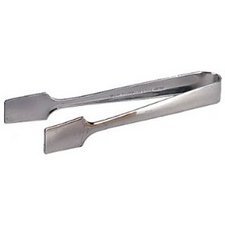
Wanna feel your jaw drop to the floor? Check out this label that came in the wrapping of two pair of cooking tongs purchased at Target:

P1020160

Got that? In case any of us is vision-impaired, let’s try that again, bf/cc/clc:

WARNING: Handling of the plastic used in this product may expose you to lead, a chemical known to the State of California to cause cancer, birth defects, or other reproductive harm. Wash hands after use.

Now you’ve got it, right? We’re talking about cooking tongs, the gadgets you use to flip chicken in the frying pan, to flip steak on the barbecue, to toss salad at the table. The only plastic on the things is a coating smeared all over the handles.

Even though this little caveat is in plain sight, I didn’t notice it while I was inside the Target store shopping for old-fashioned hinged tongs. It’s tucked away on the back side of the packaging, and of course one is careful to display the merchandise with the front of the packaging showing. I just grabbed it off the rack and ran. The “plastic” mentioned here is a kind of tacky surface, white on one pair and black on the other, applied to the handles of these tongs, presumably to make it easier to manipulate them. The old tongs we used to get in the grocery store had no plastic goop on them — they were just plain stainless steel. They worked just fine. No one needed or asked to have the handles dipped in a vat of lead-laced plastic. But apparently if it ain’t broke, we have to fix it.

Now I’ll have to take these things back. Like I had nothing to do but traipse to Target. Over and over and over again…

It’s beginning to look a lot like they don’t make plain boring scissors-style stainless tongs anymore. They all have some degree of coating on them, though to what extent its nature may be poisonous is unknown — at least, so it goes at Amazon. That means eventually I’ll be reduced to having to get used to the now ubiquitous tweezer-type tongs, which I hate but which at least can still be had sans stupid coatings. Aggravating.

Can you imagine? A freaking cooking utensil, coated with a toxic substance. In an American store that one would presume would come up to American safety standards. Get used to it, indeed: in the brave new world of globalization, if the Chinese, denizens of one of the most polluted countries on earth, will put up with it, you get to put up with it.

FlickingLemonOilAnother aggravation: English Lemon Oil for furniture has disappeared from the market. The only oil-type rub-0n furniture polishes still available are Old English and, in a very few places, Weiman’s. Old English lemon oil, my preference, is still available at Amazon, for 16-ounce prices ranging from $3.49 to $8.47. This once commonplace item no longer appears on retailers’ shelves. Period. I’ve been to Target, Safeway, Lowe’s, Home Depot, Walgreen’s, and Ace. Lo! no more Old English lemon oil, screw you very much. So now, having wasted a great deal of gas in the search, I’ll have to dork around with ordering it online.

Ridiculouser and ridiculouser.


{Grump!!!}

Spent half the morning compiling a round-up, interrupted about every thirty minutes by one or the other…interruption. Hit “publish” and…FOOP! Disappeared the damn thing.

Apparently I hit “Move to Trash.” And there’s no “Trash” link anywhere to be found in the dashboard. Jesse the Wonder-Guru is going to try to resurrect the thing. Later.

All of which makes me exceptionally crabby.

In brief, the one thing I really need to get online today: Many thanks to Miss Thrifty for hosting this week’s Carnival of Personal Finance and kindly including Funny’s squib on the art and business of panhandling. Love the Dr. Faustus theme!

Meanwhile…If you’d asked me I would’ve told you:

• The new J. Jill collection is weirdly reminiscent of the Sears clothing I knew and loathed during my misspent childhood: everything looks like your mother made it from Simplicity or Vogue patterns.

• We’re a day late and a dollar short in figuring out that the pending demand for long-term care is about to take this country on a skateboard ride to Hell.

• I love our cops. But I sure do hate cop helicopters buzzing our houses and being routed back and forth over residential neighborhoods all the time.

• Man is the noisiest animal.

• Being lured into buying stuff from some retailer is not the same as loyalty.

• Our brave new world gets creepier and creepier by the day. Make that “by the minute.”

• News about movie actors and rock stars bores me witless.

• Every time I hear another story about the Great Desert University I’m sooooo glad I don’t work there anymore!

• People who let their dogs run loose in public parks — especially when the dogs are chihuahuas and the parks are home to coyotes and rattlesnakes — are dumber than posts.

• There’s a special place in Hell for parents who give their kids weird names. Demons will torment them by forcing them, into eternity,  to spell their children’s bizarrely mispronounced monikers.

• Styrofoam is the world’s most annoying substance with which to make cups and plates. I’m pretty suspicious of it as insulation, too.

• Houses covered with stucco look like they’re deliberately engineered to look shabby in 10 or 12 years.

• The word “multiple” makes users sound like they’re speaking with their mouths full. And using the word to mean “two” or “a few” is just plain affected.

• Elected leaders who think it’s their government’s place to tell citizens how much soda pop they can drink lead me to wonder who on earth elected them in the first place.

• Chocolate is good for your health.

• Wine is good for your health.

• Working is bad for your health.

Do We Have More Expenses Than Our Parents Did?

At Surviving and Thriving,  a reader named Grace posted an interesting comment on Donna Freedman’s latest gracefully written post about generosity and about keeping perspective on one’s own problems.

Perspective is such an important thing, and one that we so often lose in the face of our personal woes. While I am quick to whine about my financial state, I do try to keep in mind that my parents reared their children, bought a home and had a satisfying retirement on far less than I make. Naturally, they didn’t have my expenses, but truth to tell, I shouldn’t have my expenses!

Our parents brought up their families, paid for a home, and had an adequate retirement despite never earning much…. They didn’t have our expenses, but…maybe we indulge ourselves. Oh, God. I can’t resist:

Really? Is that so?

My parents rented all the time that my father was working — partly because we lived overseas for ten years, and partly because my father felt mortgage interest was the biggest rip-off known to humankind. When my father retired, he bought a house in Sun City with cash.

The house my parents retired to would sell for about $71,000 today. In 2004, it sold for $110,000, considerably less than Zillow thinks it was worth at the height of the bubble, in 2005.

My parents bought that house in 1962. Let’s go with the $71,000 figure as the value of the house, although, relatively speaking, it may have been somewhat higher when the place was brand-new. In 1962 dollars, that price would be $9,235.  In 1960, the average price of a Sun City house was about $10,550 — and my parents’ house was one of the smaller models.

I think my father earned about $8,000 to $10,000 a year as a Merchant Marine deck officer with a license to sail any tonnage on any ocean. That translates to about $61,500 to $76,880 in 2013 dollars. And it’s probably low: today a tanker captain with an unlimited license earns between $120,000 and $200,000. However, toward the end of his career my father sailed, by choice, as first mate, because the job didn’t entail 24–7 responsibility for the ship’s operation and safety.  So, the lower figures are probably accurate. My mother occasionally took office jobs, but she wasn’t paid much — in today’s dollars, probably no more than about 18 grand. By the time my father retired, purchased a new car, and put me through college, he had about $130,000 left in savings; that would come to about $999,400 in today’s dollars.

If that estimate is anywhere near accurate, he was doing a great deal better than his daughter is doing.

Is it true that they didn’t have our expenses?

Well, my father paid for my tuition, room, and board at the University of Arizona. He gave me $1,000 a year to cover all my bills for the nine-month academic period. That’s the equivalent, in 2013 bucks, of $7,868. I paid the tuition and dorm bills, budgeted $10 a week for all my meals, clothing, laundry, and other incidental expenses, and, at the end of spring semester, came out about even. Today, if you lived on campus, it would cost you about $24,744 to attend the UofA.

So: check! There’s an expense he didn’t have.

The four-door Ford Galaxie he bought cost $2,500: about $19,980 in today’s dollars. Not much difference there: that’s what I have budgeted for the purchase of my next vehicle.

In 1962, the cost of gasoline was about 25 to 30 cents a gallon: $1.92 to $2.31 in 2013 dollars: about 2/3 of what we pay today, adjusted for inflation. Some savings there, but not as much as one might have expected.

A Porterhouse steak cost $1.19 a pound; hamburger was 45 cents a pound; butter, 67 cents a pound; baby food, 25 cents for three jars; carrots, 9 cents a bunch; asparagus, 19 cents a pound; potatoes, 39 cents for 10 pounds; corn, 5 cents an ear; onions,  29 cents for 2 pounds;  oranges, 89 cents for two dozen; bananas, 10 cents a pound; bacon, 79 cents a pound; Crest toothpaste, 50 cents a tube; Tide laundry soap, 59 cents.

How much would that market basket cost us today, if we paid the same amount in inflation-adjusted dollars?

• Porterhouse steak: $9.15 a pound (= $1.19 expressed in 2013 dollars) (Safeway has Porterhouse for $5.99 a pound just now)
• hamburger: $3.46 a pound (Bureau of Labor Statistics estimates average price of $3.055/pound for 100% ground beef in 2013)
• butter:  $5.15 a pound (BLS estimates $3.37/pound in 2012)
• baby food: $1.92 for three jars (at Walmart, 98 cents for two; that’s $1.47 for three)
• carrots: 69 cents a bunch (BLS estimate: 55 cents a pound, which would probably be about $1.10 a bunch)
• asparagus: $1.46 a pound (on sale at Safeway in 2011 for $1.28 a pound)
• potatoes: $3 for 10 pounds (in 2011, the federal government estimated you’d pay about $6.50)
• corn: 38 cents an ear (in 2012, $1 for 6 ears at Safeway; 17 cents an ear)
• onions: $2.23 for two pounds — about $1.12 a pound (last week I bought onions at Safeway for 88 cents a pound)
• oranges: $6.84 for two dozen (today’s price: 88 cents a pound; for 24 that would probably be about $10.55)
• bananas: 77 cents a pound (55 cents a pound, Safeway)
• bacon: $6.07 a pound (BLS estimate, 2013: $5.23 a pound)
• Crest toothpaste: $3.84 per tube ($3.67 at Kroger; $1.67 with a coupon)
• Tide laundry soap: $4.54, unknown quantity (2013 price: Costco, $17.49 for 170 ounces, high efficiency)

Let’s compare. In the comparison, though, let’s drop the laundry detergent, since we don’t know how much that inflation-adjusted $4.54 bought and since the new HE version would wash many more loads than 1962’s Tide would.

What would they have paid, in the same dollars we use, for their products, and what are we actually paying for those products today:

1962 vs 2013 prices

I swear: I’m not making this up!

If you express the amounts they paid in 2013 dollars and then compare what you and I would pay for the same products today, the total is…just about the same!

So no. Their day-to-day expenses were not a lot less than ours.

What about utilities?

Well, the average residential cost of electricity in 1965 was 2 cents per kilowatt-hour; adjusted for inflation, that figure would come to 15 cents per kilowatt-hour. In 2010, the average cost for residential users was 11.53 cents per kilowatt-hour. No bargain for our parents there.

Most homes had no air-conditioning, although we did have swamp coolers and window air-conditioners, which, like heating systems, were inefficient and expensive to run. And of course no one had ever heard of a DSL connection.

Average cost for cable TV: about $50 a month; in 1962 dollars, this would have been $6.50. But it’s moot: there was no cable TV in 1962 — television viewing was free. There was less advertising, too, we might add.

After much Google and Yahoo searching, I haven’t found a reliable figure for the base monthly cost of a residential land line in the 1960s. Today’s basic cost for cell phone service of $30 to $50 compares favorably with the  $45 landline cost claimed by Wiki Answers (there were no cell phones, of course), except…$45 would equate to $331 today, plus you had to pay extra for toll calls. Highly unlikely. If memory serves, I think the base residential cost was $8 or $10 a month, but any call to another area code, including one just a few miles away, would result in a long-distance charge, which could be pretty expensive. When we lived in San Francisco, my mother had to pay long-distance charges to call her grandmother in Berkeley, a 20-minute drive across the Bay Bridge. Assuming you rarely made toll calls, though, a $10 bill of 1962 would be $76.88 today — about what I pay Cox for a DSL connection and a landline.

If we moderns dispense with the land line, we can get cell service for a much more modest rate. We’ll have to pay for the phone itself — but that’s a one-time hit. And besides…the “phone” is not really a phone: it’s a tiny computer connected to the airwaves.

In 1968, a 23-inch color console TV cost $349; a quick conversion indicates this was the equivalent of $2,328. A 60-inch high-definition flat-screen color TV will set you back only 980 of today’s dollars at Costco. And you won’t have to deal with the recurring visits by the repairman that we enjoyed during the 60s.

The average salary from which our parents paid costs that were the same as or higher than the prices we’re paying today was $4,659 in 1965 — $31,082 in today’s dollars — and most households had only one salary: the man’s. Today’s intact families usually have two earners. In 2012 the average starting salary for new college grads (those who could get jobs…) was $44,259. For all earners, the average salary in 2011 was $42,980. But bear in mind: in many households today, two adults are working. In 2012, the average U.S. household income was $63,091 — twice what a typical married couple in my father’s generation could expect.

Think of that. They were paying the same or higher costs — sometimes much higher — for the same products and services we buy. But in many cases those products and services, such as automobiles that were unsafe at any speed and clunky hard-wired phones with extra fees for long distance and TV sets prone to snow, static, and spinning images, were decidedly inferior to ours. Overall the cost of living was not a heckuva lot less, when the monetary units consumers paid with are inflation-adjusted.

• Did our parents make far less than we do? Yep. In general.

• Did they have fewer expenses than we do? Not exactly.

• Should we have our expenses? Well, sure we should. Most of them buy the same services and products our parents had, only better in quality and lower in real cost. The only indulgence I can see in the expenses shown above is cable television — and many American TV fans have canceled that in favor of cheaper, less wasteful entertainment such as Netflix.

Maybe there’s a reason we live in bigger houses than our parents did, collect electronic gadgetry that would have been science fiction to them, and park two or three cars in the garage: we can afford them.


 

MORE Perp Hassle!

F’crying out loud, the ba*tards have sent me ANOTHER pair of subpoenas! Now they want me to show up in court at 8:00 a.m. on the 25th to testify about events of which I know nothing. Four days ago, they told me our hoodlums’ trial was vacated. Now it’s back on.

They’ve dropped the burglary charge, eliminating the only topic about which I can testify, and even in that event, I have little to say, because I never saw Mr. Avery‘s face — only the back of his head as the cops were dragging him, bruised and battered, to the paddy wagon. The other one, Mr. Mejia, never came anywhere near my house or me, as far as I know.

They have sent me eleven subpoenas! Each one threatens, alarmingly, to put me in jail if I don’t show up downtown to have my time pointlessly consumed.

They’re going after these two clowns for three counts (each) of armed robbery and nine counts of kidnapping and aggravated assault. I was not present when they stuck up the pawn shop, and, unless the county attorney’s office thinks cowering in some old lady’s garage is the same as kidnapping and assaulting her, I was not present at whatever happened to evince those charges.

This is starting to feel like more than a nuisance. Each of these subpoenas, one of which was delivered in person by a sheriff’s deputy, comes with an explicit threat to throw me in jail. Every one of them demands that I cancel whatever I have scheduled on the many days when they’ve called upon me to spend an unknown amount of time in a courtroom for no discernible useful purpose. If they drag me down there next week and the proceedings last more than a day, then it will interfere with a doctor’s appointment for the very painful condition I’ve been wrestling with for the past year. Assuming it’s once again continued, next month I’m supposed to go on a hike up the West Fork of Oak Creek, a one-time opportunity (also assuming I can walk that far by then…); I may have to cancel the trip if I get a subpoena for a day or two beforehand.

I guess whenever the sun comes up this morning, I’d better to call down to my ex-husband’s office and see if I can hire a lawyer to bring a stop to this.

Like I have nothing else to spend $200 an hour on…

Counting Our Blessings…with a Grain of Salt

OldBeggar1Over at Blue-Collar Workman, TB was listening to a relative bellyaching when he happened to glance out a window and see someone begging on the street. This led him to reflect that most people’s complaints can look mighty petty when compared to real problems, like homelessness, unemployment, and poverty.

It’s true we should count our blessings, and that whatever problem we have, someone else has a worse one.

I’m skeptical about folks begging on the street corners, though. Two reasons:

1) A police officer who surfaced in one of my classes advised that one should never give street-corner beggars money, because most of them are drug addicts seeking cash to buy more dope. She also said they often have an organized system for allocating the most profitable corners — her description of this was pretty eye-opening.

2) Consider how much you could make if you parked yourself at the right corner or haunted the right parking lot. Twenty bucks an hour, maybe? That’s more than some of us earn on the job. If you’ve got welfare and food stamps, $20 to $50 a day, tax-free, would make for some decent pocket change; $20 an hour — unreported — would provide  you with a decent living, especially when combined with government benefits.

For a panhandler to make $20, only two people would need to hand him a ten; only four would need to give him a fiver. And some people, you can be sure, do fork over a $20 bill — because, after all, that’s what comes out of the ATM.

There’s a guy who takes up a post outside the local Safeway, a would-be busker. He sets out a hat and plays the saxophone. Safeway employees chased him off the parking lot, so he does business on the sidewalk at the entry to the lot. Problem is, the guy can’t play. So his serenades consist mostly of ear-splitting sour notes. It sounds like an eight-year-old’s practice session. He’s a friendly sort, though, and will chat amicably with you if you say hello. A lot of customers go out of their way to carry hand-outs over to him.

It’s hard to know how much panhandlers actually earn, for obvious reasons. One sociological study suggested that beggars in Toronto made about $300 a month, although the authors admitted their subjects may have been low-end earners, in contrast with a Toronto journalist who, for an investigative story, lived on the streets and reported earning $200 a day.

Tales of middle-class and better income from panhandling are highly anecdotal. The Huffington Post, the Internet’s answer to The National Enquirer, once reported that a guy in Oklahoma City was earning $60,000 a year at panhandling. More credible is a study done by Coos Bay, Oregon, police showing that panhandlers outside a local Walmart were earning $300 a day — as much as the employees inside the store earned in an entire week.

Overall, though, apparently it’s not a high-income endeavor. In the first place, even if you did earn, say, $200 or $300 in a day, income would be sporadic, at best. And it’s unlikely your average panhandler sticks at the job eight hours a day, fifty weeks a year. Too, while many panhandlers are not homeless, most have substance abuse problems or untreated mental health issues.

Experts on homelessness and poverty recommend donating your money to organizations that feed, clothe, and house the homeless rather than forking over spare change to street-corner beggars. Of course this doesn’t help people who don’t want to stay in homeless shelters, for any number of excellent reasons. But at least it doesn’t transport your cash straight to some junkie’s drug dealer.

How do you respond to panhandling? Do you give money to people asking for a handout? Have you ever thought about  panhandling yourself?

Image: The Old Beggar. Louis Dewis, 1916; painted just outside his clothing store in Bordeaux. Public Domain.


Queen of the Universe in Action

The Human, also known as lady-in-waiting to the Queen of the Universe, is whipped. What a day!

P1020085Did you notice that the Queen hit the big time? Yes. Hufflepup, newest entry in the Cuteness Derby, was amused by her Majesty’s habit of ordering the lady-in-waiting around. So, if Her Majesty needed a moment of fame, now she has one.

The Queen approves Hufflepup’s attempts to train his own Human, who apparently is even more refactory than the lady-in-waiting. Gawdawful amount of work, these humans, aren’t they?

This afternoon her Queenship deigned to bathe, the weather having reached an acceptable 80 degrees. The Royal Bath is always quite a production, involving the human trying to soap and rinse the Queen and the Queen taking off like a rocket. The Queen has an allergy to water.

Luckily, I learned a few handy clues from this video illustrating the grooming of another member of the corgi aristocracy.

First, I nabbed the idea of giving her a preliminary spray of diluted hair conditioner (don’t be fooled: conditioner is conditioner is conditioner, doesn’t matter whether it’s dog or human). As suggested, let it sit on her coat for 20 minutes before pouncing her for The Bath.

Then, I really like the idea of scrubbing her, without wetting her down, using a wet sponge with a dab of shampoo. This worked very well, with a lot less doggy trauma than soaking her in the hose and scrubbing her with large squirts of soap.

This was an easy way to clean fur in general and desperately filthy spots in specific, and it worked without disturbing her noticeably.

That meant the only real moment of terror for Her Majesty came when I had to rinse her off in the hose. First I poured a half-gallon of vinegar water over her soaped fur, which helped, in our hard water, to speed the horrible rinsing process. The result: it didn’t take long to rinse out the shampoo.

P1020091The Queen’s fur looks very lovely: fluffy and bright white (as appropriate) and rich brown and frightfully clean. And damp…she takes forever to dry. Blow-drying her this afternoon took some of the water out, but as usual it’s required a full day for her to come back to about normal.

Spent two hours at physical therapy this morning. While the boss was away, the mice decided to play: an excellent new employee decided to focus on whatever the hell ails me. She showed me a bunch of new exercises and worked on the endlessly painful hips, which seemed to help a lot.

Wrestling with the Queen didn’t help to preserve that improvement, alas. And there there was the fact that I haven’t cleaned in three weeks and so was reduced to vacuuming, dust-mopping, and steam-mopping 1860 square feet of tile this afternoon. This, after a bookkeeping frolic and a file-updating frenzy.

Since I worked until 2 this morning, I started out tired. And now am very, very tired.

And so, to bed…