My late, great associate editor and de facto business partner Tina has a good shot at a full-time editorial position at the Great Desert University’s business college. It’s incredibly good news. The presumptive boss managed to extract an assistant editor’s line from the university despite the dire economic conditions. It means this is someone with enough political clout to get money when no money is there.
I just spoke to the woman and rhapsodized about the kid’s overall genius and entrepreneurial touch. She sounded impressed. Let’s just hope she’s impressed enough to hire!
Last weekend my now-former research assistant, who bought a house in the neighborhood shortly before Her Deanship announced the university would close our office and can us all, reported that the house was burgled while she and the kids were at church. The burglars missed her laptop, which was recharging in an out-of-the-way spot in the family room, but they did grab her husband’s laptop and cleaned out all her jewelry, most of which consisted of keepsakes from her mother.
Understandably, she’s feeling pretty disturbed and vulnerable, especially since the burglars entered with ease through the carport door. Apparently popping the lock was so easy, the cops said they couldn’t even find any evidence of forced entry. She’s taken to putting a piece of Scotch tape at the door’s threshhold so she can see whether anyone has entered before she goes into the house.
Even though our area is relatively safe compared to some parts of the city, no neighborhood is immune to burglaries and home invasions. I personally resent and resist living behind iron bars, glaring lights, and shrieking alarms. It’s the criminals who belong in jail, not us!
Over time, I’ve developed a number of strategies to minimize the risk of burglaries and the damage done if a perp gets into the house. Some of these are psycho-philosophical, some are mechanical.
On the philosophical level, I’ve adjusted my attitude about break-ins. Except for the dog, the stuff I have in my house is junk. Most of it is low in value—the only things that really matter are the computers, and even those are not the point: what matters is not the computer; it’s the data in the computer. The data can easily be backed up onto a flashdrive and carried around on one’s keyring, thereby protecting the only truly important inanimate object in the house.
So. My attitude is that I don’t much care if the burglar comes visiting, as long as he stays out of the house while I’m here. I don’t want a home invasion, several of which we have had in this neighborhood, because anyone who knowingly breaks into your house while you’re there doesn’t mean you any good. But otherwise…meh!
For my home office, I installed a solid-core door and a heavy-duty pick-resistant lock whose bolt slides through the framing into the stud next to the door frame. While it’s not 100 percent burglar-proof, it sure will slow the perp down. Outside the window, which faces the street, I planted the thorniest, fiercest roses I could find, and this spring a man-eating bougainvillea may join them. Most burglars would rather enter where they can’t be seen, and obviously they’d prefer an entrance that is not going to leave them bleeding.
From the guys who put the elegant lock on my office door, I learned that most locks are very easy to open. The lock they installed will break the perp’s drill bit if he tries to drill the lock. Trouble is, it ain’t cheap. On the other hand…what’s peace of mind worth?
Other than discouraging entry to my office in my absence, for me the trick is not to make unauthorized entry impossible but to force the perp to make enough noise to alert me if I’m here when he tries to get in. All I want is enough lead time to get out a different door and run down the street—or to barricade myself and the dog inside the office behind the pick-resistant lock so that I can call the cops or, if the phone’s disconnected, climb out the front window.
On the front entrance, I installed a low-end security door, purchased at Lowe’s. The problem is, the locks you buy at big box stores are just ordinary door locks; even the best are simple to defeat. Though the metal door itself is pretty strong, it’s only as burglar-resistant as the lock. To get a security door that will really deter burglars, you have to buy a specialty lock and have a locksmith install it. So, I think of the security door as something that will slow the burglar down a bit and cause him to make enough noise to alert the yapping dog while he’s trying to get in. Here, the point is to let me get out the back door while he’s trying to get in the front.
My house, like my RA’s, has several Arcadia doors, and all the the windows are also sliders. These, as we know, are extremely vulnerable. Some people install bars over the windows and double-wide security doors over the sliding doors. This strategy is counterproductive for two reasons:
• Barring intruders from getting in through a window means you also bar yourself from getting out during a fire. The idea that a set of bars will have locked release catches and in an emergency you’ll find the key, unlock them, and then climb out is highly problematic. In a fire, smoke can cause true black-out conditions. If the power is out, as it’s likely to be once a fire gets going good, you can find yourself trapped in a bedroom with no light, even if there’s little smoke to blind you. Children in particular are likely to panic in these conditions and not be able to find the key or remember how to work it. Personally, I’d rather go mano-à-mano with the burglar than die in a fire.
• Security doors are not at all difficult to break through. All it takes is a crowbar.
La Bethulia had those one of those double-wide security doors put over an Arcadia door in the back of her house. She went out to dinner for about an hour one evening and when she got back some guy had pried it open and had a nice visit. The locksmith told me he felt they’re a waste of money because they’re way too easy to break into, and that for the cost you’re better off installing an alarm system.
A sliding door or window can be secured pretty well in one of several ways:
• Put a piece of doweling in the track along the bottom. This makes it impossible to lift the door and slide it open. An alternative is to drive a small metal screw into the metal frame at the top of the door, tightening it just enough that the head of the screw clears the top of the slider. This also will block a person from lifting the slider far enough off its track to slip the lock and push it open.
• Install two sliding bolts, one that slides downward into a hole drilled in the concrete slab or window frame, and one that slides upward into the frame above the door or window. Be sure the bolt on top side of the door is long enough to slide well into the wood frame. If you place them intelligently, they’re hard or even impossible to see from outside, and so this will usually discourage the perp.
• Get screw-on locks made for sliding doors. They come in two varieties: one with a little lever that you just turn to tighten the device down, and one with a key lock. However, remember that everyone in the house, including children and the very elderly, needs to be able to get out in a fire. These things mustn’t be tightened down so much that a kid can’t get it open quickly and easily, or out of a child’s reach. Better to lose the jewelry and the computer than the kids.
On all my sliders, I use both screw-on locks and dowels in the tracks. To get through a door or window that’s been secured in this way, you have to make some noise. Chances are, you’ll have to break the glass. Many burglars prefer not to break windows, because the noise can draw a neighbor’s attention. In any event, if you’re home, the sound of a man struggling to defeat these devices or breaking glass to get at them will alert you so you can get out before he gets in.
To add to the noise level, you can get inexpensive battery-run alarms that you can attach unobtrusively to sliding doors and windows. I found a lifetime supply of the things at Costco; no doubt Lowe’s and the Depot have them, too. They glue on. When the little switch is in the “on” position, the alarm emits an ear-vibrating shriek when the door or window is opened. Not a true burglar alarm, of course, but it’s enough to wake you up if someone tries to get into the house.
Just knowing that you’ll be alerted is usually enough to give you some peace of mind. I have them on all my sliding doors and windows, and on the dog door cover. Because, when the weather’s nice, I like to sleep with the front door open and the security door locked, I even put one on the security door, so it will go off like a banshee if someone drills that lock.
Should the burglar come a-calling while I’m out of the house, I’ve left a few treats around for him. For example, I have some check pads for old bank accounts that were closed years ago. I put a few of these in easily accessible drawers. If he finds them, he’ll think he’s scored a whole pad of negotiable instruments. An ancient Toshiba laptop, so superannuated it’s useless today, sits out where it’s easy to find. And I’ve also left a few fistfuls of cheap costume jewelry in a couple of drawers.
The things my mother gave me, which aren’t worth much but which I’d like not to lose, are hidden in strange places—yes, you could find them, but it would take some time and effort, both of which are in short supply for burglars.
Truth to tell, many burglars are fairly benign. They don’t relish violence—that’s why they burgle rather than mug, rob banks, or deal dope. My feeling is that if some guy wants to make off with the priceless necklace I made with $20.00 worth of stuff from the craft store, bully for him as long as he stays out of the house when I’m home. A few alarms and extra locks will keep you safe from intruders while you’re in the house, and as for the rest of it…BFD!
Now that Medicare is coming up, I have to find an insurer from whom to buy a Medigap policy. Yesterday I found an unexpected and valuable resource for insurance consumers, which I’ll describe below.
First, by way of background for those who have not yet enjoyed the privilege of trying to navigate the astonishing maze that is Medicare, the system works like this:
You can choose “Traditional” Medicare, a type of indemnity plan cobbled together with Medicare Part A (which covers approximately 80 percent of most hospital bills and which is free) and Medicare Part B (covering a certain amount of but not all of your doctor’s bills, at a cost of about $95 a month); or you can choose an “Advantage” plan, which is basically a private HMO with all the benefits and risks associated therewith. Most people feel the “traditional” plans are worth the extra cost.
If you go the “traditional” route, you must also buy a “Medigap” policy to cover the significant amounts that the government policy does not provide for. Medigap policies are standardized plans that come in a dozen flavors, from Plan A through Plan L. An hour or two of poring over the rules and features will reveal that Plans C and F are probably the only way to go—these are the plans that cover most or all of the things that Medicare proper does not cover. I’ve decided that Plan F is best, because it not only picks up the 20 percent missed by Plan A, it also will cover so-called “excess” charges for doctors who think they should make a living in the practice of medicine.
Now. Because these plans are farmed out to private insurance companies, the market is just. freaking. insane! The plans are all the same; insurers are required to offer identical plans with identical benefits. But the prices are all over the map. Here in lovely Arizona, for example, you can pay anything from $93/month to $417/month for the same plan!
The state Insurance Department hands you a booklet showing premium comparisons. It’s forty-six pages long!!!!! You have to sift through fifty-three insurance companies, trying to figure out which offers what plans for how much, and which companies are reliable and which are likely to rip you off or give you a runaround.
It takes hours and hours to parse through all this stuff.
I figure I can afford $150/month at the outside. Thirteen companies in Arizona offer Medigap policies for $150 or less. So, I made a table, preparatory to telephoning every one of these corporate horror shows. In it, I made room for a price comparison, notes on conversations with CSRs, and notes on Google, Better Business Bureau, and Consumerist reports. Then I spent about four hours trying to track down information on the thirteen likely vendors.
While stumbling around in Google, I came across a consumer service offered by the Texas Department of Insurance. Go to this page and you can search for an insurance company. Because Texas is famously huge, most insurance companies of any significance do business there. Enter, for example, something like “Lincoln Heritage,” and up will come a long page showing contact information (including headquarters addresses and phone numbers, plus names of company officers), financial information spanning the past three years, links to four financial rating organizations, a summary of the company’s history, and…ta da! complaint records!
Yes. Texas tells you how many complaints each company has registered in each of several underwriting areas and also calculates a “complaint ratio” and a “complaint index,” showing how the company’s complaint history compares with those of other insurance companies.
This, as you no doubt recognize, is platinum-plated data.
Thanks to the Texas Insurance Department and the Better Business Bureau, I’ve narrowed the preliminary search down to five companies with clean complaint histories and a likelihood of staying in business for a while:
Assured Life: $97/month
Loyal American: $138/month
Sterling: $139/month
United of Omaha: $93/month
USAA Life: $129/month
Amazingly, the cheapest companies appear to deliver high-quality service—Assured, run by a fraternal organization, and United of Omaha, associated with Mutual of Omaha, have the cleanest complaint records all the way around. So I’m hoping one of those will do.
The cost of this is just breathtaking: take $96 for Medicare Part B and add a bare minimum $93 for Medigap and you’re already up to $189, more than I’m paying for COBRA! And then I still have to buy Medicare Part D, the prescription plan, which is around $50 a month with a $250 deductible!!!!!
What I don’t understand is why the pathetic State of Arizona, whose administration by and large is a joke, can manage to provide employees an EPO for $39 a month that covers almost every doctor in the state (including the pricey Mayo Clinic) and provides prescriptions with a $15 copay, but the vast and powerful federal government can’t manage to engineer better rates than this. Now it must be admitted that if you had to pay the full freight for COBRA, that EPO would run almost $500 a month, and that the retirees’ cost for it is $400 a month.
So…maybe $240+++ a month that of course I do not have and will not have for the duration of 2010 is a bargain. But still….
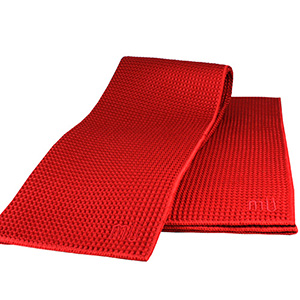
Tammy points out that you can make napkins from bath towels and face towels, among other handy sources of fabric. When I’m here alone, one of my favorite napkins is a waffle-weave dish towel. They’re very absorbent, soft on the hands, and big enough to cover your lap generously.
If you have a family and would like them to behave as though they live in civilized society, it would be very easy to snip a waffle-weave towel into napkin-sized pieces and seam the cut sides. You could get two out of a single towel, and since they only cost about three bucks apiece, this is highly cost-effective compared to buying finished napkins. They come in lots of colors and designs, making it easy to find something that goes with your decor.
Beth points out that it’s easy to make one of those microwaveable warmth bags with a sock and some rice (oatmeal works handily, too). These things are great. She also contemplates various ways to apply ice to sore muscles and bruises.
If you’re not repulsed by the presence of plastic, a convenient way to make an ice pack is to dampen a paper towel (you could use a cotton washcloth or towel, of course!), lay it flat inside a ziplock bag, zip the bag tightly shut, and freeze it flat in the freezer. The result is much less messy than a plastic bag full of ice cubes—doesn’t leak as the ice melts—and as it softens you can mold it around a sore body part. To keep from applying extreme cold directly to the skin, wrap it in a light towel (such as a cotton flour-sack towel) or a napkin.
I find these work exceptionally well for migraine headaches. Yes. Weirdly, an ice pack may ease your migraine. Whatever works, works.
The City of Phoenix, strapped to the point of having to lay off firefighters and police officers, has decided to institute a sales tax on food sold in grocery stores, which we’ve never had before. The new bite will be 2 percent, added on top of the existing 8.3 percent tax we pay on every other retail item.
This will raise our retail tax, effectively, to 10.3 percent.
Doesn’t stop there, though: the state is about to float a referendum asking taxpayers to approve a “temporary” (har har!) 3 percent sales tax. This would raise our extra gouge in the grocery store to 15.3 percent!!!!
Holy mackerel.
It could pose a bit of a problem for me. Depending on how you look at the post-canning finances, over the course of a year, either I have almost no wriggle room or I have a fair amount of budgetary play. Because I don’t know which and will not know until a year passes and I see what happens, the only responsible tack I can take is to assume the worst: a very tight budget, indeed. In that case, an abrupt jump in costs for food and daily necessities could be a headache of marathon migraine proportions.
The only way for me to cope with an increase like that will be to ask SDXB to buy my food and household goods at the commissary and base exchange, where he pays no taxes.
This will be extremely inconvenient, because it will mean a) I will have to wait on his convenience, and he only shops about once a month; and b) I’ll have to drive way to Hell and gone out to Sun City to pick up my groceries. There’s also the issue that SDXB, being the extremely manly sort, doesn’t pay any excess of attention to what the Little Woman wants. I can ask him to get X and only X, and I’ll end up with Y because he decides to substitute something he thinks is just as good or to buy me something that I explicitly say I don’t want. He doesn’t see any reason, for example, why anyone needs soft toilet paper and absorbent paper towels, and so when I ask for Charmin’ and Viva I get cheap TP in short rolls with the texture of newsprint and cheap paper towels perforated every six inches that are about as absorbent as wax paper.
While he can get me into the BX if he’s not dragging New Girlfriend around, he can only take a certifiable wife into the commissary. Fortunately, NG has a place in Colorado and so is gone a lot. Also, these serial girlfriends never last very long, so I don’t expect she’ll be barring the door to the BX forever. In theory, I could go out to the base with him and buy household goods in the BX and then send him to the commissary to pick up food.
First crack out of the box this morning, it was off to the credit union at the (relatively) nearby West campus, there to hand-deliver 15 pages of paperwork.
Well over a month ago, M’Hijito and I had asked to negotiate a loan modification of the downtown house’s mortgage. They asked for evidence of every deep breath we’d taken within the prior 30 days, which after much thrashing around we scraped together into a big digital pile and e-mailed to them.
Well, this mound of debris reached the loan lady one day after the credit union outsourced its loan management. So now, instead of the six-day turnaround on a decision we had been promised, we were told there would be a one-week “blackout” on all information coming from this outfit, and that after that…they had no idea what would happen.
Weeks went by: nothing.
So I called Loan Lady the day before yesterday and asked her voicemail if I was correct in assuming that silence means “no deal,” since we would need to figure out how to pay the mortgage or decide whether we should take a walk, given last month’s munificent earned income of $161.
Within hours, comes a call from Higher-Up Loan Lady, who says that the credit union is “taking some loans back in-house,” among them ours, and would we please send the entire mound over again, only add written proof that I actually was canned and update several other documents, now gone stale. Translation: “we lost your documents.”
Of course, the fuck-you-very-much announcement on ASU letterhead was not in digital form. The new printer/scanner refused to scan it. So that made it impossible to e-mail the new pile of junk, which took a good half-day in the collecting and updating. The new printer/scanner doesn’t have a FAX, and even the old printer/scanner/FAX machine would not talk to Cox’s modem and so would not have sent a FAX anyway. She suggested I either mail it (about $2.00 worth of postage) or take it to the credit union and get them to FAX it.
I chose the latter. This ensured that someone there actually saw to it that the documents went through, and they gave me the printout of confirmation showing the stuff reached Higher-Up Loan Lady. The cost of the gas to drive over there—about $2.53—was probably as much as or more than the cost of postage, but at least it ensured that the pile of paper didn’t disappear again.
Despite the annoying waste of time and gasoline, this junketdid allow me to take advantage of a serendipitous occurrence of the Money Happens phenomenon.
A few weeks ago, a client gave me a $25 gift card to Fry’s grocery stores, a nice little under-the-table lagniappe. I never shop at Fry’s, because the two stores in my general vicinity are located in pretty threatening neighborhoods. After the manager of the restaurant in the Fry’s shopping center at 19th and Glendale was murdered by thieves, I quit going there. On the way to ASU West, though, I passed a store in a working-class neighborhood that looked pretty safe, and so decided to spend the money there.
Not bad. For $20 I nabbed milk and eggs with which to make some excellent biscuits for breakfast, a small stoneware bowl of the sort I’ve been needing for a while, a bag of chunk hardwood charcoal, and some produce. The pork, much needed for Cassie, was ten cents a pound higher than Safeway’s, so I passed on that. But I did find a pair of kitchen tongs with handles, not those chopsticks on a spring that are currently popular. Real tongs have have turned into a hard-to-to-find item, as I discovered when my ancient pair wore out.
Yesterday I had a meeting that took place after I finished teachingin the middle of the afternoon. Because I couldn’t afford to have lunch out even if there were something available on the campus that I’d want to eat, by the time I stumbled in the door I was dead starved. It was evening by the time I’d fed myself and the dog taken the dog for the required doggy-walk and added more acid to the pool. Then I had to wrestle with the mountain of paperwork (above). After that was ready to go, I
was sooo tired I sat down to relax by working on a pencil drawing I started yesterday. The next time I lifted my head, it was quarter to eight and I was an hour late to choir practice.
Started to climb into the car to race down to the Cult Headquarters, but with the garage door open and the engine on, I realized I just couldn’t do it. So went back in the house and missed practice. Now I’ll be in the doghouse again. Oh well.
My beleaguered former RA, who lives just a few blocks from me, was burgled last Sunday. They stole all her jewelry—most of it sentimental gifts from her mother with little monetary value—and her husband’s laptop. {sigh} This neighborhood is under siege from the cockroaches who inhabit the tenements across 19th Avenue. Burglaries are as common as falling leaves around here. I’m almost inclined to go back up to the pound and see if that fake “bloodhound” is still there. Whatever he was, he was no bloodhound. Neither did he appear to have any pit bull in him. But he was big enough to mean business, or at least to look like he might.
I don’t know. I can’t afford another dog. Just feeding me and little 25-pound Cassie is a challenge. On the other hand, I can’t afford to be burglarized, either.
Speaking of the neighborhood, when I got home late yesterday afternoon a carpet cleaning crew was over at Biker Boob and Bobbie McGee’s house, overseen by a hulking bruiser of a man swaggering around in a wife-beater. Turns out said bruiser was a great big, charming gay guy who is a Realtor. He strolled over to introduce himself and say Boob and Bobbie are history and he’s putting the house on the market. He’s asking $239,000, substantially less per square foot than the $285,000 our local Real Estate Empress is trying to get for the same model two blocks to the north and west. He said the place is in pretty bad shape and needs a lot of fix-up.
Not surprising.
As sweet as Queer John was, at one point he had five men living in there with him. (QJ was the original renter, an affable little guy but pretty nuts.) After QJ was chased down in a dramatic pursuit through the neighborhood and hauled off by a team of five cruisersful of cops, he was replaced by Biker Boob and his lady, Bobbie McGee, a raunchy cowgirl given to dumping car trunkloads full of mystery garbage in the big trash bin behind my house and Sally’s. We figured if whatever she was stuffing in there (neither of us cared to tear open the bags to see what it was) couldn’t go into the bin behind her house, it probably wasn’t supposed to go into the city garbage bins at all.
According to Zillow, $239,900 is what the present owner, who lives in upstate New York, paid for that house in 2004. He must figure the market has recovered enough to unload an ill-advised investment. Let’s hope he’s right!
While fooling with the Excel files yesterday by way of cranking the new reports the CU wanted, I made an interesting little discovery.
In January, I only spent $1,698. Multiply that by 12 and you get an estimated 2010 expenditure of $20,376. Optimistic, to be sure—summer power bills will raise that by about $200 a month, adding approximately $800 to the projected total: $21,176.
But if you include the tiny drawdown I’m taking from ASU’s 403(b) plan so as to qualify for the state’s sick leave payment (the net is only $385 a month), you come up with this net income:
“Pension” net: $385 x 12 = $4,620
Social Security net: $1,000 x 12 = $12,000
Net teaching income: $14,400 – 25% = $10,800
$4,620 + $12,000 + $10,800 = $27,420, projected net income
$27,420 – $21,176 = $6,244 positive cash flow for 2010
That’s a far cry from the $1,400 year-end balance I estimated by manually adding up all my projected costs, month by month, and subtracting them, month by month, from projected income (and, during the summer, nonincome).
So far I haven’t been able to account for the difference. I think I’ve included all predictable costs. The $1,698 January expenditure includes the $314 I had to cough up for COBRA, significantly more than either COBRA or Medicare will cost after this. The only thing I can imagine is that my month-by-month estimates of what the community college will pay must be wrong. But they couldn’t possibly be wrong by $4800…that doesn’t make sense.
Time will tell. If the shorthand calculation turns out to be correct, maybe I won’t have to teach three-and-three!