Coffee heat rising

Employer Beware: Here come our students!

Holy mackerel.

I gave a student a gentleman’s B on an extended definition assignment — an 80 when in fact the paper was worth at best about 75 points and in fact was eligible to have 100 points deducted, leaving the poor lad with a goose-egg.

But because it’s an online course — they do have difficulty learning this stuff on their own, without someone to draw pictures on the whiteboard and explain it over and over in every iteration the instructor can think of — I’m giving this bunch the benefit of the doubt. This has been especially so for the extended definition, which is a difficult genre even for upper-division students to get their minds around, and for MLA style, to which many of them have never been exposed in their entire lives.

So a day or two after I ship this thing off to the little twit, feeling some misgivings about the generosity of the score, he e-mails me back to complain and ask what on EARTH he did wrong, since he carefully followed the MLA style guidelines shown at Purdue (no, he didn’t) and he didn’t think the paper was unfocused, as accused.

Argh.

I just finished explaining all this to the kid, in writing. To do so entails writing MORE copy than the student had to write for the assignment itself!

Original comment, tossed off quickly but IMHO right on target:

Okay, first off you’ll need to learn how to cite a source using MLA style. Please read the chapters assigned in the textbook on this subject. If you haven’t bought the textbook or it doesn’t help, then an excellent site to learn these techniques and to see examples is the Purdue OWL. It has an entire section explaining MLA style: https://owl.english.purdue.edu/owl/resource/747/01/

Second, it is best to avoid the dictionary definition. With your essay, I can see why it would be useful to give comparative definitions, but it’s best to find a different way than relying on the dictionary.

And third, your body paragraphs do not tell a cohesive story. In some ways you showed what those for and against gay marriage believe. A more interesting and effective approach may have been to define gay marriage in terms of its legal, fiscal, and religious implications. It appears you have sources for this. This way your essay would be less of a “debatable” topic and more presenting some important facets of this definition.

New comments…

[Student opens essay with two insipid dictionary definitions, knocked off (one without quote marks) from Merriam-Webster Online. The subject matter is same-sex marriage, an insipid topic much favored by high-school teachers and English 101 instructors, and so the paper is probably recycled for this assignment.]

This is a direct, word-for-word quote. Even when you give the source, you STILL have to put quotation marks around strings of words that are directly quoted from the source: Marriage: “the state of being united to a person of the opposite sex as husband or wife in a consensual and contractual relationship recognized by law.”   In writing an extended definition, it’s best to avoid using a dictionary definition, but if one feels one must, one at least ought not to start out with it.   

I’d make a new paragraph here, since you’re switching subjects a bit.

Also, it is best to avoid starting with the dictionary definition.

[Student comes to the end of the introductory paragraph with no sign of a thesis statement anywhere in sight.]

Okay. Now let’s think about where we are at the end of this opening paragraph. We’ve set up a kind of contrast between two dictionary definitions (one of heterosexual and one of same-sex marriage) and we’ve said that some people resent the idea of same-sex marriage as an affront to what they believe are the moral values of the United States. But – and here’s the big but – we haven’t established our own definition of anything.

As it stands, the thesis statement says that some people are offended at the idea of same-sex marriage, and that might work for  a report on the state of moralistic huffiness about this issue. However, the point of an extended definition is to present your own interpretation of what something means, an interpretation that goes beyond a mere dictionary definition. Thus, an extended definition’s thesis statement should put your definition (i.e., your interpretation, your personal spin, or your insight) in a nutshell.

One could have any number of definitions of marriage. For example, you could define it as solely a legal arrangement and argue that in a country of laws, that is all it is and the government has no business imposing religious definitions of marriage on those who do not subscribe to a specific religion – the U.S., after all, is not a theocracy. You could go the other way around and argue that marriage is more than a lowly human legal contract but instead has spiritual implications that go far beyond legalities, and so it should be a special case. 

In either event (or in any other event you can dream up), your interpretation needs to appear up-front, and it needs to drive the rest of the paper’s argument. In other words, your interpretation drives the point you want to make, and so it is the thesis statement, or at least a crucial part of the thesis.

[Student inserts an in-text citation: (Peter Sprigg, 2012).]

So what we want to do here is use only the author’s last name in the in-text citation; if there’s more than one author we’d use their last names up to a point…I think in MLA style it’s six, but look it up; after six, use the lead author’s last name followed by et al.: (Sprigg, 2012); (Sprigg and Twigg, 2012); (Sprigg, Twigg, and Busch, 2012; Sprigg et al., 2012).

[Student writes, “Mr. Sprigg claims that…”]

In academic writing, just use the person’s last name for this context; no Mr. is needed.

[Student regurgitates Sprigg’s reasons for opposing same-sex marriage, one of which is mildly specious and three of which are downright silly.]

Okay, it’s all very nice that Sprigg makes these claims, but how is it related to the definition of straight or gay marriage? And why should we buy these claims, which on their face are pretty silly? The Social Security issue could be a valid concern; the others, not so much, since people who are unhappy in marriages usually leave, whether or not they can settle down in wedded bliss with their same-sex partners; same-sex partners regularly adopt or obtain custody of children and raise them, and the fact that those partners’ relationship is legally recognized is unlikely to change that. So…what do Sprigg’s points have to do with anything? Especially with how marriage (straight or gay or both) is defined?

[Student rehashes the arguments of someone taking the pro-gay marriage stance; in doing so he mentions the claim that legalizing gay marriage is an attack on the institution of marriage itself.]

Ah hah! Here’s something we could use as a thesis for an extended definition. We could make the claim that the institution of marriage itself has a specific set of criteria that exclude same-sex unions. Note, though, that making that claim, while it would give us a definition to work with in this essay, would not of itself lead to the conclusion that legalizing same-sex unions and calling them “marriage” will result in the end of civilization as we know it. To do that, we would have to define marriage as the basis of and the bulwark of the entire moral and ethical construct of Western culture. That could be done…but to do so, we would have to say it in so many words.

[Student brings up recent cases in Arizona and New Mexico.]

Okay, we’ve got some good research here. But for the paper per se, we’re still in a kind of debate mode: yea or nay on gay marriage. We haven’t come up with an original point of view on marriage in general, on heterosexual unions, or on gay unions; we’ve only stated that people have differing opinions about the legitimacy of same-sex marriage. Note, here, that you only need the authors’ last names. BTW, I seem to have had my brain stuck in APA style here; MLA style spells out “and” while APA style uses the ampersand.

[In a muddled concluding paragraph, Student brings up the issue of religious beliefs, says Americans are not required to buy into but are supposed to respect others’ religious beliefs, and ends by deciding marriage is not just a word; it’s about love.]

Yes. This is an important point. But don’t lose sight of the fact that the US Constitution not only guarantees that Americans can worship God in any way we choose, but also that we are not forced to worship God at all. The government makes no establishment of religion. And there’s an incontrovertible fact that can bring us around to a way to use extended definition to argue one way or the other on this point. Here it is: we could build a definition of marriage as either a religious arrangement or as a legal arrangement – in this country, it happens to be both. Because Americans have conflated those two issues – i.e., a member of the clergy can legally marry a couple, and the couple does not have to go to a justice of the peace to make that church-based, church-sanctified union legal – we end up with a loud, contentious, and unpleasant argument over who can live together in a de facto state of marriage.

If we defined marriage as solely a religious arrangement, then we could argue that churches should have some say over what legal rights a couple may have. Using this to claim same-sex marriage should be disallowed would be difficult, because some established main-line churches are tolerant of gay marriage (just a few months ago, I was present at a marriage between two men performed by clergy of my church…one of the oldest Episcopal churches in the state). But it could be done.

If we defined it as solely a legal arrangement, then we could argue that clerics have no say about who may or may not be married in someone else’s church or down at the county courthouse – that they may say who may or may not be regarded as married in their church, but they may not dictate what people who are not members of their religion believe or practice.

You can make these arguments, obviously…but the idea with an extended definition essay is to make the arguments based on how a term is defined. What is marriage? Is it a legal arrangement? Is it a church institution? Is it merely a social recognition of a long-term (hopefully a life-long) commitment between a man and a woman, or between any two people? Is it the consecration of a sexual union intended to produce and protect children (and not primarily for pleasure or love)? Is it the consecration of two people’s love for each other? Is it the legal recognition and framework of a financial and parenting contract between two adults? Whatever definition you select and develop, that is what drives the essay…it’s what forms the argument (the point) you want to make. That’s not what’s happening in this essay.

 [In his Works Cited, Student lists two essays from Gale’s Opposing Viewpoints in Context, a library database designed to make it easy for students to find sources espousing different arguments about commonly assigned subjects. He gets the documentation style wrong.]

Italicize names of websites, book titles, movie titles, TV series, and other “long” things; put short things such as articles, poems, and short stories in quotation marks. Did you find these in an electronic source? If so:

Kellard, James. “Gay Marriage Should Be Legal.” Gale Opposing Viewpoints in Context, 2012. Web. 1 April 2014.

 [Student cites a website sponsored by the Pew Research Organization. He gets that wrong, too.]

Use caps & lower-case for all titles. Note the format for dates used by MLA. Add whether this appeared in print or online; if it’s a Web source, add the date of access. Use hanging indent (in Word: Format > Paragraph > Special > hanging). Separate the names of two authors with “and.” Pew Research Center is the sponsor of the Fact Tank website, so that’s set up like this:

Lipka, Michael and David Masci. “Arizona Bill Sparks Debate about Religious Objections to Gay Marriage.” Fact Tank. Pew Research Center. 25 February 2014. Web. 1 April 2014.

 [Instructor reviews rubrics/score sheet, wondering if the paper was graded unfairly. She thinks not…]

I understand that these are headache-inducing, ditzy details – that’s why scholars hire people like me to edit their research for publication and to get the citation and documentation correct according to whatever style manual the publisher happens to use. The trick is, whichever style manual you end up using in your academic career or in the world of work (if you’re in business, the health sciences, the social sciences, or education, you’ll use APA style), pay excruciatingly close attention to these annoying details. What capitalization conventions does the manual use (APA uses sentence style for article titles and books but caps & lower-case for magazines and journals; MLA uses caps & lower-case for all titles)? Where do the standard elements like author, title of article, title of journal or website, date of publication, and date of access go? What parts of the thing are set in italic? Even though the details differ from style manual to style manual, the overall principles are the same.

The score on this paper actually is generous – I only marked down 5 points for incorrect use of MLA style, and because the paper is not really an extended definition, had I been feeling particularly dyspeptic I could have marked it down 100 points. (What a harpy!!!!)

Try to get that MLA style down. It’s a real PITA, but you can do it, given some patience and time.

Herein lies a problem: To explain this stuff face-to-face would have taken…what? 10 minutes? It probably wouldn’t have been necessary, because I would have gone over it all in the classroom, where I could draw pictures on the whiteboard, ask the students to figure out how sample citations should look, and give them an opportunity to bring up their own questions. This would have occupied an hour or two of class time.

It’s to my advantage not to have to diddle away my hours standing in front of a classroom, partly because the more hours I stand in front of a classroom, the lower my hourly wage works out to be. In fact, it can work out to less than minimum wage, depending on the amount of course prep and grading time I put in.

However, mounting an online course is time-intensive, and the time used to create it and put it online is unpaid, as a practical matter. It all has to be done before one goes on the payroll.

Thus, the more time I put in on grading, the lower my pay. That means I tend to compile succinct summary comments like the one shown at the top of this series of rants, especially for papers that are not failing. When a student with a “B” demands that I explain myself in detail, then my hourly rate goes down because I have to spend some unholy amount of time figuring out how to explain what the student should have learned on his own — assuming he is competent to learn on his own.

What we have here are students who probably are competent but — get this — have never been asked to write a research-based paper in their ENTIRE thirteen and a half years of education. The kid hasn’t a clue.

Most of them have never been asked to write an extended definition, either. It’s not a genre that’s commonly taught in high schools.

By and large, they do not understand why they should have to take freshman comp. They don’t understand why the skills that they should have learned over the prior thirteen-plus years have value in the real world, nor, for that matter, do they have any idea what skills they’re missing. Consequently, because they think their time is being wasted (and are oblivious to the amount of their instructor’s time they waste), they feel entitled to turn in papers that they’ve already submitted for other courses — often for high-school classes.

When an instructor decides, as I did this semester, not to force students to write on subjects of her or his choosing but to let them select their own essay topics, what they invariably will do is recycle old papers. Few to none will write a new, original paper that actually fits the assignment.

Yes, I could combat that by indeed deducting 100 points from a paper that does not fulfill the assignment — in this case, a paper that’s not really an extended definition but just a review of opposing viewpoints on a controversial subject. But…ever hear of Rate Your Professor?

I have a friend who was short-listed for a job at a much better university in a part of the country where she dearly wanted to live. After she didn’t get hired, she learned she was eliminated because a student had posted an anonymous and, IMHO, libelous review of her teaching practices at Rate Your Professor. Anyone who is not tenured — as adjuncts by definition are not — is crazy to fail a student for not turning in a paper that exactly matches the assignment.

People who are underpaid and whose job evaluation depends on anonymous popularity contests are put in a position of simply not being able to teach adequately. They are not able to deliver an honest assessment of a paper — or, if they do so, they do it at considerable risk.

I have given up the elaborate project of inventing original study topics and assigning specific paper themes that are difficult to self-plagiarize. It’s too much work; it takes way, way too many hours, leaving me earning less than minimum wage. Out of self-defense, our underpaid and overworked teachers, from K-12 all the way through the BA, are forced to let things go that should not get past them, to deliver substandard guidance, and to leave students pretty much in the dark.
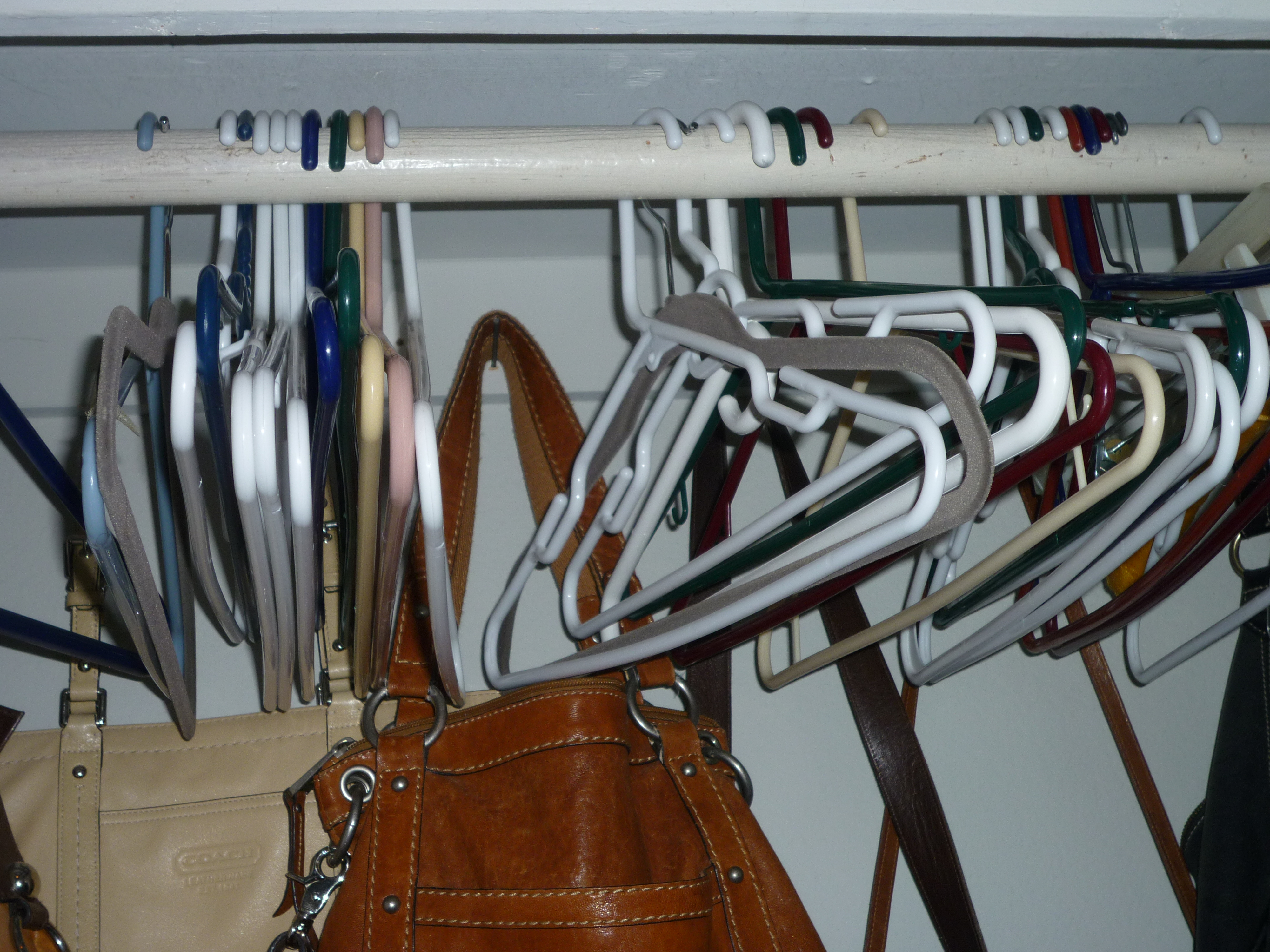

 

Hoarding, Divesting, and the Frugal Impulse

P1020979Spent part of the afternoon yesterday finally emptying out the closets, which have accrued old clothes as stale bread accrues blue mold. Threw out a bunch of tired stuff, moved the winter outfits to a closet in the other room, and gathered the summer stuff in the bedroom closet. In doing so, I freed up a vast number of clothes hangers, which before the cleaning frenzy were in short supply.

Huzzah! Now there’s room for more second-hand clothes from My Sister’s Closet! Actually, the other day my friend Joan and I dropped by the  Nordstrom’s Rack outlet. Though neither of us bought anything, I saw several goodies that I’d like to try on. But I suspect my frugal impulses may get in the way.

Here’s the thing: I tend to buy expensive clothes that are well made (or were, back in the day). These last (or used to last) forever and a day. Some of the stuff that closet harbors has been in there since before I was divorced…and that was a good 20 years ago. Matter of fact, as we scribble I’m wearing a shirt that dates back to said era.

The frugality of this strategy is obvious, no?

Well. Except of course if you buy clothes more than once every 20 years…

As time has passed and American clothiery has been shipped offshore, quality has slipped (we could say “plummeted”) to the point where even high-rent shirts, pants, and skirts not only do not last 20 years, they barely last 20 months.

So in amongst the…uhm…classics are any number of latter-day items from Talbot’s, Dillard’s, Chico’s, J.Jill, and of course that old standby Costco. Rags, all of it rags: faded, stretched, shrunken, frayed, and raveled.

But oooh, how can you throw out perfectly fine rags that could be used for…for gardening? And hiking! And housecleaning! And of course for the ever-present house painting!

Throwing this junk out is difficult. Very difficult. Even painful. How can a person get rid of a raggedy old shirt that she could still wear? A lot of raggedy old shirts, for hevinsake!

And therein lie the two problems: the closet is full of perfectly fine superbly made clothing, only slightly out of date, and perfectly fine gardening clothes, albeit a shade on the threadbare side.

Maybe, in an era when only the most unaffordably expensive clothes are made to last anymore, maybe it would actually be more frugal — or at least less crazy — to buy outfits that you have no intention of keeping more than a few months. At the end of every season, throw the damn stuff out.

That seems so wasteful, it frosts my cookies. But you might spend less money — or at least no more — and from season to season you might have cuter clothes. And you’d have to buy fewer coat hangers.

What think you, Dear Reader? Buy expensive clothes and make them last forever? Or buy cheap stuff and churn it every season? Which is smarter? Or, conversely, which is dumber?

Beyond Cute!

Ohhhh…so cute!

P1020937(Click on the image for the full dose of cuteness.)

We’ve found the newspaper recycling basket, and we think it’s an extremely cool place to hang out. Adorable, eh?

Right now she’s harassing Her Stratospheric Majesty, who in spite of an occasional testy moment is amazingly patient with the little pest. They’re having a horrible fake “fight” just this minute, very funny.

Since we switched to the new feed recommended by the holistic vet we tracked down, Pup has begun to put on substance. She was pretty frail, being the runt of the litter, much tinier than her little brothers and sisters and really very delicate. She’s now developing some vigor and spunk, and she’s utterly unafraid of the Queen of the Universe and Empress of All Time, Space, and Eternity. She’ll call the Royal Bluff at the drop of a growl.

After she damn near drowned in the pool…omg! Did I report that here? I’ve got another site on a Corgi board where most of the puppy antic stories are going.

Well, the other day we’re sitting out there and pup is roaming around the yard. I look up and see she’s managed to weasel her way through the barricade I put up to keep Charley the Golden Retriever away from the shrubbery-clogged deep end of the pool. Uh oh…there’s a reason I don’t want the dogs down there.

I slip off my shoes and start to walk around the shallow end toward her, hoping to call her to me before she can fall in — she’s now toddling along the very, very narrow strip of Kool-Dek on the far side of the pool. Too goddamn late. Before I can reach her, she topples into the drink!

She’s now as far from me as she can get and floundering in the very deepest part of the pool — which is 8 or 10 feet deep, farther down than I can swim.

I run around the shallow end to reach the deep end and throw myself in, fully clothed. My foot slips as I jump and I land in the water with a belly-flop, creating a tsunami that swamps the puppy. She starts to go down. I manage to get to her just as she’s getting one helluva snootful, grab her by the leg, and lift her head above the water.

We make it out of the drink. I’m shivering. She’s shivering. Bluejeans are very heavy when they’re wet.

I wrap her in a kitchen towel long enough to pull off the soggy clothes. Then run her to the bathroom, wrap her in a bath towel, pull a space heater out of a closet and plug it in, and wipe her dry in front of the thing.

This, as it develops, is not very difficult: puppy coats are not what you’d call very substantial.

Luckily, the water is not very cold — weather has been in the high 80s and really, a person could go swimming right now, if a person were brave enough or stupid enough.

Now on an endless QV, I realized another Animal Barricade Contraption was needed. Hence, the following:

P1020941

This contraption is built from three-foot lengths of (relatively) inexpensive garden border fencelets, made of wood. They’re flipped upside-down and strapped together with UV-resistant plastic zip-ties, and then roped to the patio upright, a chair, and the metal bordering around the poolside flowerbed. Cost is nominal, especially compared to the metal equivalent. They’re low enough that I can step over them without risking disaster, but high enough that neither dog is willing to try jumping over them.

Heh. My house: Home of the Eccentric Innovation.

Anyway, Pup is OK. She’s going strong, except for having been set back a bit in her house-training project. She’s reverted to Stealth Peeing, a strategy at which she is very, very effective. I didn’t know it was possible to pee by mental telepathy. This dog can be on one end of a room and cause a puddle to materialize all the way over on the other end of the room. It’s weird.

Huge Rip-off Narrowly Averted

Review freshly posted, by me, of Leslie’s Swimming Pool Service, on Angie’s List:

My pool pump stopped working about a week ago. It’s one of the old single-cycle pumps, and I’ve expected it to go out  sooner or later, but this could NOT have happened at a worse time: one  unexpected expense after another, starting in early January, has drained my emergency savings and then some.

I tried to reach my go-to service, Swimming Pool Service and Repair, but when I called the number I have — and that’s still posted on the Web — I got a “no longer in service” message. So fell back on Leslie’s.

On Saturday they sent a guy over. He took one look at the thing, listened to the “hummmmm” it made when power was turned on, and announced I needed to buy a new pump…to the tune of $1500!!!!!

This is $1500 I don’t happen to have. I explained that I’m trying to live on Social Security and that I’ve had a series of burdensome unexpected expenses. I asked if he was sure  he couldn’t fix it. He said no, it couldn’t be fixed. I said I’d seen a pump like it at Leslie’s website for $625, so why can’t I have that? He said our lovely legislators had passed a law stating that only the new power-saving multicycle pumps can be installed. That sounded a little fishy — you can say many things about Arizona’s elected representatives, but “environmentally sensitive” is not one of them.

As it developed, the soonest the new pump would be in was today, Tuesday, but this particular service dude was going to be off work today. So, he said, they’d send another guy.

Thank heaven for small favors!

This morning, a young man named Chris shows up.

In the course of conversation, I happen to mention that $1500 is a hit I can’t afford. He says, “Well, do you mean you don’t want the pump?” I say, “Well, I’ve gotta keep the pool running — it would cost more than fifteen hundred bucks to fill it in.” He says, “I think all it needs is a capacitor.”

Say what?

I say, the guy who was here last week said it couldn’t be fixed. He says, I’m sure I can fix it. I say, will you get in trouble? He says his boss will be mad. I say, I don’t want you to get canned. He says, no problem. He goes off to acquire the part.

Not counting the junket to get the part, it took Chris all of about 10 minutes to replace the thing and get the pump running happily. Total cost: $141.97.

The part itself cost $32.29. Leslie’s gouged me $85 for the “service call” (what d’you bet Chris never sees much of that?) and $22 for the “trip charge”: that would be $107 just to drive over to my house.

Chris obviously is worth a great deal more than that, since an honest man seems to be hard to come by these days.

I’m hugely relieved to save $1400 that was needed to cover food bills. But on the other hand, I’m not pleased that at the outset Leslie’s sent a guy who obviously tried to cheat me. I don’t think I would do business with Leslie’s again: evidently their business model is such that their workers are treated in a way that tempts them to rip off customers. Next time I’ll come back to Angie’s List and look for some other provider.

Does that take the cake, or does that take the cake?

New Enterprise a-Bornin’

Honestly, I don’t know what’s wrong with me. It must be an addiction: I can NOT stay away from entrepreneurial schemes. So…okay, here we go again: I want to found an e-publishing house. It would be an enterprise of The Copyeditor’s Desk, Inc.: a sub-entity, as it were.

Actually, what I have in mind is a micropublishing house. It will be designed to put my own golden words in front of all three readers who’d like to see them and also to publish editorial clients’ work in e-book and PoD formats.

Friend of mine has drifted from IT work to e-book formatting — he can do a down-and-dirty Kindle format direct from a Word file, if the file is simple enough and light on graphics. But when you look into it, you find that several programs exist to convert from Word or Pages not only to .mobi but to Epub and even to LaTex(!). Most of these programs are cheap, though they all have a learning curve. Naturally.

At any rate, so my friend and I get up to attending meetings of a local Romance Writers of America chapter. To make a long story short, what we discover is that, contrary to officially accepted opinion, it in fact is possible to make a modest living by self-publishing one’s own maunderings. To our amazement, we learn that a number of such Successes concur in thinking that the tipping point from a hobby to a decent side gig is eight (count’em, 8) e-books self-published to Amazon.

I’m listening to all this palaver and tracking down studies and thinking about it…and wait! Right this instant I have three potential e-books in the can. Friend is working on one of them as we scribble; two others are waiting in line for formatting.  One of these books is the first volume in a planned series of speculative fiction tales. I’m six chapters into the second volume in that series. Meanwhile, residing on the hard disk are several book-length nonfiction squibs, things I’ve used for courses and that I used to sell, through the campus bookstore, to my students.

Clean them up and format them and…voilà! EIGHT E-BOOKS! The very magic number, itself. It takes nothing for me to dream up subjects for another three totally unwritten but easy to produce tomes. Soooo…what we have here are three books in the can, four in draft and easy to produce, one in progress, and one a scintillating figment of my imagination. That would be nine potential books, at least four of which I should be able to get out this year. If I dedicated a certain number of hours per day to this enterprise, I could probably get another four out by the end of 2015.

Place this in the back of your mind, and move on to…

Bowker. I’m at Bowker registering an ISBN for the book my friend is formatting in .mobi, and I’m also at the US Copyright Office filling out forms for a copyright registration.

I’m registering the S-corp as the publisher, because of course I want revenues to flow to the corporation. One of these sites asks if The Copyeditor’s Desk is publishing the book under an imprint.

Say what?

What’s an imprint, and do I have to incorporate it or can it be part of the existing entity?

I ask some knowledgeable friends in publishing; they indicate this is a pretty casual appellation. Next I inquire of ex-DH, the corporate lawyer, who happens now to be with a large firm one of whose specialties is media law. He reports that you can “do business as” XX or YY imprint, that it can be a dba function of your existing corporation, and no, you surely do not have to incorporate the proposed sub-entity.

Well. Hell. Can you or can you not sense the possibilities here?

In the first place, right this minute I have two clients working on projects that lend themselves to self-publishing. If I have a subcontractor who can do the necessary conversion work and another who can do PoD (“publish on demand”) book design (such a person, mirabilis, I just do happen to have…), there’s no good reason we couldn’t offer to take clients’ projects through the editing process all the way through to electronic and print-on-demand publication.

Holy $h!t.

I could use an entity like this to publish my own books, of which I already have enough to create a respectable “backlist” (I know: it’s arrogant, but it’s the term all these folks use), and assist clients to get their work before the public with the least amount of hassle possible for the client.

In other words, I could take an “imprint” and build it into a kind of virtual publishing house. And I’ll betcha I could make money on it.

Further discussion with the corporate lawyer reveals that pricey trademarking through the federal gummint isn’t necessary; one can stake one’s claim by registering the trade name with the Arizona Secretary of State.

Well. This looks pretty intriguing. In fact, it’s intriguing enough that I’m raring to go and chomping at the proverbial bit.

I’ve not created a new business plan, because a) the thing would be a subsidiary of The Copyeditor’s Desk, which has its own formal business plan, and b) because start-up costs would be funded by The Copyeditor’s Desk, which has more than enough in the bank to jump-start this scheme. In lieu of a formal business plan, I’ve tricked out an informal strategic plan.

Since the trade name is not yet registered, let’s call it XYZ press. Here’s what its goals and strategies look like:

XYZ Press
An Imprint of The Copyeditor’s Desk, Inc.
Strategic Plan

Mission Statement: To publish books on Amazon and CreateSpace, in e-book and print-on-demand formats; in the future, possibly to provide this service for editing clients.

Goals:

  • To publish 3 books by the end of first quarter 2014
  • To publicize these books on websites, Twitter, Pinterest, and Facebook, and analogue media
  • To publish a total of 4 books by the end of 2014
  • To publish 8 books by the end of first quarter 2015
  • To build a clientele of people who are willing to pay for editing, layout, and book uploading to Kindle and CreateSpace
  • To net enough by the end of 2015 to replace teaching income, $7,680
  • To net enough by the end of 2016 to replace editing income ($8,000) and teaching income (total revenue goal by December 2016: $15,680
  • From 2016 forward, to publish at least one vh novel/year and at least one vh nonfiction book/year
  • From 2015 or 2016 forward, to publish at least one client book/year and collect a fee from it, causing XYZ Press to function like a subsidy or vanity press.
  • By mid 2014, learn and download Scrivener and use it to create a book. Scrivener can be used for several platforms. Ask Ken why he’s not using it, since it converts not only to .mobi but also to ePub. It apparently also can be used to make camera-ready art, but evidently CreateSpace has templates for PoD books.

Strategies:

 3 books by the end of first quarter 2014, or by April 30

  • Get Gary to finish artwork for Fire-Rider
  • Register copyright and ISBNs for cookbook and Fire-Rider ASAP
  • Have Ken convert all three books to Kindle forthwith
  • Learn how to create layout and PoD in CreateSpsace
  • Create websites for XYZ Press and for each publication
  • Download Pages to create layouts for PDFs to sell on websites

 8 books by end of Q1 2015

  • Revise and develop existing “tight writing” book
  • Develop “how to edit your own stuff” book or revive CAP seminar
  • Collect FAM idle essays
  • Write a schmaltzy dog book based on FaM and Corgi posts…need some kind of unifying theme
  •  Publish at least one vh novel/year and at least one vh nonfiction book/year
  • Continue writing XXX Chronicles and start YYY saga, producing one piece of fiction per year
  • Be alert to and active in developing ideas for short inspirational and how-to books – these can actually be quite short

Publish at least 1 client book/year

  • Recruit Ken and at least one other Kindle conversion guy
  • Recruit editors who can quickly clean up bad copy; establish fair rate of pay
  • Establish minimum quality requirements; i.e., do not accept copy that’s a tangled mess!
  • Learn to lay out and publish PoD books in CreateSpace
  • Develop several packages of services
  • Build a contract wherein CEDesk engrosses some part of the rights and gets pay from Amazon sent directly,  forwarding royalties to authors or paying them as subcontractors
  • Build a clientele of wannabe Writers, possibly by building writers’ groups and sponsoring a writer’s conference
  • Join RWA – but look into the Scottsdale group and see if it’s better than the one on the Westside. It would be good to avoid showing up with Ken at every damn meeting, and possibly best if one of us was working the Eastside group and one the Westside.

 Function like a real publisher

  • Join New Mexico publisher’s group
  • Rejoin SSP; budget funds to attend meetings of these outfits
  • Develop a set of packages and be sure to have vendors who can do these things at short notice and who are willing to provide a discount or charge a low enough fee that you can scrape off a finder’s fee.
  • If it’s not difficult to do layout for CreateSpace, build simple templates that can be used for fiction and nonfiction. These should be uniform in appearance.
  • Have Gary (or someone) make a logo, if only just a couple of linked letters.
  • Publicize the service with students
  • Rejoin Local AZ and SHOW UP!
  • Join North Phoenix CofC
  • Join RWA – but first check out the Scottsdale chapter
  • Describe the business as a micropublisher that offers editing, text conversion and publishing to Kindle, and basic layout for PoD on CreateSpace.
  • Get on radio talk shows here, regionally, and nationally
  • Show up at AHC book fair
  • Show up at writer’s conferences
  • Speak at writer’s conferences and local groups
  • Once a presence is established, revisit SP Program and also GDU’s MFA people and PC’s writing program, if it still exists; also contact Lois R-D

 Learn to use Scrivener and CreateSpace

  • Download Scrivener free trial and put one of the books into it.
  • See what it can do and what’s involved in uploading it to Amazon
  • Find out what’s involved in publishing a book to CreateSpace—use the Adjunct book

Net enough income to replace the present tedious jobs

  • Do all of the above, religiously and effectively
  • Develop and publicize book websites aggressively, with shopping carts and contact pages
  • Get on forums, develop a presence, and hustle books there in low-key way
  • Use LinkedIn to publicize new books and news on existing ones
  • Use Twitter, FaM, and  Corgi.com to publicize
  • Recruit people to read and review books, by using giveaways and by hiring people to do so. Pay people to read and review; pay more to buy the book and post a review I’ve written.
  • Ask fellow bloggers to review the books.
  • Farm e-mail addresses from all blogs; proactively send notices of new publications

So. There’s an outline of what to do next. Looks like a lot of work. But it could be fun. And if the optimistic reports from e-book publishers are even remotely true (one doubts it…), it just might be possible to replace the present piddling income with a similarly piddling but adequate income from my own creative work. Rather than from editing Chinese Ph.D. dissertations and teaching, that is.

Bloggin’ Luv

Over at 20s Finances, proprietor Corey Frick got my attention with a post suggesting, eloquently enough, that one should get to know one’s professors — assuming one is in college, of course. It’s a good idea, within reason. Most faculty enjoy students and like schmoozing a bit. And sometimes faculty can give you a leg up with a variety of opportunities, such as internships, graduate assistantships, and fellowships. However, it depends on what the faculty member is doing at the time, what priorities are placed on job performance (teaching is often low on the evaluation totem pole), and whether the person is actually an employee or is an adjunct contract worker. Adjunct faculty often have no place to meet with students, and pay is so low that any work done outside the classroom amounts to free labor. And meeting with students is a form of work. Also, there are circumstances in which it can be unprofessional for faculty to “hang out” with students.

Here’s a very nice rumination from Revanche at A Gai Shan Life on the subject of charity and generosity. As a tightwad and the daughter of a fine artist of tightwaddery, I find it difficult to think clearly about this…the bag lady syndrome tends to get in the way. I’m willing to volunteer my time and talents to certain causes, but I really don’t like giving money. One reason for that is indoctrination by my father, whose mother forked over her entire inheritance — the inflation-adjusted equivalent of something over a million dollars — to scam artists and a questionable church. My father was left with an abiding distaste for organized religion and was dead set against charitable giving of any kind. In his memory, I’m pretty damn skeptical about giving money to causes, myself.

* * *

Dayum. Pup just damn near drowned in the swimming pool!

Wet bluejeans sure are heavy…

Oh well.

* * *

Where were we?

Revanche’s reflection about charitable giving and attitudes thereunto inspired another post on the subject over at I Pick Up Pennies, one that segues into a fugue on bag lady syndrome.

And speaking of good works, you’ve gotta read this amazing story at Asian Pear!

There’s a great post at 101 Centavos about stupid interview questions job applicants have been known to ask. Heeee! If you’ve ever been in a position to hire, you know these make some of your interviewees look smart…

Crystal at Budgeting in the Fun Stuff never, ever ceases to amaze me. This pair, IMHO, is the ultimate PF blogger’s role model.

Along the same lines, Mr. & Mrs. Planting Our Pennies also take stock of their finances. Very nice. Everyone who has money in the market seems to be feeling pretty good about things these days!

Over at My Journey to Millions, Evan is doing reasonably well with the dividend income, too.

LOL! I almost fainted when I saw last month’s Fidelity statement…the crazy thing earned over 23 grand! In one month, enough to support me for a year, when combined with Social Security. More than enough, come to think of. I try not to get too exercised about those statements, though: next month it could just as easily show a $23,000 loss. 🙄

Here is a highly entertaining — and amazing — story at DQYDJ, occasioned by some wacky speculation about the possibility of the Russians having some fun manipulating US treasury debt. The figures boggle the brain.

Like 101 Centavos’ “Fish Wraps,” nicoleandmaggie’s round-ups can be too much fun. Definitely check this one out.

The Frugal Scholars are engaged in a bizarre saga with what appears to be a demented dentist’s staff. You need to scroll back through the site to get the whole, strange story. I dunno…if it were me, their most recent rather polite letter to this outfit would be emanating from my lawyer. But then…I tend to go around with my .45 strapped to my waist.

A very funny rant recently appeared at Donna Freedman’s Surviving and Thriving. The story’s good, and so are some of the comments. 😀

Back in New Zealand, NZ Muse has landed a job she loves; Mr. NZ Muse is still searching and wondering whether to hold out for The Dream Job or to take whatever comes along.

Money Beagle surveys the several important things in the Beagle empire that need a checkup. And how, brother! The pool pump just went out here: that’ll be $1500.

At Streets Ahead Living, Tara posts an entertaining rant about entitlement…or the illusion of it.

Here’s a word to the wise about multi-level marketing from Mrs. Accountability.

Pup is waking up from a long nap following her trauma, so I guess it’s time to run around. Bye!