Coffee heat rising

Summer is the most expensive month…

More crazy bills, one right after another. What is it about extra expenses that causes them to cluster in the season when your regular costs are at their highest?

The water bills are in low orbit. The power bills are just below them, hovering in the stratosphere. In another month I get to pay for yet another nuisance emissions test and fork up some more money to register the car.

Soooo…. Last week M’hijito and I had to cough up $370 apiece to get a gigantic tree in his front yard trimmed back. Almost eight hundred bucks is a helluva lot better than the $2400 fine we’d have to pay to the city if the garbage truck drivers complained about the way the thing was taking over the planet. It was not only trying to consume the neighbor’s front yard, it was radically in violation of the city right-of-way code.

Naturally, a few days later he had some strange health episode that sent him to the ER — allergic reaction, apparently. It subsided before they could start drugging him up, but that visit will cost him $500, the full deductible on his health insurance.

On my part, this tree-hacking bill came right after a $350 brake job and car maintenance bill.

And now it’s time to get the accursed palm trees trimmed. Early each summer, Mexican fan palms sprout these huge, spiny flower fronds. They look sort of like plant fireworks. And they drop tiny, sharp, POOL-CLOGGING blossoms into the water. With them come long stringy things that choke Harvey the Hayward Pool Cleaner and these hideous white grubs that live up in the trees. Don’t know what these three-inch-long worms are, but they get stuck in the skimmer and pump pot baskets and are absolutely gross to clean out. Ugh!

So Gerardo and his guys are here this morning. They were supposed to show up around noon, but today Gerardo decided to invert the mañana principle and appear at 7:30. This was smart on his part — the heat has yet to come up; by noon it will be killing.

However, choir has to sing at a wedding to day. I have to be out of here in half an hour. My hair was up in curlers when he surfaced, and my face still isn’t painted, and I have NO IDEA how much to pay him.

On that note, come to think of it…I’d better start running. Again.

***

Wah! WRONG DATE! Fortunately I realized before racing out the door to the Cult HQ that I entered the wedding on the wrong date. Otherwise I’d be even more ridiculous than I usually am.

Okay. This gives mit the entire freaking day to amuse myself and clean the palm tree mess out of the pool. Heh…probably cleaning the pool is gonna take the entire freaking day, too…

🙄 😆 🙄
Planning to Live on Irregular Pay

Not much time to write today: I’ve worked from dawn to well after dark the past three days on a big rush project. It’s an index of some heavy-duty scholarly work — a mind-numbing job! — and it came along just as a nasty little cold hit. But pay will more than meet The Copyeditor’s Desk‘s minimum monthly revenue goal, and that’s on top of several other projects that came in this month. And it doesn’t count the jewelry sales, which I consider a bit of a fluke.

If I finish this thing today, which I probably will, I’ll earn almost as much in four days as the community college pays for two weeks of work. Think of that… 🙄

When you’re working on a contract basis, it’s important to bear in mind that some months no work will come in. And some months, you’ll have more work than you can handle. That means you have a fairly large kitty from which you can disburse a regular “paycheck” to support your monthly budget.  What made it possible for me to quit my day job, as it were, is the amount that has accumulated in the S-corporation’s bank account, plus the remains of my “survival fund” of emergency savings that I had when I was laid off in 2009.

I’ve spent most of the latter — a fair amount of it went to shoring up the house’s defenses after the late, great garage invasion — but after replenishing with the last Heavenly Gardens paycheck, about $7,000 remains. A year’s worth of living expenses resides in the S-corp. Those two bank accounts taken together (the S-corp’s and Survival Savings) will serve as the kitty to bankroll my future of glorious planned unemployment.

Or rather, “self-employment.”

The plan is to draw down about 3 percent from retirement savings, in quarterly chunks, and at the same time disburse quarterly payments from the corporation. These funds will go into the Survival Savings account at the credit union, from which each month I’ll transfer enough to my checking account to cover regular budgeted expenses and the several self-escrows required to pay insurance, car registration, and property tax.

To avoid impoverishing the S-corporation, The Copyeditor’s Desk will have to earn a set amount per month to pay its bills and support me. But because I live so penuriously, that amount is surprisingly little. Just a couple of halfway decent assignments a month will do the trick.

This month more than a couple have rolled in the door. The amount billed in December is  more than twice the minimum revenue the corporation will need for me to pull this off.

That means next month I don’t have to earn anything. As a practical matter, the S-corp can float along for a month on what it’s earned this month, pay its bills and me, and still not eat into the fund that was in the bank when I quit the teaching job.

Living on irregular pay means finding a way to gather all sources of income into a single kitty from which you can disburse only enough to cover your month-to-month bills. At the outset, you do need to hold on to the day job until you can accumulate a fairly substantial base fund to start with — at least a year’s worth of living expenses, preferably two years’ worth, plus a short-term emergency fund for unexpected expenses. But once you have that, the trick is to regard the “kitty” as something that accumulates its funding on cycles that are longer than your budget cycle.

So, if you budget from month to month, as most of us do, the money from which you fund that budget should be accumulating funds on a quarterly or annual basis. This smooths out the demand for immediate income: if more than enough pay arrives in January, it will reduce the amount that absolutely has to come in February. Assuming your enterprise earns more in March or April, at any given time there should be enough in the larger account to fund monthly expenses.

In theory, you could have one big fund from which you draw for all day-to-day expenses and into which all dribs and drabs of income irregularly flow. Personally, I want to see a bottom line that tells me how much is left to spend in any given month, and I don’t think a large fund would easily allow me to do that. It’s a function of my weak math skills, no doubt. That’s why I have a checking account for expenses and a money market account for the kitty that collects the several forms of irregular pay that come my way. Doing that actually converts the irregular pay to something like “regular” pay: you pay yourself a monthly paycheck out of the collector account.

To make your escape from the rat race, then, you need…

One or two years’ worth of savings
One or more sources of self-employment or retirement income
An account in which to accumulate that income; we’ll call that the “kitty”
A checking account to hold disbursals for monthly bills

Irregular income → Kitty account → Monthly budget account

From month to month, the kitty account, which is substantially larger than the monthly budget account, will grow and shrink according to how much comes in at any given time. But it’s not on a monthly cycle: it’s actually on a quarterly or yearly cycle. As long as enough comes in over a quarter or a year to cover monthly disbursals, you’re cool.

Gotta get going: more things to do today than there are hours to do them!

Costco: How Much Does Saving Money Cost You?

Scrutinizing the budget now that this month’s bills are all paid… Several extraordinary costs—those Heath dishes, for example, and a pair of shoes, and a trip to the car mechanic’s—ran the American Express budget $325 into the red. But in theory, all of them combined shouldn’t have overtaxed that budget. So…WTF?

In addition to those two extravagances and the car repair, I’ve been spending with gay abandon at Costco: $407.39 diddled away in that place!

And what on earth, pray tell, might I have purchased with this munificent amount? I’ve been strictly on the wagon for the past three months, so it didn’t go to my favorite potables. Mostly food and household goods, I think: the lifetime supply of paper towels. And the $75 or so for the underwear extravaganza. Haven’t bought toiletries. Haven’t bought pool tablets. Haven’t bought Brita filters or blue jeans or replacement toothbrush heads or a lifetime supply of laundry detergent. Looks like the main costs were large packages of chicken thighs (at 99 cents a pound, a better buy than anyplace else where I shop), pork, produce, the paper goods, and clothing.

Probably paper towels and toilet paper and detergent, purchased in bulk, are a little more cost-effective than the same goods bought in smaller quantities more often at grocery stores. However, a funny thing happens on the way to the Costco: Sure, a giant container of paper towels lasts four to six months. It sets you back $15. But then next month you need toilet paper: $20. Next month after that, you need chlorine tabs for the pool: $80. And so on  to infinity. If every month you’re buying a lifetime supply of one thing or another, then each month you’re spending more on groceries and household products than you would at an ordinary retailer for smaller amounts that would only last a week or a month.

Although over the long run you might spend more at a grocery store for a specific product than you would, unit-wise, by purchasing a gigantic supply at Costco, because each month you buy a new lifetime supply of something else, each month’s bills are likely to be higher than they would be if you equalized purchases over time.

What that suggests is even though you’re paying less per unit for certain products, you’re actually paying out more each month as you have to replenish different products month by month.

By comparison, during the budget cycle just ended, I spent only $35 at Safeway and $68 at Trader Joe’s. Admittedly, I haven’t felt well and so haven’t eaten much—mostly I’ve grazed off the Costco stash. But still..one wonders.

I decided to try to limit Costco purchases to $200 a month. Which…well, really, shouldn’t that be more than enough?

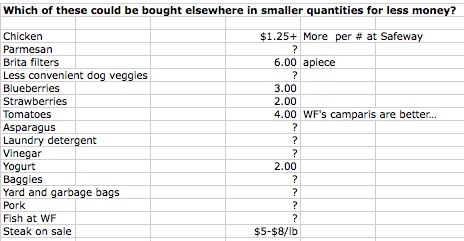
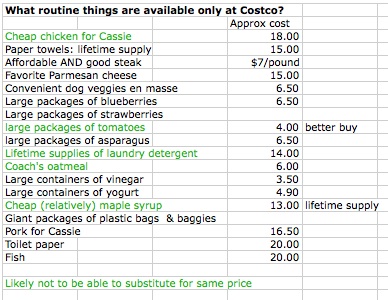
This led me to consider what routine purchases are available only at Costco, and what things might be bought somewhere else in more manageable quantities at more manageable ongoing prices. Videlicet:

Some of these items are hard to find at other stores around here, or can’t be found in the same quality or for the same price, or both. I’ve marked those in green.

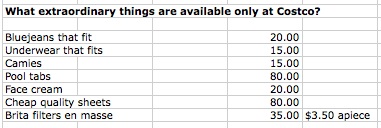
There also are a number of things I buy on occasion at Costco because they don’t seem to exist in any other stores or because, as in the case of the chlorine tablets for the swimming pool, Costco far underprices its competitors:

Bed sheets comparable to the sets you get at Costco, which come with four pillowcases BTW, would cost far more in other stores unless you caught them on sale. Anywhere else, it’s almost impossible to find either underwear or denim jeans that fit a normal adult woman. Face cream is expensive at Costco but downright outrageous elsewhere. So it goes.

I’m none too sure what these things would cost at non-warehouse stores. But I’d be willing to bet that when you buy less, you pay less at the checkout stand, even if you’re paying more per unit. In some cases, you’d have to pay a fair amount more. For example, I wouldn’t consider buying fish at Safeway; probably the only other source of acceptable fish in town is Whole Foods. Don’t even ask what they charge for the stuff.

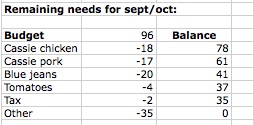
If I limit spending to $200 for the September/October budget cycle, what could I buy between now and the end of the month-long cycle?

I’ve already spent $104 at Costco this month. That leaves $96 to diddle away:

That’s not unreasonable, I think. It provides enough meat to last the dog for the rest of the month (since canids need about 2/3 of their food to be in the form of animal protein, a 25-pound dog consumes a surprising amount of fresh meat). My blue denim jeans are wearing out, frayed at the cuffs and faded at the knees—the height of style for younger things, but not, I’m afraid, for moi. So pretty quick I’ll need a new pair. Arizona doesn’t charge tax on food, and so the 10% soaking applies only to the clothes. And…that even leaves something for one or two other purchases! Buying the rest of my food—mostly produce, since at least two months’ worth of beef, fish, and chicken reside in the freezer—shouldn’t cost much at Safeway, Trader Joe’s, or Ranch Market.

What think you? Does it make sense to try to stay on budget by spending more per unit on less product?


Staying on Budget: Manually Track Credit-card Charges

Over at Planting Our Pennies, there’s a nice discussion about the many tergiversations of budgeting, kicked off by an acquaintance’s remark that the best way to budget is to put cash in envelopes by category, and quit spending on a given category when the envelope runs dry.

Like me, the POPs rarely carry cash and instead use a rewards credit card (paid off at the end of each month) as a budgeting device. They like the way this allows you to track where every penny goes, in excruciating detail.

As long-term readers at FaM know, that’s been my strategy, too. But I have to say, it’s gotten to be a time-consuming pain in the tuchus. Hanging onto 87 berjillion pieces of paper and then, once every week or two, entering them in Quickbooks or a spreadsheet, is a gawdawful nuisance. No two receipts seem to have the date printed in the same place, and then outfits like Safeway that proudly add up every on-sale item so they can crow about how much you’ve “saved” by spending money at their place drive you NUTS, because you have to study their receipts to find the figure that tells what you did spend.

I’ve begun to wonder what is the point of knowing precisely where every penny goes…does that degree of detail really provide any useful enlightenment? Is said enlightenment worth the time required to juggle receipts and allocate every transaction to its proper spreadsheet column?

Possibly not.

At the start of this month’s credit-card billing cycle, it was time to quit chasing flyaway receipts. And also to quit itemizing every expenditure and keeping track of how much is left in each and every ditzy little category. WGAS, anyway? All that matters is that there’s enough left in the discretionary spending budget to cover the month.

So. To get the wads-of-receipts nuisance under control, I’ve been carrying a checkbook register around and scribbling down each transaction as it’s made. This way, I never have to  look at the receipt again: just drop it in the current month’s receipts folder, so that after a given charge statement comes in and is reconciled, the receipts can be neatly stacked and stapled to the statement for the accountant’s future reference. That rudimentary organization, by the way, makes it easier to find a receipt if it’s needed some time in the future—instead of rifling through disorderly file folders or boxes full of receipts, simply scan statements until you find the transaction, and you’ll know the receipt is attached to that statement.

This new strategy has hugely sped the bookkeeping task! It’s now easy to see each transaction’s date and easy to see which credit card was used. The credit card is identified in the first column and the date appears in the second. I’m keeping track of three cards—the corporate card, a personal MasterCard, and a personal American Express card–in one book. To enter this month’s transactions in Quickbooks couldn’t have taken more than ten minutes.

Putting them in the new, simplified discretionary budget tracker took even less time. Instead of subtracting each transaction from a figure at the top of a separate column for each discretionary spending category (clothing, for example, or food, gasoline, personal entertainment, etc.), I’m entering one figure: the $1100 max budgeted to discretionary spending. All expenditures are subtracted from that, so at any given time I know how much is left. Separating out these hundreds and thousands of items, month after month, is just. not. worth. the. effort.

In the new regime, then, the budget tracker looks like this:

The panic-inducing bottom line is an illusion, because I’ve included among the charges two items intended to be paid not out of monthly cash flow but out of savings for extraordinary expenditures: the washer that I had to buy and the new interior door hardware that I chose to buy, which add up to about $1,000. Then my son reimbursed me $100 for a jacking-around The Hartford Insurance delivered when they raised the insurance on the downtown house because I changed the policies on my house and car to Safeco. Taken together, those three items “reimburse” the budget to the tune of over $1100. Figuring that into the bottom line, we see that at the end of the billing cycle, the budget was $95.32 in the black. Yay!

Should I ever feel impelled to scrutinize exactly how much I spent on a given category, it’s easy enough to create a little “report” in Excel with the “Sort” function.

Hmm… I got a little carried away with eating out (“entertainment, personal”), but it doesn’t seem to have busted the budget. In fact, I didn’t spend that much. Because I don’t carry cash, I charged the whole tab on AMEX and my friends reimbursed me in cash, which I then diddled away at the grocery store and waypoints.

As usual, I have NO idea what I spent that cash on. Cash flows through my fingers like water. This afternoon I used some of it to buy some yogurt at Trader Joe’s. But the rest of it…????

This is much easier than trying to categorize every little charge as it’s entered. And paradoxically, adding a manual stage—write charges down as they happen—certainly is easier and less ditzily annoying than shuffling dozens of pieces of fly-away paper.

Each, as PoP suggests, to his or her budgetary own. 😀

Click on the images for a higher-definition view. Why has WordPress suddenly decided to put low-def images in every upload? Gr!

Money Unhappens, Money Rehappens

Am I in the hole this month? Ohhhh no. That is what we call a “bottomless pit.”

Once again, I lulled myself into a false sense of confidence and, while bucketing around the tourist section of historic Glendale with friends, succumbed to the siren call of exotic clothing. Actually, quite a few sirens called. And the clothing is all made in the USA, meaning it cost about eight times what something comparable (if you could find it, which you can’t) would cost if it were made in Kuala Lumpur. Every time this happens, it’s invariably at the beginning of the budget cycle. And in theory, I have plenty of money in savings to cover the occasional indulgence—that’s what short-term savings are for, f’rhevvinsake.

So it seems. But, as usual, by making these purchases near the beginning of the month, I was thoughtlessly neglecting to think about the fact that my yard and garage would soon be invaded by a desperado and the police would soon haul me out of my house behind a bullet-proof barricade, and that I would soon be craving steel bars over the doors, ungodly locks, and fancy hard(er)-to-jimmy sliding doors.

How could I have been so careless?

Really. By now you’d think I’d know better. It never fails.

The combination of the clothing (which actually I thought I was charging on last month’s credit-card bill but which didn’t go through and so will come due in another few days) and the $500± for the security door and the locksets put me $1100 over budget. And since my budget is $1100…well. Not to say {gulp!}

So it was that Wonder-Accountant, who’s been trying to help me figure some of this stuff out, and I were surprised when the mail arrived with a missal from American Express:

Dear Funny:

We are writing to inform you that, due to an internal processing error (WONDER-ACCOUNTANT cringes visibly), the annual Costco reward coupon that you received in your February billing statement was incorrect. (WONDER-ACCOUNTANT and FUNNY: “Auuuughhhhhhh!”) We will issue a statement credit (“Say what??”) on your next billing statement (“You mean, the one that’s supposed to come in at about $2200?”) for the remaining reward amount…

We apologize for any inconvenience this may have caused…

Sincerely,

American Express Customer Care

Please. Inconvenience me some more.

I’m sure the adjustment will be about $1.95, if that much. But hey. Every little bit helps.

Moments of Fame:

James Petzke: Graduating with a Surplus hosted this week’s Carnival of Personal Finance and included Funny’s report on the reviving Phoenix-area real estate market.

Financial Success for Young Adults hosted the Yakezie Carnival, where What a Lender Is Thinking made the cut.

$mall miracle shaping up

Only 8 more days to go in the budget cycle, and despite the $475 bill for the brake job, I’m only $13 in the red!

Amazing. Still will need to buy a half-tank of gas to make it to the end of next week, and probably will need to make one small grocery run. About $30 or$40 for gas and, say, $40 at the outside for groceries? Wow! Less than a hundred dollah over budget despite that unholy bill!!!!!

Because I haven’t run the heat or AC all month, the power bill is only $71.68. So there’ll of money left over from the nondiscretionary budget to cover that $100 shortfall.

It’s been a mighty boring and straitened three weeks. But at least the bank is not busted—I won’t have to draw down from savings to cover the car repair, after all. 🙂