Gotta hurry! Today I have to write chapter 2 of a client’s book, his check finally having arrived on the scene.
Up early and off to walk the dog by 5:30. Breakfast on the back porch, interrupted (as usual) by the roar of a flicking helicopter. This time it didn’t go away or hover over the war zone at 19th and Dunlap or park over the neighbor’s house, but kept buzzing back and forth, low to the ground. MedicEvac??? Get up to check.
It’s this splendid balloon floating past, accompanied by a copter buzzing like a turbocharged mosquito around it! What a hoot, eh?
Once I bought my ex- a balloon ride for his birthday. They invited me to climb into the basket, too. It was great fun. I think these things are the most hilarious and wonderful form of travel invented since the bay mare.
Tried to snap a photo of the balloon and the copter in formation, but by the time I got to the office, grabbed the camera, and ran back outside, they were too far away to get a really good shot. This was about the best I could do:
(Click on the images for larger, sharper versions.)
Working out of one’s home has a distinct disadvantage: when you’re in an office, you attend to office business all day. When you’re at home, you’re distracted by all the chores that need to be done. Sometimes I feel like I’ve been laboring like an animal and then at the end of the day feel like I’ve accomplished essentially nothing. Certainly nothing payable. Yesterday I decided to keep track of what the heck I do that kills so much of my time. And…no, it’s not like I’m doing nothing:
• Walked dog
• Fed dog
• Fed me
• Read New York Times
•Watered roses
• Set soaker hose
• Watered a little on west side
• Read Eng 235 paper
• Updated Quickbooks (after a month-long lapse…)d
• Transferred funds from PayPal to CED checking
• Updated records on investments
• Filed a mountain of paperwork
• Hassled with AMEX over an incorrect debit
• Bathed, washed & dried hair, painted face
• Raced to campus
• Wrestled with Registrar over incorrect withdrawal of 235 student
• Hauled student’s paperwork all over campus
• Met two classes
• Updated students’ grades; reported to graders on student progress
• Drove to credit union, deposited money
• Stopped by Fry’s Electronics on way home; bought printer cartridge, notecards
• Bolted down microwaved dinner
• Checked e-mail; skimmed Google News
• Cruised Zillow
• Raced to campus, just made it to real estate class on time
• Sat through class
• Drove home
• Consumed two Camparis on the rocks while watching old episodes of My Name Is Earl
• Dropped into the sack around 11 p.m.
• Attempted to read detective novel; fell asleep after about 15 words
So…today, damn it, I’ve GOT to get some work done!!!
And it must be admitted that work is the last thing I want to do. The day is just gorgeous. It beckons: Come to me, come to meeeee….
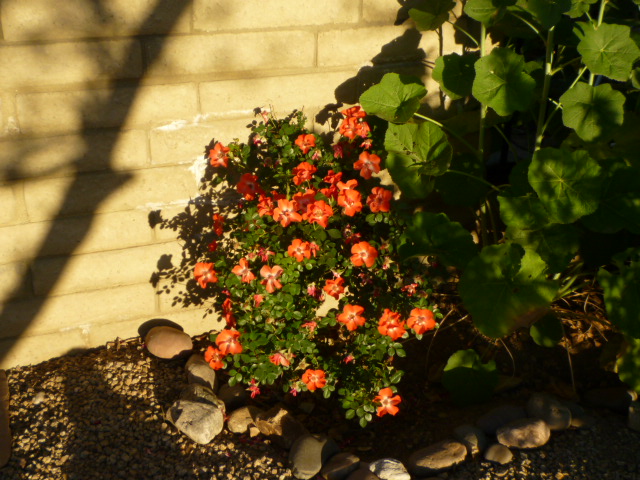
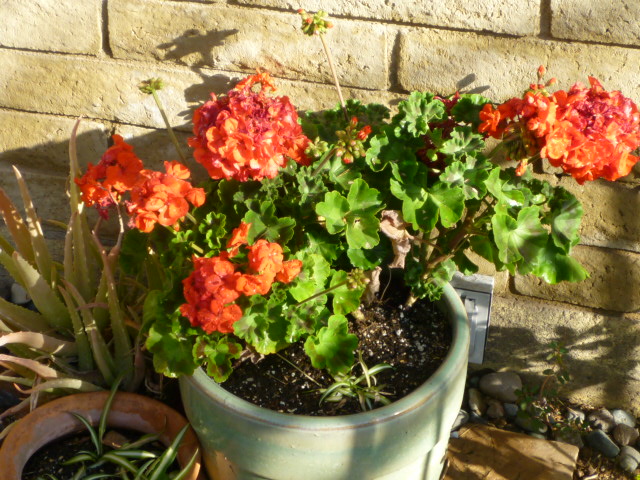
Water bill is high, it develops, because the last big power outage somehow reset the watering system to come on every day instead of every other day. That plus the fact that I’ve decided to actually water the plants has revived the landscaping. Quite a few moribund plants have come back to life. I’d about given up this rose for dead, for example:
Those blossoms are more fuschia-colored than orange: early-morning light through mare’s tails. And here’s a little beauty from another rose that really suffered last summer. In January, I decided not to prune this bush because it was so exhausted—better, I figured, to just leave it alone for a year. What it needed was not pruning but water:
The bougainvillea’s gone insane this spring:
Isn’t this cute? It’s growing on a weed-like thing that sprouted from the shade-loving seeds I sowed in the backyard flowerbed last fall, none of which germinated until the days started to get longer few weeks ago.
No clue what the thing is. Then we have this…
…and this…
And these…
And this…
And these…
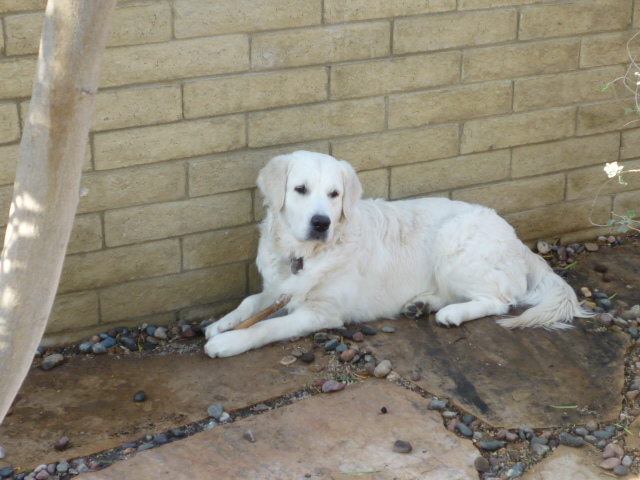
And Charlie contemplating the next spot to dig a nice hole…
Speaking of Charlie, he’ll be here soon. MUST get some work done before my son shows up with that dog!!!
The All Saints Choir, under the direction of the truly astonishing Scott Youngs, performed a spectacular concert today, alternating between us (choir) and several really lovely soloists and accompanied by a string ensemble. It was an exciting and wondrous experience, one of those moments that makes one feel privileged to be alive. We got to sing d’Astorga’s Stabat Mater, Victoria’s Lamentations, and Hasse’s Miserere Mei. If you live in the Phoenix area, even if you’re not religious (which I’m not, especially) you should keep an eye on this church’s music program, which includes professional singers and extracts professional-quality sound out of the mostly amateur music-lovers in its choirs. In particular watch for special performances around Easter and Christmas. I started attending All Saints after I wandered in one Sunday and realized you get a high-quality chamber music performance at nearly every service—and that’s not an exaggeration. If you love music, this is a place to be.
So I was looking forward to coming home, climbing into a pair of cutoffs, pouring a glass of wine, and spending the afternoon reading about real estate transactions. Or maybe reading inchoate magazine articles from my budding journalists. Or maybe ghostwriting another chapter of our amazing new client’s memoir.
No such luck.
There’s a reason M’hijito has taken to dubbing Charley the Golden Retriever with the “bad dog” title, Charley Manson. When I opened the kitchen door from the garage, a fine gut-wrenching stench greeted me. Charley had left a deposit the size of a loaf of WonderBread in the middle of the kitchen floor!
Miserere indeed! Naturally, he had to polish it off with a little diarrhea. Lovely. As we scribble, the whole house reeks of its stomach-tossing perfume.
Mercifully, he’s no longer having to stay in his crate, so the mess was confined to one pile and not smeared, as it was the last time, all over him, his (now former) bed, his crate, the floor, and the adjacent wall. And thank goodness the weather is nice: every door and window is open, and every fan in the house is going full-blast.
It’s not his fault: expecting to be gone about two hours, I fed him shortly before leaving. Bad move. We actually convened for three hours, and that was just longer than even an almost grown pup can be asked to maintain his doggy integrity.
{sigh}
This calls for something stronger than old-vine Zinfandel.
As soon as I can bring myself to re-enter the kitchen, I’m gonna pop a pan of corn, pour a bourbon and water, and…yes, real estate. I believe real estate will be this afternoon’s reading matter of choice. It has a positive ring about it: there’s a distant possibility that maybe, just maybe, this could be an avenue that would allow me to earn enough to make ends meet.
LOL! We know the wolf’s at my door about half the time. Now we can add another critter to the menagerie: Coyote.
The other day Cassie and I went out, as usual, to pick up the newspaper. Opened the front gate and she went bounding out. Luckily I was right behind her, because she bounded straight into the face of a coyote that was skulking around the driveway.
Grabbed her by the mane of hair around her neck and dragged her back inside the courtyard. In the process, I made such a commotion, hollering at her to get back inside, that the coyote spooked and took off like a hungry greyhound.
Here’s a fellow who says a coyote can sprint at 65 kilometers an hour. That’s about 40 mph. I wouldn’t be surprised if she hit that speed in four strides. Before she got past the edge of the wall she was a streak, and when I walked down to the corner to see if I could spot her, she was long gone.
If I’d dawdled inside the courtyard after opening the gate, Cassie would’ve been breakfast!
Okay, so I swing my leg over a Harley, and what happens? I go completely off the deep end. Actually, it’s not my fault. I blame my friends. It’s all their doing. I swear. I’m not getting wilder and wilder. Seriously.
Not 12 hours after the motorcycle fugue, I was sitting down to breakfast with those rowdy members of the Scottsdale Bidness Assocation. Each time we meet, we all throw a buck into a pot, from which each person takes a ticket. If your number is called, you win that week’s staggering ten bucks or so.
It’s enough to infect a man’s mind (or a woman’s, I’m afraid). As the basket is going around, George the Younger posits a question:
“What do you think I could do with $13 million?”
The group being out of control at that moment (as it was most of the morning), he recasts the question: “What would you do with $13 million?”
This gets some attention. Thirteen million bucks…what to do?
“Not this, that’s for sure!”
“I’d quit my job tomorrow!”
“Jerry (travel agent) would set up a meeting for us in Tahiti!”
“I’d just keep on doing what I’m doing.”
“Wh-a-a-a-a-t????”
So it was that we decided that the 13 bucks, all told, we put into the pool would be used this week to buy our group 13 MegaMillions tickets.
No. Really. I do not play the lottery. I subscribe to the theory that says, “You can’t lose if you don’t play.” And I do know you have a better chance of being struck by lightning a half-dozen times than you do of winning the MegaMillion lottery. Yes. Seriously.
It was peer pressure. How could I not throw in a buck? I haven’t won the pool in over a year. So throwing away a buck…what difference does it make?
Forthwith our intrepid president went out and bought 13 lottery numbers, PDFs of which he forwarded to the merry group.
Thirteen tickets. How can we lose?
The payoff is up to $640 million now. Think of that.
If When we win it, if we take the $462 million in cash that represents, we’ll each collect $35,538,461.54. And who could be more deserving?
What are you planning to do with your MegaMillions winnings?
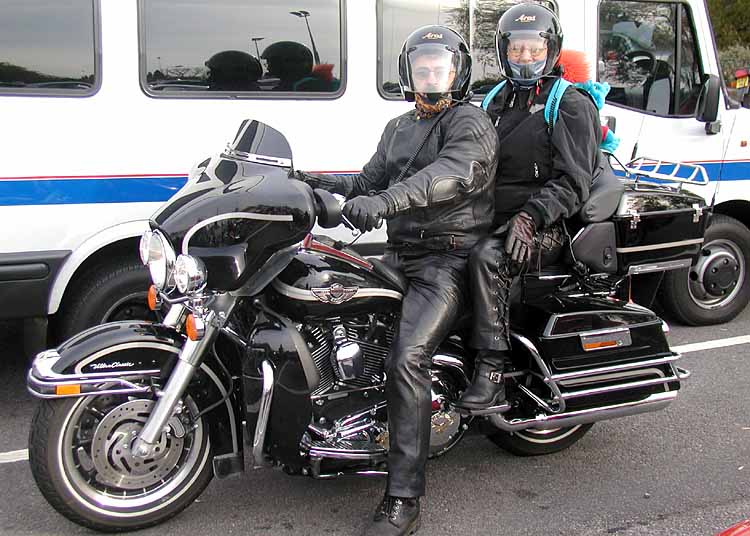
What a boot! A couple who sings in choir–real mainstays with wonderful voices–have a secret wild side. He has always wanted a Harley, and some months ago he finally realized his dream. It’s big and black and gorgeous. As we were walking out, they were getting ready to charge off and I said, jokingly, “I wanna ride it!”
So to my amazement, they offered me a ride. Great fun!
That was my ride on the wild side for this year.
Right now am whipped: up at 3 a.m.; read real estate textbook; tried to get back to sleep, unsuccessfully. Out of the sack at six, running on three and a half hours’ sleep. And we do mean run: this is Thursday from Hell. Seven ‘o clock meeting in Scottsdale; back into town; fill in take-home real estate quiz; wrestle with pool; water plants; wrestle with dogs; feed dog; out the door; spend four hours in the classroom; make min-Costco run; trudge home over surface streets; fix and bolt dinner; feed dogs; out the door; real estate class; trudge home again. Third? fourth? fifth insomniac night in a row? I’ve lost count.
Beyond nonfunctional. And so, to bed…
Image. Adrian Pingstone. Harley Davidson Electra Glide “Ultra Classic,” at Aust Motorway Services, Bristol, England. Public domain.
The weather gets nice, and all sorts of flora and fauna emerge from hibernation. Among them: the burglars who live in the slums across the Conduit of Blight to the west of us.
News came in from the president of our neighborhood homeowner’s group, who relays a report from a neighbor:
******Burglary on 11th Ave and Erewhon*****************
We were badly burglarized last Monday. We live at 11th Ave. and Erewhon. They gained entry via the alley by breaking our gate then forcing entry into the back french doors. Our alarm was on, but it was not monitored (lesson learned!). They really took their time. We had a safe installed in my husband’s closet and they sawed it out. They emptied every drawer and got every item of value.
<<< Really sorry to hear this Becky but glad, as I know you are, that no one was hurt. It’s difficult to know how the burglars figure out when you’re not home. It’s a good time for everyone to remember that most times, they are watching our house, watching us leave, looking for signs that we’re not home. Remembering this may cause us to change some habits and lessen the chance that the bad guys get that opportunity.>>>
This is the second incident following that MO that I’ve heard of lately—the other was three houses down from La Maya and La Bethulia’s place. That means we’ve probably got a specific set of sh!theads targeting the neighborhood.
Think of that: they managed to remove a built-in safe. Doesn’t say whether it was bolted to the slab, but “installed in a closet” seems to imply that.
We’ve all been following the lynch-mob frenzy over the killing of Trayvon Martin, the 17-year-0ld who tangled with a volunteer neighborhood watchman. No one deserves to die for burgling or for looking like he might burgle. But it’s mighty risky behavior. You can be sure if one of our local thieves gets into my house while I’m here, he’ll very likely get himself shot. Wandering around the street looking suspicious, though…not so much.
Still, you have to figure people are on edge. And we have a gun-loving culture that encourages citizens to imagine they can “defend” themselves if they can just carry heat wherever they go. If it’s true that the young man actually jumped the amateur security guard, then clearly lugging a gun around doesn’t prevent an attack on one’s person. But whether the incident came down that way or not, under the circumstances it’s not surprising someone was killed in such a confrontation. It was bound to happen sooner or later.
Single heads of household now outnumber couples, and last year unmarried women made 21% of the home purchases in this country. Men, though they may not want to admit it, are no less uncomfortable about the prospect of some criminal breaking into their homes than are women, and as many men as women must be living alone—since 2005, single people have comprised the majority of home buyers. Knowing there are shady characters roaming around your neighborhood watching you and planning how they can break into your house is guaranteed to give a solitary homeowner (or a renter) the jitters.
Anything we can do to make ourselves safer? Welp…waving a gun around is not one of the possibilities. Most people will not shoot a person unless they’ve been trained extensively to do so. Even under duress, one pauses, and that can give an aggressor just the edge he needs to grab your gun and turn it on you. Very stupid. There are easier and less problematic strategies:
Make it appear that your house is occupied, even when you’re not home.
Leave a radio or the television blatting away while you’re at work during the day. Yes, it runs up the electric bill. But between you and me, I’d rather pay three or four bucks more each month than come home and find all the valuables cleaned out. And the safe sawed off its bolts.
Use timers to turn lights on and off when you’re out at night.
These are very cheap. If you attach several to different lamps, you can create the illusion that occupants are moving from room to room: have a family room light (and maybe the TV) go on at dusk; these go off a couple of hours later, when another light goes on in a bedroom. You could set it up so lights go on and off in back rooms in a seemingly random way all evening.
Leave a light on in a room that has no windows or whose windows are well covered at night.
If a prowler can see that a light is on somewhere in the house (because light is visible down a hallway) but can’t be sure whether someone is there or not, he’s going to be less likely to break in. I often leave the hall bathroom’s light on—you can’t see into the room from outside the house, and so it’s impossible to tell by looking into any of the windows where the light is coming from.
Install motion-sensitive lights around the outside of your home.
You can now get decorative motion-sensitive exterior lights inexpensively at the warehouse stores. I’ve installed them at the front and the back of the house and on either side of the garage door. They look just fine—no ugly glaring spotlights—and they come on if someone walks up to the door. Burglars don’t like that.
I also have a pair of spotlights in back that come on if anyone enters the back gate or walks across the expanse of yard behind the house. These do double duty, because they also light up the barbecue area and come on every time I go out there to throw a piece of meat on the grill. Very handy.
Secure the gates into your yard.
Our latest burglary report has the perps breaking down a gate. Hereabouts, most backyard gates opening onto the alleys are just nailed-together wooden things. Obviously, a lock on a flimsy gate can be circumvented with a few swift kicks.
For not very much money, you can get a metal-framed gate. Wood boards are bolted to the wrought-iron frame, creating an attractive appearance. Assuming you have a block wall (true, many of us do have wooden fences…), one of these gates can be securely installed onto metal uprights bolted to the wall. They don’t sag, and they’d be pretty hard to kick down.
Whatever kinds of gates you have, keep them locked. The burglars may still get into the house, but if they have to heft things over the wall, they at least may leave some of your stuff behind.
Grow man-eating plants around windows and along fences or walls.
What could be prettier (and ornier) than a rose, eh? How about a bougainvillea? They have claws like a well-fed wildcat’s. A Spanish sword agave lives up to its name: this is not something a burglar wants to climb over or land on as he’s jumping a wall or fence. Decorate with defensive plantings.
Want to raise chickens in your backyard? Get a goose.
They’re aggressive to strangers and they bite.
When you leave the house, look up and down the street to be sure no one is watching you.
Check cars parked along curbs for people sitting in them. Never leave your house when someone you don’t know can see you drive away. Better to be late for work than to come home and find your home cleaned out.
If you see someone you don’t recognize walking a dog, don’t leave your house until after they’re out of sight. Also from this week’s neighborhood report:
***********Suspicious Activity************
(Thanks Wayne and Darren for reporting this suspicious character to the police and letting us know. If others observe this activity in your neighborhood do not hesitate to call the police)
There has been a dirty grey Honda AZ license, with damage and black paint near the right rear fender well driven by a 20’s white male subject with a pit bull type of dog in the neighborhood for three days in a row apparently casing the neighborhood.
He parks and walks around back and forth with the dog with no apparent destination. This evening a 20’s Hispanic male with his baseball cap on backwards in a very dirty beat up white sedan (Honda??) bearing Colorado license was aimlessly cruising around and stopped off the end of my house to peer into the open garage door, when the driver observed me in the garage he punched it and took off he had made two passes in just about 2 minutes.
On Thursday February 23rd at about 3 p.m. I observed a car parked at the south side of my property on El Milagro east of 16th ave. He proceeded to get out of the car with a dog and he walked 1 block to the east, turned around and walked past his car and then 1 block to the west. He then got in his car and drove toward the park. I called crime stop and reported his description and plate #. On Friday at 11 a.m. he was back again and parked in the same spot and walked his dog again repeating the same actions as the day before.
I again called crime stop and relayed the same plate # and description. It does not make any sense to drive past the park if you intend to walk your dog. He is a white male, in his 30’s, 6ft tall, 190lbs wearing sunglasses and a baseball hat. The dog was tan & muscular like a pit bull. He drove a silver 4 door Toyota Camry (approx 2000 yr) w/hub caps and tinted windows. AZ ACF5337. The responding officer agreed the actions were suspicious and encouraged us to continue to report such activity.
Cancel newspapers and suspend mail delivery when you go on vacation.
We have one neighbor who goes off all the time and leaves newspapers piling up on the front sidewalk. They could save money on the newspaper subscription by simply putting up a sign that reads BURGLARS ENTER HERE.
Whenever you’re out of town, ask a neighbor to pick up advertising litter hung on your doorknob or thrown on your lawn, too.
Never leave a message on your voicemail saying you’re away from the house.
Ditto to notes left on the door, Tweets, and Facebook posts.
If you have a garage, clean it out and park your vehicles inside.
My neighbors across the street were burgled because they park their cars on the drive all the time. When no car is there, obviously no one is home. She works out of a home office. When she went out to a client’s office, the perps noticed she was gone and made themselves to home.
Leaving your cars on the driveway or yard is just another advertisement for burglars.
Don’t expect a dog, a deadbolt, or a security gate to keep burglars out. Dogs are easily poisoned, shot, clubbed, or simply tricked. A crowbar will snap a security gate open in a second. Deadbolts are simple to defeat.
To my mind, about the best you can hope for is to keep intruders out while you’re home. If they get in while you’re gone, who cares? But you sure don’t want to confront some meth-head inside your home, not at any time of day or night. I do have security gates and deadbolts, partly to keep the insurance company happy and partly so that a prowler will have to make enough noise to alert me before he can get in. For the same reason, I have squealers (small battery-operated stick-on alarms) on all the windows and doors. All I want is to be able to get into my safe room or out another door when some creep is coming in the back door or window.

 Gotta hurry! Today I have to write chapter 2 of a client’s book, his check finally having arrived on the scene.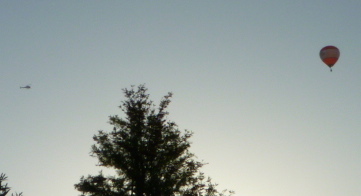
 The bougainvillea’s gone insane this spring: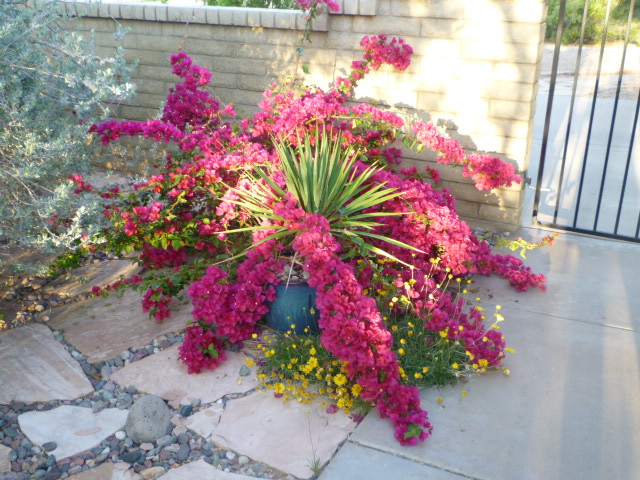



 And this…
 Speaking of Charlie, he’ll be here soon. MUST get some work done before my son shows up with that dog!!!