
What is it with sites that seem purposely designed to discourage readers from commenting? Have you noticed that more and more comments functions are set up to deliver your remarks to utterly irrelevant forums or to force you to identify yourself as a persona that’s not relevant to the community you’re cruising and that you don’t care to use for the purpose? And to ride my favorite hobby-horse again: are you aware of the extent to which these things invade your privacy?
Lookit this:
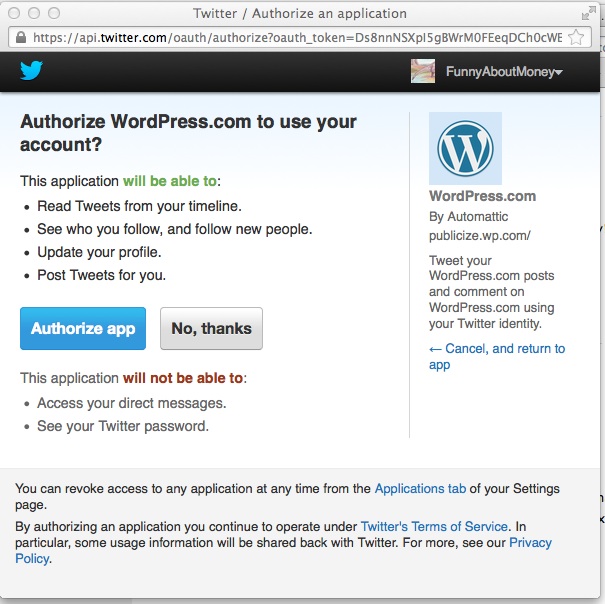
WordPress.com is especially egregious in this respect. Here, I wrote a comment on a favorite blog, hit post, and up came this. I am not logged in to WordPress right now, or at least, I don’t intend to be. But WP has decided I will identify myself as a WordPress blogger, whether I want to do so or not, and I will not identify myself as Funny about Money, which no longer is hosted there. The initial offer I get is to identify myself as the irrelevant “pvcccourseseng102,” a moniker that will make no sense to the blogger and that is utterly irrelevant to the PF community to which the blogger is holding forth. Nor will it pass any sort of recognition along to my blog.
But if I prefer, instead of surfacing as a WordPress.com blogger, I could post my comment to Twitter or Facebook.
Well, in the first place, I’m not talking to freaking EVERYONE IN THE WORLD WHO SUBSCRIBES TO FREAKING TWITTER, dammit. I’m addressing one blogger and maybe three readers who have commented on her site. And I’m not even faintly interested in commenting to everyone in the world. So the answer there is “No, thanks.”
Nor am I interested in posting my comment to Facebook, where it will be read by various friends and “friends” who have little knowledge and less interest about the blog in question. Why would I want to post an irrelevant message to my Facebook account?
And in the second place, why on earth would I or anyone want WordPress to “read Tweets from my timeline” (WhateverTF that is), see who I follow, see when I follow some new FaM admirer, update my profile for me? The answer to that one is NO, but hold the polite “thanks.”
Moving on, we arrive at Blogger.
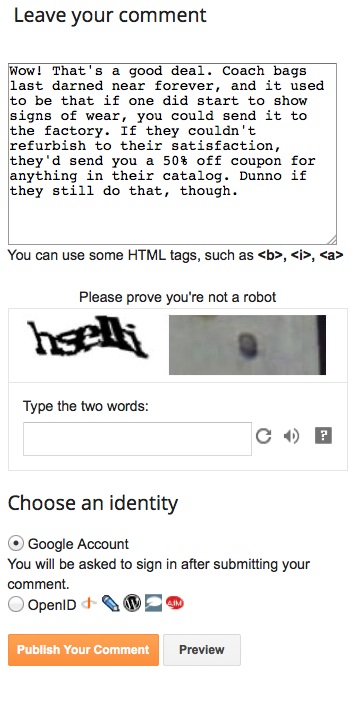
OpenID is another service that forces you to sign up before you can comment. It has been shown to make users vulnerable to various kinds of malicious attacks. Even if it were safe as pablum, as with “loyalty cards,” I have “signed up” with quite enough acquisitive and inquisitive websites and merchandising scams, thank you, and I’m not signing up for another one. Nor am I signing up for LiveJournal (the pencil), Typepad (the cloud), or…or the American Institute of Mathematics (???? which is what “AIM” signifies to me). Here, too, Blogger thinks I’m pvcccourseseng102, a meaningless identity I have no intention of using on anyone’s blog or any other website. Other than my freshman comp website, of course.
Blocked from two of my favorite websites, let’s visit The Huffington Post:
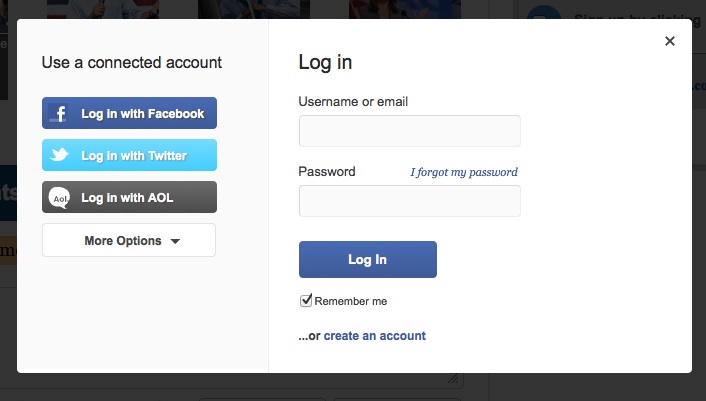
Here you’re given the option of signing in to Facebook, Twitter, or AOL. The “more” options include Google, Yahoo, LinkedIn, or Hotmail. Again…why would I want a random comment I make on some random news site to be linked with and presumably displayed to readers on Facebook, Twitter, or LinkedIn? Select Google and you’re told that Huffington wants to access your real-world name, your country, your language, and all your Google contacts!
And once again, the answer is NO / replace “Thanks” with an unprintable expletive.
Then there’s Disqus. The makers of this thing, available for WordPress as a plug-in, apparently are trying to make it ubiquitous, and they’re not doing a bad job of that. It tracks every comment you make, anywhere and at any time, under the persona that you first registered with. Nevermind that you might want to post as Melete of Adjunctorium at one site and as Funny of Funny about Money at another: you are who you aren’t. Nevermind whether you’re logged in or not: this little gem tracks you as you wander from site to site. It knows your IP address, the version of your Web browser, what page you came from before you landed on one of its sites, and where you go when you leave.
The information Disqus collects, which has been shown to be “de-anonymizable,” is shared with third parties. And with lots of other folks: Disqus publishes your entire commenting history, along with a list of blogs and services you frequent, on a publicly viewable profile page. Not only that, but you can be banned from commenting on your favorite Disqus-powered site for no reason whatsoever, as has happened to me with The Atlantic. As it develops, publishers can ban entire blocks of IP addresses, and if yours happens to be in that block, tough nougies—we don’t need no steenking First Amendment!
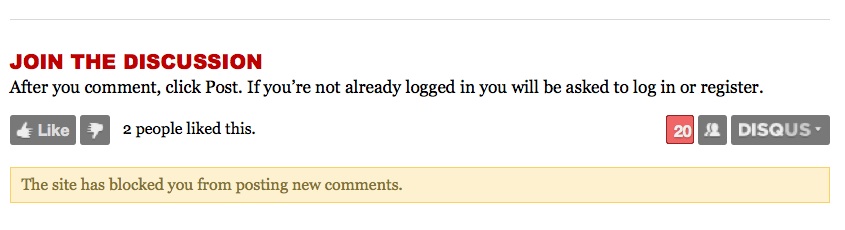
I understand that WordPress would like readers not to publish naughty and mean-minded comments on the sites of its mostly newbie bloggers, some of whom may be children or teenagers. But Akismet, which comes with all WordPress.com sites, does a fine job of blocking spam, and most WP webmasters can figure out how to block unwanted commenters. It’s really very easy.
As for the others, obviously they’re intent on gathering personal information. I’m just as intent on not sharing it with them.
These annoying devices bring a dead stop to commenting on blogs and news sites, as far as I’m concerned. And I think that’s too bad. It’s kind of fun to jump into the commenting fray at a news site.
But the whole point of blogging is to invite comments…that’s what blogs are for! The comment-killing gimmicks just stymie me. I can not understand why anyone would deliberately want to discourage readers from commenting on a blogsite. If you want reader comment, choose a host that doesn’t try to extort information from your readers. Or configure your comments function so readers can choose to identify themselves as their online personae. If you don’t want reader comment, then for heaven’s sake, save bandwith and use a spiral notebook to write your journal.
Grrr! Am I the only person in the world who hates these things and refuses to leave comments on sites that use them?