You know you’re getting old when (among other things) you begin to feel that none of the gadgets, doodads, gizmos, and minor amenities that made your life comfortable exist anymore. Or if they do, the darn things don’t work anymore!
These little frauds are a total mystification. They’re clumsy. They’re ugly. They won’t wrap around a hot pan handle. And contrary to what their admirers say, they don’t protect your hands from heat any better than a real potholder, which is to say, “a potholder made from several layers of heavy terrycloth.”
One consumer effuses, “I absolutely love these potholders!!!!” Exclamation point. Then she goes on to remark, “You need to be aware of the location of the hole in one corner of the potholder. I didn’t pay attention one day and got a nasty burn pulling a very hot pan out of the oven. If you are a bit of a klutz, like me, best to keep 100% aloe in the house just in case you do what I did.”
Uhm…. Doesn’t a hole in the potholder defeat the purpose of a potholder? The whole idea of using a potholder is to keep from getting burnt so you don’t need to have a bottle of aloe vera cluttering up your kitchen counter.
Another burbles, after allowing that they are a bit stiff and difficult to use, “They have a bonus use, as a very good way to get a grip on jars or similar items that are hard to open. (I use mine to unscrew the faucet water filter when it needs to be replaced.)” So…the tradeoff for the aloe on the kitchen counter is a hot pad that doubles as a rubber gripper. Why not just get a rubber gripper for those hard-to-open jars and opt the burned fingers?
Well, we—or more likely, a coalition of manufacturers and marketers—have decided that the silicone things are so wondrous that real potholders are getting very hard to find. The last time I searched in Williams-Sonoma, Bed Bath & Beyond, Sur la Table, and Target, I couldn’t find a real, terrycloth potholder, one that’s terrycloth on both sides, not one with a decorative scene stamped on useless cotton or one with a shiny, fake asbestos backing. All I want is a terrycloth potholder, terrycloth through and through. And I’d kinda like it not to be ugly.
After some traipsing through Amazon, I came across these Gourmet Classics terry Potholders, which look like they might do the trick:
Red is the only color that’s not plug-hideous. They also come in pea-soup green, dungeon black, and apartment-house beige. What recommends them is their size: they’re 8 by 8, the size of a normal potholder.
However, here’s one that purports to be 8½ x 8½. It comes in blue, red, and yellow, and not only that, but it’s a few cents cheaper than the “gourmet” variety.
That Wedgewood blue doesn’t match the blue trim in my kitchen’s Mexican tilework, but what the heck. The things hang inside a cabinet, so no one’s going to see them when they’re put away. Truth to tell, with some exploration you discover that this model comes in many colors, from day-glo red to cobalt via moss green.
If nothing will do for your kitchen but metaphorical greenness, believe it or not they make an “organic” potholder.
We’re told these things are made of cotton “grown without the use of harmful chemicals, pesticides and fertilizers. The methods, materials and dyes used in organic cotton have a low impact on the environment and are certified by Skal International.” The only colors available are earth-tones. In addition to the brit-shindle above, there’s a kind of pinkish terracotta, a leaf green that verges on the minty, and maize yellow. That’s a better selection than any of the other offerings. This potholder, though, is an odd shape: 7¾ x 9 inches. But that might not be a bad thing.
Isn’t it ridiculous that you can no longer buy an ordinary, functional potholder at the corner grocery store or even at the mall kitchen shop? Well. If all else fails, you can make your own:
What products from the good old days do you miss the most?
Now, don’t get me wrong. I love students. And I’m thrilled to meet the 52 new and returning freshpersons in this semester’s composition courses. But let’s be frank: reading student papers is something that causes one’s attention to wander. Easily.
It’s the brain’s self-preservation strategy: focus on this stuff nonstop and your synapses clog. You fall on the floor beneath your desk, unconscious. Inexorably, the attention wanders, the Internet beckons, the fingers wish to occupy themselves with, ohhh…knitting or paper-doll construction.
Blackboard, that all-but-ubiquitous collegiate course management system, is one of the great time-wasters of all creation. Feeling bored with reading student writing? Turn to Blackboard. There’s nothing like watching a page load for five minutes to instruct you on what boredom really means.
BB’s endlessly meddling administrators took it upon themselves to install new “blog” software (the function doesn’t really mount blogs, but it apes them in an oblique way). Was anything wrong with the old “blog” function? No. They just wanted to add a little bloatware, complicate our lives, waste a bit more of our time. Mission, we might add, accomplished.
After having strained every gut to get my spring courses built and online by the end of fall semester, what do I find when I reopen my BB courses by way of revving up for the first day of class? Yes. They’ve disabled all my blogs, which form a central part of each of my three courses. To get them back online, I have to sit through an endless “synchronizing” process…for each and every separate single individual goddamn redundant blog! Over and over!
Okay. Did that a week ago.
Get online today and find…what? Every blog I open goes through the same endless (“This may take a few minutes”) process…AND once the execrable things finally do load, there’s no way for users to create the entries they need to build for their assignments. So, send an inquiry to the admin who has been assigned to struggle with this program for us.
Go back to reading student papers.
Brain boggles. Cruise the local Play-Nooz sites, killing time by clicking thumbs-up or thumbs-down on the commentary. Gratified to see that Gabrielle Giffords is improving beyond what anyone could imagine.
Re-engage Blackboard on the blogging battlefield. Finally force it to bring up a “New Entry” button. Write new instructions for how to use the blog function; post these on all three course sites. Over and over and over again…
Read e-mail. Review the 46 college & district messages MacMail has already relegated to the trash; find that MacMail is right about all of them.
Learn from BB admin that now you have to instruct students to “save” and THEN “save and submit” to post a BB blog entry. Rewrite and repost instructions. Over and over and over again.
Begin reviewing intro papers and entering attendance and participation scores. By way of speeding the interminable grading process, I’ve learned to make a hard-copy notecard for each student, listing all the assignments with places to enter their scores. This is much easier and faster when you’re plowing through a random set of papers than trying to plod up and down BB’s endlessly reloading pages (which take you back up to the top of the grade sheet, over and over and over again…never stop saying you’re bored…). Once you’ve finished reading all the papers, all you’ve got to do is alphabetize the cards (easy to do when you’ve also numbered them) and then enter the scores quickly from top to bottom.
Problem: This entails handwriting 12 assignment titles 52 times; that would mean writing the same 23 mind-numbing words 624 brain-deadening times.
But wait! I recall I have a ream of heavy card stock, liberated from the Great Desert University when I abandoned ship. If I can recreate a set of 3 x 5 cards with a table, I can enter the semester’s assignments once and then just copy them to create a page of identical cells, which can then be printed out 26 times. It means I’ll have to cut these things apart with scissors, but somehow that seems less onerous than writing 23 mind-numbing words 624 brain-deadening times.
A lot like cutting out paper dolls.
Persuading Word to build a table with cells that measure exactly 3 inches by 5 inches without dorking things up is not as easy as it seems. Mind-numbing.
Enter in Google the following search string:
I hate Blackboard.
Dozens and dozens of sites come up. I quit scanning them after five pages of hits.
Enter in Google the following search string:
I love Blackboard.
Three sites come up, one of them titled “I love Blackboard—NOT.” One reports the results of a poll asking people whether they love or hate Blackboard; 7 percent report they love it, implying that 93 percent hate it. The third emanates from a site called blackboard.com.
Take scissors and cut out 52 notecards word-processed onto heavy stock. Fill in names and scores. Alphabetize and number cards. Enter students’ scores in Blackboard. Discover that in each spreadsheet, the endlessly redundant, space-and-time-consuming unwanted columns I marked as “hidden” have all come “UNhidden.” Click “hide” again. Over and over and over again (never stop saying you’re bored…). Hit “enter” to submit a grade and what happens? All the hidden columns get UNhidden. Again.
Other first-rate procrastination strategies: Google “evil Blackboard,” “useless Blackboard,” “frustrating Blackboard,” “annoying Blackboard,” “fu¢king Blackboard” (fill in the obvious character there), “farking Blackboard,” “godawful Blackboard,” “demonic Blackboard,” “accursed Blackboard,” and so on.
At last, you finish your work. A two-hour job has only taken you about five hours.
You have now killed a substantial part of the day. It is unclear whether you have wasted more time trying to do your job with an impossibly clumsy tool or whether you have wasted more time trying to distract yourself from the tedium of trying to do your job with an impossibly clumsy tool. Whatever. It’s time to get up, feed the dog, fix dinner, and go to choir practice.
One dares not reproduce this fine graphic, for fear of lawsuits from its creator or, more likely, from the megacorporation that promulgates Blackboard. But it expresses one’s sentiments nicely, after a day of educational time-wasting:
Things are looking up. The departmental chair has assigned me not one but two summer courses, God bless him! Even though it appears the magazine writing course will not make, that’s still seven sections for 2011 (assuming three sections materialize in the fall). Pay for seven sections amounts to $16,800, or a net of $13,272. We await the credit union’s offer in the pending renegotiation of the upside-down mortgage on the house M’hijito and I naively got ourselves into, but it can’t be any worse than we were paying before we got the loan modification at the time I was laid off. In the worst-case scenario, I would owe $9,600 in 2010. My teaching income is the sole source now of cash with which to pay my share of the payments. Think of that: $13,272 − $9,600 = $3,672, a nice little windfall!
What on earth am I going to do with $3,672?
Seriously. After a year of living frugally, I actually had to think about how I could spend an extra thirty-seven hundred bucks.
The obvious, of course, is stick it in savings! But in February another unpaid sick-leave reimbursement will come in. It will fund my Roth IRA with about $1,650 to spare; what I can’t put into the Roth will go into the brokerage fund. The net represents 31 percent of net 2011 earned income. So I don’t feel any great urgency to stash the the cash I’ve earned by actually working.
Au contraire. It’s time for me to have a life.
There are a few things I’d like to spend some money on. For example: air conditioning. I do not ever want to have to spend another summer sweltering inside my home with the thermostat turned up so high the activity of tapping on a computer keyboard breaks a sweat.
Then: water. In the summer of 2009, as some of you may recall, I kept a mostly unsuccessful container garden under the orange trees. Because plants in pots have to be watered every day and because I could afford to be lazy while I had a job, I would carry the hose to the pots and set the timer for ten or fifteen minutes…every single morning. The container garden was a fail, but the water bill was cause for celebration down at the city water & sewer department: $214 in July 2009! That’s about $90 over my water budget.
The $214 water bill, as it develops, produced nothing that summer, but it did buy a fantastic bumper crop of glorious oranges. By last February the trees were loaded with big, juicy fruit as sweet as candy.
Last July’s water bill was a far more modest $96.10. I shut off the drip watering system, dragged the hose to the landscape plants, let the xeric planting in front go without, and most certainly did not indulge in container gardening. Or much of any other kind of gardening, come to think of it.
The result: Tiny little parched fruit on the orange trees. This spring’s crop, what there is of it, is hardly usable.
The fruit took a beating from the hail storm. About a third of the oranges dropped off the trees; maybe half the surviving fruit was all bruised up, left with brown scars on the orange skins. The fruit that managed to cling to the branches is stunted—no larger than a tennis ball, and many pieces smaller than that. While most of the surviving pieces are reasonably juicy, they’re not very sweet. Some are almost flavorless.
Obviously, orange trees need a lot of water to thrive. And since I adore those oranges, I want them to thrive.
The highest electric bill of last summer was $239.08, which was $14 over budget. It was hotter than the hubs of Hades in my house—truly uncomfortable, enough to start me thinking about moving away from Arizona. Supposedly the new hyper-efficient air conditioning will hold the power bills down a bit this year.
Right. I’ll believe that when I see it. The first power bill with that unit in place came to $85.64; the January 2010 bill was $104.34. Difference was only twenty bucks…but then, we didn’t have a hard frost last winter. Until the summer bills come in, we can safely assume the new Goodman will cost about as much to operate as the old Goettl unit did.
So, I figure that to cool the house to a reasonably comfortable state (say, no hotter than 76 or 78 degrees) and to irrigate those citrus trees adequately will take about an extra $300 per month.
Okay. That’s $900 for the three hottest months of the year.
Now. I need a pair of shoes, and I wish to shed the Costco jeans and start wearing some decent clothes. That’ll be $150 for one new pair of pain-frees and let’s say $200 per shopping spree in the midsummer and post-Christmas 2011 sales: $150 + $400 = $550 to upgrade the wardrobe.
The house needs a lot of work. To repair the foundation crack on the west side, repaint the sun-blasted gables, touch up eroded exterior paint, paint the office door (a job that never did get done!), spray-paint the grungy interior of the garage, and build a French drain to direct ponding rainwater water away from the patio will cost about $500.
I need a new pair of progressive shades in the frame style I favor, which I’ve already ordered. Price tag: $720.
And this last week I made a surprising discovery: going to concerts makes me feel happy. Yes. Very happy. Music tameth the neurotic beast. A week of attending Bach concerts every second day left me feeling an unaccustomed calm, unruffled by the usual minor aggravations. As you can imagine, I wish to continue this.
Season tickets to chamber music are $200 for eight concerts, which works out to a fairly reasonable $25 per performance. When you buy them one at a time, it’s $30 apiece. The Downtown Chamber Series is only $10, but they don’t do many performances. The Phoenix Chorale is doing four performances this season plus several special events; prices are $5 less for us old bats, and you can attend their rehearsals for free. The Louise Kerr Cultural Center has a jazz series; price is about the same. The Desert Botanical Garden has its “Music in the Garden” series, mostly jazz. Plus the community college and the university music departments mount performances all the time, at very reasonable prices. So there’s a lot going on. Five hundred dollars would buy two series and entry to a number of miscellaneous events.
Soooo…. What would this spend it or bust budget look like?
Holy mackerel! I can’t even think up enough ways to spend the extra money!
Whence this spectacular new lucre? Well, it’s happening because I finally gave up trying to avoid drawing down retirement savings. The nest egg recovered pretty well in 2010, to everyone’s amazement. Really, I don’t think the boys down at Stellar believed, in their heart of hearts, that the market would come back the way it has. On their advice, I tried my level best to get by on just Social Security and the piddling $14,160 that Social Security allowed me to earn from teaching last year. That was difficult; it just wasn’t enough for me to live on.
With happy days here again (except for the 17 percent of Americans who remain unemployed or underemployed, myself among them), we’ve changed the strategy. Right now I’m spending down the post-tax savings I had accrued before GDU laid me off, to the tune of about $1,100 a month. This should last until September, at which point I’ll start a 3 percent drawdown from retirement savings. That plus Social Security amounts to just enough to meet my base monthly needs. So, everything I earn teaching can be used to meet expenses beyond bare survival.
My initial thought was that the teaching income—virtually all of it—would go to pay the mortgage on the downtown house. And that would have been so under the onerous earnings limitation imposed by Social Security in 2010.
However, in 2011, I’m free at last of the earnings limit. That allows me to take on two extra courses, about the max the community colleges will hire me to teach. Net income from two extra courses is almost $3,800.
If a miracle happens and the magazine-writing course makes, then I would net about $5,570 more than needed to pay the mortgage.
It’s a miracle!
Now, if I saved the money instead of spending it on myself, in three years I’d have enough to buy a brand-new car in cash, despite the low trade-in value of a decade-old gas-guzzling minivan.
But I figure…what the hell. Since I can’t dream up enough ways to diddle it all away, unspent cash is going to accrue in savings willy-nilly. My car has 100,000 miles on it. The mechanic par extraordinaire thinks it will run to 150,000 miles. That’s five more years. By then, we should have much better choices of fuel-efficient vehicles, and some of them will be a year or two old, available at post-depreciation prices. Hang onto the Dog Chariot until it’s ready to fall apart, and I’ll only have to buy one more car during my remaining lifetime. How to go about paying for this new vehicle is a problem that will have to solve itself when the time comes.
As for how we’ll cover the cost of the mortgage when I can no longer work—about four years from now, by my estimate—fifteen or twenty grand in savings would delay but not solve that problem. The mortgage also is something we’ll have to deal with in due time.
Have you ever noticed how whenever you realize you really like a piece of clothing or household object, it immediately wears out and you can’t, under any circumstances, find another one like it? Especially if the object is a sock. Who would think styles in socks were so fleeting?
Women’s socks no longer seem to come in colors—they’re all black, gray, or white. So when a favorite blue pair developed a couple of holes, I remembered a frugal way to extend their lives, something I learned when I was a little kid and pretty much forgot: darn ’em!
Darning is a crude form of reweaving, and it’s pretty easy. Simply create a “warp”—a structure on which to weave horizontal threads—by stringing thread or yarn across the hole. Then run your “weft” over and under the warp threads. The process is simplified by placing an “egg”—a wooden ovoid or globe—inside the sock to stabilize the fabric around the hole.
Well, naturally I didn’t happen to have a wooden egg sitting around the house. I used a rubber ball instead.
Turn the sock inside out, and then place the ball (or whatever you choose to use as an “egg”) inside the sock and smooth the fabric across it, like so:
It’s a good idea to stitch around the hole to create a sort of frame, although it’s not always necessary. Don’t tie a knot in the thread, because a knot will irritate your foot. Just make a running stitch to secure the thread.
Starting on one side of the hole, run thread back and forth across the hole to fill the space. The more threads you can fit across the hole, obviously, the finer and firmer your repair will be. This is a job that can require some patience. 😉
Here’s what I came up with:
Not great, but good enough for government work. The sock’s weave is kind of loose—not that loose, though. Oh well.
Anyway, whenever the basis of the weaving process is ready, the next step is to run thread through it at right angles to the “warp” threads. Basically what you’re trying to do is imitate or rebuild the original woven fabric by weaving new thread over the hole. After a while, you have something that looks like this (significantly better, with any luck…):
Not hardly gorgeous…but what the heck! Whoever’s looking at the bottom of your socks prob’ly deserves what he gets.
A finer, more careful weave probably would last longer, but this will hold for a while. It’s been a long while since I darned a piece of fabric, so I felt OK to get the thing more or less together.
With better skill, it’s possible to repair fabric with a stitch that looks very much like the original weave. Some reweavers can unstring pieces of the fabric’s thread from a hem or hidden spot and use it to make a truly invisible patch, restoring a torn or cigarette-burned piece so that you can’t see the fix at all. The Swiss darning at right imitates the original fabric’s twill-like texture. Really fine reweaving is called Belgian darning.
In my callow youth, I had a Siamese cat that loved to eat wool. Leave a wool garment, any wool garment, laying around, and the cat would chew a hole in it before you could blink twice. One day I lent a beautiful and very expensive white wool sweater to my mother-in-law. When she was done with it, she tossed it on the bed. By the time I discovered it, the cat had eaten out a hole an inch across.
Luckily, the buttons were hand-made, rings with the sweater’s wool yarn woven around them, and a couple of extras were included. By unraveling the spare buttons, the reweaver was able to retrieve enough yarn to fill the hole. To this day—thirty-five or forty years later—I still have that sweater and still wear it every winter. I can’t even find where the hole was.
Darning: it’s a frugal way to extend the life of an expensive or a beloved piece of clothing.
We’re having a brief warm spell, the days in the 70s and the nights dropping not much below 50 or so. Very pleasant, and a fine excuse to tidy up the garden after the winter’s depredations. Not too much was lost, mostly because I dragged almost every pot indoors as the Big Frost approached. It’s a lovely Sunday afternoon, and after a month’s break from the fringes of academe, I’m feeling pretty relaxed. Wish this could go on forever!
Last night, after enjoying a couple of concerts in a Bach series for which I’d snagged some free tickets, I ponied up $35 to go to the grand finale, the Mass in B Minor, once described as “the greatest artwork of all time.” It was very beautiful, impressive indeed, conducted by our own illustrious choir director, who has been one of the founders of the Bach festival.
By chance, I happened to sit next to an old-time Phoenician, a gentleman who could remember what this area was like in the 40s and 50s. He was a chemist—had spent a career with the City Water Department—and his wife, a Ph.D. in chemistry, taught on the college level most of her career; their son went off to become a physicist and then gravitated to Tucson, where he presently works for a research facility.
He and his wife still live in the house they bought as newlyweds—in the very neighborhood of pretty little red brick homes M’hijito is living in! He must live a few steps from M’hijito’s house. He described with great pleasure how much they loved living there and how the area has evolved since it was out in the suburbs of a large small town.
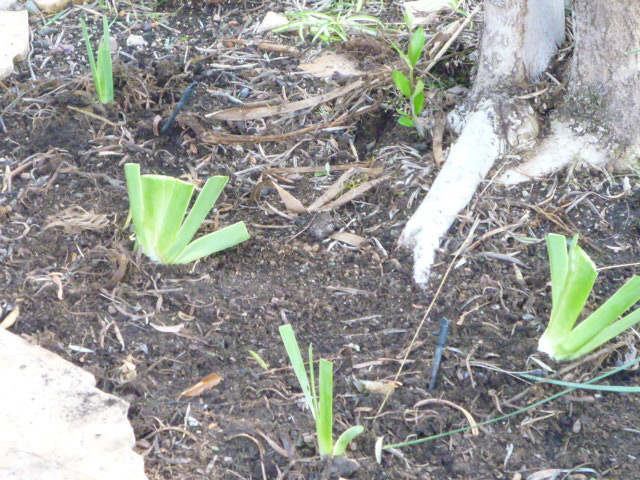
This morning one of my choir friends, of the very couple who gave me the beautiful purple bicycle, brought in a bunch of iris bulbs she’d cleaned out of her garden. She gave me two large rooted bulbs, each of which had a babe. So now the olive tree in the front courtyard has four nascent bearded iris at its feet.
Don’t know how they’ll do there. I dug some of this winter’s compost into the holes around them, so assuming bulbs like compost, that should give them a little tonic. But over the summer it gets awfully hot out there. Under the tree is probably the most temperate place in front, but “temperate” compared to the surface of the planet Mercury is a relative term. I hope they live. Love iris.
Never did get around to finishing the tree-trimming I started yesterday. Oh well. There’s one more day before class starts, so maybe it’ll get done tomorrow.
Grabbed a few handsful of bok choy (which, amazingly, is starting to bolt to seed despite the cool weather) and chard, to embellish the rich chicken broth I concocted a day or two ago and finally bestirred myself to strain and pack up in freezer containers today. Made a very fine lunch!
The Bok Choy Monster living in the backyard was not deterred by the hard freeze. Really, I thought it would kill off the bug-eyed little guy, but nooooo… The bok choy continues to get chewed, and now the critter has moved on to the chard. So I guess I’d better eat that while there’s still some to eat.
An entire head of fresh garlic sprouted in the kitchen. So, I broke it apart and planted it where it could replace the various herbs and veggies that turned to mush in the late, great frost. I’ve never had much luck getting garlic to grow, but maybe this time will be a charm. If so, we should end up with half-a-dozen new heads of garlic. LOL! I won’t have to buy garlic all summer long.
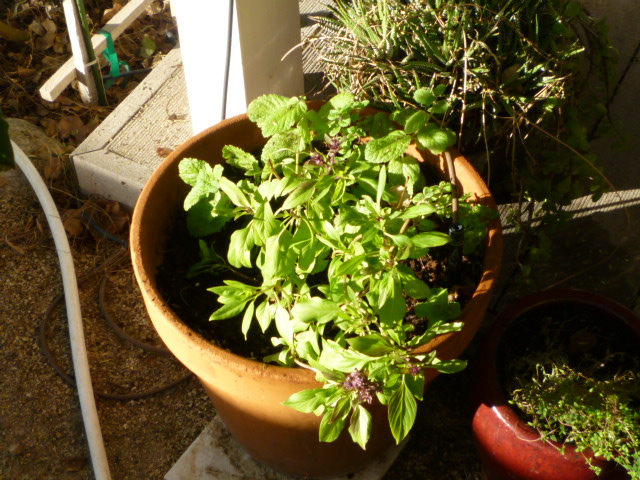
We’re told the weather is supposed to cool again this week. How nice it would be if it would maybe not freeze again this spring. The plants are starting to spring back, and I’m very pleased at the survival rate of those I managed to drag indoors during the last freeze. This Thai basil made it with no damage (except for the loss of some leaves to a predatory human), as did its companion plant, a fine, healthy mint. I love the combination of basil and mint. And Thai basil, with its distinct overtones of licorice, is even more delicious than Italian basil.
So it goes. Wonder what’s going on in the blogosphere?
Over at Money Crush, Jackie suggests that if we must procrastinate (and who among us has any intention of giving it up?), there may be ways to procrastinate wisely.
Hmmm…. Financial Samurai adds some spice to his current grouse about tax laws by mixing a bit of sexism into the stew. It worked to get his readers talking. 😉
Budgets Are Sexy wonders how many of us fudge our earnings when we make out our income tax forms. LOL! There’s a stunt I’ve never had the chutzpah to try: vacationing in Leavenworth isn’t my idea of travel adventure.
Budgeting in the Fun Stuff has launched a new blog carnival! She’ll be hosting it every Monday in January. So, that’s cool: be sure to send her some of your golden words.
Bargain Babe is taking off for MLK Day, but her contest to win a $250 Macy’s card (and various other goodies) will run until 11:59 p.m. EST tomorrow. Get your entry in right away! 🙂
And speaking of giveaways, Donna Freedman is offering CHOCOLATES! This one also closes tomorrow (Monday).
And in the “what to do with it all?” department, Abigail over at I Pick Up Pennies was recently startled to discover a windfall: extra money in the budget.
Did you know Parmesan rinds are edible? Frugal Scholar offers a recipe from, of all places, The Wall Street Journal. Sounds pretty tasty, too.
Speaking of dogs (as we were indirectly in contemplating the Late Great Dog Food Question), I’ve been reading an entertaining book by psychologist Alexandra Horowitz called Inside of a Dog. In it, she proposes to help us appreciate the canine umwelt—the dog’s unique way of experiencing the world—by understanding what and how a dog sees, smells, hears, senses, and thinks. Based on what we know to date of dog physiology and psychology, she suggests we can figuratively get inside a dog’s mind.
As intellectual exercises go, it’s great fun, and the insights you gain are slightly different from Cesar Milan’s dominance-and-submission theories. She points out that though dogs probably are descended from wolves, after tens of thousands of years spent living with humans, they’re not wolves, and their mentality, intellectual capacity, and social interactions are markedly different from those of wolves. This has some amusing implications.
The book isn’t especially well written and in places it’s poorly edited, especially near the beginning. She doesn’t start to get on a roll until almost half-way through, but once she does hit her stride, her story gets pretty interesting. We’re amazed by how “smart” (human definition) dogs are about some things and how obtuse they appear to be about others…quite reasonably, on reflection, in light of what dogs and humans do to get by in the world.
At one point, Horowitz reflects on the extent to which dogs understand the meaning of human speech, specifically their skill at recognizing individual words. She suggests they respond to the prosody of speech—its patterns and musical “meaning”—but they’re not always good at recognizing individual words. Says she,
Try asking your dog on one morning to go for a walk; on the next, ask if your dog wants to snow forty locks in the same voice. If everything else remains the same, you’ll probably get the same, affirmative reaction. The very first sounds of an utterance seem to be important to dog perception, though, so changing the swallowed consonants for articulated ones and the long vowels for short ones—ma for a polk—might prompt the confusion merited by this gibberish.
Hmmm…. A challenge! To paraphrase a less than perfectly articulate robot, “I love a challenge!”
But first, what the heck is a swallowed consonant? Simon Mumford, an English instructor, tells us a “swallowed consonant” happens when a speaker elides a consonant in such a way that it can barely be heard or can’t be heard, as in “I got a cold” for I’ve got a cold. Doesn’t seem to apply in the substitution of polk for walk, but what the hey. Every writer needs an editor.
So, to try this on Cassie the Corgi:
HUMAN: arising, walking up the hall, and paraphrasing the daily liturgy with accustomed verve: Do you want to go for a smoggy talk?
DOG evinces puzzled expression.
HUMAN evinces continued verve: C’mon! Let’s go for a smoggy talk!
DOG’s expression morphs to utter befuddlement.
HUMAN:Smoggy talk! Smoggy talk! Hurry up! Let’s go for a SMOGGY TALK!
Still appearing mystified, DOG eyes HUMAN with evident curiosity and takes a few tentative steps after it.
HUMAN: Gathers collar, leash, package of dog mound baggies, and hat.
DOG, viewing HUMAN‘s activities: Arf!
DOG dances toward front door.
HUMAN: It’s time for a smoggy talk!
DOG, whirling in circles: Arf arf arf arf ARF!
HUMAN: “Smoggy talk,” eh? {snort!} Here, hold still while I get this collar on you.
DOG and HUMAN exit, stage left.
So, alas, it does not appear that dogs deduce meaning from tone, emphasis, prosody, or brute human verve. It also appears that this particular dog can tell the difference between “doggy walk” and “smoggy talk.”