Coffee heat rising

I Love My Students, but….

{sigh} It’s 5:30. For the third time today, I think I’m done reading the current raft of travesties student papers that are pouring in as the semester ends. Most are still in the draft stage, so I will have the privilege of reading it all over again in the next week—much of it unchanged from the so-called draft.

You know, I really do enjoy students. They’re invariably interesting human beings. Most of them seem to be fairly bright. Some are funny, some are sweet, some are teeny-bopper obnoxious, some are scared, some are bold, some are earnest, some are full of beans. As a group, they possess a great deal of charm.

There’s that about teaching.

And I really do hate wasting my time. Few things annoy me more than feeling that I’ve devoted a great deal of time and effort to something for naught.

There’s that about teaching.

And therein lies the fundamental conflict. Few activities can delight an instructor more than dealing with students, and few things can waste more of an instructor’s time than dealing with students. It is a pursuit that at once pleases and infuriates.

A bouquet of comments (in blue, so as not to evoke blood by writing in red ink) from today’s readings:

Mr. Boxankle:

A college-level paper is organized into blocks of copy called “paragraphs.” Each paragraph treats one and only one topic. In the block above [which comprised the entire jumbled 750-word essay, except for a couple of sentences], you’re trying to deal with a bunch of different topics. Try making a topic outline. A “topic outline” is organized like this:

A. Thesis

1. A paragraph discussing a topic related to the thesis, containing the thesis statement.

a. Detail supporting or developing this point
b. Another detail supporting or developing this point
c. And so on, for as many details as are needed

2. A second paragraph discussing a topic related to the thesis

a. Detail supporting or developing this point
b. Another detail supporting or developing this point
c. And so on, for as many details as are needed

3. A paragraph discussing a closely related issue, and so on, to accommodate as many points as needed

B. A major issue to discuss relevant to the subject

1. A paragraph discussing a topic related to the issue

a. Detail supporting or developing this point
b. Another detail supporting or developing this point
c. And so on, for as many details as are needed

2. A second paragraph discussing a topic related to the issue

a. Detail supporting or developing this point
b. Another detail supporting or developing this point
c. And so on, for as many details as are needed

3. A paragraph discussing a closely related issue, and so on, to accommodate as many points as needed

C. Another major issue relevant to the subject

1. A paragraph discussing a topic related to the issue

a. Detail supporting or developing this point
b. Another detail supporting or developing this point
c. And so on, for as many details as are needed

2. A second paragraph discussing a topic related to the issue

a. Detail supporting or developing this point
b. Another detail supporting or developing this point
c. And so on, for as many details as are needed

3. Another paragraph discussing a closely related issue, and so on, to accommodate as many points as needed

 The items marked with capital letters (A, B, C) represent major sections of your paper. In some instances the items marked with capital letters might also represent single paragraphs; items marked with Arabic numerals (1, 2, 3) would always represent paragraphs.

So, let’s see how this might look as applied to your subject:

 A. Thesis: Public high schools should provide condoms to students, by way of preventing the spread of disease, forestalling unwanted pregnancies, and lowering drop-out rates. [PARAGRAPH]

1. Need for condom distribution

a. About 10% of girls aged 15 to 19 become pregnant
b. Many such children drop out of high school or perform poorly in school.

2. Acknowledgement of & summary of response to controversy

a. Even though the issue is controversial, more harm is done to teenagers by ignorance of safe sex and by unwanted pregnancy than by exposure to sex education and availability of contraceptives.

 B. Condoms protect their users from sexually transmitted diseases [PARAGRAPH]

1. These diseases include (name them)

2. Rates of STD among teens are (find out what these are, discuss)…

a. Syphilis
b. Gonorrhea
c. Chlamydia
d. HPV
e. HIV

3. Condoms have proven effective at preventing the spread of these diseases

a. Studies show that condom use cuts disease rates by x, y, z (look it up!)

 C. Condoms protect against pregnancy [PARAGRAPH]

1. Success rate is comparable to hormonal pills

a. Pills fail at XXX rate (look it up)
b. Condoms fail at YYY rate (look it up)

 D. Clearly young women who avoid pregnancy have a brighter future than those who give birth at an early age [PARAGRAPH]

1. XXX % of teen mothers do not complete schooling

2. High rate of pregnancy childbirth complications among teen mothers (get figures)

3. High rate of health problems for infants of teen mothers (get figures)

 E. Objections to condom distribution: Moral  

1. Some religions forbid use of contraceptives [PARAGRAPH]

a. Catholicism
b. Judaism (particular concern about condoms, as opposed to pills)
c. Extreme conservative Muslims

2.  Rebuttal: not all followers of these faiths agree with this [PARAGRAPH]

a. Percentage of Catholics who practice birth control (it’s something like 90% — look it up)
b. Exceptions in Judaism
c. Islamic thinking (http://www.bbc.co.uk/religion/religions/islam/islamethics/contraception.shtml)

3. Rebuttal: The U.S. Constitution strictly separates religion and secular government institutions, including schools; thus religious dogma should be kept out of public school policy. [PARAGRAPH]

 F. Objections to condom distribution: Practical

1. Some secular conservatives believe making condoms available will promote promiscuity. [PARAGRAPH]

a, b. Quote a couple of pundits holding forth on this idea

2. Rebuttal: a large percentage of teenagers are already sexually active, whether or not condoms are easily available [PARAGRAPH]

a. Show statistics proving this
b. Try to find stats showing that the absence of condoms has little effect on teen sexual activity

 G. Objections to condom distribution: educational

1. Many secular and religious conservatives believe teenagers should be taught abstinence, not informed about sexuality or given tools to control the consequences of sexual activity. [PARAGRAPH]

a. Explain their point of view; provide a quote or two from these people

2. Rebuttal: abstinence-only has been proven ineffective [PARAGRAPH]

a. Provide statistics (look it up!) to show this.

 H. Conclusion [PARAGRAPH]

1. Summarize pro’s and cons

2. Reiterate or emphasize your point of view

This is why outlining your ideas and facts is important! Whether you do so before you start to draft or after you’ve barfed out a draft on paper, you should always outline your material, so that you can organize it into coherent paragraphs.

Can you believe this? A graduate of 13 years of Arizona’s fine public schools does not know how to organize a three- or four-page essay into paragraphs. Or maybe,  like Bartleby, he prefers not.

Poor little guy doesn’t stop  there, though:

Works Cited

“Condom Conumdrum: Should condoms be available in schools.” Health Psychology Home Page. N.p., n.d. Web. 30 Nov. 2011. <http://healthpsych.psy.vanderbilt.edu/condomConumdrum.htm>.

Why do you think there’s no date on this? When I go to the page, I see this, right at the top:

Condom Conundrum:  Should Condoms be Available in Schools?

Michelle Reising

Date: 11/16/2005

Note that this information includes the author, the date, and the title, correctly set in caps & lower case (In MLA style, we don’t type titles in all lower-case).  Another glance at this page reveals that there is indeed a publisher: Vanderbilt University. Please look up MLA style at the Purdue web page. This is another issue that a writing coach at the Learning Center can help you with.

Emihovich, Catherine. “Condoms in Schools: Debatabase – Debate Topics and Debate Motions.” IDEA: International Debate Education Association – Debate Resources & Debate Tools. N.p., n.d. Web. 30 Nov. 2011. <http://www.idebate.org/debatabase/topic_details.php?topicID=235>. What’s this? No reference to it appears in-text.

FOR REVISION: Organize the paper into paragraphs; get enough research data to support the points you want to make.

FOR REVISION: Make sure all in-text references appear in the Works Cited and that the only things that appear in Works Cited are items to which reference has been made in the text.

FOR REVISION: Get MLA style right for both in-text citation and Works Cited.

FOR REVISION: Check facts; be sure your assertions are accurate.

Moving on… Ms. Wallbanger submits a paper advocating euthanasia. She neglects to mention that some people might object to practice.

Ms. Wallbanger:

Okay, now you need to add to this a consideration of THE OTHER point of view. And there are some good reasons to oppose euthanasia. The one that makes the most sense, if you’re not the religious type, is that some people are suicidal not because their ailment couldn’t be treated and made bearable but because they are pathologically depressed. In these cases, when the depression is treated, the patient often changes her or his mind.

For people who are religious, suicide (assisted or not) is a mortal sin. It condemns you to eternity in Hell. Thus we are morally obliged to discourage our fellow human beings from committing suicide, even if the person doesn’t subscribe to our religion (which we know to be the revealed truth).

Another issue you could address is the question of whether assisting a person to commit suicide makes the person who does the assisting a murderer. Under our present laws, it does. How exactly are the laws of 50 states and the U.S. government to be rewritten? Or should they be? There’s always the possibility that someone who stands to profit from a sick or elderly person’s death will choose to hasten things along. Same could be true of people who simply don’t like a relative.

 [Peer Reviewer A] and [Peer Reviewer B] question the strength of the thesis statement (or even what it is). I see it as this: “Not practicing euthanasia at the request of the dying person is violating a person’s rights, creating an economic burden, interfering with a doctor’s job, and increasing suffering.” It’s OK for a thesis statement, I think, tho’ the wording is a little clumsy & verbose. Try something like “Denying a dying person’s request for euthanasia violates the person’s rights, creates…, interferes with…, and increases….” Whenever possible, use strong verbs and write tight.

 FOR REVISION: about a third of your essay needs to respond to the thinking of people who have a different point of view. You can accomplish that by cutting some of the polemic, presenting the points in favor of euthanasia in an objective way, considering the other point of view and responding to it in a reasonable way, and then winding up with a satisfactory conclusion.

Heh heh heh heh… See, this is why we call it an “argument”…

And of course, this is why we call them “students”: They’re still learning.

🙂

It would be nice if they would learn from some of the things we’ve discussed in class.

Every now and again, a surprisingly good piece of writing surfaces from these characters. One young man has written an essay that verges on publishable. The topic is powerful, the content is well organized and well researched, the style is excellent for a writer at this level…or for any writer.

The thing that’s amazing about these community college classes is the enormous variety of skill and preparation among a student body that mostly consists of alert, bright, and motivated people. I would be very surprised if the author of the paper that shows no sign of instruction in basic organization were dyslexic, learning-disabled, or at all stupid. The author of the second effort is not unthoughtful. And the writer of the startlingly excellent paper is really no brighter than his classmates.

What is the explanation?

Some are numbed by boredom. Some have managed to slide through 12 years of Arizona’s version of K-12 education without having to develop any study skills (an IQ in the very low triple digits will allow that), and so they don’t know how to read effectively, they don’t know how to take notes, and they have no clue how to base a piece of writing on even the simplest research. Some spend so many hours working that they have neither energy nor time to do more than triage their classes. Some are immature and are simply goofing off.

About 80 percent of them have been shortchanged at the education check-out counter. Maybe 10 to 15 percent of them shortchange themselves. And another 5 to 10 percent arrive fully prepared and fully engaged.

I don’t know…maybe that just reflects human nature.

Stress-free Finances: Bank at a Credit Union

Yesterday morning I e-mailed the credit union to ask about prequalifying for a loan, should I decide to buy the house I’m presently coveting. Though my house is paid off and probably, when sold, will net enough to pay for the adored other house, which is on the market as a short sale, in the present conditions it could take quite a while to sell my house. So I’ll need a bridge loan to get into someplace else.

Forthwith an answer arrived in the mail. The lending overseer there suggested using their online form, but since it’s pretty generic and doesn’t allow me to explain that I will pay off the proposed loan quickly with principal from my sale of my present house, I e-mailed back and asked if we could meet. Once again she answered promptly—and she arranged a meeting with a loan officer at my convenience!

Can you imagine a bank doing anything at a customer’s convenience?

This is one of the reasons I do all my banking through a credit union: customer service is always primo. In fact, you’re regarded not as a “customer” (which in the banker’s mind seems to mean “mark”) but as a “member.” Unlike a bank, a credit union is a kind of co-op. It’s a nonprofit, operated by a board of volunteer directors elected by the members, whose purposes are to encourage thrift, provide loans at low rates, offer banking services to its members, and promote community development.

Credit unions offer the same products banks do—usually for lower costs or even no costs. I have never paid any fees at all for the use of my checking, savings, or money market accounts, for example, and credit unions don’t gouge you for the use of a debit card. Your money is insured by the National Credit Union Share Insurance Fund (NCUSIF), just as FDIC insures your deposits in a bank.

Although membership is theoretically restricted, in recent years requirements have become so broad that just about anyone can join a credit union. Here in Arizona, for example, the Desert Schools Credit Union will accept anyone who lives, worships, or attends schools in Gila, Maricopa, or Pinal Counties or who is a member of the immediate family of anyone who qualifies. Many credit unions accept people who work for or do business with certain entities—I joined the Arizona State Savings and Credit Union before I started working for the Great Desert University, because a freelance contract with the State of Arizona made me a vendor for the state. However, anyone who goes to a public school or college or who works for one is also eligible.

“Members” can also be businesses. My S-corporation has a corporate account with the credit union.

The NCUA has a credit union locator that makes it easy to find an institution near you. Credit unions take most of the hassle and grief out of banking, and by and large employees treat you like a human being, not like a cow waiting to be milked.

True, it can be a hassle to move your accounts out of a bank. However, so many Americans have gotten fed up with big banks that many credit unions now provide simple, step-by-step guides and tools for switching automatic deposits and withdrawals. It’s not very difficult, and the payback in better service and lower fees is so worth it!

Once you’ve done business with a credit union, you’ll wonder why anyone ever goes near a national bank.

The Stress-free Finances Series (A Work in Progress)

What Do You Want?
Cultivate Minimalism
The Budget
Bank at a Credit Union
Deposit and Pay Automatically

Keepin’ the Books, Keepin’ the House

This weekend updating Quickbooks Online occupied a full afternoon. As with everything else of late, I’ve gone totally lâche with that project. Not, in this case, out of raw laziness but because Intuit seems to discourage users from backing up Cloud-based data onto local computers. Because I couldn’t find instructions for any back-up other than one that would download to an installed Quickbooks program, I’d decided I would enter transactions first in Excel and then, when time allowed, re-key them into QB Online so as to simplify my accountant’s life.

Well. As usual, time did not allow.

So I ended up entering transactions dating back to last May, for The Copyeditor’s Desk’s checking account and for its credit-card transactions. This of course entails creating new “client” and “vendor” entries and a number of other antics. Time-consuming but not at all difficult. The only annoyance is that my iMac is soooooo old it runs at the speed of a galloping snail. Having to wait anywhere from 30 seconds to two minutes for each plug of data to upload eventually will drive you to tear your hair.

At any rate, moments after I contrived a workaround for the download issue (in Firefox right-click to “print frame”, then print to PDF; this will store the entire page—not just a screenshot), what should I find hidden away in an obscure corner but a way to download to Excel (create a Journal report, pulling all your data into one place; then on that page you’ll have an option to download to any of several formats, one of which is Excel).

w00t!

This will obviate the double-dose of work.

I’m pretty pleased with QB Online. That, I suppose, is because I don’t allow Intuit to reach out to my credit union and brokerage accounts. As long as all it’s doing is tracking data, you don’t enter any sensitive passwords. Thus the risk of hacking is low. About all a hacker can do is scramble your data, and if you’re backing up to Excel every time you go online, the world will not end if that happens.

This year I used QB Online only for the corporation’s account, and that at my accountant’s request. It’s very orderly, and because it standardizes the way everything is entered, it allows none of my creative schemes for entering various reminders and comments in Excel. This is good for the accountant, very good. And she can run her software on the data from the Cloud, hugely reducing the cost of tax preparation.

Because my personal accounts are fairly complex—counting the joint account into which M’hijito and I pour cash for the accursed mortgage, I ride herd on five checking and savings accounts and two credit card accounts—in 2011 I decided to try QB only on the relatively simple corporate books. But starting in January, I’m definitely going to take out a second subscription for the personal books. This will hugely simplify the bookkeeping, and especially the tax accounting.

Speaking of the books, despite a budget overrun in discretionary spending (yasss…in exactly the amount of the dentist’s bill for cleaning my teeth), I’ll still come in with $166 to spare this month. This is because nondiscretionary bills drop radically in the winter. Water and electric each dropped almost $100 in November. Lhudly sing huzzah.

If these bills rise much higher, though, I can’t imagine how I’ll get through the summers. One utility company in the West Valley has announced a scheme to raise customer’s water bills by 83 percent!!! That’s a private water company, but I’m sure if it gets away with that, the municipalities will soon follow suit.

LOL! That “$166 to spare” is a relative term: I’m having to draw down $2000± from savings each month to make ends meet. Some of it is reimbursed during the eight months the community colleges pay me an adjunct’s pittance, but that amount is nowhere near two grand and it doesn’t come in when bills are at their highest. So the truth is, every month I’m running in the red, since I can’t afford to use savings while the stock market is jerking around like a weather balloon in a hurricane.

Junk heap, tidied

In the catching up department, I finally got around to cleaning out the storage shed and the hidden corner behind it where pots and junk reside on brick-and-board shelves. What a mess! It took all morning of one day plus half the afternoon on another day to shovel through the debris, clean up the wads of composting leaves, and haul the junk to the garbage can in the alley.

This, in light of the possibility that I might put the house on the market.

As it develops, Gerardo and his sidekick haven’t been doing such a hot job on cleaning up the leaves and pods that sift down there every day from the devil-pod tree. They can’t be too severely blamed—I’ve left a great collection of broken pottery and other priceless collectibles laying around out there, to the extent that the place had begun to look like Dave’s Used Car Lot, Marina, and Weed Arboretum. Old leaves and bougainvillea flowers were packed tight under the boards that form the lowest b&b “shelves,” partly because you couldn’t easily walk around the junk back there to get at the mess.

Six years of dust had accrued inside the shed, which I haven’t seriously cleaned since I moved into this house. Think I breathed most of it in while sweeping it off the shelves in there—this morning the throat still feels like it’s made of sandpaper, and I’m still coughing. Should get up and drop a Sudafed, I suppose. Yuch.

Now, consider this: What happens when you begin to think seriously about putting your house on the market?

Yes. Everything breaks!

Saturday I turned on the oven’s self-clean cycle. Leapt back a half-foot when the thing emitted a jackhammer-decibel BDRDRDRDRDRDRDR! Dayum!

So now I’ll have to get a workman in here to see if that can be fixed. There’s an outside chance it’s a fan. But if its not…well. Satan and Proserpine, in the course of renovating the kitchen, installed a freaking double oven in there. They come as part of a single unit. You can’t just replace one oven. You have to replace them both!

Joy. A comparable 27-inch unit will run around $2,000, plus delivery plus installation plus the 10% sales tax. So we’re lookin’ at a $2,500 hit here.

And where is that hit gonna come from? Yup. Out of retirement savings. Just now monthly disposable/short-term emergency savings contains all of $1,379. So having to buy a new oven will clean that out completely and drain survival savings by another thousand bucks.

The inside of the house will need at least some paint, too. The white trim is filthy and dinged up, the door I put on my office so I could lock it securely never did get painted, and that terra-cotta orange hallway is going to have to be painted a subtler color. Ditto the puce orange accent wall in my office that never got painted over because it’s too much hassle to drag the heavy furniture and navigate the tangle of computer cables. God knows what that’s going to cost.

I…need…a…JOB!


Moments of Light

Moments of light: that’s what Wordsworth called those instants of transcendent vision that our excellent pastor calls the “thin places” between this flesh-bound world and the view of spiritual reality. It’s surprising how little it can take to elicit an “ah-hah” moment, the “I can see clearly now/The rain is gone” insight.

A day or two of peace and quiet and several seven-hour nights of decent sleep are all it’s taken for me, this time around. As the avalanche builds while our beloved McBoingers concoct their final, most brilliant papers they’ve ever written, only a few excused late stoont paper have remained to be read. M’hijito’s decision to take vacation time coinciding with a holiday sprang me free of a full day of performance and grading also freed me from hectic puppy-sitting, allowing me and Cassie to rest, exercise, and think. (Well. I don’t know if Corgis think, although I suspect they do. But the Human certainly did a fair amount of thinking.) Thanksgiving at our friends’ house, replete with a bottomless well of free booze, provided six hours in which to stop focusing on workworkworkworkwork and to tie a fairly large one on.

Thinking and drinking. Drinking and thinking.

And here’s what I think:

Mark Twain was right when he said some writers are tone-deaf. We see that most clearly when we force writing out of souls for whom text-messaging is a challenge. For me, reading composition papers must to be akin to what our highly educated, musically sophisticated choir director would feel if he had to hear all forty of us, professionals included, screeching some classical piece off-key.

“When a person has a poor ear for music,” said Twain, “he will flat and sharp right along without knowing it. He keeps near the tune, but it is not the tune. When a person has a poor ear for words, the result is a literary flatting and sharping; you perceive what he is intending to say, but you also perceive that he does not say it. This is Cooper [substitute “the freshman comp student”]. He was not a word-musician [not by a long shot!]. His ear was satisfied with the approximate words.”

It is painful for me to read the stuff so carelessly dumped on my desk. When I said, after several years of supporting graduate school by teaching English 101 and 102 courses, that I would go on welfare before I ever taught another freshman comp course, that is what I was talking about. This morning it was all I could do to keep what remains of my mind on those gilded words long enough to comment on them and assign them a score. Absolute agony.

Insight #1: I really, really, REALLY don’t want to do this for the rest of my functional life. If I have to, I suppose I will, because I can’t make ends meet right now. But if I can find another way, I’ll take it.

But…but would I take the full-time teaching job for which I’ve applied, were it offered?

Insight #2: Damn right. I’m in terrible straits financially, and I can’t go on like this much longer. Pay for full-time faculty in the district runs on the high side of respectable. Five or ten years at that grindstone, as painful as it sounds, would allow me to recover the losses to my retirement savings that happened when I was laid off my job. And it would be enough to let me buy the last car of my driving lifetime and get myself into a home that will accommodate me until they cart me off to Hospice.

So. Yes, she said. Yes.

howEVER….

Insight #3: Truth be told, I do not need $65,000, $70,000, $81,000 to get by just fine.

If a miracle happened and the church happened to offer me the rather interesting job it has open just now, for which I happen to have applied, would I accept it and its amazingly low salary?

Oh, yes, she said. Yes!

Money-wise, the ridiculously low salary would combine with Social Security to provide a living wage: $45,000 or $48,000 gross.

I would love to work for the church, partly because I love the church and partly because I truly do believe I can do the job.

Would there be a learning curve? Sure.

Can I do the tasks? Yeah: I’ve been doing all those for the past five or ten years.

Would I be willing to pay, out of my own pocket, for specific training to do that job ? Darn right: give me an offer and today I would sign up for an accounting course, or I would bribe my accountant to train me in GAAP and the application thereof.

Moment of light: Any day I would rather enter numbers in spreadsheets, ride herd on financials and employees, and keep an office hanging together with paper clips and Scotch tape than read another student paper.

🙂

Here’s another moment of light: the American Dream, Formerly Affluent Boomer rendition.

O

M

G

!

Just look at that place!!!!

I know that neighborhood. I’ve haunted it in the past, when prices were way, way, WAY beyond my price range. A short sale, however, brings this updated little babe right down to what I think I can net off the house I’m living in.

Lookit that kitchen! Okay, okay…no gas. But hey! I hardly cook anymore…in the depression that accompanies Old Age, I don’t feel like eating, much less like cooking. And do I or do I not have the Propane Barbecue of the Gods? If I want to do some serious cooking, I’ll take it outside.

Lookit those patios!

Lookit that yard! Is that or is that not Cassie Heaven? It’s even Human Heaven. NOOOOO swimming pool!!!! Lookit those patios! Lookit those trees! Lookit that privacy!

Well. There is a swimming pool. Someone else gets to take care of it. 🙂

Lookit those acres of greenswards, all common areas. Cassie would not even have to walk a block and a half to sniff every waft of dog pee ever deposited on this earth. At least, in her limited little doggy universe.

Lookit those freaking DOUBLE-PANED FRENCH DOORS AND WINDOWS. Oh god oh god oh god. I think I have found nirvana.

Let’s hope no one has found it before me.

I have asked the credit union if I can prequalify. I have asked a friend in my business group if he can round up some investors who will lend me enough for a bridge loan, damn the usurious interest rates. I. WANT. THAT. HOUSE.

Moments of light.

Have you spotted any lately? What are they?


Happy Thanksgiving!

My beautiful son
Great friends
The All Saints Choir
Cassie the Corgi
Charley the Puppy
A roof over my head
Enough to eat
A beautiful cool morning

What are you giving thanks for today?

Images:
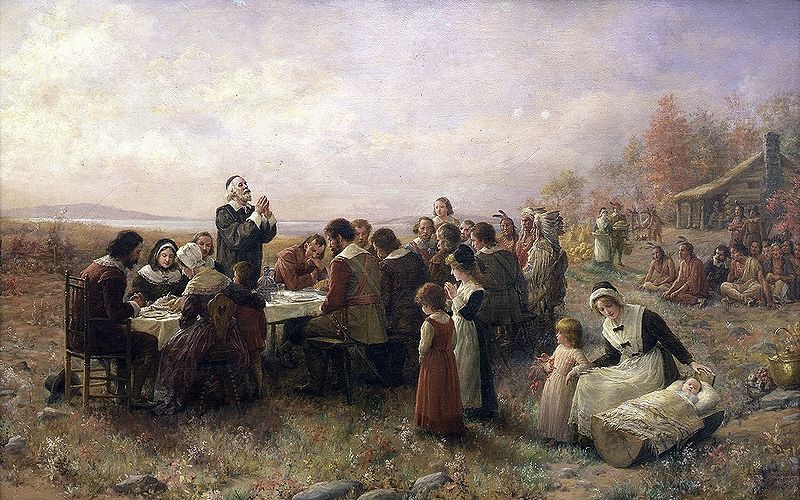
Jennie A. Brownscombe, The First Thanksgiving at Plymouth. 1914. Public Domain.
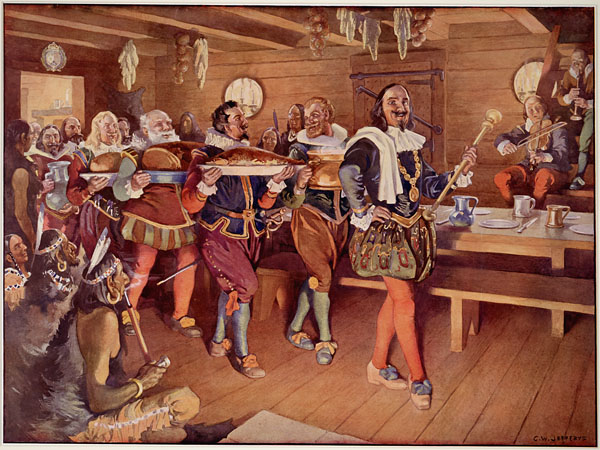
Charles William Jefferys, The Order of Good Cheer, 1606. 1925. Public Domain. (The Order of Good Cheer was an early Canadian thanksgiving holiday.)

Black Friday: Turn Off Your Phone at the Mall

If you’re planning to dive into the Black Friday maelstrom, you might want to think about turning off your cell phone before you walk into the mall. That is, if you’re the type who passionately values your privacy.

In the latest encroachment by the quasi-government that is Corporate America, a couple of malls will experiment with tracking people’s movements as they wander from store to store by tracking radio emissions from their cell phones. This will be a lot subtler than some of the earlier strategies, which have even included hiring employees to stalk you through the mall. Forest City Commercial Management, which runs the malls in Southern California and in Virginia, claims this is not an invasion of your privacy because supposedly they can’t personally identify you without a court order.

Well. One man’s “not an invasion” is another man’s “get out of my face!” And as one reader pointed out, eventually computerized face recognition programs will make it easy enough to connect the image gathered as you enter the mall with the image you posted on Facebook. Nor is it impossible to imagine hackers breaking into the system and identifying users. If a hacker can do it, big business or government can hire the hacker to do it.

The only way to stop this intrusion is to turn off your cell phone before you enter the mall. Of course, that defeats the purpose of owning the cell phone, for which you pay a pretty penny: you wouldn’t have the thing if you didn’t want to be jangled up at every hour of the day and night, no matter where you happen to be or what you happen to be doing. But nevermind.

Hmm. Actually, this could be a good thing: wouldn’t it be nice to shop for a day without having to listen to people yapping on the phone?

While we’re in the silver lining department, this sort of news invariably makes me glad I can’t afford a cell phone and I can’t afford to shop in malls any more.

😀

Image: Appraiser, Escalator at Edmonton Mall. Public domain. Edmonton Mall is NOT one of the properties reported to track customers’ cell phones.