Welp, it’s supposed to hit 110 sometime in the next few days. The flowers are frying, and summer has finally arrived.
A few blogging friends came over yesterday. The pool was warm enough to swim in but still cool enough to be refreshing—not yet bathwater temp but getting there.
A 110-degree day means the air conditioning will have to run all day long. Hateful. I don’t like having to keep the house closed up 24 hours a day. It’s stuffy and claustrophobic. And the expense! OMG! I’m expecting bills to rise well over $200, and that’s if I keep it uncomfortably warm inside the house. If you want it cool enough so that you don’t break a sweat walking to the bathroom, you’ll pay $300 for the privilege.
According to Wunderground, though, night-time temps should stay in the 70s—tonight it cools to 77; on Thursday (supposedly) it drops all the way to 70. So maybe I can shut the AC off at night. That will help some.
And in my new penury, I’m going to have to wrestle with the ever-annoying digital thermostat, the contraption that decidedly does not save on power consumption. Right now it’s set to cool the house to a temperature where I can sleep at night and then go back up to stifling about midnight, when I hope to be out cold. That’s going to have to stop: cooling the place into the 70s, even for three or four hours, is now outside my budget.
I need to find a new air-conditioning contractor. Our regular outfit has gone to seed. In addition to having installed said thermostat, which appears to be inappropriate for the heat pump on my house, they gouged us $500 for a repair on the downtown house’s swamp cooler that we would not have done had they called first and said what they intended to charge, and now they’re trying to nick us another $85 to have the guy come back and fix it because he didn’t install the pump right! I’m totally fed up with that outfit and am going to call my neighbor Sally’s AC guy to do the annual service on my unit, which my guys have quietly forgotten.
I’m sorry to can them, because I know the company has been struggling through the deprecession—they’ve laid off all their staff but one guy, who apparently is not busy full time, because they cut his salary to half-time. But we can’t support their business single-handed, which is evidently what they expect. Hope Sally’s guy is OK…the air conditioning business around here is awash in incompetents and crooks. She’s a wily old gal, though, and so I have some hope that he can do the job without cleaning out my bank account.
…you ask a young woman in the glassware department of Gargantuan Booze Warehouse if they have any highball glasses and she doesn’t know what a “highball” is.
…you’re glad to see the latest shades of green, brown, gold, and orange back in style, because now you can haul out the old 1970s knick-knacks you stashed in the back of the closet because you could never bring yourself to throw them way.
…the piece of junk you gave to the Salvation Army last year is going for $500 at Snooty Antiquities.
…you think capris are just as unflattering now as they were back when you wore them and called them “pedal-pushers.”
…a front-loading washer brings to mind all those sudsy overflows and all those back-aches from bending over to unload and reload the darn thing.
…you find yourself instructing young women about how to hang their laundry out on a line.
…young girls tell you that women in the 50s dressed elegantly to do housework, and then say they know that’s so because they saw it on I Love Lucy reruns. 🙄
…you still have an Encyclopaedia Britannica in your bookcase.
…you know how to use an Encyclopaedia Britannica.
…you have a smallpox vaccination scar.
…you can remember when all women were SAHMs—or 99.8 percent of them, anyway.
…you think that holidays once came on specific days of the year, not on Monday. Come to think of it, school’s not supposed to start till after Labor Day, is it?
…you know how to use a typewriter.
…the last time you worked as a secretary you were called a “secretary,” not an “administrative assistant.”
…cheap tumblers remind you of the glasses and mugs gas stations used to give away.
…you miss having a gas station attendant fill your car, check the oil, and wash the windshield.
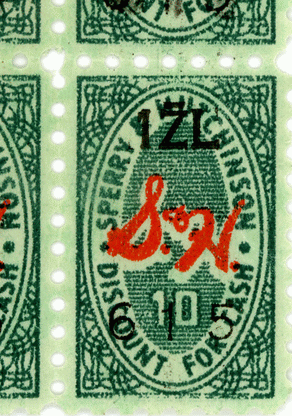
…you still use a lamp, tableware, wicker hamper, or other valuable purchased with S & H Green Stamps.
😀 Are you a survivor of some prior geologic age? What memories do you own to prove it?
Want another dog? The corgi rescue has a black-and-red male they’re trying to adopt out. This little dog doesn’t show at their site, but the Rescue Lady has been back and forth over the e-mail for the past week or so, figuring she’s found a soft touch. 😉
She tried to get me to take a pair—a female with her teats full of milk and her presumed mate, found wandering loose in the streets. But there’s a limit.
The limit may be one: Cassie the Corgi. Few people need more than one dog, and I’m definitely not among the elect.
Cassie might benefit from a doggy companion. Even though I’m not working and my social life is minuscule, I’m busy most of the time with writing, editing copy, and the daily survival chores. Most of the time she’s content to loaf around. But there are some signs she’s developing a few neuroses.
She’s become obsessive about balls. Every waking moment is spent petitioning the human to throw the ball for her to chase after. This can be quite a nuisance. Once in a while a ball game is great fun. But every time you turn around?
More ominously, because I live in almost perfect solitude, she’s becoming desocialized. Two walks a day are not enough to keep up her human skills, even though we often meet people who burble over her cuteness and we often meet children who come over to pet her. Last weekend we went to a party at M’hijito’s house. All his friends are spawning just now, and so three infants and a toddler were part of the mix.
Cassie normally dotes on children. But when the toddler, a little girl, tried to pet her, she acted as though she were being tortured. Each time the child touched her or even reached out toward her, Cassie shrieked like someone was beating her. The kid was not hurting her, not pulling her hair, not grabbing her ears, not yelling or squealing. The dog didn’t make any move to snap at the child, but she behaved like she was in pain.
It was strange behavior, especially for a dog that’s normally friendly and happy around children.
So I’m thinking maybe another dog to play with would benefit her. Doggy mentally, that is.
Experience shows, however, that getting another dog does little or nothing to quell the first dog’s quirks and neuroses. Anna H. Banana was bananas, all right; M’hijito has called her “bat-shit crazy.” She was just as wacky about balls and rope toys as Cassie has become, and she also believed she could speak English. She would often try to carry on conversations, ooking and whistling at the humans.
Bringing Walt the Greyhound onto the scene really made no difference. Though she seemed to like Walt (surprisingly: she plotted the assassination of every other dog on the planet), she became no less toy-obsessed, no less inclined to yak at the humans, and no less focused on the human as the center of all existence. And sometimes getting a second dog, especially if both are the same gender, can create all sorts of problems, from overdependency to fighting.
What bringing in Walt did at my house was double the dog-care workload and double the extraordinary cost of pet ownership. The vet bills for those two animals were breathtaking, and the cost of food was enough to put you in the poorhouse.
Cassie, because she’s so small, costs a great deal less to maintain and is nowhere near as much work. Her health has been excellent, and so she hasn’t run up any new bills since she shook off the kennel cough she picked up at the dog pound. But that is sooo atypical!
One recent study by the American Pet Foods Manufacturers Association showed that owning a dog costs an average $1,571 a year, or $15,710 for ten years. It’s easy to run that up, given the the abundance of toys, doggy beds, dog gates, dog crates, dog shampoos, dog toothbrushes, dog collars, dog blankets, dog harnesses, dog jackets, dog booties, and mugs emblazoned with a picture of your dog’s breed. If, as a 2009 survey showed, 62% of Americans own a pet, the profitability of the pet industry is HUGE. That’s 71.4 million households!
In 2009 we spent $45.5 billion on house pets. That figure is expected to go up to $47.7 billion in 2010. We spend as much on our animals as the GDP of Luxembourg and Bulgaria; more than twice the GDP of Bolivia.
Think of that. People are going hungry while we spend the equivalent of an entire country’s production on pet food and doodads.
Plenty of Americans, however, find that they can’t afford the upkeep of a dog or cat, or that they can’t handle the behavior and the mess. The Pet Guardian Angels of America, a pet rescue trade group, has a listing of U.S. animal rescue groups by state. Click on your state and cruise the “adoptable pets” at each group’s site. The sheer number of lost and rejected animals will drop your jaw.
Most distressing is the number of dogs above the age of seven that have been handed to rescue groups, dumped in dog pounds, or dropped onto the streets. This is about the time a dog starts to run up big vet bills: an elderly dog is an expensive dog.
Well, the Rescue Lady put me on to a beginning class in agility training. Cassie is an athletic little dog, and this activity not only would keep me amused, it would run off some of her energy and resocialize her with other dogs and people. So I’m thinking I may enroll us.
That might be a smarter move than getting another dog!
Every now and again, the credit union sends out a mass e-mailing to lobby members to ask elected representatives to vote this way or that on matters that affect credit unions in specific and banking in general. Normally I think yup yup yup! what’s good for my credit union is good enough for me and do as I’m told. This time, though, they’re asking us to weigh in on the “interchange legislation” that is part of the new financial regulatory reform act.
And I’m not so sure.
We’re told in the e-mail:
A new amendment under consideration by legislators will benefit merchants and soon you could be paying more to use your debit and credit cards. Merchants are asking legislators to reduce their fair share of the cost of the card payment system.
If they are successful, merchants will:
• Dictate which debit and credit cards they will accept and where they will be accepted
• Limit your ability to choose your preferred payment methods
• Be allowed to set minimum and maximum amounts for credit card purchases
• These changes could result in higher costs at checkout, and fewer rewards and benefits for your debit or credit card. You can protect your preferred method of payment by acting now!
Oh. Eeek. I’m afraid. I’m very afraid.
This bit of slippery-slope logic led me to wonder what on earth they’re going on about, so I hit the link to the boilerplate they would like us to send to our legislators. Here, the proverbial plot thickens.
Here we’re told that the new legislation would include “a provision that would mandate price controls on the interchange fees paid by merchants for accepting debit cards. This bill has unintended consequences for credit union members and every consumer with a debit card in his or her wallet.”
Price controls on “interchange fees“… What we’re talking about here is the amount that retailers have to pay for the privilege of letting you and me rack up our purchases on credit and debit cards. This can be a significant zing. The charges vary from card to card, which is one reason that a lot of vendors won’t accept American Express…it’s mighty expensive.
Agreements with all the major credit-card purveyors forbid merchants from offering a discount to customers who pay in cash. That’s one of the things the lobbyists who want you to write to your legislator are exercised about.
Soooo… At this site, you can broadcast your pro-banker opinions to any and all of your federal representatives using any or all of the following boilerplate:
As a constituent and a credit union member, I am writing to urge you to oppose inclusion of the Senate-passed interchange provision in the final financial reform bill. This provision will have unintended consequences for credit union members like me and every consumer with a debit card in his or her wallet. It has not been thoroughly studied and does not belong in this bill.
Merchants receive tremendous benefits when they choose to accept debit and credit cards as a form of payment. They are paid immediately, and they do not have to deal with cash or wait for a check to clear. Like electricity or rent, the interchange fee that the merchant pays is a cost of doing business. Government rate controls on interchange reduce the merchants’ responsibility to pay for the benefits received from the card payment system and will drive up costs for credit unions and their members.
My credit union incurs significant expenses in operating its card payment system. For example, my credit union is responsible for administration of card programs, customer call centers, and reissuing cards in cases of merchant fraud. Interchange supports these costs. If interchange fees were reduced, my credit union and other small financial institutions would be forced to raise rates and fees for card services. My credit union might even have to curtail debit and credit card services for members, and that might force me to move my account to a big bank that offers cards at a higher price. Furthermore, there is no evidence to suggest that merchants would pass along any savings resulting from lower interchange to consumers.
This provision offers no real “exemption” or “carve-out” for credit unions; if it were included, merchants and big banks would set rates that would make it impossible for my credit union to compete. In the end, merchants could refuse to accept the credit union debit card I rely on for everyday purchases.
The interchange provision requires a more thorough review and does not belong in this bill. I urge you to oppose its inclusion in the final financial reform bill and hope you will ask conferees to keep this provision out of this bill.
The little red arrows are widgets that allow you as the “author” of the legislator spam to choose whichever paragraph you choose.
Soooo… The question is this: Is what’s good for my credit union good for me? And you?Should there be no cap on the amount banks are allowed to require merchants to pay just because their customers think it’s handy and dandy to rack up debt on credit cards and overcharges on debit cards? (Or not: some of us don’t charge up more than we have in the bank in any given month…but still!). Why should a merchant have to pay for our convenience, especially when the purveyor of our convenience is making a freaking ton of money off of us?
And what happens when your grocer, your toy store, your veterinarian, your clothing shop has to pay Visa, MasterCard, or American Express so that you can use Visa, MasterCard’s, and American Express’s startlingly profitable plastic?
Oh, yes: we do know what happens. The cost gets passed along to you and me! Everything we buy from retailers across the nation and around the world costs more because we’re paying the surcharge in the form of higher prices at the checkout stand.
Well.
If the Safeway gave me a discount for buying a week’s groceries in cash, I would cheerfully break out a fistful of dollars or write a check. If Chuck’s Auto Service, the premier car mechanics in central Phoenix, would exempt me from interchange fees if I paid cash, I would be mighty happy.
All right. All right. Debit and credit cards are very handy, and I admit to using my AMEX card because it is just downright convenient. I don’t like to carry cash around—having been robbed once, I know I can’t collect for lost cash from an insurance policy, and I know my losses from a stolen credit card are capped at $50. Very nice. And I do hate dorking around with writing a check and jumping through the merchant’s check-cashing hoops every time I make a purchase.
What about that kickback I’m getting from Costco’s American Express card? It amounts to 3 percent for gasoline charges, 3 percent for restaurant bills, 2 percent for travel costs, and 1 percent for everything else. Well, I hardly ever go out to eat (which means instead of a 3 percent kickback for food, I only get 1 percent), and I never travel. So it wouldn’t harm me to pay cash for restaurant meals and grocery bills, especially if I got a 1 to 3 percent discount for doing so. Because paying cash at a gas station is a hassle, I’d probably still charge gasoline, unless the cash discount were significantly more than 3 percent.
But if this legislation puts credit card issuers out of business (why do I think it won’t?), do I care? Will my world end if I have to write a check or pay with actual dollars for everything? Well, in a word, “no.”
No x 2.
How do you feel about this matter? Do you think credit card issuers should be allowed to continue the status quo? Is there a difference between debit and credit cards issued through credit unions and those issued through banks? If so, what is it?
If you haven’t seen Environmental Working Group’s2010 sunscreen guide and Carrie Kirby’s excellent report on it in WiseBread, now is the time to start reading. Hang onto your hat (literally: you’ll be needing it!).
The long and the short of it is that most commonly used sunscreens are not as effective as claimed and contain ingredients that may do more harm than good. Vitamin A, currently popular in U.S. sunscreens, may actually accelerate growth of skin tumors. Oxybenzone, the most common ingredient in these cosmetics, is a hormone growth disruptor and should not be used on children.
Sunlight delivers two types of ultraviolet radiation: UVA, which penetrates deep into the skin, and UVB, which causes sunburn. Scientists believe that to avoid melanoma, an aggressive and deadly skin cancer, you need protection against both UVA and UVB. However, most sunscreens sold in this country provide little or no protection against UVA radiation.
Interestingly, researchers do not even agree on whether sunscreens prevent skin cancer at all. In fact, some speculate that use of sunscreens encourages people to stay out in the sun longer than they might otherwise do, and, since these products do not necessarily protect against the carcinogenic effects of ultraviolet radiation, they may actually increase the risk of skin cancer. To obtain any meaningful amount of protection from a sunscreen, you need to glop it on: a palmful at a time. And you have to reapply it frequently. Using high-SPF products does nothing to change these facts.
Seals of approval by the American Cancer Society, such as the one that appears on the tube of Neutrogena UltraSheer sitting next to my keyboard, get there because the manufacturer pays for the privilege of using it. Says the ACS: “…[W]e do not endorse a specific product and…a royalty fee has been paid for the use of our brand logo.” To get the Skin Cancer Foundation’s Seal of Recommendation, manufacturers pay $10,000 a year to belong to SCF’s Corporate Council.
Is there a solution to this conundrum?
Yup. You’ve got it hanging in your closet: clothes. Wear clothing and a hat when you go outdoors.
Indigenous peoples in hot, sunny parts of the world often wear traditional clothing that protects them from the sun. When I grew up in Saudi Arabia, the locals wore robes covering them from head to toe. We know, of course, of the notorious burqa intended to hide women from the public eye—because these were black, they must have been miserably hot, further discouraging women from appearing in public during the sunlight hours. The men wore white, sun-reflective robes that allowed air to circulate around the body, and a headdress that protected the back of the neck, much of the face, and any bald spots in the hair.
Meanwhile, we whiteys ran around half-naked in the 100-degree heat, all of us in pursuit of a “healthy tan.”
Loose cotton and linen clothing is readily available in this country, for men as well as for women. Get some, and get a few nice hats. Wear them when you go outdoors. And use the pool in the very early morning and at night, not in the midday sun.
Take time out of your busy day, or your relaxing day, to remember those whose sacrifice made it possible for us all to be busy or relaxed in freedom, and those who as we pass our day in peace at home are at the fronts in Afghanistan and Iraq.
To get your mind around the enormity of war, take a look at this mix of image and fact by author Robert M. Poole (On Hallowed Ground: The Story of Arlington National Cemetery) and design studio Rumors.