Coffee heat rising

DIY Pool Debris Shields that Work and Save Dollars

Leslie’s sells a nifty gadget called a “debris shield” that does a nice job of protecting your swimming pool filter from floating crud, cuts down on the backwashing jobs, and staves off the day that you’ll have pay someone to take the filter apart and clean it out. It’s extremely simple: a stretchy nylon mesh bag that fits down inside the plastic skimmer basket. And for what it is, it’s stupidly pricey: $12.49! For this package of five, that would be $2.50 apiece.

Though you can rinse them out, they don’t last very long. If you live in a place like Arizona, where high summer winds blow dirt and leaves into the pool all summer, or if you have a dog that likes to swim, you need a finer filter than just the skimmer basket.

The other day, M’hijito wanted to bring Charley the Golden Retriever over for a dip in the drink. Meanwhile, Cassie the Corgi has taken to falling in the pool during her frenzies over the humans’ swimming activities. Cassie has more loose hair on her 25-pound body than Charley has over his entire 70-pound expanse, and Charley alone will leave a skiff of hair floating on the surface. Fresh out of debris shields and unable to afford a new one just then, I cast about…and found this:

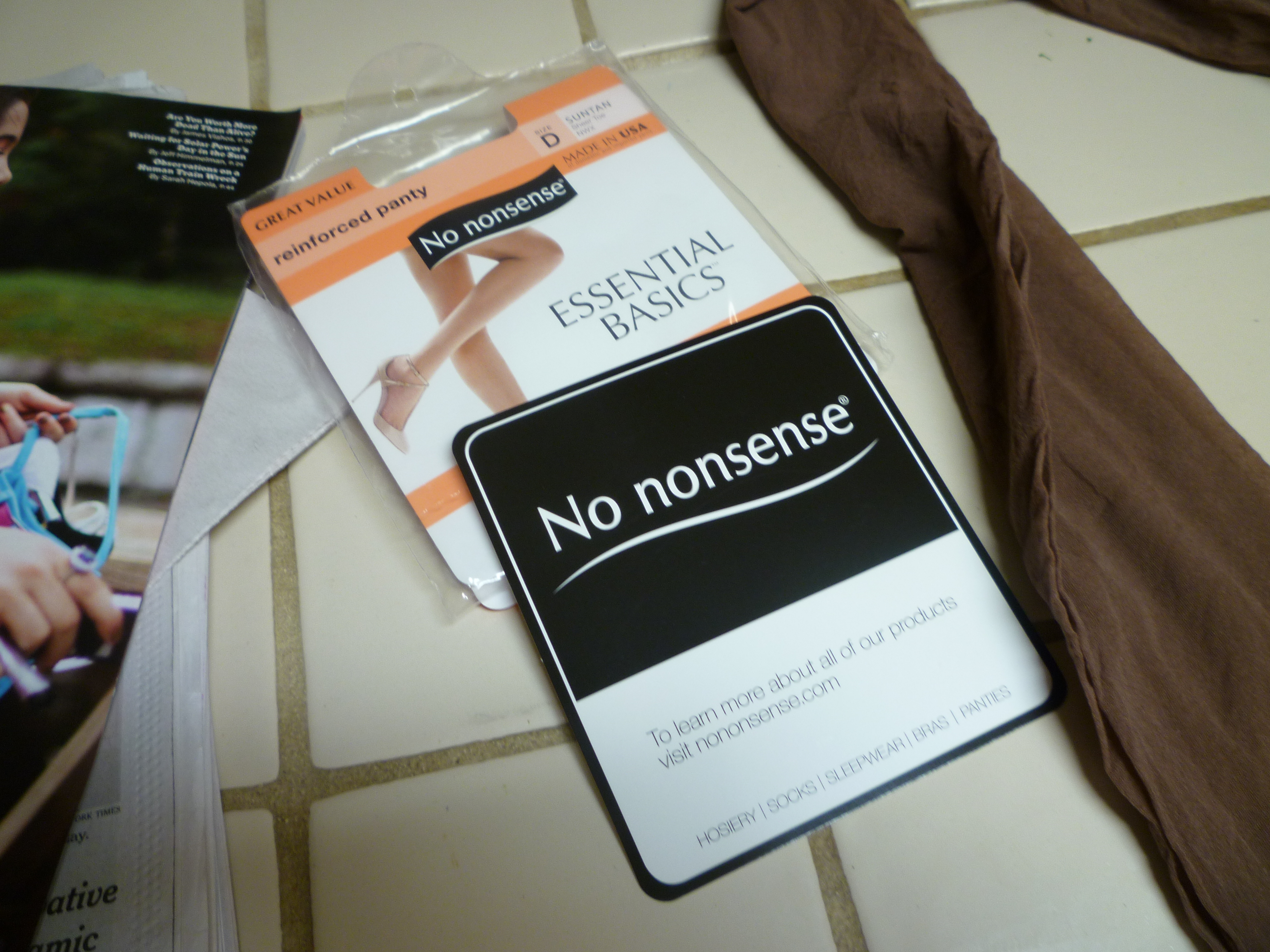
Nylon hose ($1.24). Yea verily, an investment of a dollar and twenty-four cents will get you not one, not two, but five very effective debris shields. Here’s the trick:

Get the cheapest pair of pantyhose you can find. These came from Walgreen’s, where I paid a buck and a quarter for one “queen-size” pair. Take a pair of scissors and cut off the bottom part of the legs, about halfway up.

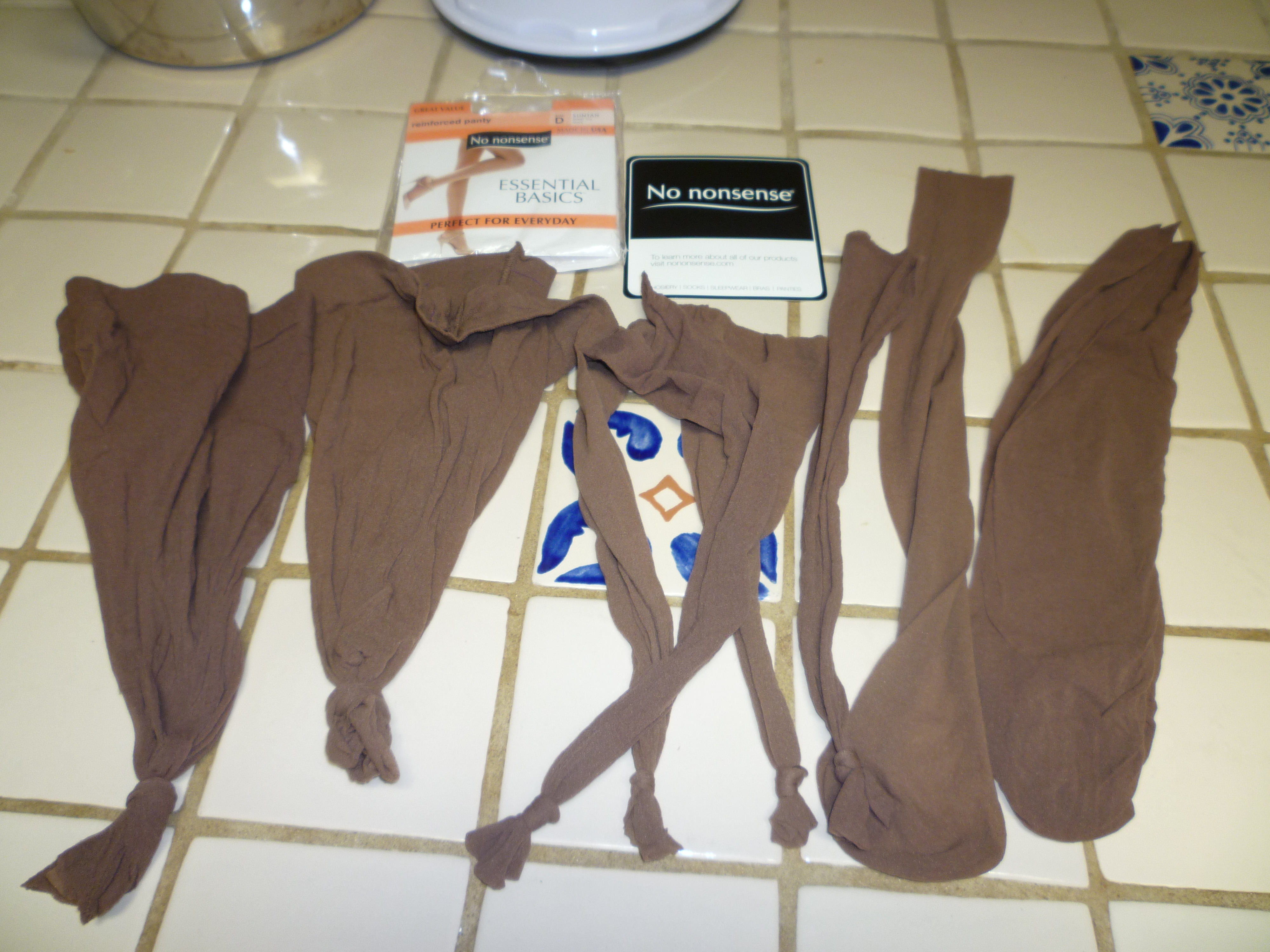
Now you have two debris shields.

Next, cut off the remaining length of the legs, just above the line where the reinforced panty part ends—this is right at the crotch. Don’t include the crotch seam in either of these two lengths.

Tie a knot to close one end of each of the second two lengths of hose you’ve cut off. Lo! This creates two more debris shields. The second set ends up with a tight, stretchy reinforced segment at the top.

Take the panty section and tie a knot at the bottom, where you cut off the legs. Presto-digito! Another debris shield. Two pair of hose gave me ten DIY debris shields.

Drop the knotted or toe end into the filter basket. Stretch the top over the rim—it should fit firmly. And there you are: exactly the same thing as Leslie’s $2.50 (plus tax) mesh debris filter, only you’ve paid 25 cents for it.

This works very effectively, and you can rinse it out and reuse it quite a few times. Check out the wad of dog hair the thing kept out of the pool’s filter!

After this heroic save, I simply washed the bag out and put it back into the skimmer basket, where it kindly grabbed a fistful of small, filter-clogging leaves the next time the wind blew:

Works perfectly. And it’s cheap. Very, very cheap.

Unpaid Labor

Am I unreasonable? Maybe I’m getting just too, too cranky in my old age. Couple of days ago over at Adjunctorium I published a long whine about the unpaid labor expected of adjunct faculty, and today I’m getting even more annoyed with the whole thing. Not that I wasn’t already annoyed at having to teach excruciating freshman comp courses to keep food on the table.

But this is beyond the pale. Is there any other industry whose management assumes employees just love donating their time to the corporate cause?

At the end of every summer, the college puts on a variety of elaborate conference. It must take weeks for the admin staff to organize this thing, because it is a very big deal that involves coordinating a lot of (paid! full-time!) faculty. Adjuncts are, of course, expected to attend the departmental meeting—that will be two hours (plus another 40 minutes, round trip, of driving time) on Thursday. But then we’re also invited to attend any or all of this amazing array of meetings:

Learning Sessions Scheduled for Tuesday, August 14, 2012

Tue Aug 14   9:30 – 11:30 AM Conversations to Improve General Education Learning Q120A &B
Tue Aug 14   12:00 – 1:15 PM Having a Blast With Honor Projects K101 Honors Office – Note location is in K Building North Entrance (Not KSC)
Tue Aug 14   1:30 – 2:45 PM Who Are Jane and John Q. Underprepared Student? Q120B
Tue Aug 14   1:30 – 2:45 PM Changes are Coming in Distance Learning E132
Tue Aug 14   1:30 – 3:00 PM Blackboard Essentials: Course Setup Q130
Tue Aug 14   2:30 – 3:30 PM Media Made Easy E109
Tue Aug 14   2:30 – 3:45 PM Studying Abroad in Vietnam Q120B
Tue Aug 14   3:00 – 4:00 PM eBeam Engage Devices E134
Tue Aug 14   3:30 – 5:00 PM Blackboard Gradebook Q130

Learning Sessions for Wednesday, August 15, 2012

Wed Aug 15   11:00 – 1:00 PM Canvas Overview Q130 – Class is full – please no walk-ins
Wed Aug 15   01:00 – 02:15 PM Distance Learning – Past, Present & Future E142
Wed Aug 15   01:00 – 02:25 PM Three Weeks to Make It! Q120B
Wed Aug 15   01:00 – 02:30 PM Prezi Q130 – Class is full – please no walk-ins
Wed Aug 15   2:30 – 4:30 PM Canvas Overview Q130
Wed Aug 15   2:30 – 04:00 PM Learning Centered College Q120B

NOTE>>>> Please make sure to check the room locations.  Most are scheduled in E and Q buildings.

The Center for Teaching and Learning Conference Rooms, Q120/Q130/Q125 are located in Q Building at the south end of campus accessible off of 32nd Street at Grovers, 17811 North 32nd Street.  If general parking is full, Employee Parking is located on the east side of building. Take the road on south end of Q Building to the Employee Parking area.  Enter through the Mathematics Department.  Q Conference is on North west quadrant of building.

Some of these are very valuable. I would like, for example, to hear about dealing with unprepared students, who comprise about 60% to 80% of classmates in my sections. I’m always interested in “changes that are coming” in distance education. (Note, however, the timing conflict of the only two sessions that really would be useful.)  Prezi is pretty cool software in the cloud, and I wouldn’t mind learning more about it. Canvas is a course management program that is slated to replace the universally hated Blackboard, and of course I’d like to learn about it, even though I’ve built my own quite adequate CMS sites in WordPress.

But consider:

We do not go on the clock until August 20. I will not be paid before September 1, and even then, it won’t be much. In fact, because the District outsources payroll to PeopleSoft, which uses a lagging paycheck approach, I wouldn’t be surprised if we don’t get paid until September 15. Either way, attending meetings on August 14th, 15th, and 16th is pure and simple unpaid work.

And yes, as interesting as some of these topics may be, I do consider attending meetings associated with my “job” to be work.

I use the scare quotes advisedly: though the District claims we are its employees, we are not. We are contract workers, on the order of contract cleaning ladies and lawn men. Except that I pay the guy who rakes the yard a great deal better, by the hour, than the District pays me….

Consider also:

I have already donated over 40 hours of unpaid work in course prep, and I am not done. I still have to add new sets of links to two websites, and I still have to update the magazine-writing course’s website. Since that’s only five weeks and its now pretty formulaic, it shouldn’t take for-freaking-EVER, as the changes in the new syllabi and sites for the comp courses did. But still: we’re looking at two to four more hours of prep time.

By the time I finish, I will have put in about 46 to 48 hours of unpaid labor. It can’t be avoided—you’d be crazy to walk into a college classroom unprepared. Especially into these classrooms…it’s not like we have what you’d call self-starting students here. You have to be  convincingly in control on the first day, and you have to stay in control for 16 long weeks. Slip up in the first week, and you are doomed. So are your students, though they may not see it that way. 😉

And as for these unpaid shindigs? I’ll probably go to at least a couple of them. The information is valuable and it does help me to do my “job.” But…as contract workers, which is what we are in reality, we should be paid for these work-related meetings. The departmental meeting (2 hours) plus the unprepared students talkfest (1.25 hours) plus the intro to Canvas (2 hours) will add 5.25 hours of unpaid work time to the freebie hours I’ve already donated to the district. That’s well over 50 hours of off-the-clock work!

The mystification is this: Why is it assumed that teachers at all levels, from K-12 through college, should attend meetings during periods when they are not paid for their time?

Would You Pay to Read the Local Paper Online?

Yesterday the Arizona Republic, for a short time in the distant past a half-way decent metropolitan paper but, since its purchase by Gannett, a much-weakened affair with sagging circulation and profits, announced that it’s going to start charging a $10/month subscription for peeks at its online incarnation.

Within living memory, Gannett went about “streamlining” the paper. Even before the recession hit, they fired most of the veteran reporters and all of the investigative writers and editors. The recession gave management an excuse to fire still more editorial staff, leaving mostly inexperienced, lower-paid fresh J-school graduates to man the ship.

The baleful result shows: today the paper publishes mostly froth, blood & gore, and local puff pieces, plus almost untouched versions of national and regional wire stories. Content is poorly edited, frequently sporting grammatical and spelling errors and, more seriously, errors in fact. In-depth reporting on state government and city hall are minimal. Often you get better reporting from the eastside paper.

Some years ago, the Republic held such a large market share that it could (and did) crush competing newspapers by telling its own advertisers that if they dared to advertise in another local paper, they would never again be permitted to advertise in the Republic. This may no longer be a credible threat, since so few people subscribe to the aptly nicknamed Repulsive today. Nevertheless, to this day the East Valley Tribune reports mostly on the East Valley, leaving the antics at the Phoenix city hall pretty much untouched.

Thus we have few sources of local news, none of them very good.

Although I have the New York Times delivered, I no longer subscribe to the Republic. The reason I don’t is that it simply doesn’t carry enough news to justify the number of trees that are chopped down to print the thing.

When the paper would appear in the driveway, I would carry it straight to the recycling bin and start throwing out the stacks and stacks and stacks of advertising. Most of it was just that: ads, not coupons. What would be left to read would be two slender sections of play-nooz. It wasn’t even very good reporting—mostly froth and sensationalism. The Sunday paper was the worst of the lot: they’ve shrunk the comic strips so you need a magnifying glass to read the damn things, and after you threw out the chaff, the two or three remaining news sections had just a few pages. Feeling I wasn’t getting my money’s worth, I canceled it.

That was years ago.

Today I get my local news online and from the local PBS station. The online incarnation of the Republic is even weaker than its print edition–difficult to navigate, devoid of an editor’s touch, and often sketchy. The main reason to visit the site is idle entertainment: the obstreperous comment sections far outshine the “reporting.”

The question, then, is “am I going to pay $10 a month for idle entertainment”?

I kind of think not.

Judging from the ninety-four pages of comments that have accrued so far at the Republic‘s announcement of its new policy, a vast majority of the paper’s online readers also think not.

In the absence of decent reporting, there’s really no point in paying to read a newspaper online. There are too many free sources of the things the alleged “paper” delivers:

• Many the Phoenix metropolitan area’s commercial radio and TV stations provide the same quality of news (rather low) online for free.
• One Phoenix-area NPR station provides news reporting, free, that is far superior to the Republic‘s play-nooz.
• The Phoenix New Times puts all its content online, and it occasionally publishes investigative journalism.
• All of the local grocery stores except Safeway (which is engaged in its current scheme to invade its customers’ privacy) publish their weekly food ads online.
• A number of sites publish movie screening times
• TV Guide publishes TV schedules, admittedly in a difficult format; Cox has a much better local site.
• More sites than you can shake a stick at publish restaurant reviews.
• Shopping coupons are abundantly available online, and you don’t need a pair of scissors to get them.
• The funny strips that matter can be read online, free of charge.

So…why on earth would anybody actually pay to peek at the Republic online?

There are some organizations whose online news reportage I might pay for. I might pay for NPR, for example, because of the high quality of its content. I might pay for the Times (I get it free because of the print subscription just now), because it is one of only two national newspapers of record. I would have paid for the Wall Street Journal before Rupert Murdoch got his grimy hands on it. But a half-baked local rag?

Would you pay to subscribe to your local paper’s online incarnation? Where would you draw the line, when it comes to paying for online content?

Safeway’s Latest Gimmick: Enough, Already?

The Times takes note today of Safeway’s latest scheme to make customers think they’re getting bargains, thereby inducing them to buy more junk. The stores here in town have been pestering customers for months, trying to get us to sign up for this “program,” which creepily tracks your buying history through the red loyalty card and pitches products to you by offering alleged discounts on things it thinks you’re likely to buy. Cutely called “Just for U,” the program makes you cough up your e-mail address so the corporation can send you digitized coupons, which are loaded onto your red card. Discounts offered to you are based on your shopping habits, which Safeway has tracked and analyzed through your use of the red card.

The website where you go to sign up for this thing is short on information about exactly what it is and how you use it, for the obvious reason that there are some things you’re better off (from Safeway’s point of view) not knowing. Evidently they want you to sign up without thinking too hard about it.

These tracking programs, into which consumers are lured by purported discounts (i.e., those who don’t have a loyalty card pay more than the normal retail price, while those who agree to carry one around and let the corporation track their every purchase pay a fair price), are highly invasive. Corporations don’t want to “offer” you a loving blandishment; they want to sell you stuff, and they’ve learned they can manipulate you by spying on you and analyzing your buying habits. Retailers, for example, would  love to know when you divorce, because you’re more likely to start buying a different brand of beer then, or to purchase whole new sets of trash baskets and kitchen utensils.

This strategy has already had some not altogether benign results. One father, for example, was surprised to learn his high-school-age daughter was pregnant when Target, having divined the fact by what she bought, started mailing her coupons for baby clothes and cribs.

Target is so secretive about its snooping program that when a Times reporter looking into it sent the company’s PR people a prepublication summary of his reporting, he was told every statement was inaccurate, but they would not address any part of the reporting to enlighten him. When he tried to make an appointment to discuss the alleged inaccuracies, they refused to meet with him. When he went in person to Target’s corporate headquarters, he was told he was on a list  of prohibited visitors.

What, really, do they not want you to know about what they know about you? That question alone should tell us something.

Besides the obvious invasion of privacy, there are other reasons to object to favored-customer plans:

1. They’re elitist. You have to own a computer and, for best results you need a smart phone. Not everyone can afford a smart phone, and some people aren’t too clever with computers, either.

2. They add another layer of nuisance to shopping, an already onerous proposition: now you have to go online to check the day’s offers before you head out the door for another trudge through the stores, where you will have to check and bag your own purchases.

3. They’re budget-busters: they lure you to buy products you don’t really need. Today’s Times piece describes a Maryland woman who chose to buy a large bottle of cranberry juice rather than the smaller bottle of cran-apple juice she normally buys and to pick up a package of “discounted” Cocoa Puffs. (Yech! Is there any question why the average American consumes 156 pounds of sugar a year?)

4. Information about your private habits can be used against you just as easily as it can be used to offer you a glowing “bargain” on junk food you shouldn’t waste your money on. This data, folks, can be subpoenaed and, more to the point, it can be sold. The government isn’t allowed to invade your privacy without good reason and a court order, but we allow huge corporations to do so, and those corporations have no limits on who they can sell that information to. Your private habits not only can reveal whether you’re a pregnant 16-year-old, they also can show whether you’ve taken up your old smoking habit again, what and how much you drink, whether you eat a healthy diet or whether you favor Cocoa Puffs and sugary “juice,” whether and how often you buy prescription or OTC medications for ailments like migraines and GERD.

This information can be used against you. Do you really want your soon-to-be ex-spouse’s lawyer to get her hands on records of how much alcohol you buy or whether you buy condoms or birth control pills your spouse doesn’t ever see you use? Do you really want an insurance company to learn, secretly, about your drinking and smoking habits, or about aches and pains that could mean higher premiums or outright denial of coverage?

5. It’s fundamentally unfair to offer one person a lower price because she doesn’t know better than to allow a corporation to track her every move or because she can afford a smart phone and a computer. By its nature, then, Safeway’s favored customer scheme disadvantages the poor, the laid-off, the cautious, and the elderly.

6. They jack up prices all the way across the board. You don’t really believe Safeway is giving away stuff to everybody who consents to being spied on, do you? In fact what’s happening is all the prices in the store go up, and the so-called discounts are mark-downs off inflated prices.

Personally, I would like to see legislation prohibiting retailers from collecting, storing, or analyzing individual consumers’ purchases and shopping habits. In our present political climate, where elected leaders are purchased by well-heeled corporate interests, of course that’s never going to happen.

Welp, in my case I can’t very well take advantage of Safeway’s new spying digital coupon program, because my red card was taken out in the name of my now deceased German shepherd, and the phone number was that of the local Safeway headquarters. I got the number out of a telephone book—it was that long ago!—and I don’t even own a phone book anymore. It’s unlikely that the CIA Safeway publicizes the number of its local corporate offices on the Internet.

So. It’s a good reason to buy local. It’s a good reason to shop at stores that don’t demand you carry a card around or sign up at an online spy shop, even if you have to pay more for the privilege. It’s a good reason to grow your tobacco in the backyard.

Images:

Safeway before Opening. Mattie B from Santa Cruz. Creative Commons Attribution-Share Alike 2.0 Generic license.
Tobacco in blossom.  kevinbercaw. Creative Commons Attribution-Share Alike 3.0 Unported license

Medical Overkill?

So a fine flare-up of a chronic bellyache sends me to the Mayo’s ER with chest pains. Six hours of idling around that place in some discomfort yields the discovery that I have not ever had and am not now having a heart attack. The ER doc diagnoses GERD and a probable ulcer, and urges me to make an appointment with a regular doctor.

Now, the problem is, the part of the Mayo that houses its doctors’ offices is halfway to Payson from my house: twenty miles one-way, an hour’s drive through thick traffic.

Anyway, concerned about the possibility of an ulcer, I present myself to yet another new-to-me doctor (you never see the same doctor twice out there). She decides that I need an endoscopy with biopsies for H. pylori and cancer. This unpleasant test entails knocking you out, stuffing a tube down your throat, and cutting a sample out of your stomach lining.  Obviously, since they drug you into oblivion, you can’t drive home.

So I start searching for someone to drive me out there. La Maya is in full crisis mode just now. KJG lives halfway to Yuma on the other side of the valley; asking her to drive to the Mayo would be like asking her to drive to Albuquerque. My son has a difficult time getting off work; besides, I’d just as soon he doesn’t find out about this until I learn what the hell we’re talking about. I call the church and at first am rebuffed, but then reach the head of the health-care ministry, who launches into a full-bore search for someone to make the 40-mile drive with me.

Time passes. Eventually, I calm down enough to think this through.

Item: The Mayo does not take Medicare assignment. This means that Medicare and Medigap will only reimburse—me, not the clinic—for the amounts they unilaterally decide services and procedures are worth. The Mayo will send the bills to Medicare but will not accept reimbursement. This means you have to pay the up front and then collect whatever Medicare and a Medigap insurer will disburse, which comes in little dribs and drabs of $30 or $40 over a period of several weeks, always long after the bill is due.

I figure an endoscopy and two biopsies are going to be bloody expensive. I also despair of finding someone to drive me out there, and I sure as hell can’t afford a taxi, which at best, with the senior citizen discount, would run over $80. A Mayo phone lady seriously suggests I rent a room at the Marriott next to the hospital, for a mere $100 a night, two-night minimum.

So it now occurs to me that really, if I need this procedure, there’s no reason to have it done at the Mayo. Why not find a provider who will accept Medicare assignment and then just have them send the results over to my doctors? Besides, wouldn’t it be better to have a doctor close to hand who can see me for routine issues, rather than having to drive all the way out to Taliesin West for every sniffle and bellyache?

At Angie’s List I find one, count it one, medical practice that’s universally lauded and is not in Scottsdale or way over on the far west side. Make an appointment. Get in forthwith to see a brand-new young doctor. He’s a DO, not an MD, but the old guys who do have MDs aren’t taking new patients, and since he’s the new kid in the practice I figure he’s probably consulting with the bosses, at least until they’re sure he’s not going to kill anyone.

Young Dr. Kildare, as it develops, is an absolute charmer about my son’s age. We discuss my various complaints.

He expresses surprise that the Mayo doc even brought up the prospect of cancer with me, much less went into detail about staging, surgery, and chemotherapy. Gastric cancer, he says, manifests several other symptoms that I don’t have, such as swollen lymph  nodes, bleeding, and weight loss. He says he’s certain that it’s GERD, about which he knows quite a lot because he suffers with it, too. It is possible, he thinks, that an ulcer is forming and suggests doubling up on the omeprazole, which he says needs to be used for three or four months to get the situation fully under control. At this time, he says, an endoscopy is unnecessary. Instead, he thinks it would be better to continue the drug treatment for a few weeks, especially since the ailment is starting to settle down. If, however, break-through symptoms persist, he will want to do an upper GI series or an endoscopy. But not now. Come back in six weeks.

Meanwhile, he suggests I stay off the sauce, refrain from eating large meals, never eat late in the evening, lose weight, and get some exercise.

Huh. Whaddaya make of that?

Sure sounds like I was about to be subjected to some serious medical overkill, doesn’t it? Anyway, the tests are off until we find out whether the omeprazole (which is generic Prilosec) kicks in and and gets this thing under control. There may yet be a tube down the throat in the future, but at least now I should be able to keep the cost of it under control.

And so to the pool, for some of the prescribed exercise…

Image: Flexible endoscope. de:Benutzer:Kalumet. Creative Commons Attribution-Share Alike 3.0 Unported license.

Who was young Dr. Kildare?

An Alternative Option to a Standard Pension

Like U.S. workers, the British have seen their pensions take a beating recently. Hard-earned savings have been eroded by economic contraction across the Eurozone, which is having knock-on effects in the U.K. People in retirement and those close to retirement age are having to rethink their spending habits and cut down on treats they’d been looking forward to enjoying in their retirement for their entire working lives.

A new survey by Primetime Retirement has found 36% of over-55s are cutting back on spending in certain realms of life including going out, 65%, holidays, 62% and buying clothes 61%. This is because of falling real incomes for the over 55s. For people ages 55 to 64 £318 per week is the average income. However for over 65s this rate drops by 24%.

As a result people are looking for alternative forms of income to their standard pensions. One option to consider is a pension annuity.

A pension annuity converts money locked away in your pension scheme into a regular income. Most people in ‘defined contribution’ pension schemes have to use their pension fund to buy an annuity, which, because it works like an income, is liable to income tax.

There are many types of annuities, and the market is filled with annuity providers claiming to offer the best rate. Before purchasing any kind of annuity it’s important you seek sound professional financial advice. The Money Advice Service is a good place to start before contacting a financial advisor. It offers an annuity comparison table to compare various annuity providers and types of packages to find one that works for you. You just have to fill in a few financial details and the comparison page is then tailored to your requirements making it an effective way of starting your search.

In the U.S., it is important to consider your own circumstances carefully when thinking about investing in annuities, which in this country are a type of insurance product. Although for some people they can be a reasonable part of a larger plan, for most people they’re not the best choice, for the following reasons:

a) Some (but not all) annuities have no provision for inflation-adjusted increases. Thus, although I might get a 6% return on investment by putting a chunk of money in an annuity today, 6% on, say, $100,000 would give me $6,000 now and evermore, whether or not the company issuing the annuity invested my money so that in grows or falls in value.

Thus in 20 years at a reasonable 6% return on investment, my $100,000 might have grown to about $320,700 if managed professionally in a diversified portfolio. But I would still be getting only $6,000 a year…which in the year 2032 ain’t gonna buy much. The annuity issuer would have paid out $$120,000 to me; but it would make a profit of $220,000 on the investment of the $100,000 I handed over at the outset.

If instead I kept my money, had the principal managed professionally, and drew down a more conservative 4% from my investment, at the end of 20 years I would still have control over my entire fund. It would not amount to $320,7oo, but assuming a 6% growth rate and a 4% drawdown rate, I still would have more than $100,000 in savings.

b) When your money is in an annuity, it is tied up permanently. If you need it for some unexpected reason (say, you or your spouse has to go into a nursing home and without it the person will end up in a grungy Medicaid home), you can’t get it back.

c) No matter when you die—whether you live to a ripe old age (God help you!) or you drop dead tomorrow—the money may not go to your heirs. Thus you leave your offspring without the financial capital that they should reasonably expect to inherit as members of a middle-class or higher SES family. Some annuities continue to disburse payments to heirs until the end of a specified period; others do not.

d) Most variable annuities have hefty commission charges and fees. These range from 5% to 14%. Other fees combine to make annuities a very expensive investment. There are no-load annuities, but these are not widely known and not used much. Regulations in the U.K. are undoubtedly different from those in the U.S.; investors need to familiarize themselves with what the laws in their countries allow insurance companies to charge for these products, and to know what the costs will be before deciding to invest.

e) In the U.S., annuities have some complex and onerous tax issues associated with them.

For some people, investing in an annuity is a smart move, and for some, not so  much. Factors to consider include your age, your “fear factor,” your potential longevity based on your  health and the longevity of your immediate relatives, and your projected income tax rates through retirement. Study the matter carefully before investing in annuities—or, for that matter, in any financial product—and consult a trustworthy financial adviser and a tax professional. Remember it’s important to get it right first time. There is no room for second chances in annuities; once you’ve picked, you cannot change your mind.

Image: Piggy bank from German bank HASPA, around 1970. Georgh HH. Public domain.