Coffee heat rising

Burning Down the House, or How to Cook Bacon

Our most delightful new neighbors, parents of four hopelessly adorable young children, are busy doing battle with insurance companies and contractors to get their home restored after a kitchen fire did some startling damage. Mercifully, only the dad was hurt, and he is recovering nicely.

Dad decided to cook up a skilletful of bacon for the kiddies. He put the pan on the glass-topped stove and wandered off to chase children. He didn’t wander far: only into the family room, which opens into the kitchen — really, the kitchen could be regarded as part of the family room/dining area. The floor plan is pretty open.

Wouldn’t you know it, with no visible flame under the pan, what’s happening with the bacon goes unnoticed until the grease in the pan bursts into flames.

Four kids and a woman in the house, Dad’s testosterone also bursts into flames. He grabs the blazing pan with his bare hands, hauls the thing outside, and heaves it into the pool.

In the process, he blisters his hands pretty mightily.

He’s OK, though, thank God. Today he seems to already be healing up, his fingers wrapped in antiseptic-infused bandages.

Meanwhile… The microwave over the stove MELTED! It literally dripped down like melted wax. The stove itself was trashed, as were the cabinets around it. The firemen punched holes in the drywall searching for fire that might have made its way into the walls. And the whole house is permeated with toxic-smelling smoke fumes.

Sooo… What can we learn from this?

First: In a fire, get everyone out of the house, including yourself. Better that the place should burn to the ground than that anyone be harmed. Don’tpick upa burning pan it’s extremely dangerous.

Second, obviously: GET INSURED AND STAY INSURED, even if you have no mortgage requiring it. Their insurance will cover repairs and replacement of the appliances, walls, cabinetry, countertops, and smoke-damaged goods. This, as you recognize if you’re a home-owner, represents a ton of money.

Third, less obviously: Buy your insurance through a broker, who will run interference for you with claims adjusters. At first, Dad and Mom were a little worried about how they were going to approach their insurer, since a) this is the first house they’ve ever owned and b) this is not their first homeowner’s claim. The previous owner had either let the insurance lapse or, more likely, pocketed the settlement for the roof damage from the late, great hailstorm. As a result, their present company has covered three large claims that resulted from the prior owner’s neglect, including one for reroofing the house. Needless to say, they called their insurer with trepidation.

I put them in touch with my broker, who was able to advise on what they would be entitled to, what they should say and ask for, and what the outcome is likely to be. He knows a lot about the insurance industry and gave them some useful guidance.

Fourth: Learn to cook bacon. More generally: never turn your stove to blow-torch setting under a pan that contains grease or oil in any form.

Aside: How to cook bacon

Bacon does not need to be cooked over high or even medium heat. In fact, it should not be cooked that way.

Lay the bacon slices flat in a skillet. Place the pan on a burner and turn the burner to low heat. Allow the bacon to cook slowly and gently until it reaches the state of done-ness you prefer. Turn the bacon slices over several times during the process.

This takes a while, but if you put the bacon on before you start preparing the rest of the breakfast, it will be cooked by the time you’re ready to serve the food.

Never turn a burner to “high” under a pan of bacon. And do not leave the kitchen while food is cooking on the stove.

Alternatively, you can cook bacon in a microwave. Lay several layers of paper towels on a dinner plate. Arrange bacon slices, flat, on top of the paper towels. Cover with several more layers of paper towels. Cook on “high” for one minute per slice, more or less. Watch carefully. And experiment: the one-minute-per-slice thing is a rough rule of thumb. It works for two to four slices but is less perfect for larger amounts.

Fifth: Always have a container of baking soda within easy reach on the kitchen counter — preferably not too close to the stove. Baking soda is an effective fire extinguisher and can be used safely on grease fires. Just grab a fistful and toss it into the flames.

And item six, IMHO: if you can possibly manage it, get a gas stove. Electric stoves, especially the glass-top numbers, have as their sterling disadvantage that the user can’t see at a glance how hot the burner is — or in some cases, even whether it’s on. You can’t miss a gas burner when it’s on…and you can easily gauge the heat simply by looking at it.

I wouldn’t own a house that doesn’t have gas service. 😉
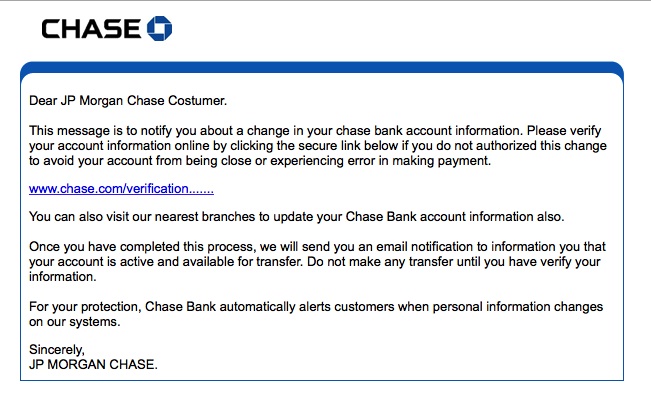
Every Phisherman Needs an Editor!

Do you or do you not just LOVE this? Supposedly from Chase Bank:

Chase scam“if you do not authorized this change…”  “your account from being close or experiencing error…” “until you have verify your information…”

ha ha ha ha ha ha ha ha ha ha ha ha ha ha ha ha !!

Where do you guess it came from? China or Russia?

My bet’s on the Russians: the unfamiliarity with the use of articles with nouns is a clue (a native speaker of English would say “an error” or “errors”). Most halfway decent Chinese ESL speakers get the verb tenses down pretty well: “do not authorized” and “you have verify” are atypical, but on the other hand, Russians can usually get Western European verb structures better than this.

Let’s toss Africa into the mix, too. “Once you have complete this process, you will transfer $10,000 to our account in Nigeria so Prince iBangiBangi can succeed to his throne, at which time he will bestowing the $1 million reward upon you via Western Union…”

Heeeee!

Fleas?????? Is there ever a break from the timesuck?

So I wake up this morning with a nice little pattern of bug bites on one arm. Now, there’s nothing unusual about the occasional solitary bug bite around this place. Arizona, as the local climate has warmed and the feckless humans have flooded in and tried to clone the upper Midwest wherever they come to light, has been overrun with mosquitoes.

You never used to see a mosquito here. Now they fill your house every spring and hang around until December, when the weather chills down a bit. One day a couple of years ago, I killed a dozen of the little monsters inside the house!

We haven’t had so many this year. I don’t know why. Haven’t had many flies, either.

WhatEVER. All that notwithstanding, I happen to know what a mosquito bite looks like. Having grown up in the Middle East, I also happen to know what flea bites look like.

Mosquitoes are not piggish eaters. They sit down to dinner once and then get up and fly away. Fleas, on the other hand, have never met a blood meal that they didn’t want more of. Right away, please.

So three or four really itchy bites clustered within a radius of an inch or two or three usually means a flea has come visiting.

And you know what that means?

Oh yes.

TIME SUCK!

Time suck of the first water.

You need to get on the job of flea-whacking instantaneously if you’re to have any hope whatsoever that your DIY efforts will work.

So. First thing after the requisite doggy-walk (we do the doggy walk at 5 a.m. because i wish to live and because one corgi will boss a human around but two corgis will reduce the human to full obedience at all times), it was into the bathtub with the hounds.

Actually, before we left, I inspected both pooches for fleas and didn’t find any signs that I recognize. It’s pretty easy to tell if the animal is heavily infested. My mother once brought a badly infested cat home from a pet store…the vet taught us how to recognize flea eggs and flea debris. They don’t seem to have any eggs in their fur, nor did I see any flea sh!t. However, both dogs had a strange dark deposit around their hindmost titties. I think this was dirt — probably congealed urine, since a female dog can spray her belly by accident, especially when it assumes as deep a squat as a corgi does. So I smeared these areas with olive oil, figuring some oil would loosen whatever that was.

Olive oil will not harm your dog, BTW. Baby oil and bath oil may, since they consist mostly of mineral oil. That’s antithetical to an animal that can be guaranteed to lick the stuff off.

So by the time we got home from a mile’s stroll, the dogs had been marinating in olive oil for twenty or thirty minutes.

Into the bathtub.

You do not want to know what a circus it is to launder a corgi. When they say a corgi is “a big dog in a small dog’s body,” that’s not quite spot on. The fact is, under certain circumstances, a corgi IS a big dog.

Two wrestling matches later, the dogs were clean and the bathtub was filthy.

Scrub bathtub out.

Now it was time to gather ALL the bedding, including the bedpad, all the mats the dogs lay on, all the area rugs in the house, all the clothing I’ve worn lately all the towels I’ve used, all the…whatever. These all needed be washed in HOT hot water and then dried on the dryer’s hottest cycle.

Six loads of laundry got stacked in the garage next to the washer.

The ACCURSED GODDAMN SAMSUNG WASHER!

That thing takes about an hour for every load. So we’re looking at SIX HOURS OF LAUNDRY out there!!!!!!!!!

One of the damn thing’s many charms is that you can’t select “hot” water on most of the cycles. There’s actually only one cycle that lets you select very hot water: the one that’s intended to “sanitize” the inside of the thing, since as we know these so-called “high-efficiency” washers tend to grow mold and stink to high heaven.

“High efficiency.” SNORT!!!!!! How exactly is having to run the electric for SIX HOURS to do a three-hour (or less) job “efficient”?

Then it was time to drag out the vacuum. Vacuum every nook and every cranny in the bedroom. Vacuum every square inch of the mattress and bed springs. This is complicated by  the fact that it’s one of those “pillow top” monsters that were in style at the time I bought the thing. “Pillow tops” are held in place by stitched-down patterns, which collect…yes…dirt and debris. Had to get an orange stick and a stiff brush to dig that stuff out of the stupid stitch thingies and THEN vacuum all that up. Endless.

Then climb under the bed (which weighs too much for me to budge) and vacuum every square inch under there. And vacuum every square inch under the dressers. And in the closet. And up the hall. And in the other rooms. Ugh.

Thank god for tile floors.

It’s almost 10 a.m. Good thing the dogs rousted me out at 5, otherwise I’d still be doing all that. Well, I am still doing all that: the accursed goddamn Samsung washer is grinding away out there.

It’s 10:03 a.m. and I have done no work. I mean, real work on the writing empire. Well. I uploaded an image to the Camptown Races blog, which will be called “Camptown Ladies Talk.” The images I wanted to use turned out to be a) too large and b) too difficult to fit into the header image space without some serious Photoshopping. But I found some images in the public domain that simply defy belief.

If you’d like a preview, you can peek at her here. But IF YOU ARE WITH THE CHURCH, DO NOT GO THERE, DEAR FELLOW CHOIR MEMBERS, CLERGY, AND HANGERS-ON because that will pop your eye out. That site is strictly adults only. Racy adults.

Yesterday I finished what I hoped would be the last chapter of the current Bobbi and the Biker bookoid, but as it fell together, I found Bobbi and Billy demanded at least one more chapter. This is alarming, because we’re already over 7,000 words. Whatever wraps this episode up is gonna have to be succinct.

This weekend I also posted book III of Fire-Rider. The marauding war bands get back on the road, after having flattened a major enemy stronghold, and the journey begins…

And now, speaking of metaphorical journeys, I must away!

Big Brother: Not about to quit watching us

Interesting op-ed article in today’s NY Times: former CIA officer and NSA contractor Edward Snowden rejoices that at last Americans and people around the world are waking up to the ubiquitous spying on innocent private citizens accused of no wrongdoing. He applauds Congress’s move to ban the NSA’s phone-call tracking program and President Obama’s about-face in stating that surveilling every citizen of the United States has done nothing to prevent even a single terrorist attack.

All very nice. But it’s a day late and a dollar short, in my opinion.

In the first place, a huge government infrastructure designed to track the private movements of everyone in the country now exists and has been deployed against us all. Does anyone seriously believe it’s suddenly not going to be used anymore?

And in the second place, Big Brother is not the government. It’s private industry. Note that only the NSA has been told to stand down from spying on us.

Google hasn’t. A few weeks ago, members of our neighborhood association reported that Google mapping trucks were moving up and down the alleys with vehicle-top cameras peering down into people’s backyards. Google tracks every move you make on the Internet. Every time I walk down my home’s hallway, the Nest thermostat on the wall records that I am home and sends that tidbit of information back to a Google-owned server. Nest also records and transmits the details of when I use power to air-condition and heat my home, and how much I use.

Just about anyone who wants to sell you something or to keep tabs on the public is watching you.

Using cookies, any business on the planet can keep track of every website you visit, every message you post on Facebook, Instagram, Twitter, every search term you enter in  your browser, every whatnot.

When you walk through a major shopping mall with your phone in your pocket or purse, curious minds are watching what stores you enter, what food kiosk you visit, even which window you pause in front of to eyeball the merchandise.

Insurance companies, healthcare corporations (that would include your doctor’s and your psychological therapist’s employers and any hospital or out-patient facility you visit), financial institutions, and credit bureaus gather and store — permanently — vast amounts of private information about you.

Here in my state, the county sends helicopters aloft to photograph people’s property; the aerial images are stored, and when you go in to ask for, say, a zoning variance so you can build some addition on the back of your home, an inspector studies a picture of your lot. If anything is found to be out of order, the supervisors will order you to take it down. They’re also likely to deny your variance request.

Every time you telephone your credit-card company, a utility, or many other entities, your phone number is recorded and checked against the number you gave when you started doing business with that entity. This overrides any caller-ID blocking you may have in place.

Retailers track your buying habits by name, phone number, and address every time you foolishly hand over your private information in exchange for a card giving you a few cents off a store’s inflated prices.

Facebook tracks everything you do on its site and often uses casual remarks to spin advertisements to you and to your friends.

Netflix knows what you’ve been watching, reminds you of what you spent time with, and tries to persuade you that you’d like something else based on your viewing habits.

And by now, you may be sure that some hacker somewhere knows your name, address, birthdate, Social Security number, employment history, and educational history.

Most that information is none of anybody’s business. But in fact, just about anybody can easily make it their business.

That Congress is finally coming around to putting the eefus on the hideous Patriot Act is all well and good. But we’re not going to get our right to privacy back until private enterprises are also prohibited from gathering and storing personal information about us.

What Do Surveys Survey?

The beloved Charles M. Blow is holding forth on the Walter Scott case, which one would expect that he should. I’m not going to say whether I agree or disagree with today’s column (those of  you who’ve been watching closely can imagine). But I would like to discuss a source that he (graphically supported by the NY Times) uses to help make his finely honed point: a Gallup poll asking Americans about their views of police force.

Every time someone trots out statistics from one of these polls, I find myself asking What do these questions really mean? And more to the point, what did the respondents really mean when they answered “yes,” “no,” “maybe”?

Let’s consider the responses to the questions Mr. Blow’s graphic designer presents.

“How much confidence do you have in the police”? Those responding ‘a great deal/quite a lot’:

Whites: 59%
Blacks: 37%

How much confidence do you  have in the police? I’ll tell you what my answer is: “It depends.”

It depends on the call to which one asks the officer(s) to respond. It depends on the officer’s training. It depends on the officer’s years of experience and on the quality of that experience. It depends on the officer’s overall IQ: smart, normal, or dumb as a post?

I feel a lot of confidence in most officers’ ability to cope with a traffic accident. I feel a lot of confidence in their ability to respond to my call to 911 reporting that some creep is trying to get in a bedroom window.  I feel a lot of confidence in their ability to respond to a cell phone call saying I’m at Tatum and Shea, headed for the Paradise Valley Police Station, and someone scary is following me.

I do not feel a lot of confidence in most officers’ ability to deal safely with domestic violence in progress, although I suspect they would do better than I could. Especially if they were bigger than me.

I do not feel a lot of confidence in any man’s or woman’s ability to respond when someone threatens his or her life; no more than I feel a  lot of confidence in my own ability to respond to a direct threat on my own life (other than to know that if I had a pistol in hand I would not hesitate to shoot).

I do not feel a lot of confidence that a police officer would deal kindly with Gerardo or Luz if someone called to say they saw one or the other of them entering my property when I wasn’t home — even if I’d left the key for Luz or the back gate unlocked for Gerardo.

I do feel a lot of confidence in any officer’s inclination to sacrifice his or her own safety to help someone whose life appears to be in danger.

“How would you rate the honest and ethical standards of police officers.” Those responding “very high/high”:

Whites: 59%
Blacks: 45%

How would you rate the honesty and ethical standards of police officers? Me, I think 59% “high” or even 45% “high” is pretty damn good. I would rate the honesty and ethical standards of most human beings as “mediocre” to “low.” Police officers seem to be human beings, and so…well…

Is the American justice system biased against black people?” Those responding “no”:

Whites: 69%
Blacks: 26%

And you? Do you think the American justice system is biased against black people? Yes, no, maybe? As for moi, my response is WRONG QUESTION!

In my not very humble opinion, the American justice system is biased against poor people: the more money you have, the more justice you can afford. Thanks to a legacy of slavery and discrimination, a larger proportion of black folks than of white folks live in poverty, or in something close to it.

Is the American justice system biased against poor people? Damn right. To the extent that a lot of black people are poor, well, sure: the system is biased against them. If you asked me, out of the blue, “biased against black people?” I might or might not answer “yes.” Or “no.” Depending on my mood and on what you asked in the previous questions.

So you see…I hate these surveys. You see why?

What Do You Grab When the House Is on Fire?

So here’s this story in today’s New York Times, upon reflection a rather odd story. The author recalls the time a fire broke out in an apartment building where she, her husband, and her then infant son lived. She describes their hurried exit from their home.

He runs around collecting papers and he grabs his laptop. We’re told that the laptop contains a website whose proceeds largely support the young family, so it makes some sense that the first thing he’d think of is his family’s livelihood. Although it’s odd. More about that in a minute, after we get out the door.

She, having been interrupted in the process of getting ready for bed, puts her pants on, collects her toothbrush, and grabs a hunting knife, which she slides into her belt band — before she picks up the sleeping baby and heads out of the place.

Outdoors, there’s snow on the ground. She arrives on the icy pavement in her bare feet.

They escape the fire, linger long enough to watch the flames consume the building, then get in their car and drive away. Their dog, she remarks at this point, is “cowering at our feet.”

Does anything here strike you as strange? To me, it’s possessed of weirdness.

To start with, the last thing I’d pick up before grabbing the kid is a 79-cent toothbrush. Even if it was a $60 electric number, the kid would come first.

Would I put my pants on? Maybe. I’d  be more inclined to at least get into a pair of slippers, if I didn’t have a pair of slide-on shoes that I could step into; then I’d grab the pants, carry them downstairs with the baby, and get dressed once I was outside the building.

What about the knife? Maybe, if it was an heirloom — if it was my father’s favorite fishing knife and it was sitting on a table, I might grab it. If I believed I needed a weapon, I’d take a gun. In fact, if I could get to the gun quickly enough, I’d take it simply to prevent risk of its being stolen and used later in a crime. If it took any time to get at it — for example, if it had to be extricated from a safe or an elaborate hiding place — I would leave it.

But the heirloom issue doesn’t appear to have been the case. The narrative suggests she simply saw it and picked it up on impulse. Odd. I mean…you think you need self-defense against rapacious firemen? Wha-a-t?

The dog is not mentioned until the story’s last lines.

Odd.

If it were me, the child would come first: before the clothing, before the toothbrush, before the knife, before the papers, before the computer.

The dog would come second.

The papers would probably come third — no, make that fourth, after the car keys.

And the computer, a distant fifth.

Now, about that computer: What? Their website resides on a laptop? Really?

So is he using a laptop as a server? Really? Why doesn’t the profit-making website reside on someone else’s servers? It’s not like, say, BlueHost would break you up in business. Even their premium services are pretty reasonable. If I had a money-making website whose income I depended on, I certainly would back up every byte of data off-site. And why isn’t he using something like Carbonite to automatically back up his data, far far away from potentially combustible real estate? Many such services exist, and none of them cost much.

Many people subscribe to the idea that you should have a “go-box” where you keep crucial papers like your passports and the deed to your house, as well as memorabilia that you’d like not to lose. I like that plan — it makes a lot of sense, assuming the fire or other Disaster of the Day isn’t between you and said box. In my case, I really don’t have anyplace to stash such a thing. Key documents are in a file drawer, which itself is full — no room in there for a box. The shelves in the office closet are full. The garage (which also hosts a file cabinet) is the most likely site where a fire would start: a car with a large gasoline tank sits backed up close to a gas heater.

But the computer… Ah, the computer.

Nothing should reside solely on a computer in such a way that the only way to rescue data is physically to remove the machine from the building. The young father shouldn’t have had to even think of rescuing an inanimate object when his wife and infant son were in a burning structure.

It’s simply too easy and too cheap to back up everything off-side, automatically. There really is no reason either to leave your data at the mercy of a thief, a fire, or a natural disaster or to have to risk your life to make a side-trip through smoke and flames to retrieve a computer.

Virtual box in the cloud. Real box in the closet. And a set of priorities: think through who or what should be rescued first — before the fact.