Coffee heat rising

Let’s Say Something Personal-Financey

Over the years, Funny about Money has wandered away from its original subject: at the outset and for the first half or more of its lifetime, it was a personal-finance blog. A good 98 percent of what I wrote about had to do with money.

But there are only so many ways you can say “get a decent education; get a job; get out of debt and stay out of debt; live frugally; build retirement savings; invest savings; build an emergency fund; live on a budget.” After you’ve said those a million times, you tire.

Okay, admittedly: the story about saving money by washing your clothes without laundry detergent — that one was pretty good. Actually got me in the national media. And the one about using olive oil to condition your hair: all-time favorite, got a zillion views before anyone ever heard of “social media.” But still…. How many wacksh!t penny-pinching ideas can one person come up with? 😀

So Funny has evolved away from “personal finance” toward plain old “personal.” It has become a kind of online journal, a five-finger exercise to start a writing or editing day.

Yesterday as I began downloading posts by way of back-up — don’tcha just know this new “Gutenberg” thing WordPress is about to foist on us will erase a LOT of archived content! — this fact floated into consciousness: really, I should write more about money matters.

These days money seems to me much tangled in politics. Unless you’re describing ways to mix up home-made laundry detergent, you cannot talk about money without some political inflection. And given the political place our country has taken itself, that is a tedious subject.

Interestingly, The Economist’s columnist “Bagehot” holds forth this week about the glum mood of Britons. In doing so, he exactly describes the political and economic mood in the U.S. “It is hard to look at British politics these days without worrying that this is a country in decline…. Today Britain is a shadow of its former self: inward-looking and anxiety-ridden, stagnant and expensive, split down the middle and fearful of the future…. Productivity growth has been nugatory. Real wages have been falling for a decade. A growing population is trapped in a cut-throat gig economy. The next generation fears that it will be worse off than the baby-boomers.”

Where have we seen that of late?

Bagehot speculates that “Most of Britain’s problems are internally generated….” But I would suggest that what he describes reflects an international dysphoria. It’s not just the Brits who sense that we’re cruising toward Hell on a skateboard. This fear — these falling wages, these “side gigs” that are no longer opportunistic schemes to supplement our salaries but now form many citizens’ only source of income, these obscene medical and health insurance bills, this junk merchandise imported from countries where workers earn 90 cents a day, that college tuition that straps a graduate to an entire lifetime of debt, this sense that our children and their children will never live as well as we have, this spreading drug addiction, these people sleeping on the sidewalks and begging on the street corners, this prison population that is the largest in the world — this fear has brought us the likes of Donald Trump.

And, IMHO, it — this fear — leads us to miss the point.

The problem is that money is politics and politics is money. He who has enough billions of dollars, as we saw in 2016, can afford to buy a presidency. And who has those billions of dollars?

Big, big business. Megacorporations.

Those megacorporations have been quietly taking over the running not only of our country but of every country in the so-called “developed” world for at least a generation. When you have companies that can observe your every move (did you know that Google tracks you everywhere you carry your smartphone?) and record your every word and block you from public forums if you say things the company decides it doesn’t like and manipulate your choices of everything from the food on your plate to the reading material on your tablet, what you have is a kind of shadow government.

That shadow government has nothing to do with the truths we hold to be self-evident. It has everything to do with maximizing profit and with controlling the sheeple who pay into the profit. It is, IMHO, one of the reasons we have seen our public schools dumbed down into the sub-basement: when young adults know nothing of history and civics and literature and jurisprudence and ethics, they can easily be tricked into voting for interests that actively operate against their welfare.

So…we Yanks suffer from financial and political angst, same as the Brits do? You bet.

Financial angst and political angst are manifestations of a shared loss of government of the people, by the people, and for the people. Shadow government is actively taking over representative government. Angst, indeed. When we get government of the corporations, by the corporations, and for the corporations, the man and woman in the street lose financially. Shadow government is not good for your pocketbook.

When private corporations own your country — and, for that matter, the world — you do not tell them what to do. They tell you what to do. They control you through your pocketbook, and they control you through the products and services they allow you to access. They choke off representation of the people — unions are crushed, monopoly replaces competition, education is degraded, productive leadership is replaced with circuses, class differences are aggravated, schism is fostered, hatred and hostility replace discourse.

These are not accidents, my friends.

Mark my words: Money is politics; politics money.

Why I Bank at a Credit Union…

A fine Day from Hell in every way: at five in the morning, temp on the back porch in the 90s and air so thick you need a spoon to breathe it. It rained during the night, so that did cool things off. But. Ugh.

First order of the day’s business, once business establishments opened, was to run up to the credit union and try to find out why all my accounts are scrambled.

Ugh, indeed!

You’ll recall that to reset my grip on the finances, I decided to use Costco cash cards and my existing credit union cookie-jar accounts to create an “envelope method” approach to budgeting. Purchases at Costco would stop when the current cash-card was used up ($300, though I may drop that to $200). And (as usual) set-asides for 2019 taxes & insurance, for incoming Medicare and Medigap reimbursements, and for an emergency fund would be doled out, monthly, among three credit-union savings accounts.

These accounts have always existed. You can make as many savings accounts as you choose at my credit union, plus your checking account. So I’ve always had an account called “Emergency Savings,” one called “Mayo” (for the medical reimbursements), and one called “T&I” (for tax & insurance).

At the time I make this decision, I figure I’ll live on my 401(k)’s Required Minimum Drawdown (or try to), and transfer all the Social Security payments into “Emergency Savings,” an account whose balance had dwindled to a little over five dollars. To accomplish this, I get on the phone and talk with a credit union’s CSR. I ask this person how I can arrange to auto-transfer the gummint’s monthly electronic deposits from checking to the account branded “emergency savings.”  SS payments come in unpredictably, roughly depending on what cycle the bureaucrats use to send them to you. Mine arrive sometime between the first and about the 12th of the month. I explain that I’d like this money set aside to build an emergency fund and I’d like not to have to do that manually whenever the SSA gets around to sending the money. She says she will make it so.

Good. Days go by.

Now I do some more budgeteering — and I realize that there’s no way I can possibly live on the RMD alone. While I probably can avoid suctioning up all the SS income, I’m going to need at least $500 a month of it. Probably more. When I go online to arrange an automatic transfer of $530/month, I’m astonished to discover the “Mayo” savings account has disappeared, and the chunk of dough set aside in there to pay the Mayo’s next bill has disappeared with it.

The money to cover medical bills has been moved over into my regular savings account (which I’d dubbed “Emergency Savings,” but which has been renamed “Share Savings”).

When I go to double-check the scheduled transfer of the SS funds, I can find exactly no trace of it.

So. You know better. I know better. We all know better: Never do your banking over the phone.

This meant I had to drive to the credit union, collar a manager or assistant manager, and find out WTF is going on.

  1. What happened to the scheduled transfer of the monthly Social Security deposit into Emergency Savings?
  2. If it didn’t get arranged, why not?
  3. If it did get arranged, why doesn’t it show as a scheduled transfer? Where did the transfer that was supposedly arranged go? Is that monthly deposit going to disappear into limbo?
  4. If it did not get arranged, can we arrange it? Can we be certain that we’re not duplicating a scheduled transfer that doesn’t show even though it  supposedly was made?
  5. Can we arrange an auto transfer on the 20th of each month from Emergency Savings (holding the SS deposits) to checking, enough to make ends meet?

Oh, those lucky people! We need to start a U-Tube Video series: Here She Comes Again!

So I get up there and discover…

  1. If a scheduled transfer was made from the CU’s environs instead of by you, you can’t see it in the online “scheduled transfer” function. (Naturally! Why did I ask?)
  2. He doesn’t have a clue what happened to the “Mayo” savings account.
  3. He suggests it would be simpler to transfer the difference between the total SS monthly deposit and the amount I need  into the “Emergency Savings” account. Keep whatever is needed in checking and transfer the rest to the savings account.
  4. He will rename “Emergency Savings” as “Mayo,” leaving the amount for the medical bills in that account rather than transferring them around.
  5. And he will create a new “Emergency Savings” account to hold a little over half of incoming Social Security deposits, leaving the rest in checking to cover cash flow. We hope.

Sounds OK, right? He says what I see at home is different from what he says on his monitor. He suggests I send him a screenshot, after I get back to the Funny Farm, so we can check that all this is working.

And so, off I go to retrace the 8.2 miles of my steps back to the house: it required driving 16.4 miles and about 90 minutes of my time to accomplish this.

A check-up revealed that we had it almost right. We ended up with…

  • a checking account  (Balance: one year’s worth of RMD plus a few bucks)
  • a savings account (“Emergency Savings, 00.” Unfunded)
  • a savings account, (“Taxes & Insurance, 60.” $8408)
  • a savings account (“Taxes and Insurance, 61.”  $538.95)

So what has happened is that the set-aside account to cover medical bills was redundantly named “taxes and insurance” rather than “Mayo.” But at least we have an account into which to stash Medigap and Medicare payments.

Gaaaahhhhhh! So I had to get on the email, send him the desired secreenshot, and ask him to rename account 61 in such a way that I can distinguish it from the real tax-&-insurance “envelope” at a glance.

Jeez.

Long as I’m wrestling with money online, I decide to check to see how much AMEX thinks I owe it as of this minute, to be sure it jibes with the $130 I believe I’ve charged up.

Well. No. AMEX’s website says I owe that fine outfit $682!!!!!!

WTF??????? Have they not received the seven-something I sent them when the last statement came in?

Go back to the credit union’s site and find that they have indeed paid last month’s bill, as directed. AMEX should have received the money on or about the 5th…four days ago.

Get a chat rep online at the AMEX site. After endless waiting and screwing around with typing out the question and explaining that it was paid electronically and should have been received, I learned that yea verily it had been received. It would take another 24 to 48 hours  before that fact registered on their website.

Ducky.

Q. So, I ask: how much have I charged up on the card in the current billing cycle — that is, how much do you see owing right now?

A. About $126.

That’s four bucks less than my records say I’ve charged — probably because this card applies an automatic cash kickback to eligible transactions. But at least their conception of reality is now close to my conception of reality.

What a bitch of a morning! And early afternoon.

Coulda been worse, though. Just imagine if all those cookie-jar shenanigans had been happening at, say, Wells Fargo.

Needing to pick up some one-pound bags of chlorine shock treatment this morning, I serendipitously discovered a Leslie’s about six blocks from the campus (where the CU office resides). And even more serendipitously, right next door to the thing was a Fry’s grocery store….where I could buy another breakfast melon, some grapes, and a few tomatoes to restock the larder.

And at the Leslie’s, I discovered that eight pounds worth of shock treatment in bags costs about $14 less than the same amount of the same stuff dispensed in bulk. Jeez. Such a deal.


Budgeting: Back to the Envelope Method

And, for a change: back to Funny about Money’s long-defunct theme: personal finance. You’ll recall, those of you who are Dave Ramsey fans, that one strategy for keeping yourself on budget is called the “envelope method.” In that scheme, you cash out a month’s worth of dollars and fill a separate envelope with the amount designated for each budget item. So, $200 for groceries in one envelope; $100 for gasoline in another, $30 for dog food…and so on, ad ditzy nauseam.

Well, some of us have neither the patience for that kind of ditz nor the stomach for putting an entire month’s worth of funding at risk of being heisted by some enterprising burglar or dropped unnoticed on the pavement. I use credit cards and electronic payment to minimize loss from theft and incompetence.

Conveniently, though, if you happen to bank at a credit union, you have an easy route to create electronic “envelopes.” My CU allows members to add any number of savings accounts. So right now, for example, I have one to collect the constant dustfall of tiny checks from Medicare and the Medigap insuror — whenever a couple hundred bucks accrues, I fork it over to the Mayo. And one for emergency savings. And one to hold enough to cover income tax, accounting bills, property tax, homeowner’s insurance, Medigap insurance, and car insurance, all set aside at the beginning of my personal “fiscal” year, when I have to take an RMD from my 401(k).

This allows you to earmark and set aside specific amounts for specific purposes, placing them where they’re unlikely to get diddled away in day-to-day spending.

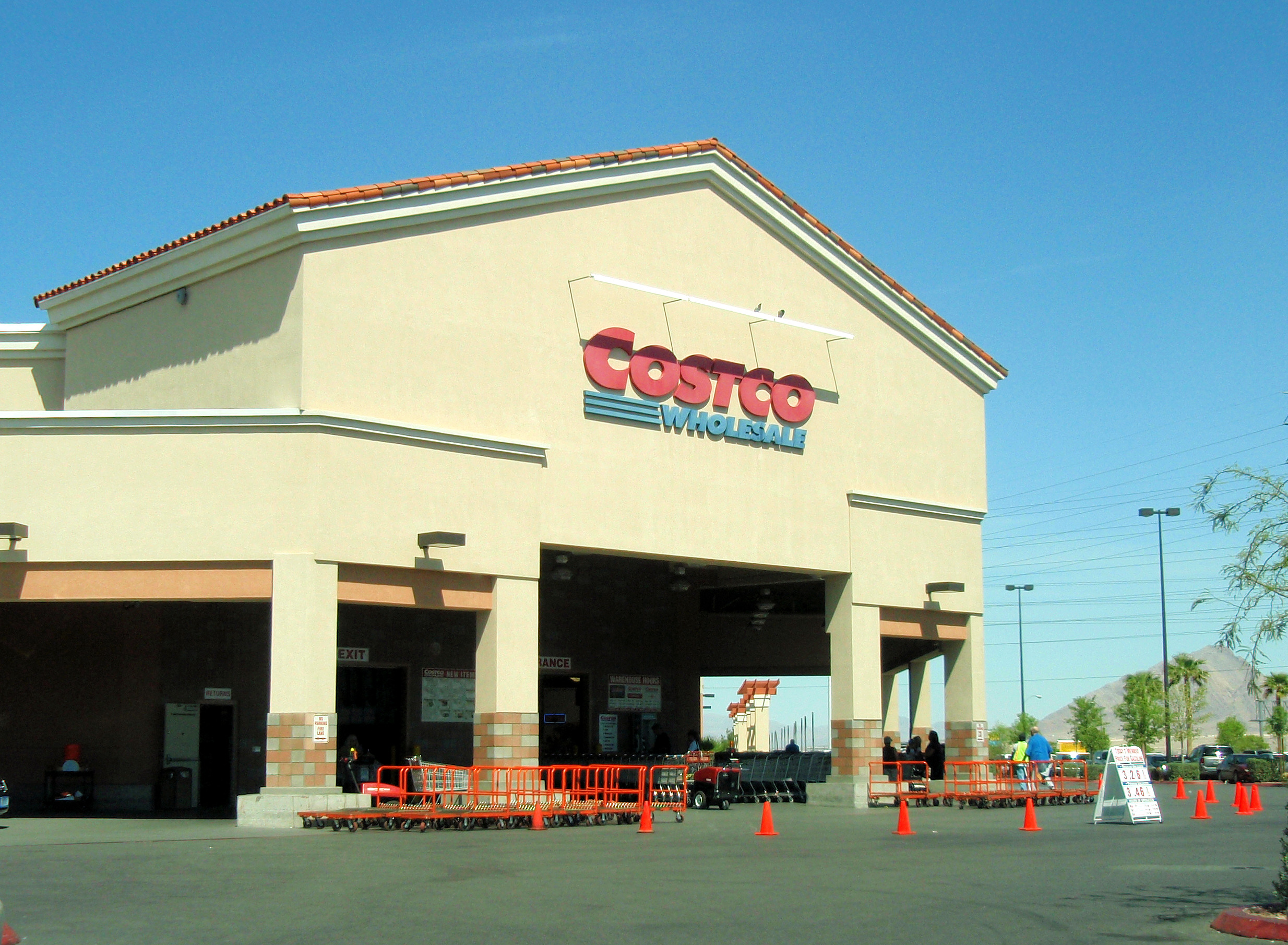
Now we have this question: in the absence of a desirable Visa credit card, how — really — am I going to continue to shop at Costco? I haven’t cut up the credit card or closed the account — it’s never a good idea to close a credit account in good standing — but because I don’t do business with outfits that treat me like sh!t, I will never use the card again.

I do have a debit card. But for a variety of reasons, I prefer not to use it. For one thing, there’s not a chance on God’s Green Earth I’m gonna put the thing in a gas station pump — certainly not at the Costco where I shop, which is flanked to the south and the west by dangerous slums and a park that has been taken over by bums. But I do prefer to buy Costco gas, because it’s the cheapest deal in the city. And there’s always an attendant — invariably a large, imposing male — standing around that Costco gas station, so I don’t feel so much at risk as I do at the rip-off QTs within reasonable driving distance of the ‘hood.

So. Here’s my plan:

Create a new savings account to hold money budgeted to spend at Costco. That would be an entire year’s worth of money budgeted for Costco ventures: shopping and gasoline, combined. So let’s say on average I spend, maybe…what? $340 on food, clothing, household goods, dog treats, personal products, impulse buys, and gasoline. When the 2019 RMD comes in — which will be about in September — I set aside $4,080 (= $340 x 12 months) in this account.

Then I trot in to Costco and buy a cash card for the amount I imagine I’ll spend at Costco, both inside the store and at the pumps, over a month. That would be around $340. That is what I carry to the store to make purchases. Each month I pay for it out of the Costco Envelope savings account.

I spend no more than that in any given month. Run out of money: quit shopping at Costco. How hard is that?

If money is left over at the end of the month, the next month’s cash card is loaded with accordingly fewer dollars. So, say, in March I spend $250, leaving $90 unspent; the April card has $340 − $90 on it: $250. Thus whenever I spend less than $340 over a month, the overage stays in the bank account.

So at any given time, the Costco cash card never has more than a month’s budget on it. If I don’t spend the entire budgeted amount, then whatever is not diddled away stays in that savings account.

I figure at the end of the year, anything that’s left can be transferred to the Emergency Savings account, and the Costco Budget account can start over from zero at the start of the new “fiscal year.”

When you know there’s an upper limit on what you can spend, you find yourself feeling a lot more cautious about your spending.

Therein lies the threat of Costco, the Mother of All Impulse Buy Hells. When the budget is open-ended — in your mind you think you have plenty to live on (which you do, if you don’t run amok) — you go “oh, it’s only $20…no problem, I can afford that.” And you could, if you just didn’t keep doing it over and over…

But if you’re thinking, “Helles Belles, I’ve only got x number of dollars to spend today,” then you realize the $20 doo-dad is not a life-or-death purchase. The beauty of the Envelope Method is that it sets a limit on what you’re willing to diddle away.

So, what started out as an annoyance — yet another stupid faceless bureaucratic hassle — may work out to my advantage. Not so much to Costco’s advantage, but certainly to mine: by getting the Costco spending under control, this new, enforced budgeting strategy will let me stay within the annual RMD for another year or two, despite soaring health insurance and property tax rates.

After that, it’s anyone’s guess. I may have to think more seriously about moving out of the country, to some venue where I can stay in the middle class on the retirement income. But we’ll cross that bridge when we come to it…

De-accessioning As Frugalist Strategy

Getting rid of stuff feels so good! Out with it! Seriously: one tried and true frugalist strategy is simply not to buy things you don’t really need. Another, though, is getting rid of stuff that you no longer need. (Or…ahem…maybe never needed in the first place.)

Case in point: the beloved Pawley Island hammock that has resided in the backyard since I moved into this place. Actually, I bought it in the old house, quite some years before I moved out. Since I was there about 12 or 14 years, I’d probably had it there about 8 or 10 years. That house had park-like landscaping full of mature trees, and so I could hang it between a big old olive tree and a silk oak, one of the messiest trees known to personkind.

Loved loafing in that hammock. Once it came over here, though, I had no place to hang it. Satan and Proserpine (the previous owners) were great at DIY interior redecorating, but they simply did not know what to do with any space not under roof. The backyard had almost no trees. So I bought one of those arc-shaped hammock stands. Like this…

Expensive as all get-out. Took three men and a horse to put it together. Too heavy to move without said three men and the horse. But once in place, it worked fine.

I’ve been in this house for 14 years now. So…that hammock lasted about twenty years before it finally rotted in the sun and rain and fell apart under my weight. No kidding. This: a couple weeks ago. No problem hauling off the hammock. But the wooden stand itself was a challenge.

Thought about replacing the hammock, to the tune of $150. Then thought…why?

Gerardo came by Saturday with his crew. They were happy to take it away. They did deconstruct it (the only way they could get it into their truck). Whether they’ll reconstruct it, I don’t know. But with four guys there, I expect one of them will cheerfully accept the donation.

SDXB used to say that throwing out stuff he was no longer using made him feel lighter. And there’s something to that. In the old house, the thing hung over a patio, so I could walk up to it bare-footed. Here, it stood in the middle of a field of quarter-minus. That’s very fine gravel. It pokes your feet, and if that doesn’t poke your feet, the sharp debris the devil-pod tree drops surely will. So to lay on the hammock, first I had to put my shoes on! Since I’m usually barefoot in the house, shoes are usually lost somewhere. Having to track them down made hammock-swinging more trouble than it was worth.

Hence, the contraption’s near-abandonment.

I’m so glad to get that thing out of there. Even though it served its purpose, it took up a phenomenal amount of room. The dogs would go in behind it to do their business, meaning I would have to climb in behind it to clean up after them. One fewer thing to have to take care of! The yard looks better without the clutter, and now there’s nothing over there for the hose to get caught up on.

Deciding to get rid of the arc stand, which was approaching decrepitude, too, meant I saved a hundred and fifty bucks.

No. Make that more like three hundred bucks. The stand itself was getting pretty weather-beaten and would soon need replacing…and those things cost $150, sans hammock.

There’s no way I’d get another $300 worth of use out of a new hammock and new fancy stand. At the old house, I certainly got my money’s worth out of the hammock. But here, for the reasons above, I’ve rarely used it.

How does that translate into a general Frugality Rule of Thumb?

Well, when something gives up the ghost, delay replacing it. Don’t hurry right out and buy a new one right this minute. Put off a new purchase long enough to see whether you can comfortably do without the thing. Maybe you really don’t need it. Maybe you really don’t want it.

And maybe your spirit will be lighter without it.

Retirement: The Cost of Living

So, let us continue to mull over the splendid new device that I put on the pool: On reflection, I realized that because the thing will make it so much easier for me to care for the pool, it will delay the need to hire someone to do the pool maintenance for several years….or to give up living here and move into an old-folkerie. Possibly, if my health holds, for quite a few years: nothing that remains to be done is very strenuous. I would have to be seriously incapacitated to find myself unable to do the minor jobs that remain.

In other words… The $1250 I put into upgrading the pool equipment will put off the dread day that I have to move into a life-care community — possibly by a factor of years.

And every year that I do not move into one of those places saves me, in today’s dollars, the net on the sale of my house (about $300,000, the cost of buying into a life-care community) and living costs of something between $333 to $2,400 a month. In other words, every year I do not move into a warehouse for old folks, I keep the value of the house in my estate, hopefully to be passed along to my son, and I save a big chunk of dough every month.

How do I figure?

Welp, it goes like this:

Life-care communities — where you move in while you’re still ambulatory, live “independently” in a private apartment, and get a couple of meals a day plus, if desired, a limited amount of driving to doctors and shopping — are spectacularly expensive, and those expenses are spectacularly difficult to calculate. This is because there are several schemes for buying in. On the low end, you can effectively rent the place without a large buy-in. On the high end, you pay a six-figure buy-in fee plus a hefty monthly bill: basically you sell your house and give the outfit the proceeds of the sale.

Assuming your house is paid for, that is.

It’s also very difficult to get a handle on exactly what those costs are likely to be. Many of the figures posted online are several years out of date — they increase with inflation at about 4% a year, but you have no way of knowing exactly what a 2009 average figure would be in 2018.

In 2013, Marketwatch reported that the average buy-in fee for a life-care community was $280,618. That would be about what I would net if I sold my house today — maybe a little bit less. Now add 4% a year over the past five years, and you’re up around $341,400 — i.e., more than I could get for my house, after realtor’s fees.

A 2008-09 study by Metlife found monthly costs for these places ranged from $2470 to $3469. Again, if these figures have increased by 4% a year, today that could be as much as $3750 to $4748 per month!

These figures represent nationwide averages. Locally, in Scottsdale one of the few places — possibly the only place — that posts its prices online wants $243,200 to 283,200 to buy in to a one-bedroom apartment (remember: this is the equivalent of the net proceeds on the sale of a 4-bedroom home on a quarter-acre of xeriscaped land with a swimming pool, in a half-way decent centrally located neighborhood within walking distance of the lightrail) PLUS a monthly fee of $3260-$3600. That’s only for food, lodging, and minimal transportation. For one person. One. Not two. If one bedroom is too cramped for you, then you might consider one bedroom plus a den: entry fee, $297,400 to $411,000; monthly fee: $3700 to $3900.

Well. To live in my house, which is paid off and which has one hell of a lot more liebensraum than one measly bedroom in a people warren, costs me about $1,545 a month. Toss in groceries, a few unplanned expenses, and the cost of running the paid-off car, and you come up with something between  $1,600 and $1,767 a month.

That not only gives me all the very high-quality food I choose to eat, it also gives me a car that takes me any place I choose to go at any time of day I choose to travel. It covers the cost of yard and regular house maintenance, plus utilities, taxes, and insurance. In other words: it covers more than the palace in Scottsdale costs. By how much?

Subtract the monthly costs of running my house and my car plus my average grocery and utility bills from the monthly amount it will cost me to live in one of those places (assuming I’m unfortunate enough to live long enough to have to move into one of them), you get a difference — in my favor — that ranges from as little as $333 a month (for a low-end retirement home, where you really, really do NOT want to live) to as much as $2,400 a month (very nice, no doubt: but still…an institution).

What that boils down to:

Every month that I live in my house, I save approximately $1600 to $1767 a month over what it would cost to live in that Scottsdsale old-folkerie. In other words, every single month that $1250 filter stands out there in the backyard helps to make it possible for me to stay in this house is a savings of more than the filter cost.

And that doesn’t count the cash value of the house, which I would very much prefer to leave to my son.

Banner image: The Village at St. Barnabas. By Generic1139 – Own work, CC BY 3.0, https://commons.wikimedia.org/w/index.php?curid=41879989

The Endless Dollar Drain

Today’s dollar drain courtesy of the City of Phoenix: the new greased-gravel “paving” they’ve installed in the alley pretty clearly is not going to stand up to the force of water flowing out of a backwash hose. In theory, it’s against the law to backwash into an alley: if they catch you, it’s a $2,500 fine. This law is most honored in the breach. Presumably if you drained an entire pool into the alley — upwards of 10,000 gallons — someone would notice and the city would show up at your door. But most of the time, no one pays any attention.

However, you can be sure the Trash Cops certainly will notice if the fine new fake blacktop is dug up. Besides which, even if no one complains, the damn stuff is almost impermeable to water…and of course, they didn’t build drains alongside the crud. So that means every time it rains and every time someone backwashes onto it, we are going to have fine mosquito ponds.

For quite some time, I’ve been figuring that when the DE filter on the pool gives up the ghost, I’ll replace it with a cartridge filter, which doesn’t have to be backwashed. In theory, you only have to take it apart twice a year and clean out the cartridges. (We’ll believe that when we see it…) If this is so, it will represent a considerable savings both in terms of hassle and of service calls. The present filter has to be cleaned out three or four times a year…and the $1,250 tab for the thing is less than half the cost of a fine.

So the pool guy is out there. The difference in how efficiently this device runs, as compared to the ancient one, will make up $1,250 in my time — and in annoyance factor — within just a few months. Think of it: NEVER HAVING TO BACKWASH AGAIN!  Wooo hooo! And when you change out the pump pot basket, you don’t have to bleed off the air, another source of hassle and mess.

It does mean I will run out of money before next September, when I have to take the annual required minimum drawdown from savings. Fortunately the stock market is up, and fortunately I can charge this on a credit card, thereby deferring payment into 2018. That means I can move the tax hit into a year in which our tax bill supposedly will drop (har har hardy-har har!!!!). If the usual set of politicians’ lies turns out, for a change, not to be outrageously false, then maybe I can at least keep the tax hit down some.

Plus I expect the economy to tank after 2018 — probably in 2019 or 2020 — and I’d like to cover as many of these expensive house maintenance jobs as possible while the market is up and my investments will recover the losses in a month or two.

But my God, the backwash valve on the Money Bin has been running out of control now for months!

Paying off the car drained both personal and corporate bank accounts. I’ve had a thousand bucks worth of dental work so far and at the least am still looking at replacing two crowns. This predicament, naturally, developed after I took it into my pretty little noggin to paint the house, which probably wasn’t immediately necessary, but certainly will be if I decide to put the place on the market and move away from Bum Central and Meth, Inc.’s headquarters. I do love my house and my neighbors, but realistically, there are some drawbacks to living here. 😀

Among them, one could argue, is the cost of maintaining the Funny Farm…