Scrutinizing the budget now that this month’s bills are all paid… Several extraordinary costs—those Heath dishes, for example, and a pair of shoes, and a trip to the car mechanic’s—ran the American Express budget $325 into the red. But in theory, all of them combined shouldn’t have overtaxed that budget. So…WTF?
In addition to those two extravagances and the car repair, I’ve been spending with gay abandon at Costco: $407.39 diddled away in that place!
And what on earth, pray tell, might I have purchased with this munificent amount? I’ve been strictly on the wagon for the past three months, so it didn’t go to my favorite potables. Mostly food and household goods, I think: the lifetime supply of paper towels. And the $75 or so for the underwear extravaganza. Haven’t bought toiletries. Haven’t bought pool tablets. Haven’t bought Brita filters or blue jeans or replacement toothbrush heads or a lifetime supply of laundry detergent. Looks like the main costs were large packages of chicken thighs (at 99 cents a pound, a better buy than anyplace else where I shop), pork, produce, the paper goods, and clothing.
Probably paper towels and toilet paper and detergent, purchased in bulk, are a little more cost-effective than the same goods bought in smaller quantities more often at grocery stores. However, a funny thing happens on the way to the Costco: Sure, a giant container of paper towels lasts four to six months. It sets you back $15. But then next month you need toilet paper: $20. Next month after that, you need chlorine tabs for the pool: $80. And so on to infinity. If every month you’re buying a lifetime supply of one thing or another, then each month you’re spending more on groceries and household products than you would at an ordinary retailer for smaller amounts that would only last a week or a month.
Although over the long run you might spend more at a grocery store for a specific product than you would, unit-wise, by purchasing a gigantic supply at Costco, because each month you buy a new lifetime supply of something else, each month’s bills are likely to be higher than they would be if you equalized purchases over time.
What that suggests is even though you’re paying less per unit for certain products, you’re actually paying out more each month as you have to replenish different products month by month.
By comparison, during the budget cycle just ended, I spent only $35 at Safeway and $68 at Trader Joe’s. Admittedly, I haven’t felt well and so haven’t eaten much—mostly I’ve grazed off the Costco stash. But still..one wonders.
I decided to try to limit Costco purchases to $200 a month. Which…well, really, shouldn’t that be more than enough?
This led me to consider what routine purchases are available only at Costco, and what things might be bought somewhere else in more manageable quantities at more manageable ongoing prices. Videlicet:
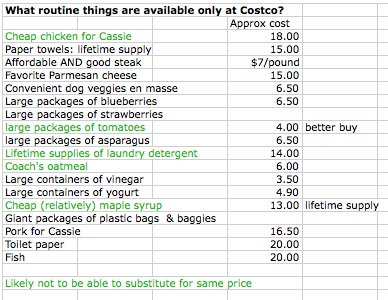
Some of these items are hard to find at other stores around here, or can’t be found in the same quality or for the same price, or both. I’ve marked those in green.
There also are a number of things I buy on occasion at Costco because they don’t seem to exist in any other stores or because, as in the case of the chlorine tablets for the swimming pool, Costco far underprices its competitors:
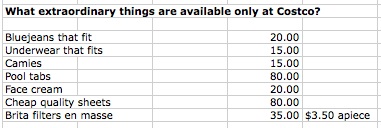
Bed sheets comparable to the sets you get at Costco, which come with four pillowcases BTW, would cost far more in other stores unless you caught them on sale. Anywhere else, it’s almost impossible to find either underwear or denim jeans that fit a normal adult woman. Face cream is expensive at Costco but downright outrageous elsewhere. So it goes.
I’m none too sure what these things would cost at non-warehouse stores. But I’d be willing to bet that when you buy less, you pay less at the checkout stand, even if you’re paying more per unit. In some cases, you’d have to pay a fair amount more. For example, I wouldn’t consider buying fish at Safeway; probably the only other source of acceptable fish in town is Whole Foods. Don’t even ask what they charge for the stuff.
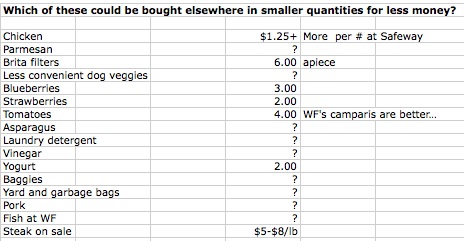
If I limit spending to $200 for the September/October budget cycle, what could I buy between now and the end of the month-long cycle?
I’ve already spent $104 at Costco this month. That leaves $96 to diddle away:
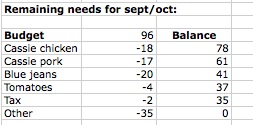
That’s not unreasonable, I think. It provides enough meat to last the dog for the rest of the month (since canids need about 2/3 of their food to be in the form of animal protein, a 25-pound dog consumes a surprising amount of fresh meat). My blue denim jeans are wearing out, frayed at the cuffs and faded at the knees—the height of style for younger things, but not, I’m afraid, for moi. So pretty quick I’ll need a new pair. Arizona doesn’t charge tax on food, and so the 10% soaking applies only to the clothes. And…that even leaves something for one or two other purchases! Buying the rest of my food—mostly produce, since at least two months’ worth of beef, fish, and chicken reside in the freezer—shouldn’t cost much at Safeway, Trader Joe’s, or Ranch Market.
What think you? Does it make sense to try to stay on budget by spending more per unit on less product?