Coffee heat rising

The Food Blast: What to Do with It

So the kitchen still overflows with produce after yesterday’s serendipitous visit from the food rescue charity. OMG, you never saw so much food in this kitchen!

Yesterday evening M’hijito came over for dinner: a kind of “hot dish” lasagne that was not lasagne; sliced eggplant layer + cheese layer + sauce layer + different cheese layer + Costco pasta layer + cheese layer + different cheese layer + sauce layer + grated Parmesan layer. Made the sauce from some of the tomatoes.

Pretty good.

So far today I’ve made a tomato soup, using six more of the gigantic cardboard-flavored beefsteak tomatoes and a couple of summer squash. It’s pretty good, having been saved by some pork broth that I stuck in the fridge after cooking up a bunch of muy cheapo Costco pork for the dogs. And by the dregs of a bottle of wine M’hijito brought over last night.

TomatoSoup

Mostly it tastes of onion, celery, carrot, garlic, pork broth, and red wine. But it looks pretty, eh? I also added a little Pomì brand packaged tomatoes — Italian tomatoes that really are very tasty, indeed. But it wasn’t enough to goose the essence de tomate much.

The result has a nice enough flavor now, even if it doesn’t taste much like tomato. 🙄 I figure it’ll be good to add things TO: heat a handful of shrimp in a pan of it, for example. Once it’s packed away, it should also provide the basis of many light meals.

LOL! I won’t have to buy groceries until that outfit comes back around next month!

A half-dozen giant flavor-free tomatoes are still sitting on the counter. Those need to be converted into gazpacho, but to do that I’ll need to pick up a bell pepper, a bottle of tomato juice, and maybe some more cheap red wine.

As soon as I backwash the pool again (! …we’re having a little maintenance issue today…), I’ll go out, get those things, come back into the sauna that is my house, and build several quarts of gazpacho.

Then put a couple of the summer squash to marinate so as to grill them for dinner tonight, and then refrigerate the rest and the two pretty eggplants to be made into ratatouille tomorrow.

It is just. too. bloody. HOT in here to spend any length of time running the stove or the oven.

Food FRENZY!

So the dogs are walking the human this morning when we come upon the gay guys who live up the street. They’re dragging a garden cart behind them, filled with full recyclable shopping bags.

I say, “Did they make you walk home from the airport with your baggage?”

They laugh and say they just came from one of those migrating food sales — the sellers are camped out in the church parking lot at the corner of Feeder Street East-West and Conduit of Blight Boulevard.

Hot diggety!

What happens is that grocery stores will take produce that’s reached the end of its (brief!) shelf life and, instead of throwing it away, donate it to organizations who distribute it to neighborhoods at an outrageous discount. They dispatch a semi truck filled with produce to a distribution center — usually a church or nonprofit — and set up shop for all comers.

The men got 60 pounds of produce for $10. Apiece.

The moveable feast was to be there from 7 to 9 a.m., said they.

As soon as the dogs had perambulated their daily mile, I flang them in the house, jumped in the car, and shot out the door.

WHAT a mountain of food I came back with! Videlicet:

• 8 yellow squash
• 8 zucchini squash
• 4 eggplants
• 16 (!!) big, ripe beefsteak tomatoes
• 8 beautiful little orange acorn squash
• 2 honeydew melon
• 2 mini watermelons

And it’s gorgeous produce. Can you believe this?

Produce

The bag of lemons and the artichoke came from the Sprouts, where I went to pick up some onions and things so as to process this bounty. But the rest of it: hand0uts.

A gigantic pan of eggplant lasagne awaits in the fridge: my son is coming over this evening to help eat some of this stuff.

Made a marinara sauce for the lasagne with some of the giant tomatoes and some of the frozen hamburger found at the bottom of the recently shoveled-out freezer. That’s going to be very nice.

Also cooked one of the little acorn squash and stuffed it with some of the hamburg: breakfast. I’m thinking the rest of them (eight of the things!) can be fixed the same way and then packed in baggies and frozen. The summer squash and the beautiful eggplants can be made into a mountain of ratatouille. The rest of the tomatoes: soup! Hey: gazpacho!

Between this bounty and the several bags of meat I found hidden in the freezer, I shouldn’t have to go to the grocery store for a month! Except to buy some salad greens.

What serendipity! Couldn’t have come at a better time, eh?


Retirement Planning for Gen X

JestJack replies to Wednesday’s post, in which I held forth on the new formal budget and revealed how much I need to live as a retireee in nominally “middle class” but in fact pretty modest circumstances.

The sad thing is I see no glaring evidence of living beyond one’s means in your or my lifestyle for that matter. But yet I seem to get the feeling you feel, like me, that you are “living on the edge” despite a pretty nice “safety net” to fall back on. I share your concerns on many levels. With poor returns on savings it seems the Fed in their efforts to prop up the economy are doing so at the expense of “savers” …i.e…..seniors. As you aptly point out, there is no substitute for “a paid for home”….that peace of mind is priceless. BUT today’s environment is very tempting. I can borrow money in the form of a mortgage for 10 years at 2.25% with no points and may even get some help with closing for the effort. I just wonder sometimes how folks WITH rent, a car payment, cell phone bills, student loans, utilities and child care make it….

The answer is, of course, that they can’t: not without a decently paid full-time job and a side gig or two.

I’m sure JestJack and I are looking through the same lens that confounded our parents at retirement age: inflation. Though it’s not nearly as rampant as it was during the 1970s, inflation will never go away. So to minds like ours, thirty grand a year looks like a LOT of money. The realization that one can barely get by on it — and only if one doesn’t have a house or car payment — is startling.

And it’s horrifying to understand that one’s “real” income — $14,400 in Social Security benefits — is well below the poverty line. Drawing down from a finite amount of savings is not creating “income”: it’s just using up your resources until such time as no more resources remain.

Thirty thousand dollars — the net amount I need to live on, not the amount I can, realistically, afford to disburse from my funds (assuming my doc’ is right that I’ll live into my 90s — or even if I make it to my early 80s), is untenable. If the entire gross RMD from my savings is consumed by taxes and living expenses each year, in 20 years I will be utterly destitute: I will have nothing left to live on but Social Security.

“Twenty years” assumes I don’t get warehoused in a nursing home, which will eat up $4,000 to $6,000 a month. That will impoverish me a whole lot sooner.

For anyone in their right mind, this represents a HUGE psychological disconnect. If you are a young person, it means the amount you will need to support you in comfort through retirement is far more than you can realistically expect to earn and save over your lifetime.

Net Social Security — $14,400 — is nothing like enough to live in a safe neighborhood, with decent food, adequate clothing, and independent transportation.

It’s poverty level.

Yet it’s almost $2,500 more than my boyfriend in college regarded as the income he hoped to have when he was “set”: a target he figured would support him and a family quite comfortably (at a time when most women didn’t work). I can remember young men, including my young lawyer husband, remarking that they would have “arrived” when they could earn $12,000 a year. Twelve grand in 1969 would be worth $78,551.28 today.

In that light, the numbers we’re looking at in Wednesday’s post don’t compute.

Even an income of twice what a young man in 1969 regarded as comfortable affluence would support a retiree, today, just barely. It might not support two people at all. Certainly not in middle-class circumstances.

If I were going to advise young people planning, very long-term, for retirement, I’d say “Figure out what you think you’ll need per year, and then multiply that figure by three. That’s how much you’ll need as a net annual drawdown from retirement savings, since there’s a good chance the Republicans will cut Social Security or make it go away.”

So. If a man in his late 30s thinks he’ll need $30,000 a year, exclusive of Social Security, to live in the splendor I enjoy just now, then in another 30 years, he should figure he’ll need enough to DRAW DOWN at least $90,000 net per year.

Gross, that’s probably about $100,000 per year, after taxes and Medicare. Let’s say he retires at 70 and he hopes to make it to about 90.

Let’s suppose Social Security survives and increases with inflation. In 2046, my $14,400 net annual Social Security benefit will have bloated to $30,205. That leaves “only” $69,800/year for our Nimrod to come up with by way of keeping a roof over his head in retirement. To maintain that between retirement at age 70 and death at age 90, he’ll need $1,396,000 in savings at the time he quits or is forced out of his job.

That’s a bare minimum. It means…

• No eating out in restaurants
• No travel
• No entertainment that costs anything
• Purchasing all clothing in second-hand stores
• Purchasing any needed furniture or household appliances second-hand
• No car purchases
• No mortgage payments
• Not even cable TV or a cell phone

And that figure doesn’t account for inflation over the 20 years of his retirement.

To retire in what most Americans regard as near poverty, today’s young men and women will need almost $1.4 million in savings. In cash dollars.

That’s assuming they plan to leave nothing to their children.

New Book! Frugality for Depressives

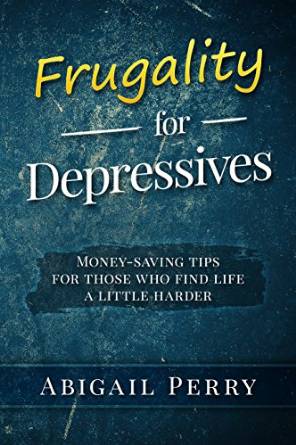
eeyoreDoes the whole prospect of pinching pennies get you down? Or were you already feeling like Eeyore before the idea arose?

Our friend Abby Freedman Perry (I Pick Up Pennies) realizes that trying to get a grip on your personal finances is even harder if you happen to suffer from physical disabilities or from depression. Contemplating that truth, she discovered that no one else has written about it or suggested ways to take control.

Hence her new book: Frugality for Depressives: Money-Saving Tips for Those Who Find Life a Little Harder.

Abbuy
Click the image to preview the book.

Says one of the book’s reviewers at Amazon…

By Susan T Mason on May 26, 2016
Format: Kindle Edition Verified Purchase
Refreshing to find a book that does not just tell you to “get with it”, but admits that it just is not going to be perfect and that is okay. While I am not a depressive, I do live with one. Neither of us is getting any younger and are finding it hard to keep up with stuff like we used to. Being frugal is important to us, but if you are not 100%, it is good to have permission to prioritize.

Check it out. You can get it in the Kindle version and also in a paperback edition.

The BUDGET: First step

So step one for the new Re-Budgeting Scheme is now accomplished.

If I’m gonna start budgeting again, I’m gonna need to have a budget. So it’s off to Excel, the classic tool of the numerically obsessed and the arithmetically challenged.

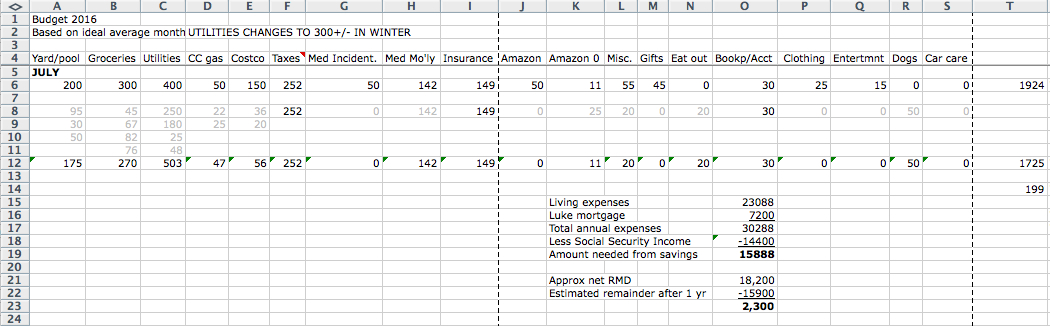
In this draft of the new scheme, monthly figures are arranged horizontally, rather than in a single column per month. This JPEG may not be very scrutable on a web page; try clicking on it for an enlarged version.
Budget 6-2016 2


The header row lists all the spending categories that consume my annual mite. Some of these things are paid annually: taxes, for example, homeowner’s and auto insurance, and some of the healthcare policies. Even though they’re actually paid when they come due, in order to account for them, they’re prorated monthly. Effectively the money is not available for monthly spending, even though it’s in the bank.

The greyed-out figures in this image are theoretical entries, since July has yet to occur. The bottom line (row 12 here) will represent the amount spent in each category in a given month. The figures on the far right total, horizontally, the amount available (row 6) and the actual amount spent (row 12). The bottom figure in column T ($199 here, as an example) represents the difference between row 6 (amount available) and row 12 (amount spent).

We shall see if that latter figure is ever expressed in positive numbers….

Utility bills will drop to around $300 in the four winter months. They probably will exceed $400 this month and next, given the early heat and now early humidity. And unless we get some old-fashioned summer afternoon rains — which we rarely see anymore, thanks to the paving over of paradise — the water bills also will exceed budget between now and September.

All told, estimated living expenses should add up to about $23,100 annually. The mortgage on the downtown house, which my son and I are copurchasing, runs $7200 a year, for a total of about $30,300 a year.

Alas, Social Security covers less than half that.

Net RMD (required minimum drawdown) from the big IRA is a little over $18,000. I’d prefer not to use that to live on, but it looks like there’s no choice. So, unless living expenses can be cut, the net amount left at the end of the year should be around $2,300.

Not great… I’d hoped to be able to reinvest a fair amount of the RMD, but evidently that’s not going to happen unless something upward of 10 grand can be withdrawn from the S-corp. This will require a lot more editorial work to come in.

So… Can savings be found in this budget, without having to sell the house and move to abhorred Sun City?

To start with, I expect the Costco bill will drop significantly. I’ve canceled the unwelcome Citibank Visa cards, which will require me to write a check or use a debit card to shop there. The extra hassle will be enough to discourage casual shopping there. After this, I’ll go into the store only to buy a few very specific items that are hard to find elsewhere.

This afternoon I bought a $50 cash card at Costco to cover next month’s gasoline, so I won’t have to use a debit card at the gas pump. Since I no longer have to traipse to a job in Tempe — and because prices are so low now — gas bills have dropped to around $45 a month. That will increase, of course, as oil prices rise, but for the nonce, fuel for the car is within reason.

I could cancel Amazon Prime. But…it’s not very much, prorated monthly. And as I scribble, I’m sitting in front of an episode of Downton Abbey, which of course I’ve missed, in the absence of a television. Amazon’s offerings are better than Netflix, and it doesn’t seem to require software that won’t run on my computer or (so far) any other techno-weirdnesses. Since I have no other source of entertainment, it seems to0 bad to get rid of it.

But if it has to go…well, it just has to go.

Laundry can be soaked and washed by hand, and then run through the short, cold-water rinse & spin cycle. That will save a few pennies on electric and gas. I already hang most of the clothes to dry, so there’s not much to be saved there.

The dogs can do without their vaccinations. The vet’s office says they’re not due this year. And in fact, after they’ve had a number of shots, there’s really no need to keep getting more. Most of them confer lifelong immunity, or nearly so. At any rate, the problem is moot until this time next year. Thank heaven for small mercies.

Clothing is easy enough to cut — I surely don’t need any more right now. Future purchases can happen at My Sister’s Closet, a second-hand store fed by Scottsdale socialites. It carries some very nice examples of last year’s latest styles.

Eating out will have to go. There’s not much of that, but it has been sneaking in now and again. No more of it!

Groceries: No more frolics at Whole Foods. Food will have to come from Fry’s, Target, Walmart, and Safeway. There are a few things I’ll still need to get at Costco — chicken, for example, is usually cheaper there than anywhere else, and the pork, which is quite good, is rock bottom.

That’s about it. My lifestyle is already pretty frugal. It’s hard to see what more to cut without selling the house and moving somewhere cheaper to maintain.

And that, I hope to avoid…

Next step: to put this scheme into action.

Salon, Brexit, and the Sad State of Journalism

Take a look at this amazing opinion piece that just popped up at Salon. Presumably the writer, Patrick Lawrence, isn’t a native speaker of English. But still: do they really not have editors? And is the teaching of history in American schools really so bad that a person can so misunderstand the reception of One-World ideas among post-war voters?

I tried to comment on the thing at Salon, but they want you to sign in to their site. At 23 single-spaced pages of user IDs and passwords in my secret printout, I’ve had quite enough of that, thank you. So I’ll share my thoughts on the article — not just its style but its thinking — with you. Lawrence writes about the recent Brexit vote and reflects, wisely enough once you get past the awful writing, on the reasons for it and on the failed promise of the European Union. He reflects on the brilliance of Wendell Wilke’s vision of a utopian post-war “One World.”

Did anyone even try to edit this thing? “Willkie was not alone in his aspirations. Very far from it. But he did well expressing those of very many. And it is these that have just died a death on the English Channel’s northern shores.”

 Those of very many what? Brits? Americans? Europeans? citizens of the world? Cats? It is these that…: these what? Aspirations? the “very many”? And how did a vague, verbose structure like that get past the copy desk, anyway? ...died a death on the English Channel’s northern shores. What else would they die? Come to think of it, is “die” a transitive verb at all?

This kind of thinking, believe it or not, was much favored among Americans at the time.

I’m old enough to remember one-worldism. Trust me, it was NOT “much favored among Americans.” Most people regarded it as a radical, seditious scheme. Few Americans were open-minded multiculturalists who wished to merge their cultural, economic, and (yes) racial identities with everyone else’s. And the people I knew believed that if and when the idea became reality, Americans’ wages would dwindle, the country would be overrun with foreigners, and American sovereignty would be threatened. The then new middle class would see its hard-won comfortable standard of living go away. Were they still living today, they would not be surprised at the present outcomes in Europe and England. Watching the bureaucratization of the EU, they would be saying “there but for the grace of God go we.”

Did Britons make a mistake in voting to leave the EU? That remains to be seen. Common sense was overruled many years ago; it’s no doubt too late to go back. But one never knows.